Tag: Port St Lucie locksmith

  • How to Rekey a Deadbolt: A Practical Guide for Homeowners in Port St. Lucie

    How to Rekey a Deadbolt: A Practical Guide for Homeowners in Port St. Lucie

    Rekeying a deadbolt is a straightforward way to change the lock's internal pins to work with a new key. The best part? It instantly makes all the old keys useless. It’s a smart and affordable move for homeowners in Port St. Lucie, Fort Pierce, and Vero Beach, especially if your current lock hardware is in perfectly good shape. Why replace what isn’t broken?

    Knowing When It's Time to Rekey Your Locks

    A person holds a golden house key towards an open white door, symbolizing new access.

    Just moved into a new place in Port St. Lucie? Or maybe you misplaced your house key somewhere in Jensen Beach? These common headaches don't have to mean buying and installing brand-new, expensive hardware.

    Rekeying gets straight to the heart of the matter: controlling who has access to your property. Instead of swapping out the entire deadbolt, a locksmith simply re-pins the lock cylinder inside. This is our go-to solution for all sorts of practical situations across the Treasure Coast.

    Common Scenarios Where Rekeying Makes Sense

    • You Just Bought a New Home: You have no idea who might have a copy of the key from the previous owners. It could be contractors, old neighbors, or extended family members. A new homeowner in Fort Pierce recently told us the very first thing they did for peace of mind was have us rekey all the doors.
    • A Key is Lost or Stolen: A missing key is a genuine security risk. Rekeying immediately neutralizes that threat. If that key ever falls into the wrong hands, it won't open your door. If you find yourself in a house lockout situation, our team offers specialized emergency lockout services to get you back inside quickly and safely.
    • Tenants Have Moved Out: For landlords in Stuart and Vero Beach, rekeying between tenants is just part of the job. It's an essential step to protect your new tenant and fulfill your responsibility to provide a secure home. It’s also important to be aware of local regulations, like the tenant eviction process, which can dictate when security measures like rekeying are required.
    • Life Changes: Following a separation, divorce, or roommate moving out, rekeying the locks ensures that former partners no longer have unwanted access to your home.

    The biggest myth we hear is that new locks are automatically safer. The truth is, if your current deadbolt is a quality model and works correctly, rekeying gives you the exact same level of security as a brand-new lock from the hardware store, but for a fraction of the cost. A professional lock change is only necessary if the hardware is damaged or outdated.

    Upgrading your home security doesn't get much smarter or more cost-effective than rekeying your deadbolts. The locksmith industry, which is on track to become a $3.0 billion business by 2025, sees rekeying as a core service for a good reason. The internal pins cost pennies to replace, saving homeowners an average of $150-$250 compared to a full replacement.

    Need a fast, reliable fix in Port St. Lucie or the surrounding areas? Call (772) 710-8169 for immediate help with clear, upfront pricing.

    Gathering Your Rekeying Tools and Supplies

    Locksmith tools, including a deadbolt lock cylinder, keys, and rekeying pins on wood.

    Before you take a single screw out of your deadbolt, let's get your gear in order. Trust me, trying to rekey a lock without the right tools is a fast track to a major headache. It can easily turn a simple project into a damaged lock and a much bigger bill than you anticipated.

    The heart of this project is a brand-specific rekeying kit. This is the most important part: a Kwikset kit is useless on a Schlage lock, and the other way around. You can find these at most hardware stores in Port St. Lucie and Fort Pierce, and they come with the essential color-coded pins, new keys, and a couple of basic tools.

    What's Inside a DIY Rekeying Kit?

    Pop open the kit, and you'll find a few key items. You'll see a set of pre-cut keys that will soon be your new house keys. You'll also find a small bag of tiny, color-coded bottom pins designed to match the cuts on those new keys. Lastly, there’s usually a small, specialized tool for removing the lock’s cylinder clip.

    But here’s a pro tip: the most critical tool often isn't even in the box. I'm talking about a plug follower. It’s just a simple plastic or metal tube with the exact same diameter as your lock cylinder. Its whole job is to hold the top pins and springs in place while you work on the bottom pins. Without it, those tiny parts will fly everywhere, and your lock will be officially out of commission. If your kit doesn't have one, you absolutely must buy it separately.

    A mistake we see all the time in Stuart and Jensen Beach is someone trying to improvise with a screwdriver or a Sharpie instead of a proper plug follower. It never ends well. The tiny top springs shoot out across the room, and the lock becomes a paperweight. If this happens to you, don't panic. Just call us at (772) 710-8169 for immediate help, and we can put it all back together for you.

    To make the whole process go smoothly, you’ll also want to have these on hand:

    • Your original, working key: You cannot start the job without the key that currently opens the lock. It's needed to turn the cylinder to the correct position for removal.
    • A Phillips and a flathead screwdriver: Standard stuff for taking the deadbolt off the door.
    • Needle-nose pliers: These are incredibly helpful for managing the tiny retaining clip and handling the pins without dropping them.

    DIY Rekeying Kit vs Professional Locksmith Tools

    Ever wonder what the difference is between a DIY kit and what a professional locksmith brings to your door? A lot, actually. The tools in a home kit are designed to get one specific job done, whereas our equipment is built for precision, versatility, and efficiency for any lock we encounter, from a simple rekey to a complex ignition repair.

    The table below breaks down what you get in a store-bought kit versus what our technicians carry on their trucks in Vero Beach and beyond. It really shows the difference between just getting it done and getting it done right.

    ItemIncluded in DIY KitUsed by Pro-B LocksmithPurpose
    New KeysYesYes (custom cut on-site)Operates the rekeyed lock.
    Bottom PinsYes (limited set)Yes (full professional pin kit)Matches the key cuts to create the shear line.
    Plug FollowerSometimesYes (multiple sizes)Prevents top pins and springs from falling out.
    Cylinder Removal ToolSometimesYes (brand-specific tools)Safely removes the cylinder housing clip.
    Professional Pinning TrayNoYesOrganizes pins and prevents loss during rekeying.
    Key DecoderNoYesAccurately reads key cuts to select correct pins.

    As you can see, a pro brings a whole workshop to the job. This ensures we can handle any hiccup, from a stubborn clip to a non-standard pin, making the rekeying process faster, more reliable, and guaranteed to work perfectly every time.

    How to Rekey Your Deadbolt: The Complete Step-by-Step Process

    Close-up of a person rekeying a lock cylinder with a screwdriver and pins, next to a smartphone.

    Alright, you've got your tools, you've got your kit—let's get to work. This is the part where patience and a steady hand really matter. The whole trick is to swap out the old bottom pins for the new ones without losing the tiny, spring-loaded top pins that live inside the lock. Trust me, they love to escape.

    Find a well-lit spot to work, lay everything out, and take a deep breath. You can do this.

    One of the best pieces of advice I can give anyone trying this for the first time? Use your phone. Before you touch a single screw, snap a picture. As you take each piece apart, snap another one. It's like creating your own personal instruction manual, and it can be a real lifesaver if you get interrupted and have to come back to it later.

    Getting the Lock Off the Door

    First things first, you'll want to lock the deadbolt so it's fully extended from the door. Now, look on the inside of the door at the thumb-turn assembly. You should see two screws holding it in place. Go ahead and remove those.

    Once the screws are out, the interior and exterior sides of the deadbolt should come right off. Set them aside.

    Now you're looking at the lock cylinder itself—the heart of the operation. There's a small C-clip or a retaining ring holding it in the housing. You’ll need to use your cylinder removal tool or a pair of needle-nose pliers to carefully pry it off. Keep a finger on it as you work; those little clips are notorious for flying across the room and disappearing forever. With the clip gone, the cylinder will slide right out.

    Important Warning: This is the make-or-break moment. If you pull the cylinder's core (the plug) out without a plug follower right behind it, the top pins and their springs will shoot out everywhere. And if that happens, you've got a paperweight, not a lock. Seriously, if you hear a pop and see tiny brass bits fly, just stop. Call Pro-B Locksmith at (772) 710-8169. We'll get a tech out to your place in Stuart or Vero Beach to put things right.

    The Great Pin Swap

    Take your original key and slide it all the way into the cylinder. Give it a slight turn—about a quarter of the way, to the 2 or 3 o'clock position. This is what lines up the internal parts so the plug can slide out.

    This is where your plug follower comes in. Hold the cylinder housing firmly in one hand. With the other, press the plug follower against the back of the plug. Now, smoothly and gently push the plug out of the housing with the follower, so the follower seamlessly takes its place. It should be one fluid motion. The follower is now the only thing keeping those top pins and springs contained.

    Set the housing down carefully. Now, with the old plug and key in your hand, just turn it upside down over your tray or workspace. The old bottom pins should tumble right out. Pull the old key out.

    Grab your new key and the pin chart that came with your rekeying kit. The chart is your map—it tells you which colored pin goes into which hole to match the cuts on your new key. Using your tweezers, drop the new pins into each chamber one by one. Make sure the pointed end goes in first.

    Putting It All Back Together

    With all the new pins in their chambers, it's time to reassemble. Slide the plug back into the cylinder housing, using the new key to push the plug follower out the other side. You'll need to keep the key slightly turned for it to slide in smoothly.

    Now, test it. The new key should turn like butter. If it feels rough, gritty, or gets stuck, stop. Don't force it. It almost always means a pin is in the wrong place or even upside down. You'll have to take it apart again and double-check your work against the pin chart.

    Once it's working perfectly, reattach that C-clip, put the deadbolt assembly back into the door, and tighten the two mounting screws. Give it a final test from both inside and out to make sure everything is perfect.

    Getting that pin combination just right is what security is all about. Deadbolts have come a long way since the first patents by Linus Yale in 1861, and today’s high-security models are a world apart. With U.S. locksmith revenue projected to hit $3 billion in 2025 and 79% of professionals focusing on residential security, precision matters more than ever. A properly rekeyed UL-listed deadbolt can fend off up to 92% of bump-key attacks—a massive leap from the 45% resistance of a standard lock. It's a clear example of why doing the job right is so critical, and you can learn more about these industry trends and lock security advancements.

    What to Do When Your DIY Rekeying Goes Wrong

    A gloved hand picks up a spring from a pile of hardware next to a compartment organizer.

    Even with the best of intentions, a DIY rekeying project can go sideways fast. You're dealing with tiny, precise parts, and one small slip can leave you with a lock that's completely useless. But don't panic. Most of the common hiccups are fixable, and knowing what to look for can save you a world of frustration.

    The number one mistake we see from homeowners around Port St. Lucie is losing the top pins and springs. It happens in an instant. You go to slide the cylinder plug out, but you aren't pressing the follower tool in firmly enough behind it. Next thing you know, you hear a few tiny pings as the springs launch the driver pins across your workbench, never to be seen again.

    The Key Feels Gritty or Won't Turn

    So you've put it all back together, but when you slide the new key in, it feels crunchy or just won't turn at all. Stop. Whatever you do, don't force it. Trying to muscle a jammed key can permanently damage the lock cylinder and the key itself.

    Nine times out of ten, this problem comes down to the pins.

    • Wrong Pin Order: This is the usual suspect. You might have mixed up the pins for chambers two and three. Your only move is to carefully take it apart again and triple-check the pin chart from your rekey kit.
    • A Pin Is Upside-Down: It's an easy mistake to make. A bottom pin might have gone in flat-end-first instead of pointed-end-first, which means the key can't seat properly.
    • Gunk in the Cylinder: A tiny metal shaving or even a speck of dust can get into a pin chamber and keep a pin from moving smoothly.

    Just last week, we got a call from a client in Vero Beach who was in a jam after their DIY attempt. The key was completely stuck, and they were convinced they'd have to buy a brand-new deadbolt. Our tech showed up, spotted two pins in the wrong spots, and had their lock working perfectly in less than 30 minutes. It saved them the cost of a full lock change.

    Don't let one tiny pin cost you a whole new lock. If your key is jammed or you’ve lost parts, the best thing you can do is stop right there. Call (772) 710-8169 for immediate help from a locksmith who knows these locks inside and out.

    "Help! My Lock Exploded!"

    This is the big one. This is the moment most DIY projects come to a screeching halt. If you pull the cylinder plug out too far and the top driver pins and their springs shoot out everywhere, you've got a real mess on your hands. Trust me, finding those minuscule parts on a garage floor is next to impossible.

    This is a textbook case of a money-saving attempt turning into a much bigger headache. What started as a simple rekey can quickly become a house lockout or the need for a complete lock change. Our mobile locksmiths in Stuart and Jensen Beach are fully equipped for these exact scenarios. We can turn your frustrating ordeal back into a quick, professional fix by re-pinning your lock the right way, saving you from a much bigger bill.

    When It's Time to Call in a Professional Locksmith

    Learning to rekey a deadbolt is a fantastic skill to have in your back pocket. It's empowering! But, let's be honest, not every lock situation is a good candidate for a DIY weekend project. Sometimes, trying to force it yourself can lead to a broken lock, a lot of frustration, and ultimately, a more expensive fix than if you had just called an expert from the start.

    Knowing when to put the rekeying kit down is just as important as knowing how to use it. Your home's security is on the line, after all.

    Red Flags for a DIY Rekey

    There are a few crystal-clear signs that you should skip the DIY attempt and pick up the phone instead.

    First and foremost: do you have the current, working key? If you've lost it, a standard rekeying kit is useless. It won't get you past the first step. A professional locksmith has specialized tools and the know-how to pick the lock open and create a new key from there—something that's simply not possible for the average homeowner.

    What kind of lock are you dealing with? If it's a high-security brand like Medeco or Mul-T-Lock, step away from the tools. These locks are engineered with complex internal pins and security features specifically to thwart tampering. They require proprietary tools and a deep understanding of their mechanics. Trying to rekey one of these on your own is a surefire way to destroy a very expensive lock.

    The same caution applies to many smart locks. While some keypads from brands like Schlage or Yale are designed for easy homeowner rekeying, others have intricate electronic components. One wrong move and you could fry the circuitry. A pro who works with these models every day knows exactly how to navigate the process without causing costly damage.

    A frequent job we handle in Port St. Lucie and Fort Pierce is keying multiple doors to one master key. While you can buy kits for this, it gets complicated fast. A professional can expertly rekey all your entry doors, your sliding glass door, and even your mailbox to work with a single, convenient key you can trust.

    Why a Pro Sees More Than Just the Pins

    One of the biggest advantages of hiring a professional is the expert assessment that comes with the service. A trained technician isn't just there to swap out some pins; they're inspecting the entire locking mechanism.

    They're the ones who will spot a worn-out deadbolt latch that's about to fail or notice the door frame has settled, causing a misaligned strike plate. These are the kinds of subtle-but-critical issues a DIYer would almost certainly overlook.

    For example, a client in Jensen Beach called us for a simple rekey. Our technician immediately noticed the deadbolt was severely corroded from the salt air, making it a major security risk. We were able to recommend and install a proper marine-grade replacement right then and there. That’s the difference between just getting a task done and getting a complete security solution.

    Deciding between doing it yourself and calling us can be tough. This table breaks it down to help you choose the best path for your situation.

    DIY vs. Pro-B Locksmith Rekeying: A Quick Comparison

    FactorDIY RekeyingHiring Pro-B Locksmith
    Lost KeyNot possible; a working key is required.No problem. We can pick the lock and rekey.
    Lock TypeBest for standard, basic deadbolts only.We handle all types: high-security, smart locks, etc.
    Tools & PartsYou need to buy a specific kit for your lock brand.We arrive with all necessary tools and parts.
    TimeCan take 1-2 hours for a beginner, plus shopping time.Typically 15-30 minutes per lock.
    GuaranteeNo guarantee. If you break it, you have to replace it.Our work is 100% guaranteed for your peace of mind.
    ExpertiseLimited to the task; no problem diagnosis.We perform a full security check and identify other issues.

    Ultimately, if you want the job done quickly, correctly, and with a guarantee, calling a professional is the right move. If you're facing a car lockout or need a key fob replacement, it's always best to rely on an expert.

    If you find yourself in any of these situations, or if you'd simply rather have the peace of mind that comes with a guaranteed professional job, don't hesitate. You can learn more about our full range of residential locksmith solutions.

    For an immediate, transparent quote, just give us a call.

    Call (772) 710-8169 anytime. We're ready to help anywhere on the Treasure Coast.

    Common Questions We Hear About Rekeying Deadbolts

    Before diving into a rekeying project, most homeowners we talk to on the Treasure Coast have a few questions. Let's tackle the most common ones to help you get started with confidence.

    How Much Does It Cost to Rekey a Deadbolt in Port St Lucie?

    You might see a DIY rekeying kit at the hardware store for around $15-$25, which seems like a great deal. But hiring a professional mobile locksmith like us is often more affordable than you'd think, and it guarantees the job is done correctly from the get-go.

    The final cost can shift a bit depending on your specific lock, but rekeying is always a much cheaper route than replacing the entire lock. For a clear, no-surprises quote, Call (772) 710-8169 for immediate help. We offer honest, upfront pricing for everyone in Port St. Lucie, Fort Pierce, and the neighboring communities.

    Is It Smarter to Rekey or Just Replace My Locks?

    For most new homeowners in Stuart or Vero Beach, rekeying is definitely the way to go. Think about it: if your current locks are in good shape and made by a trusted brand, rekeying gives you brand-new security without the brand-new price tag.

    The real goal is making sure old keys from previous owners or contractors are useless. We usually only suggest a full lock change if the locks are visibly worn out, damaged, or if you're ready to upgrade to a high-security or smart lock system.

    Can Any Deadbolt Be Rekeyed?

    Most of the time, yes. Standard deadbolts from the big names—Schlage, Kwikset, Defiant—are made to be rekeyed.

    However, things get tricky with some high-security locks, certain smart lock models, or older, less common brands. These can require special tools or might not be rekeyable at all. If you're looking at your lock and feeling unsure, the safest bet is to call a pro. Our Pro-B Locksmith techs have the gear to handle just about any lock out there, from a basic deadbolt to a more advanced key fob replacement.

    For even more answers, feel free to check out our complete list of frequently asked questions.


    When you want a job done right—whether it's a quick rekey, an urgent house lockout, or an ignition repair—trust the local experts who know the Treasure Coast. For fast, reliable, and professional locksmith services, call Pro-B Locksmith at (772) 710-8169 or find us online at https://problocksmith.com.

  • Frozen Door Locks on Cars: A Local Guide for Port St. Lucie

    Frozen Door Locks on Cars: A Local Guide for Port St. Lucie

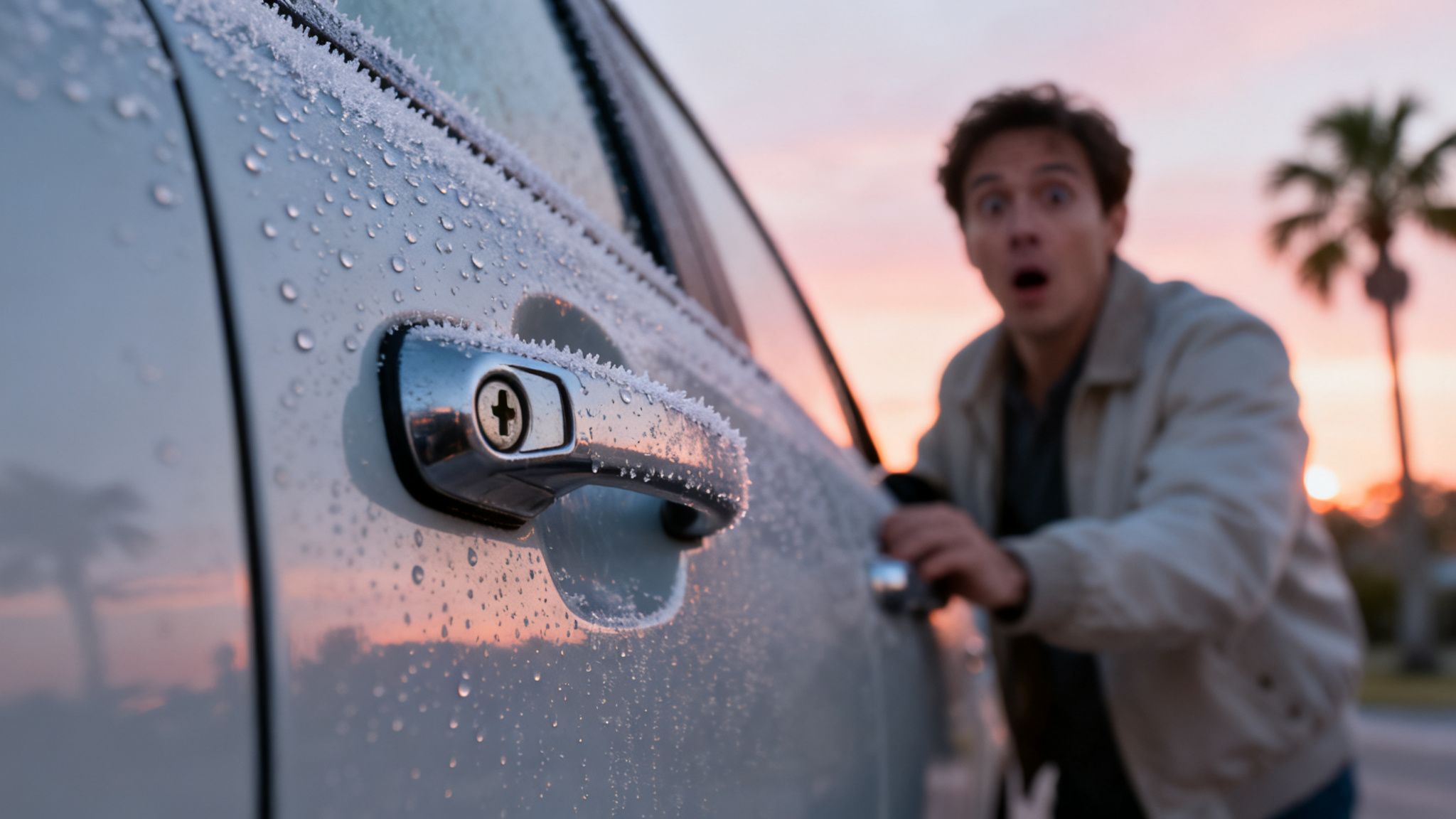
    It sounds unlikely for the Sunshine State, but a sudden cold snap can absolutely leave you with a frozen car door lock. It all comes down to Florida's infamous humidity, which gets trapped inside your car's lock mechanism. When the temperature plummets overnight—something we see in Port St. Lucie, Fort Pierce, and Vero Beach more often than you'd think—that moisture turns to ice and jams everything up.

    Why Florida Weather Can Freeze Your Car Door Locks

    Close-up of a frosted car door handle with water droplets, a palm tree and sunrise in background.

    Most people assume frozen locks are a problem for snowy, northern climates. The reality is, the Treasure Coast's unique weather pattern creates the perfect storm for this exact issue. We get those warm, humid days followed by surprisingly chilly nights, especially when a cold front rolls through Stuart or Jensen Beach.

    That big temperature swing is the real troublemaker. Moisture from the air, a heavy morning dew, or even leftover droplets from an afternoon shower can easily find their way into the tiny crevices of your car's lock cylinder. Once the thermometer dips to freezing, that trapped water expands as it becomes ice, seizing the delicate metal pins inside the lock.

    A Real Example: A Frosty Morning in Port St. Lucie

    You don't need a blizzard for this to happen. All it takes is a little moisture and a temperature drop to 32°F (0°C). According to automotive experts, even a single, minuscule droplet freezing inside the key slot is enough to expand and lock the mechanism solid.

    Just last winter, we received a call from a homeowner in a Port St. Lucie community who was completely locked out. The previous day was warm and damp, but overnight temperatures dropped to the low 30s. The moisture from the air had frozen solid inside her driver-side lock. This is a real-world example of how our local weather can cause unexpected lockouts. You can find more details on how frozen car locks happen and ways to prevent it.

    This is exactly why someone in Stuart or Jensen Beach can wake up to a clear, frosty morning and find their key simply won't turn. The problem isn't a huge block of ice; it's a tiny bit of it in the absolute worst spot.

    More Than Just the Lock Cylinder

    The keyhole isn't the only part of your door that can freeze up. A few other spots are just as vulnerable and can keep you from getting into your car:

    • The Door Seal: Moisture that settles between the rubber gasket and the metal door frame can freeze solid, essentially gluing your door shut.
    • The Handle Mechanism: Water can also sneak inside the door handle assembly itself, freezing the moving parts and stopping it from unlatching the door, even if you manage to unlock it.

    Dealing with a car lockout from a frozen lock is maddening, especially with a morning commute looming. If you've tried a few quick tricks and nothing is working, whatever you do, don't force the key. That’s a surefire way to snap it off and create a much bigger headache. Call (772) 710-8169 for immediate help and we'll get you in without damaging your vehicle.

    Knowing that humidity is the real enemy helps you understand why the simple DIY fixes we're about to cover actually work. It also makes it clear when you're better off calling a professional for a car lockout to avoid a very costly mistake, which could even lead to needing an ignition repair down the line.

    Safe DIY Methods To Unfreeze Your Car Lock

    A person pours hand sanitizer on their hand while holding car keys next to a snow-covered car door.

    When you're standing in the cold, staring at a frozen car door lock, your first instinct might be to just force the key. Don’t do it. That’s a fast track to snapping your key right off in the lock, turning a small annoyance into a real headache that definitely requires a locksmith.

    With a little patience and a couple of things you probably have nearby, you can get back in your car without causing any damage. It’s all about using the right tool for the job—even if that "tool" is something from your purse.

    The Hand Sanitizer Solution

    That little bottle of alcohol-based hand sanitizer you carry around is a fantastic secret weapon against frozen locks. Why? The high concentration of isopropyl alcohol acts as a de-icer, melting the ice that’s jamming up the pins inside your lock.

    Here's a step-by-step guide:

    1. Apply a small squirt of hand sanitizer directly onto the blade of your car key.
    2. Gently insert the key into the frozen lock.
    3. Slowly and carefully wiggle the key back and forth. Do not try to turn it yet.
    4. Remove the key, reapply sanitizer if needed, and repeat until it slides in smoothly. The alcohol will transfer into the lock and melt the ice.

    Gently Applying Heat to the Key

    No hand sanitizer? No problem, as long as you have a traditional metal key. You can use a lighter or a match to gently warm the blade of your key for a few seconds. The goal is to make it warm to the touch, never red-hot. Getting it too hot can melt the plastic on your key's head or, even worse, damage the lock's internal parts.

    Once warm, slide the key into the lock and just hold it still for about 30 seconds. The metal will transfer heat to the lock's tumblers and melt the ice. You may have to repeat this a couple of times to fully thaw it, but it’s a classic trick that works.

    Critical Safety Note: Never, ever use a flame on a modern smart key or key fob. The direct heat will fry the internal chip, leaving you with a very expensive key fob replacement bill. This trick is strictly for old-school, all-metal keys. If you have a modern key and you’re stuck in Fort Pierce, the safest bet is to call (772) 710-8169 for immediate help.

    Comparing DIY De-Icing Methods

    Not all DIY fixes are created equal. Here’s a quick breakdown to help you choose the best approach for your situation.

    MethodEffectivenessPotential RisksBest For
    Hand SanitizerHighLow; generally safe for paint and locks.Quick, on-the-spot fixes when you have it handy.
    Warm KeyModerateHigh; risk of damaging fobs, plastic, or the lock itself.Traditional, all-metal keys only. Use with extreme caution.
    Commercial De-IcerVery HighVery Low; formulated to be safe for cars.Keeping in your home or garage for a reliable, purpose-built solution.
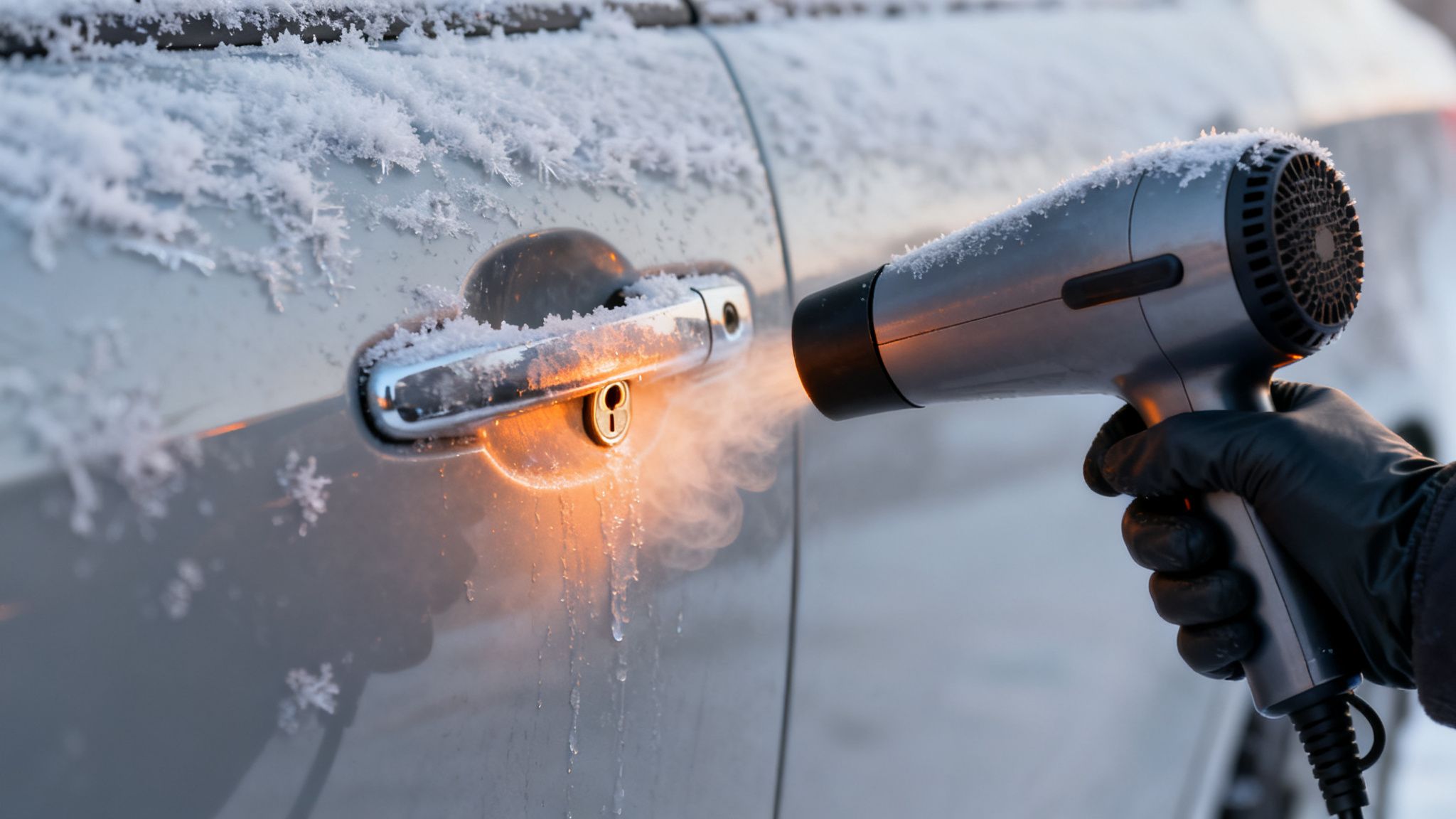
    Hot WaterLowHigh; can refreeze quickly and damage paint/seals.Not recommended. The risk of making the problem worse is high.

    While a warm key can work in a pinch, you can see why having a purpose-built de-icer or even just a bottle of hand sanitizer is a much safer bet.

    Using a Commercial De-Icing Product

    For a surefire solution, nothing beats a dedicated commercial de-icing spray. It’s worth picking one up at a local Stuart auto parts store and keeping it in your garage, especially for those surprise Florida cold snaps. These products are specifically formulated to melt ice fast without damaging your car's finish or the lock mechanism.

    Most come with a thin straw-like nozzle that lets you spray the de-icer directly into the keyhole. This gets the formula right where it needs to be. It also works wonders if the rubber seal around your door is frozen shut—a quick spray along the seam can help break the ice bond. If your DIY efforts aren't working, it could point to a more serious problem like a worn-out ignition, which might require professional ignition repair.

    Common Mistakes That Lead to Costly Repairs

    A broken car key stuck in a frozen door lock, with a screwdriver lying nearby.

    When you’re staring at a frozen door lock on your car, what you don't do is just as critical as what you do. It’s easy to let frustration take over, but those impulsive decisions can turn a minor headache into a major repair bill. We’ve heard countless stories from drivers right here in Fort Pierce and Port St. Lucie who accidentally made the problem a whole lot worse.

    A simple frozen lock can quickly spiral into a several-hundred-dollar ordeal. Before you reach for the first tool you can find, let’s walk through the common missteps that can seriously damage your vehicle.

    The Hot Water Myth

    It seems like a good idea in theory, right? Pour hot water on the ice, and it melts. Unfortunately, this is one of the most damaging things you can do to your car. That sudden, extreme temperature change can easily crack a window or blister the clear coat on your paint job.

    And it gets worse. That water doesn't just vanish. It runs down your door and seeps right back into the lock mechanism and rubber seals. Once the temperature drops again, it refreezes—this time creating an even thicker, more stubborn layer of ice. This is a very common mistake we see in Vero Beach, turning a one-time problem into a recurring one.

    There's a persistent myth that hot water is a quick fix, but it's a gamble that rarely pays off. According to AAA warnings, using hot water can crack 1 in 10 windshields due to thermal shock. It's a risk not worth taking.

    The Dangers of Brute Force

    Another gut reaction is to simply overpower the ice. This usually means jiggling the key aggressively, trying to force it to turn, or prying at the door handle with a screwdriver. This approach almost always ends badly.

    When you force a key, you’re putting incredible stress on metal that’s already brittle from the cold. The most common result? A key that snaps off right inside the lock. Now you're dealing with a professional extraction and likely a new key. A screwdriver is just as bad—it will scratch your paint and can permanently damage the delicate lock cylinder, leading to a full lock change.

    Ignoring the Risk of Costly Damage

    Trying to force your way into a car with a frozen lock is a high-stakes gamble. Studies by automotive experts show that roughly 1 in 4 attempts to force open a frozen door results in a broken handle or latch mechanism. Those repairs can easily average between $200 and $500. You can find more details on these common mistakes with frozen locks.

    If you've tried the safe DIY methods and that lock still won't budge, it's time to stop. Don't risk a broken key or a damaged door. If you find yourself in this jam anywhere from Vero Beach to Jensen Beach, the smartest move is to pick up the phone. For immediate, damage-free assistance with any car lockout, Call (772) 710-8169 for immediate help. Our mobile locksmiths can get you back in your car safely without turning a small problem into an expensive one.

    How to Prevent Frozen Door Locks in the Future

    Close-up of a person's hand spraying an aerosol can onto the door of a white car.

    Dealing with a frozen door lock on your car is a miserable way to start the day, especially on a surprisingly chilly morning here in Vero Beach or Fort Pierce. While there are plenty of quick fixes, the best solution is always prevention. A few smart, proactive steps can make sure this problem never happens to you in the first place.

    It all boils down to one thing: moisture control. Since trapped humidity is the real enemy here, your best defense is creating a barrier against it. That’s where a quality lubricant comes in, shielding the delicate inner workings of your lock.

    The Power of Silicone Lubricant

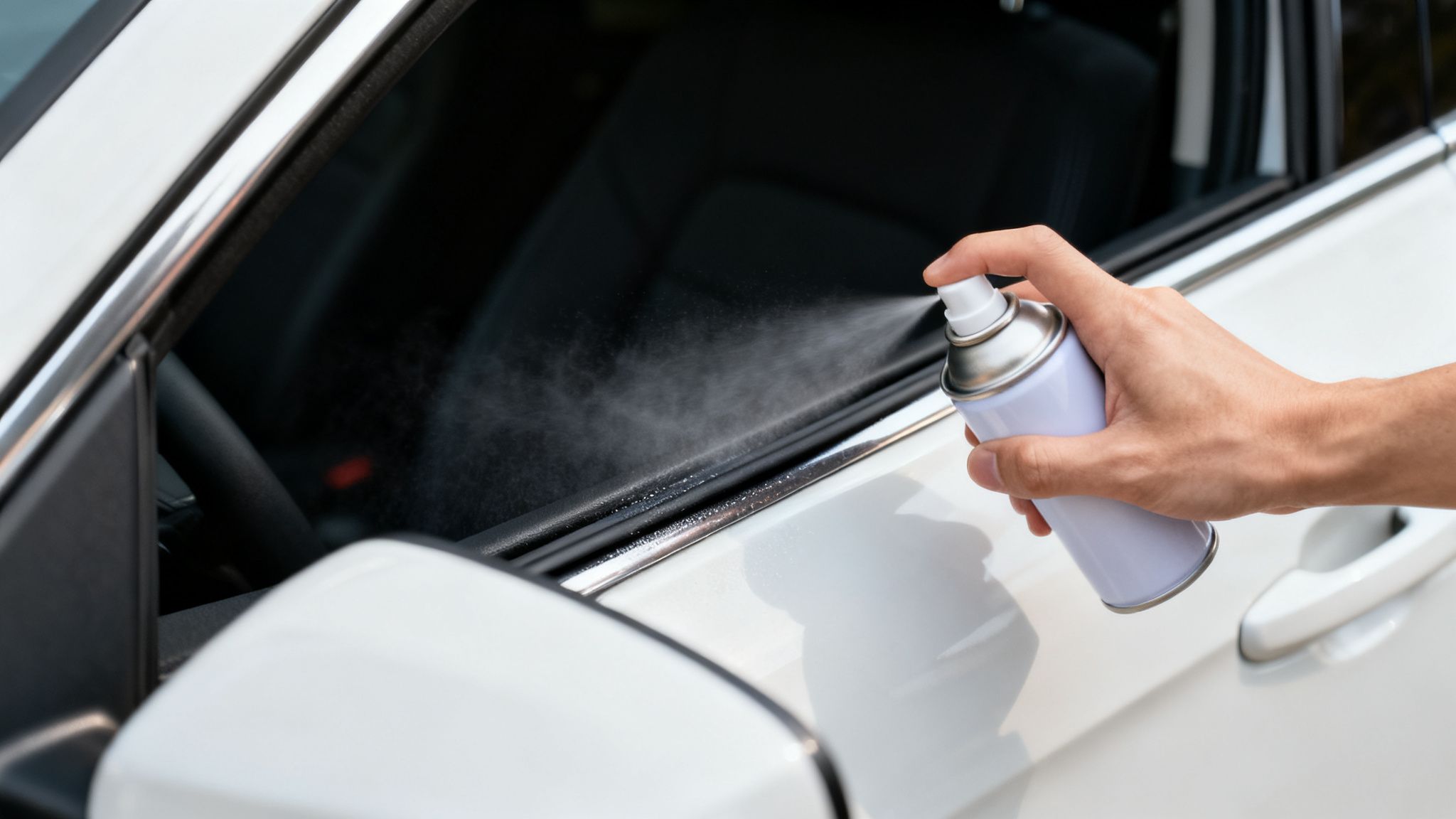
    Your number one tool in this fight is a silicone-based lubricant spray. Here's a simple, practical step-by-step for local residents:

    1. Before a forecasted cold snap, take a minute to spray a small amount directly into the lock cylinder.
    2. Slide your key in and turn it back and forth a few times.
    3. This simple action spreads the lubricant evenly across all the internal pins and tumblers.

    This does two crucial things:

    • It displaces moisture: Silicone is fantastic at pushing existing water out of the lock.
    • It creates a barrier: The spray leaves behind a thin, protective film that stops new moisture from getting in and freezing.

    And don't stop at the lock. Give the rubber seals around your doors some attention, too. A quick spray of silicone on a cloth wiped along the gaskets will keep them from freezing shut to the car's frame.

    A common mistake I see is people grabbing any old lubricant. It’s critical to use the right stuff. Heavy oils and even standard WD-40 can attract dirt and grime over time, which eventually gums up the lock and can lead to bigger problems like needing an ignition repair. Always stick with a clean, moisture-resistant silicone or graphite lubricant designed for this purpose.

    Small Habits That Make a Big Difference

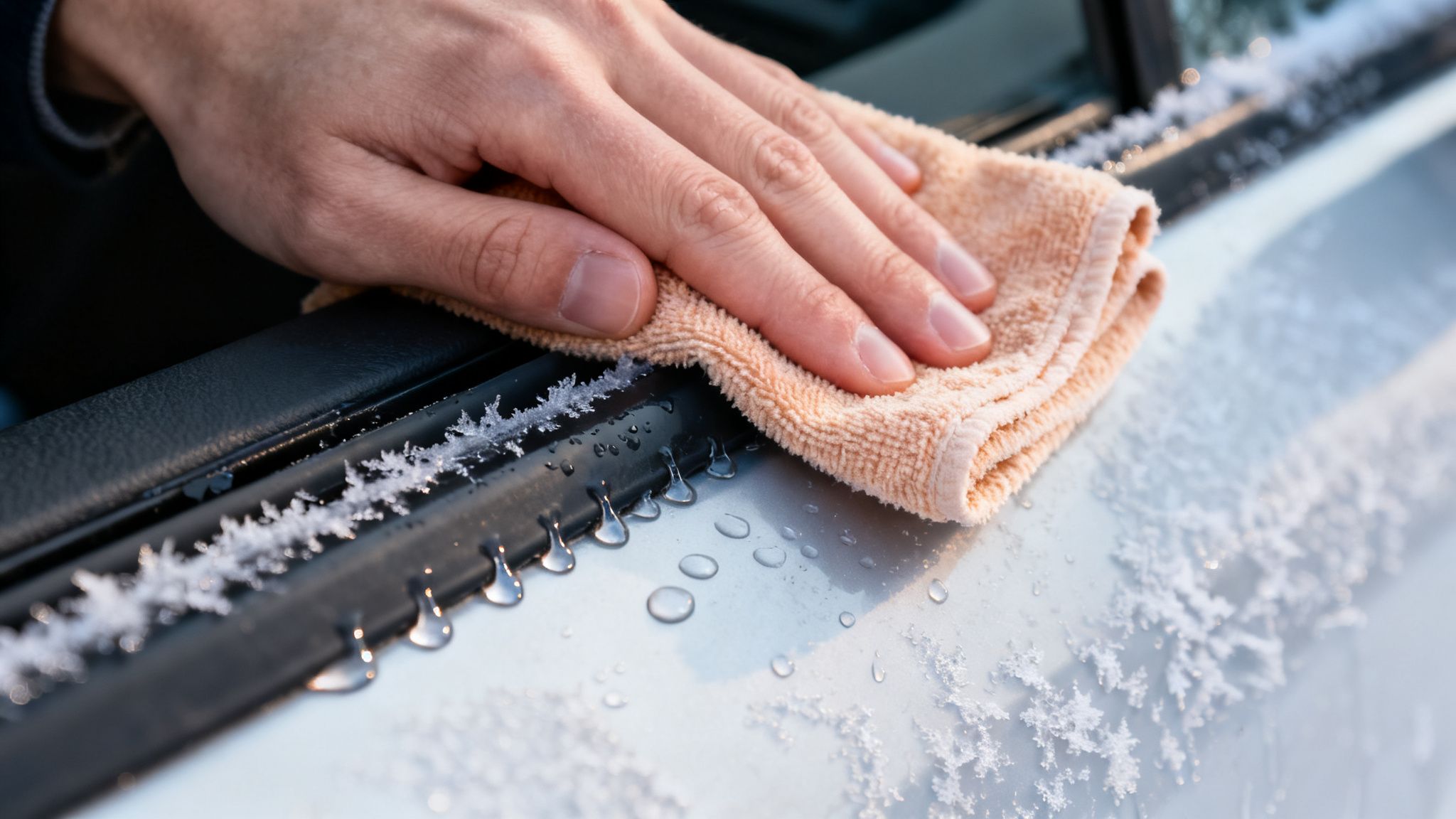
    Beyond lubricants, a few simple habits can dramatically lower your risk. For instance, if you wash your car on a cool day in Stuart, be extra diligent about drying the door handles, locks, and rubber seals. Any leftover water is just asking to freeze overnight.

    The impact of this kind of proactive care is huge. During the brutal 2021 Texas freeze, an estimated 10% of 15 million drivers were stranded by frozen locks. Experts also point out that automotive seals without proper lubrication degrade 20% faster, turning them into perfect traps for ice. Taking a few moments to use a silicone spray can prevent 85-95% of these frustrating incidents. You can find more insights on how preventative measures avoid costly issues on economictimes.com.

    Ultimately, a good schedule of overall preventative maintenance is your best defense. If your locks are already feeling stiff, it might be time for a professional to take a look. This is true for your home as well; if you're experiencing lock issues, you might need a service like a house lockout or lock change. Learn more about our full range of automotive locksmith services to keep your vehicle secure.

    When It’s Time to Call an Emergency Locksmith

    While a lot of quick fixes can get you out of a jam with a simple frozen door lock on your car, some situations are a clear signal to stop and call for help. Pushing your luck can turn a small annoyance into a major, expensive repair. Knowing when to put down the de-icer and pick up the phone is the smartest move you can make.

    Listen to what the lock is telling you. If your key meets a hard stop or you feel a grinding sensation, that’s not ice—that’s likely a damaged internal mechanism. Trying to force it is a surefire way to snap the key or destroy the lock cylinder. And if your key has already broken off in the lock? That’s a definite "game over" for DIY.

    The Key Fob Complication

    Modern cars add a whole new layer of guesswork. Imagine your key fob just stops working on a chilly Port St. Lucie morning. It's easy to assume the battery is dead, but the cold itself can seize the physical lock, which stops the electronic signal from doing its job.

    So what are you dealing with? Is it the battery, the lock, or the fob itself? Instead of playing a guessing game in the cold, a quick call to a professional can solve the mystery. We have the gear to test your fob's signal, safely thaw the mechanism, and even handle an on-the-spot key fob replacement if that’s the real problem—usually for a lot less than you'd pay at the dealership.

    Why Calling a Mobile Locksmith is Your Best Bet

    When you're stuck, the last thing you want is a long wait. Calling a mobile locksmith here on the Treasure Coast means an expert comes directly to you, whether you’re stuck in your driveway in Stuart, a parking lot in Jensen Beach, or on the side of the road in Fort Pierce.

    Here’s why it’s the better call in these tricky situations:

    • Local Expertise: We know the specific challenges of our humid, coastal climate. We're not a generic national chain; we're your neighbors.
    • The Right Tools: We use professional, non-destructive tools designed to get you in without a single scratch to your paint, weather stripping, or the lock itself.
    • Comprehensive Services: Sometimes a frozen lock is just the tip of the iceberg. Our technicians can spot and fix related issues right then and there, from a basic car lockout to a more involved ignition repair or even a full lock change.
    • A Guaranteed Fix: Why waste time and risk damage with methods that might not even work? You get a fast, guaranteed solution that gets you back in your car and on with your day.

    Don't let a moment of frustration turn into a repair bill that costs you hundreds. If you've tried the gentle methods and that lock still won't give, or if you're looking at a key broken in the door, it’s time to call in a pro.

    For fast, damage-free help anywhere in St. Lucie County, Call (772) 710-8169 for immediate help. We handle everything from a stubborn frozen lock to house lockout situations. If you're locked out right now, check out our specialized emergency lockout services to see how we can get you back on the road quickly.

    Your Questions About Frozen Car Locks Answered

    Even when you do everything right, a surprise cold snap on the Treasure Coast can leave you with a few head-scratchers. We get calls about this all the time. Here are some quick, no-nonsense answers to the most common questions we hear from folks in Vero Beach, Stuart, and across the area when they're dealing with a frozen door lock on a car.

    Is WD-40 a Good Choice for a Frozen Lock?

    That's probably the number one question we hear, and our professional answer is "no," at least not for the long haul. Sure, WD-40 can displace water in a pinch and might get you in your car, but it’s not a true lubricant.

    The real problem is that over time, it becomes sticky. It attracts dust, dirt, and gunk, which eventually gums up the delicate pins inside your lock. You might solve a small problem today only to create a much bigger, more expensive one down the road, potentially leading to a needed lock change.

    A far better choice for both unfreezing and preventing future issues is a silicone or graphite-based lubricant. These sprays are specifically made for locks—they lubricate the moving parts and repel moisture without leaving behind that sticky residue.

    My Key Fob Won't Work. Is the Lock Frozen?

    It’s a strong possibility. If the mechanical parts inside the door are literally encased in ice, the signal from your fob won't be able to move them. It’s like telling your arm to lift something when it’s stuck in a cast; the brain is sending the signal, but the hardware simply can't respond.

    But don't forget about the fob itself. Extreme cold is brutal on small batteries and can drain your key fob's power, making its signal weak or killing it completely. So you’ve got two potential culprits. Our mobile techs in Jensen Beach and Stuart can figure this out in minutes, whether it’s a frozen mechanism or just a dead fob needing an on-the-spot key fob replacement.

    When your key fob gives up in the cold, don't automatically assume your car's entire locking system is shot. If you’re not sure, it's always smarter to call (772) 710-8169 for immediate help than to risk damaging the door by forcing it.

    Can I Use Warm Water Instead of Hot Water?

    Please don't. We strongly advise against using water of any temperature on a frozen lock or window. Even lukewarm water can create a rapid temperature change, and that thermal shock is enough to cause micro-cracks in your car’s paint and even the glass.

    Worse yet, that water has to go somewhere. It will run down into every tiny crevice in the lock and door seals, and then it will refreeze. You’ll often end up with a thicker, more stubborn layer of ice than you started with. It's one of those "quick fixes" that almost always backfires and makes the problem worse. This is a real issue we see in the Fort Pierce area every winter.

    For more answers to common questions about vehicle security, feel free to check out some of the frequently asked locksmith questions on our website.


    When a simple fix doesn't cut it, Pro-B Locksmith is ready to help. Our mobile technicians serve the entire Treasure Coast, providing fast, damage-free solutions for everything from car lockouts to key fob replacements. Get professional help now by visiting https://problocksmith.com.

  • Back on the road: car ignition key won t turn? Quick fixes for Port St. Lucie drivers

    Back on the road: car ignition key won t turn? Quick fixes for Port St. Lucie drivers

    That moment of panic is all too familiar: you slip the key into the ignition, give it a turn, and… nothing. It’s completely stuck. Before your mind jumps to an expensive repair, take a deep breath. More often than not, this is a simple issue with an equally simple fix.

    As a local locksmith serving drivers all over Port St. Lucie, Fort Pierce, and Stuart, I’ve seen this countless times. Let’s walk through what’s likely happening and how you can get yourself back on the road.

    Your Guide to Common Ignition Problems

    A driver's hand is shown pressing a small circular object into the center of a car's steering wheel.

    From Jensen Beach to Vero Beach, a stuck ignition is a universal frustration. The good news is that it’s rarely a sign of a catastrophic failure. Usually, it's just your car’s way of telling you something is slightly out of place.

    Why Is My Ignition Stuck?

    Understanding the why is the first step to finding the solution. Here are the most common culprits I see in the field across the Treasure Coast:

    • Your Steering Wheel is Locked: This is, by far, the number one reason. It's a built-in anti-theft feature, but it’s incredibly easy to accidentally trigger when you get out of the car.
    • The Car Isn't Fully in Park (or Neutral): For safety, your vehicle won't allow the key to turn unless the gear selector is securely in "Park" or "Neutral." A slight misalignment is all it takes to lock you out.
    • The Key Itself is the Problem: Keys don't last forever. Years of use can wear down the grooves, or a slight bend can prevent it from properly engaging the pins inside the ignition cylinder. A damaged key is a common cause for needing a key fob replacement.
    • Something is Jamming the Keyway: It’s amazing what can find its way into an ignition lock. Pocket lint, sand from a day at Jensen Beach, and other tiny bits of debris can build up and block the key.

    Believe it or not, the locked steering wheel is the call we get most often. Automotive service data actually shows that 15-20% of all car key emergencies aren't about a broken ignition but are simply due to this security feature. It's been standard in cars since the 1980s, so it’s a problem we’ve been solving on the Treasure Coast for decades.

    For a professional, it's usually a quick, tool-free fix that takes just a few moments. You can learn the trick yourself by checking out this handy steering wheel lock guide. But if you’re stuck somewhere in Stuart or Port St. Lucie and just can’t get it to budge, Call (772) 710-8169 for immediate help.

    Expert Tip: When you try to free a locked steering wheel, don't force it! The key is gentle, consistent pressure. Wiggle the wheel back and forth while lightly trying to turn the key. Too much force on the key can bend or break it, turning a simple problem into a more serious one requiring professional ignition repair.

    Quick Troubleshooting For A Stuck Ignition Key

    Use this step-by-step table to quickly identify the likely cause of your ignition problem and the first action you should take to resolve it.

    SymptomPotential CauseFirst Step to Try
    Steering wheel is hard to move, key won't turnSteering Wheel Lock EngagedGently wiggle the steering wheel left and right while turning the key.
    Key goes in but won't turn at allGear Selector MisalignmentFirmly press the brake and jiggle the gear shifter. Ensure it's fully in Park.
    Key feels loose or difficult to insert/removeWorn or Damaged KeyInspect the key for visible bends or damage. Try your spare key if you have one.
    Key only goes in part of the way or feels grittyDebris in Ignition LockUse a can of compressed air to blow out the keyway. Do not use lubricants like WD-40.

    This quick-check table should help you diagnose the most common issues on your own. Remember to be patient and avoid forcing anything, as that can lead to more significant damage to the key or the ignition cylinder itself. If these steps don’t work, it’s a good sign that it's time to call for professional help. If you’re in our service area, Call (772) 710-8169 for immediate help.

    Practical DIY Fixes You Can Try Right Now

    A person's hands inside a car, holding a car key in the ignition while sitting behind the steering wheel.

    Before you panic and assume the worst, let's walk through a few simple, safe things you can try yourself. More often than not, the reason your car ignition key won't turn is a minor issue you can solve in less than a minute, right where you're parked here in Port St. Lucie.

    Wiggle the Steering Wheel

    This is hands-down the most common fix because a locked steering wheel is the number one culprit. When the wheel is locked, it puts tension on the ignition's lock pin, physically stopping the key from turning.

    • Step 1: Insert the Key: Place your key in the ignition as you normally would.
    • Step 2: Gentle Pressure on Key: Apply light, steady pressure to the key as if you were going to turn it. Don't force it.
    • Step 3: Wiggle the Wheel: While maintaining light pressure on the key, use your other hand to wiggle the steering wheel back and forth. You should feel a distinct "click" as the pressure releases and the lock disengages. The key should then turn freely.

    Just last week, a customer in Stuart had this exact problem after parking on a slight incline. The angle of the car put just enough extra tension on the wheels to bind the steering lock. A quick wiggle was all it took to get them back on the road.

    Check Your Gear Shifter

    Every automatic car has a built-in safety feature that prevents it from starting unless it's securely in Park (P) or Neutral (N). Sometimes, the gear shifter can look like it's in the right spot but is actually a hair out of alignment.

    With your foot firmly on the brake, give the gear shifter a little jiggle. Make sure it's pushed all the way into the Park position, then try the key again.

    Inspect the Key and Ignition Lock

    Pull the key out and give it a good look. Do you see any obvious bends, cracks, or badly worn-down teeth? Over years of use, even a tiny bit of damage can throw off how the key lines up with the tumblers inside the ignition cylinder.

    At the same time, check the ignition's keyway for debris. Pocket lint, sand, and tiny crumbs can get jammed in there and block the key. A quick blast from a can of compressed air (the kind for cleaning computer keyboards) is perfect for clearing it out. Just remember, never spray a lubricant like WD-40 into the ignition. It attracts dust and will gum up the delicate internal parts, creating a much bigger headache down the line.

    A bent or worn-out key isn't just a nuisance; it's a leading cause of ignition failure. In my experience, wear and tear accounts for an estimated 25-30% of all ignition key issues. Think about it—your key goes through thousands of cycles. After 7-10 years, that repetitive stress can warp its precise shape. This is especially true for Treasure Coast drivers who might be looking at dealership replacement costs of $200-$400 for a modern key. A local locksmith can often provide a new key fob replacement for a fraction of that cost.

    If these simple tricks don't get you going, it's time to stop. Trying to force a stubborn key is the fastest way to break it off inside the ignition, turning a manageable problem into a much more complicated and expensive extraction.

    For fast, non-destructive help anywhere around Jensen Beach or Fort Pierce, call (772) 710-8169 and you'll be connected with a certified locksmith. Our team handles all sorts of vehicle emergencies, from ignition repair to car lockout situations. You can learn more about our car lockout services and how we get you back into your car without a scratch.

    Is It a Worn-Out Key or a Bad Ignition?

    Close-up of a metallic key next to a key cylinder with its internal pins visible.

    If you've tried the simple fixes and your key is still stuck, the problem is almost certainly physical. We're talking about the key itself or the ignition cylinder it goes into. After thousands of turns over the years, these metal parts simply wear out, and eventually, you'll find your car ignition key won't turn.

    Often, the problem doesn't just appear out of nowhere. We hear it all the time from folks in Vero Beach and Stuart—the key felt a bit "sticky" for a while, or they had to jiggle it just right for weeks before it finally gave up the ghost.

    This slow, gradual failure is the tell-tale sign of internal components wearing down. It’s a mechanical breakdown, not a sudden glitch.

    Key Trouble or Ignition Trouble? A Simple Test

    Figuring out whether the problem is your key or your ignition is the most important diagnostic step you can take on your own. Thankfully, the test is incredibly simple: grab your spare key.

    • Spare Key Works? Perfect! You’ve isolated the problem. Your everyday key has likely become too worn down, bent, or even slightly twisted to line up with the ignition's internal pins anymore. The fix is a simple key fob replacement or getting a new standard key cut.
    • Spare Key Also Stuck? This is a dead giveaway that the issue is inside the ignition cylinder itself. The delicate internal pins have probably shifted, worn out, or gotten damaged, so no key—not even a brand-new one—is going to work.

    We recently helped a customer in Fort Pierce who had been fighting with his key for a month. When it finally got stuck for good, he tried his spare, which had been sitting in a drawer for years. That key wouldn't turn either, confirming the ignition cylinder was shot and letting us get straight to the ignition repair without any guesswork.

    Crucial Warning: Whatever you do, do not try to force a stuck key. I've seen it happen dozens of times—you apply too much pressure, and the key blade snaps right off in the ignition. This instantly turns a straightforward repair into a much more complicated and costly extraction job.

    When the Problem is Deeper: The Ignition Switch

    A worn-out ignition lock is a mechanical problem, but a bad ignition switch is an electrical one. The switch is the part behind the lock that actually tells your car to start and powers up your accessories.

    If the issue seems bigger than just a jammed lock, it helps to know the common bad ignition switch symptoms. Look out for things like your car stalling while you're driving, the dashboard lights flickering for no reason, or accessories cutting out randomly.

    If you notice any of these electrical gremlins, it’s time to stop the DIY work and bring in a professional. For expert ignition repair in Port St. Lucie and across the Treasure Coast, Call (772) 710-8169 for immediate help. We’ll pinpoint the exact cause and get you back on the road.

    Why a Mobile Locksmith Beats a Tow to the Dealership

    A smiling mechanic kneels on a street, fixing a grey car's door handle, with a silver van parked nearby.

    When your car ignition key won't turn, your mind probably jumps straight to the dealership. It’s a common reaction, but for drivers here on the Treasure Coast, it's almost always the slowest and most expensive path you can take. Dealerships are set up for scheduled oil changes and major repairs, not for getting you out of a jam right now.

    Before you even dial a tow truck, just think about what that choice involves. First, you're hit with the tow fee itself, which can easily be over a hundred bucks just to get your car across town. Then you’re stuck playing by the dealership's rules—and their schedule. That could mean your car sits for days before a mechanic even glances at it.

    A mobile locksmith, on the other hand, is built for exactly this kind of problem. We operate on a completely different model: one designed for speed, convenience, and your peace of mind.

    The On-Site Advantage

    The biggest difference is simple: we come to you. It doesn't matter if you're stranded in your driveway in Port St. Lucie, stuck in a shopping center parking lot in Fort Pierce, or running late in Vero Beach. Our van is a fully equipped workshop on wheels. We roll up with the right tools, the latest diagnostic tech, and the experience to fix your ignition on the spot.

    There’s no tow truck. No stale coffee in a waiting room. No wondering when you’ll get your car back. An ordeal that could stretch over several days becomes a problem we can often solve in under an hour. We handle everything from a straightforward ignition repair to programming a new key fob replacement, all without your car ever leaving its parking spot.

    Local Insight: Dealerships frequently have to order specific ignition parts or key blanks, which adds days to the repair. As local specialists serving the Treasure Coast, we keep our vans stocked with a huge inventory of parts for the most common vehicles in our area. This means we can usually finish the job in one visit, getting you back on the road—and back to your life—that much faster.

    Transparency and Real Cost Savings

    Let’s be honest: dealerships are notorious for high labor rates and bloated service charges. You often won't have a clue what the final bill will be until the work is already done. A professional mobile locksmith gives you clear, upfront pricing before we touch your car, so there are no surprises.

    Our direct-to-you service cuts out the massive overhead costs of a dealership's facility, and we pass those savings directly to you. For a typical ignition repair or key replacement, our services can be 40-50% less expensive than what you'd pay at the dealer. And that's before you even add in the towing fee. We believe in doing honest work for a fair price.

    If you need an expert you can trust for ignition repair, car lockout, or even a house lockout, Call (772) 710-8169 for immediate help.

    Mobile Locksmith vs Car Dealership for Ignition Issues

    When you're stuck, the choice becomes pretty clear. Here’s a quick breakdown for drivers in the Port St. Lucie area trying to decide what to do about a stuck ignition.

    Service FactorPro-B Locksmith (Mobile)Car Dealership
    LocationWe come to you anywhere on the Treasure Coast.You must tow your vehicle to their location.
    Response TimeUsually under an hour; immediate service.Often requires an appointment days away.
    CostUpfront pricing, no tow fees, lower labor rates.Higher labor rates plus expensive towing costs.
    ConvenienceRepair completed on-site while you wait.Involves waiting rooms, rental cars, and delays.

    At the end of the day, when your key is stuck, you just want the fastest and most affordable fix. A mobile locksmith offers specialized expertise right where you are, saving you from the headache and high costs of a dealership ordeal. You can learn more about our full range of automotive locksmith services and see how we help drivers get back on the road every single day.

    A Little Prevention Goes a Long Way

    The absolute best way to handle a key that won't turn is to make sure it never happens in the first place. Think of it like changing your oil—a few simple habits can save you from that sinking feeling of being stranded in a Stuart parking lot or your own Jensen Beach driveway.

    It's all about shifting your mindset from emergency reaction to smart, proactive maintenance.

    Lighten Up That Keychain

    I see this all the time. A customer hands me a keychain that looks like it weighs five pounds. While it might feel organized to have every key you own in one place, that weight is a slow-motion killer for your car's ignition.

    Every time you drive, the bouncing and swinging of that heavy bundle pulls down on the ignition cylinder. It might not seem like much, but over thousands of miles, that constant strain grinds down the delicate pins and wafers inside.

    My Two-Finger Rule: If your keychain is too heavy to comfortably hold between your thumb and index finger, it's putting too much stress on your ignition. Do yourself a favor and separate your car key from everything else. That one simple change can add years to the life of your ignition assembly.

    Keep Your Keys and Ignition in Good Shape

    A little bit of basic care can make a huge difference. You don't need to be a mechanic; these are easy tasks that pay off big time.

    • Blow Out the Debris: A couple of times a year, grab a can of compressed air and give the keyway a good blast. You'd be surprised how much dust, lint, and gunk can get in there. Follow it up with a very short spray of a dry graphite lubricant to keep everything moving freely.
    • Don't Copy a Worn-Out Key: If you need a spare, never take a worn, rounded key to get duplicated. You're just making a brand-new copy of a bad key. A professional locksmith can cut a new key from your car's factory code, ensuring it's a perfect match, just like the day it left the dealership.
    • Give Your Spare a Job: Don't just toss your spare key in a drawer and forget about it. Use it to start the car once every few months. This not only confirms it still works but also helps you feel any stickiness in the ignition before it becomes a real problem.

    Following these simple tips can help you avoid the headache and expense of a failed ignition. But if you do find yourself stuck with a key that won't budge, don't force it and don't panic. Professional help is just a phone call away.

    For expert ignition repair or a new key fob replacement anywhere on the Treasure Coast, Call (772) 710-8169 for immediate help. We’re not just here for emergencies like car lockouts; we’re your local partner in keeping your vehicle secure and reliable, also offering services like lock change and house lockout assistance.

    Common Questions About A Key That Won't Turn

    When your key gets stuck in the ignition, a million questions probably run through your head. Here in our Port St. Lucie shop, we've heard them all from drivers up and down the Treasure Coast. Let's clear up some of the most common concerns we hear from our customers every day.

    Can You Fix My Ignition Without Replacing It?

    Most of the time, yes. A full ignition replacement is often a last resort.

    If the problem is something like a stuck internal wafer, a misaligned pin, or some other minor hiccup, our technicians can usually get in there and repair the cylinder itself. It's a much faster process and can save you a good chunk of change compared to buying a whole new ignition assembly from the dealer. We always look for the most practical, cost-effective fix first.

    How Much Does Ignition Repair Cost?

    That's the big question, and the honest answer is: it depends entirely on what’s causing the problem. The cost can swing pretty wildly.

    For instance, simply freeing up a steering wheel lock for a client in Fort Pierce might just be a standard service call fee. A full-blown ignition cylinder replacement, on the other hand, is a more complex job and will cost more. We're big on transparency, though. You'll always get a clear, upfront quote before we touch anything, so there are no surprises.

    Our Promise: We believe in honest work. Our experts will quickly diagnose the true source of the problem—whether it's the key, the lock, or the switch—ensuring you only pay for the specific service you actually need to get back on the road.

    What If My Key Broke Off in the Ignition?

    First things first: step away from the pliers. I know the temptation to grab a pair of tweezers and try to fish it out is strong, but please don't. You can easily push the broken fragment deeper into the lock or damage the delicate components inside. This can turn a simple extraction into a costly replacement.

    Our team has specialized tools designed specifically for this job. They allow us to remove broken key bits without doing any harm to the ignition cylinder. If you find yourself in this jam anywhere from Vero Beach to Stuart, call (772) 710-8169, and we'll provide immediate, damage-free help.

    Will a New Key Solve the Problem?

    It’s possible, but only if the key is the actual problem. If your key is obviously bent, has a hairline crack, or the grooves are worn down to almost nothing, then a fresh, perfectly cut key will likely do the trick. We can even cut one for you right on the spot.

    But if the issue is with the ignition cylinder itself, a brand-new key won't make a difference. It still won't turn. This is why getting an expert diagnosis is so important—it saves you from spending money on a new key when the real problem is inside the lock.

    For more answers to common questions, you might be interested in our comprehensive FAQ page which covers a wide range of locksmith topics.


    When you need fast, reliable, and professional help with your car's ignition, keys, or locks, trust the local experts at Pro-B Locksmith. Visit us online at https://problocksmith.com to see our full list of automotive, residential, and commercial services.

  • Reprogramming Car Keys: Fast, Local Locksmith Solutions in Port St. Lucie

    Reprogramming Car Keys: Fast, Local Locksmith Solutions in Port St. Lucie

    It’s a moment every driver on the Treasure Coast dreads. You’re leaving Jensen Beach after a perfect day, and suddenly, your car key won't work. Nothing. The doors won't unlock, and the engine won't start. You’re stranded. Unlike the simple metal keys of the past, today’s car keys are sophisticated little computers. When they fail, they often need professional reprogramming to restore their connection with your vehicle.

    What Reprogramming Car Keys Really Means

    Close-up of a man holding an old, corroded car key fob near a beach parking lot.

    Think of it like a secure, digital handshake between your key and your car's computer. Every time you press a button, your key sends out a unique, encrypted signal. If your vehicle’s computer recognizes that signal, it obeys the command—unlocking the doors or firing up the engine. Key reprogramming is the professional process of re-syncing that digital handshake when the connection is lost.

    This isn't just about making life easier; it's a vital part of your car's security. Modern anti-theft systems, called immobilizers, are specifically designed to prevent the engine from starting unless it gets the right signal from a properly programmed key. That’s exactly why a basic copy from a hardware store can't start any car made in the last 20 years. If you're stuck in Fort Pierce or Vero Beach with a key that's given up, don't worry. Call (772) 710-8169 for immediate help, and a mobile locksmith can come right to your location.

    Common Reasons Your Key Needs Reprogramming

    A key can lose its programming for a handful of reasons, and it almost always happens at the worst possible time. Knowing what might have caused the issue can help you get back on the road faster. Here's a quick look at the most common culprits we see when helping drivers around Port St. Lucie, Stuart, and Jensen Beach.

    Common Reasons for Car Key Reprogramming

    Key TypeCommon Reason for ReprogrammingBest Solution
    Transponder KeyThe internal chip is damaged from a drop, or the car's computer loses the code after a battery change.A mobile locksmith can re-sync the key's unique code to the vehicle’s immobilizer system on-site.
    Remote Key FobA dying fob battery causes intermittent signals, leading to de-synchronization. Water damage from a day at the beach is also a major cause.Replace the battery first. If that fails, a professional reprogramming with specialized tools is needed.
    Push-to-Start FobSignal interference from other electronics or a major vehicle electrical issue can sever the connection.Professional diagnostic tools are required to safely re-establish the secure link with the car's computer.

    Understanding these common failure points makes it clear why a quick fix isn't always possible and professional equipment is often essential.

    Why a Professional Is Your Best Solution

    While you might find some DIY programming guides online for older models, it's a risky path. Those methods are quickly becoming obsolete, and one wrong move could accidentally wipe your car's entire security system. That turns a simple key issue into a major, expensive repair requiring a tow to the dealership.

    A professional mobile locksmith uses specialized diagnostic tools to safely communicate with your car's computer. This equipment ensures the key is programmed correctly without risking damage to sensitive vehicle electronics, providing a guaranteed and secure solution.

    Instead of paying for a tow truck to the dealership and waiting for an appointment, a local mobile locksmith offers a much faster and more affordable service. We handle everything from key fob replacement to complex ignition repair wherever you are. Whether you're dealing with a car lockout in Fort Pierce or need a completely new key cut and programmed in Vero Beach, expert help is available 24/7.

    The Tech Inside Your Car Key Fob

    Gloved hand holds an open car key fob with a visible circuit board, transmitting a signal to a car outline.

    Your modern car key is far more than just a piece of metal. It's basically a tiny, high-security radio that's constantly having a private conversation with your vehicle. Each time you hit a button or even just walk up to your car, your key sends out a unique, encrypted code. If your car’s computer recognizes that code—it's like a secret handshake—the doors unlock and the engine is ready to go. If not, the car stays completely locked down, a vital anti-theft measure.

    When that digital handshake starts failing, you need a professional to step in and reprogram the key. This can happen for all sorts of reasons, from a dead battery wiping the key's memory to the internal electronics getting scrambled after being dropped one too many times in a Port St. Lucie parking lot. The key and car have simply forgotten each other, and that connection needs to be re-established. If you're in this situation, Call (772) 710-8169 for immediate help.

    Transponder Keys: The Hidden Security Guard

    The most common type of modern key is the transponder key. Even if your key looks like a simple blade with a plastic head, there’s a good chance it has a tiny glass or carbon chip embedded inside. This chip doesn't even need its own battery; it’s cleverly powered by a radio signal your car sends from a ring around the ignition when you put the key in.

    Once energized, the chip broadcasts its unique serial number back to the car. If that number matches the one stored in the vehicle's immobilizer system, you get the green light to start the engine. But if the chip is damaged or its code is corrupted, the car won’t start, even if the key turns the ignition perfectly. This is a classic case where you'd need a key fob replacement and reprogramming.

    Keyless Entry Remotes and Smart Keys

    From there, things get even more sophisticated with remote fobs and smart keys, adding layers of convenience and security.

    • Keyless Entry Remotes: These are the fobs we all know, with buttons to lock, unlock, pop the trunk, or sound a panic alarm. They run on their own battery and have to be programmed to speak the right language for your specific car.
    • Smart Keys (Proximity Keys): Found in most push-to-start cars, these are the pinnacle of key tech. You don't have to take them out of your pocket or purse. The vehicle senses when the key is nearby, letting you unlock the doors and start the engine with the simple push of a button.

    When these more advanced keys stop working, it can be incredibly frustrating. If you're stuck somewhere in Stuart, Jensen Beach, or anywhere on the Treasure Coast, just call (772) 710-8169 for immediate help.

    Why Reprogramming Is a Security Measure

    Reprogramming isn’t just about getting you back on the road; it's a critical security procedure. When we program a brand-new key, we also take the crucial step of erasing any old, lost, or stolen keys from your car's memory. This ensures that a key that’s fallen into the wrong hands can never be used to access your vehicle again.

    This field is always evolving. While digital keys on smartphones are becoming more common, the reality is that physical key fobs—and the specialized tools to service them—are still essential. The market for automotive key programmer tools hit $2.18 billion in 2024, which really highlights the demand for professional reprogramming.

    And even though nearly 50% of mid-to-luxury vehicles now feature smart keys, simple issues like dead batteries still cause 35% of all fob failures. This means having an expert you can trust is more critical than ever. You can explore more about the surge in digital key technology to see where things are headed, but for drivers in Port St. Lucie today, a reliable mobile locksmith is your best bet for a fast, on-the-spot solution.

    What Goes Into a Professional Key Reprogramming Service?

    A male technician uses diagnostic equipment to work on a car's interior.

    When you call a mobile locksmith for key reprogramming, you're not just getting a new key. You’re getting a highly specialized, technical service delivered right to your location. This isn't something you can just wing; it’s a precise, step-by-step process that professionals use to sync a new key to your car’s complex computer system.

    The best part? It all happens on-site. Whether you're at home in Port St. Lucie, at the office in Fort Pierce, or stranded in a Vero Beach parking lot, we come to you. That means no towing fees and no long waits at the dealership.

    Stage 1: Diagnosis and Assessment

    First things first, our technician will plug a specialized diagnostic scanner into your vehicle's OBD-II port. This little port is the main communication hub for your car's brain, and our scanner acts like a translator, letting us see what's really going on.

    This step is absolutely crucial. It tells us whether the problem is actually the key’s programming or something else, like a weak battery or a faulty ignition switch. By reading the car’s error codes and checking the immobilizer system's status, we can confirm the diagnosis before starting any work. This saves you time, money, and a lot of headaches.

    Stage 2: Sourcing and Cutting the New Key

    If you need a completely new key, we've got it covered right there in our van. We stock a wide variety of high-quality key blanks and fobs compatible with nearly every make and model, from everyday Chevy and Toyota vehicles to high-end BMWs.

    • Key Blade Cutting: For keys with a traditional metal blade, we use a mobile laser key cutter to mill a perfect, factory-spec copy.
    • Fob Sourcing: If you have a push-to-start or keyless remote, we’ll provide a brand-new, OEM-quality fob that’s ready for programming.

    Using professional-grade parts makes all the difference. Those cheap fobs you can buy online? They often have incompatible chips and are a common cause of programming failures. Our automotive locksmith services guarantee you get a key that works.

    Stage 3: Erasing Old Keys and Programming the New One

    This is where the magic happens—and it's a critical security step. With our diagnostic tool connected, we access your vehicle’s computer to do two very important things.

    First, we completely wipe all existing keys from the car's memory. This is a must if your keys were lost or stolen, because it makes those old keys totally useless. Anyone who finds them won't be able to start your car.

    Next, we introduce the new key. We program its unique transponder code directly into the vehicle's immobilizer, creating a brand-new digital handshake. From that point on, your car will only recognize and trust the new key.

    Every car manufacturer does this differently. The software and steps for a Ford are completely different from those for a Honda. Our technicians are trained on these brand-specific procedures to ensure the programming is done correctly, without any risk to your vehicle's sensitive electronics. If you want to learn more about the intricacies, this is a great guide on reprogramming key fobs.

    Don't leave your car's security to chance. If you're in Stuart or Jensen Beach and need a new key programmed right, call us at (772) 710-8169 for immediate help. We make the whole process fast, easy, and secure.

    DIY Reprogramming vs. Calling a Professional

    When your car key gives out, the first thought for many drivers here in Port St. Lucie is, "Can I just fix this myself?" A quick search online, and you're flooded with videos and forum posts promising a quick, easy DIY fix for reprogramming your key. It seems like a great way to save a few bucks, but the reality, especially for modern cars, is a lot more complicated—and a lot riskier.

    Let's be blunt: DIY methods really only work for a small handful of much older cars, typically models from before the early 2000s. For anything newer, trying to reprogram a key without the right gear can backfire spectacularly. You could easily "brick" your car’s Engine Control Unit (ECU), turning a simple key issue into a repair bill that runs into the thousands.

    The Risks of a Do-It-Yourself Approach

    Trying to program a modern car key yourself is a bit like attempting surgery with a kitchen knife. You might have a general idea of what to do, but you’re missing the precision tools absolutely essential for success. The potential savings just don't stack up against the significant risks.

    • Damaging Your Car’s Computer: One wrong move in the programming sequence can corrupt the software in your car’s brain—the ECU or the Body Control Module (BCM). This can leave your car completely immobilized, forcing you to get it towed to a dealership for a very expensive system re-flash.
    • Incompatible Online Fobs: It's tempting to buy a cheap key fob online, but many people find out the hard way that it has the wrong internal chip or operates on an incorrect frequency. These fobs are often impossible to program, leaving you with a useless piece of plastic and wasted money.
    • Lack of Specialized Tools: Today's cars require sophisticated diagnostic scanners to talk to their security systems. Without this professional-grade equipment, you simply cannot complete the programming process for the vast majority of vehicles on the road.

    If you’re stuck with a dead key in Stuart or Jensen Beach, a risky DIY attempt isn't your only move. For a guaranteed fix without the headaches, Call (772) 710-8169 for immediate help from a qualified technician.

    Why Professional Service Is the Smarter Choice

    Calling a professional mobile locksmith isn't just paying for convenience; it's an investment in security, reliability, and your own peace of mind. A certified technician shows up with the right training and technology to get the job done correctly the first time. This protects your vehicle and, frankly, gets you back on the road a lot faster.

    The demand for these specialized tools is exploding. The car key programmer market, which was already at $1.2 billion, is projected to more than double by 2034. Why? Because over 80% of new models from major automakers now roll off the line with advanced immobilizer tech that demands precise, professional reprogramming. With key-related issues hitting one in five U.S. drivers every year, having a trusted expert you can call is more critical than ever. You can learn more about the car key programmer market growth to see just how specialized this field has become.

    When you hire a professional, you're not just buying a new key. You're investing in a secure, guaranteed service that uses dealership-level technology to protect your vehicle’s sensitive electronic systems. It’s the safest and most effective solution.

    Our mobile service brings this high-tech equipment right to your driveway in Fort Pierce or Vero Beach. We can handle everything from a frustrating car lockout and key fob replacement to complex ignition repair, so you never have to deal with the time and expense of towing your car to the dealership.

    This head-to-head comparison makes the choice pretty clear.

    DIY vs Professional Key Reprogramming: A Head-to-Head Comparison

    FactorDIY MethodPro-B Locksmith Service
    Success RateVery low for modern vehicles; high risk of failure or damage.Guaranteed success with professional-grade equipment and expertise.
    CostInitially seems cheap, but can lead to expensive ECU repairs.Upfront, competitive pricing that is often half the cost of a dealership.
    Time InvestmentHours of research and troubleshooting with no guarantee of success.Fast, on-site service that typically takes less than an hour from arrival.
    Tools RequiredRequires purchasing potentially incompatible fobs and risky software.Our mobile vans are fully equipped with advanced programmers and key cutters.
    SecurityLeaves old keys active; no way to remove lost or stolen keys.We erase all old keys from your car’s memory, securing your vehicle.

    At the end of the day, while the DIY spirit is admirable, modern car keys are just too complex. Going with a pro saves you time, protects your vehicle from costly damage, and ensures your car is secure.

    How Much Does Car Key Reprogramming Cost in Port St Lucie?

    When your car key suddenly stops working, the first thought that usually pops into your head is, "Okay, how much is this going to set me back?" The truth is, the price for reprogramming a car key can be all over the map. But for folks here in Port St. Lucie and across the Treasure Coast, calling a local mobile locksmith is almost always the smarter, more affordable choice over the dealership.

    So, what goes into the final price? The biggest factor is your car's make and model. It makes sense that a complex smart key for a luxury import like a BMW or Mercedes is going to cost more to program than a standard transponder key for a domestic sedan, like a Chevy Malibu. The type of key itself is another piece of the puzzle. A basic transponder key is a much simpler job than a sophisticated push-to-start remote that needs more advanced programming.

    Key Factors That Influence Your Final Cost

    Several elements come together to determine the final bill for a professional reprogramming service. Knowing what they are helps you understand where the value is.

    • Vehicle Make, Model, and Year: European brands often demand more specialized equipment and security codes than many American or Japanese vehicles.
    • Type of Key: A simple transponder chip key is the most affordable. A keyless entry fob or a smart proximity key, on the other hand, requires more complex tools and time.
    • If a New Key Is Needed: If you've lost your key completely, the cost will include the new key fob itself and the service of cutting a new metal blade, on top of the programming.
    • Emergency Service: Sure, needing help late at night or on a weekend might affect the price, but it's a far better option than being stranded until the dealership opens on Monday morning.

    Here at Pro-B Locksmith, we're big believers in transparent, upfront pricing. We’ll give you a clear, honest quote right over the phone, so you’ll never get hit with surprise fees.

    Dealership Prices vs. Mobile Locksmith Savings

    This is where choosing a local locksmith in Port St. Lucie really pays off. A trip to the dealership for a new key and reprogramming can be a real shock to the wallet, often running anywhere from $300 to $500—and sometimes even more. On top of that, you have to factor in the cost and headache of towing your vehicle there and then waiting for them to squeeze you into their busy service schedule.

    A professional mobile locksmith provides the same—or even better—service using dealership-level equipment, but at a fraction of the cost. We come directly to you, whether you're in Fort Pierce or Stuart, saving you a ton of time and money.

    The need for these services is skyrocketing. The global car key programmer market is exploding, driven by the millions of new cars rolling off the line each year with high-tech keys. When the key for your Ford F-150 or Toyota Camry gives out, a mobile pro can often cut those high dealership prices in half. You can learn more about the car key programmer market trends and see why expert locksmiths have become so vital.

    Sometimes, what you think is a key problem is actually a sign of something else, like a failing ignition that needs ignition repair. A good locksmith can diagnose the real issue, making sure you only pay for the service you actually need. Whether it's a simple fix or a full key replacement, you can find the best locksmith services in Port St. Lucie right here.

    For immediate, affordable help, just call (772) 710-8169, and we’ll be on our way.

    Why a Mobile Locksmith is Your Best Bet

    When your car key gives up on you, your whole day screeches to a halt. That next phone call you make is crucial—it can be the difference between a quick, affordable fix and a wallet-draining, time-sucking ordeal. For anyone on the Treasure Coast, from Stuart to Vero Beach, calling a local mobile locksmith is, without a doubt, a smarter move than heading to the dealership.

    The biggest win? Speed. Forget about the hassle of getting a tow truck and then sitting around waiting for a dealership service bay to free up. A mobile locksmith comes straight to you. It doesn't matter if you're at home in Port St. Lucie, stuck at work in Fort Pierce, or stranded in a grocery store parking lot in Stuart—we bring the workshop to your location, often in under 30 minutes.

    A service technician with a toolbox walks between a white service van and a grey car in a driveway.

    More Than Just Car Keys

    A good local locksmith is a genuine security partner for the community. Our expertise in reprogramming car keys is just one piece of the puzzle. We're here to provide a complete safety net for all your security needs.

    We can help with a whole lot more:

    • Emergency Car Lockout Help: We'll get you back in your vehicle using professional tools that won't leave a scratch.
    • House Lockout Services: Locked out of your house in Vero Beach? We provide fast, safe entry so you can get on with your day.
    • Lock Changes and Rekeying: A must-do for new homeowners in Jensen Beach to make sure old keys are useless.

    This full range of services shows our commitment to being the go-to security expert for everyone living on the Treasure Coast.

    When you call a local mobile locksmith, you’re not just getting a technician—you’re getting a problem-solver who brings peace of mind right to your door. We have the same advanced technology as a dealership but deliver it with the speed and personal touch only a local pro can offer, 24/7.

    The convenience of Mobile Car Key Programming means you get a fast, local solution exactly when you need it. Don't waste your day or your money at the dealership. From car keys to house locks, help is always just a quick phone call away. If you find yourself locked out, you can learn more about our emergency lockout services.

    For immediate, expert help right where you are, Call (772) 710-8169 now.

    Your Questions Answered: Key Reprogramming Essentials

    When your car key stops working, a lot of questions pop up. Here are straightforward answers to the ones we hear most often from drivers around Port St. Lucie and the Treasure Coast.

    Can You Program a Key I Bought Online?

    This is a big one. We get calls all the time from folks in Stuart and Jensen Beach who found a "deal" on a key fob online. While we're happy to give it a shot, we usually recommend against it, and here's why: those aftermarket keys are a gamble. They often use cheap internal chips that just won't talk to your car's security system, no matter what we do.

    It’s almost always better to use the professional-grade keys and fobs we stock. We know they work, they're reliable, and we back our programming with a service guarantee. It saves you the headache and wasted money of a key that turns out to be a dud.

    How Long Does This Actually Take?

    You're stuck, so time is obviously a huge deal. The great news is that once our technician gets to you in Fort Pierce or Vero Beach, the process of reprogramming car keys is surprisingly quick.

    For most cars, we can have you back up and running in 20 to 45 minutes. It all depends on your vehicle’s specific make and model. Think about that for a second—it’s a massive improvement over waiting hours, or even days, for the dealership to fit you in.

    The real beauty of our mobile locksmith service? You don’t have to go anywhere. We bring the fix right to you, cutting out the time, cost, and stress of getting a tow.

    Do I Really Need to Tow My Car?

    Absolutely not. This is probably the single biggest reason people call a mobile locksmith. We come directly to you, wherever you are on the Treasure Coast. Your car can be in your driveway, the office parking lot, or stuck at the mall—our van is a workshop on wheels, equipped with the same tech the dealers use.

    This on-the-spot service is a game-changer. Not only does it get you moving again faster, but it also saves you from a hefty towing bill, which can easily add a hundred bucks or more to what you'd pay at the dealership. If you're in a jam, just call (772) 710-8169 for immediate help.

    What Happens if I've Lost Every Single Key?

    Losing all your keys feels like a disaster, but trust us, it's a problem we solve every single day. The "all keys lost" situation is more common than you'd think, and our technicians are pros at creating a brand-new key from scratch without needing an original to copy.

    Here’s our step-by-step process, using your car's VIN and our diagnostic tools:

    • First, we cut a new key blade that fits your locks perfectly.
    • Next, we grab a compatible transponder key or smart fob from our stock.
    • Then, we program the new key to sync with your car’s immobilizer.
    • Finally, and this is crucial for your security, we erase the old, lost keys from the system.

    It's a complete solution that covers everything from the initial car lockout to the final key fob replacement, getting you back behind the wheel without the dealership's timeline.


    For fast, reliable, and professional locksmith services across the Treasure Coast, trust the local experts. Whether you need help with your car, home, or business, Pro-B Locksmith is ready 24/7. Find out more at https://problocksmith.com.

  • How to Handle a Lockout: What to Do If You’re Locked Out of Your House in Port St. Lucie

    How to Handle a Lockout: What to Do If You’re Locked Out of Your House in Port St. Lucie

    That sinking feeling hits you the second you hear the click of the door closing behind you. You’re locked out. Whether you’re on your porch in Port St. Lucie after a long day or staring at your front door in Vero Beach, the initial wave of panic is the same for everyone.

    Before you even think about drastic measures, just take a deep breath. What you do in the next five minutes can make all the difference, and often, the solution is simpler and cheaper than you think. The key is to work through your options logically, starting with the easiest ones first.

    Your First Moves When You Are Locked Out

    Your first priority is to rule out the simple oversights. Most lockouts in our area, from Jensen Beach to Fort Pierce, aren't about lost keys; they're about a moment of distraction.

    Conduct a Full Perimeter Check

    Before you do anything else, walk around your home and check every single potential entry point. It sounds almost too basic to mention, but you'd be surprised how many times a back door or a ground-floor window was simply forgotten.

    • All Doors: Don't just check the front door. Give the handle on the back door, side door, and any garage access doors a firm try.
    • Sliding Doors: These are notorious for being left unlocked. Check the latch and make sure the security bar isn't in place.
    • Ground-Floor Windows: Gently test any windows you can reach. You're looking for one that slides open easily, not one you have to force. The last thing you want is a broken window on top of being locked out.

    As a local locksmith, I can't tell you how many stories I've heard from homeowners in Stuart who spent an hour panicking, only to find their patio door was unlocked the whole time. It happens.

    Don’t underestimate the power of a simple walk-around. Before you even think about calling for help, make a complete circuit of your property. An unlocked window or side door is the fastest and cheapest way back inside.

    Contact Your Key Circle

    If your home is buttoned up tight, your next move is to run through a mental list of who else has a key. This is a far better option than trying to pick a lock yourself.

    Think about who you’ve trusted with a spare:

    • Family & Roommates: Your spouse, partner, or kids are the obvious first call. If you live with roommates, this is usually the easiest fix.
    • Landlord or Property Manager: If you’re renting anywhere from Fort Pierce to Jensen Beach, your landlord or property manager will have a master key.
    • Trusted Neighbors or Friends: Did you ever give a key to a neighbor in your Port St. Lucie community for watering plants or in case of an emergency? Now’s the time to remember.

    When you're stuck, it's easy to jump to the worst-case scenario. This table breaks down your immediate choices to help you think clearly.

    Immediate Actions When Locked Out

    ActionPotential RiskBest ForEstimated Time
    Perimeter CheckMinimal; risk of damaging a window if forced.Everyone, as a first step.5-10 minutes
    Call Key HolderRelying on someone else's availability.Those with family, roommates, or landlords nearby.15-60+ minutes
    DIY EntryHigh risk of damaging lock, door, or frame.Not recommended; only for those with specific skills.Varies Widely
    Call a LocksmithCost of service call; vetting the professional.When all other options are exhausted.20-45 minutes

    Ultimately, your goal is to get back inside without creating a bigger, more expensive problem.

    If you’ve exhausted these options and are still on the wrong side of the door, it’s probably time to call in a professional. Desperate DIY attempts often end with a damaged lock or door frame, which costs far more to fix than a locksmith's visit. For a house lockout on the Treasure Coast, a local expert is your best bet. Call (772) 710-8169 for immediate help.

    Safe Ways to Try and Get Back Inside

    Okay, so you’ve checked every window, rattled every doorknob, and called anyone who might have a spare key. The temptation to take matters into your own hands is probably pretty strong right now. Before you start looking for a crowbar, let's talk about what actually works and what will leave you with a hefty repair bill.

    The entire point here is to get back inside without turning a simple lockout into an expensive ordeal. Trust me, those movie tricks often do more harm than good.

    The Old Plastic Card Trick: Will It Work?

    You've definitely seen this on TV. Someone cleverly slides a credit card into the door frame, and click, the lock opens. While it's not pure fiction, this trick has a very slim chance of success and only works on one specific type of lock.

    This method is only for a spring-latch lock. That’s the slanted, springy bolt that's part of the doorknob itself. If you're locked out because of a deadbolt—that solid, separate lock you throw with a key or a thumb-turn—this method is completely useless. Trying to force it will just shred your card and mess up the weather stripping.

    If you want to give it a shot, here’s how to do it safely:

    • Step 1: Pick the Right Tool: Grab a flexible but sturdy piece of plastic you don't mind ruining. An old gift card, a loyalty card, or even a laminated library card is perfect. Please, don't use your main credit card.
    • Step 2: Find the Sweet Spot: Push the card into the gap between the door and the frame, starting just above the doorknob. You'll want to angle it down toward the lock mechanism.
    • Step 3: Wiggle and Push: As you wiggle the card downward, lean your weight against the door. The goal is to get the card to press the slanted edge of the latch back into the door, releasing it from the frame.

    If it doesn’t pop open after a couple of gentle attempts, it’s time to stop. Forcing it will only break the card off in the door frame or gouge your paint.

    Don't Make a Bad Situation Worse

    Standing outside your own home in Fort Pierce or Stuart can be incredibly frustrating, and that frustration can lead to bad decisions. Resist the urge to try anything destructive.

    A Word of Warning: A botched DIY entry attempt can easily cost three to five times more to fix than what you'd pay a locksmith. A splintered door frame, a busted lock, or a shattered window will always be more expensive than a simple lockout service.

    Please, avoid these common mistakes:

    • Prying the Door: Taking a screwdriver or crowbar to your door will almost certainly splinter the wood and can even bend the door itself. This not only looks terrible but also compromises your home's security for good.
    • Drilling the Lock: Without knowing exactly where the pins and tumblers are inside a lock, you're just going to destroy it while it remains firmly locked.
    • Breaking a Window: This should be an absolute, last-ditch emergency option only. Between the risk of getting hurt and the high cost of glass replacement (especially for the hurricane-impact windows we have here in Florida), it's a very expensive "key."

    It's crucial to know when to call a professional to avoid these costly mistakes. If a gentle, non-destructive method doesn't work, the smartest and cheapest move is to pick up the phone. Call (772) 710-8169 for immediate help before a simple lockout becomes a major headache.

    Knowing When It's Time to Call an Emergency Locksmith

    While it’s tempting to try a few tricks to get back inside, there's a definite point where you need to stop and pick up the phone. Pushing your luck trying to force a stubborn lock can quickly turn a simple lockout into a costly repair. Honestly, knowing when to call it quits is the smartest thing you can do.

    Some situations are just immediate red flags. Trying to tackle these on your own is a surefire way to cause more damage—or just waste your time.

    Clear Signs You Need a Professional

    If you’re facing one of these scenarios, do yourself a favor and call a locksmith right away. These aren't just minor hiccups; they require specific tools and expertise to fix without wrecking your door or lock.

    • A Broken Key in the Lock: This one’s a classic. Your key snaps, leaving half of it stuck inside. Trying to dig it out with a paperclip or tweezers can easily push the broken piece deeper, damaging the delicate pins and turning a simple extraction into a full lock replacement.
    • High-Security or Smart Locks: Those beefy deadbolts and fancy electronic locks are designed specifically to resist tampering. The old credit card trick won't work here, and trying to force them is a great way to destroy expensive hardware.
    • You've Lost Your Only Key: If your key is well and truly gone—not just locked inside—you've got a security risk on your hands. A locksmith can get you in, but more importantly, they can perform a quick lock change or rekey the lock so the old, lost key becomes useless.

    For a fast, damage-free solution to any of these issues, whether it's a house lockout or a car lockout, Call (772) 710-8169 for immediate help from a technician who knows how to handle it.

    The Local Advantage in an Emergency

    When you're stuck outside in Stuart or Jensen Beach, who you call really matters. There’s a world of difference between a local locksmith and a national call center. Those big dispatch services often just farm out your call to whoever is available, which can mean long waits and surprise pricing.

    A local locksmith from Port St. Lucie isn't just closer; they're your neighbor. This means faster response times, direct communication with the person doing the work, and a reputation they have to uphold right here on the Treasure Coast.

    It's no surprise that the demand for professional security is on the rise. The U.S. locks market hit a value of USD 1.1 billion in 2024 and is expected to keep growing. This trend underscores just how vital professional service is for both old-school and modern locks—something local experts are best at providing. You can see more on the industry's growth over at gminsights.com.

    When you call, just be ready to provide your exact location and a quick summary of the problem, like "I'm locked out of my house in Vero Beach, and my key broke off in the deadbolt." This info helps the locksmith arrive prepared with the right tools to get the job done right. You can find out more about what our emergency lockout service includes on our website.

    What to Expect from a Professional Locksmith Service

    If you’ve never had to call a locksmith before, the whole process can feel a little intimidating. Knowing what a true professional service looks like not only calms your nerves in a stressful moment but also helps you spot a scammer from a mile away. A legitimate locksmith is all about transparency, skill, and your security from the second you pick up the phone.

    First things first, a real pro will always need to verify who you are and that you belong there. They should show up in a company-branded vehicle, not a beat-up personal car. Don't be shy about asking to see their identification and proof of their license and insurance. This isn't rude; it's smart. It's the first sign you're dealing with a credible expert in the Port St. Lucie area.

    Non-Destructive Entry is the Standard

    The number one worry I hear from homeowners is, "Are you going to have to drill my lock?" Let me put that fear to rest. Drilling is the absolute last resort. In fact, it's only necessary in less than 1% of cases, usually when a lock is completely seized up or it's a very high-security model that can't be bypassed.

    A skilled technician has a whole arsenal of techniques to get you back inside without leaving a single scratch.

    • Lock Picking: This is the classic method. It's a delicate skill that involves using special tools to line up the pins inside the lock, essentially doing what your key does, but one pin at a time.
    • Bumping: This technique uses a precisely cut key, called a "bump key," to jolt the pins into alignment all at once, which lets the lock turn.
    • Specialized Tools: We have a tool for just about every lock imaginable, designed to open them cleanly and efficiently.

    This level of expertise is what you're paying for. You're not just hiring someone to break into your house; you're hiring a professional to solve your lockout problem. If you're in Stuart or Jensen Beach, you need someone who treats your property with respect. Call (772) 710-8169 for immediate help from a technician who always aims for a damage-free solution.

    Transparent Pricing and Other On-the-Spot Services

    A reputable locksmith will give you a clear quote right over the phone or, at the very least, once they see the lock and before they start any work. That upfront honesty is a huge difference between a local pro and those shady national call centers that love to surprise you with hidden fees. It’s become such a common issue, there's a whole new type of insurance popping up to cover it. The market for Home Lockout Emergency Insurance is actually growing pretty fast, which just shows how often people get locked out and how much it can cost. You can even read more about this growing insurance market on htfmarketinsights.com.

    A lockout is more than just an inconvenience; it’s an opportunity to enhance your security. A mobile locksmith can do much more than just open your door.

    Think about it. While the technician is already there, it's the perfect time to address other security concerns. If your keys were stolen, they can perform a lock change or rekey the locks on the spot, making the old key totally useless. They can also cut you new keys, help with a key fob replacement, or assist with other headaches like an ignition repair if your car is also giving you trouble. Our full range of residential locksmith services is built to provide complete security solutions, wherever you are.

    How to Prevent Future House Lockouts

    Once you're finally back inside, the relief hits. But it’s usually followed by a single, nagging thought: "I am never doing that again." The best way to handle a future lockout is to make sure it doesn't happen in the first place. Taking a few smart steps now can save you a world of frustration later.

    This is about more than just hiding a key under the doormat—a trick every burglar knows. It's about building reliable, common-sense systems that give you real peace of mind. Whether you lean on new tech or old-school habits, you can create layers of protection against that sinking feeling of being stuck on your own doorstep.

    Embrace Keyless Entry Technology

    Honestly, one of the most effective ways to prevent a lockout is to get rid of the key altogether. This is why smart locks and keypad deadbolts have become so popular here in Port St. Lucie and Vero Beach.

    Think about it: you could head out for a walk along the Jensen Beach causeway and not even have to think about grabbing your keys. That’s the kind of simple freedom a keypad lock gives you.

    • Keypad Deadbolts: Just punch in your unique code, and you're in. You can even set temporary codes for house sitters or contractors and delete them when they're done.
    • Smart Locks: These connect to your smartphone, letting you lock or unlock your door from anywhere. You also get activity logs, so you know exactly who’s been in and out.

    The shift to this technology is massive. The global residential smart lock market was valued at USD 3.4 billion in 2025 and is on track to hit an incredible USD 9.6 billion by 2035. This isn't just a fleeting trend; it’s a clear sign that homeowners are tired of lockouts and are turning to better solutions.

    Create a Reliable Spare Key System

    If you still prefer the tangible feel of a traditional key, having a bulletproof backup plan is crucial. As I mentioned, the "key under a fake rock" routine is a security risk. It’s the first place anyone with bad intentions will look.

    Instead, let's think smarter. Create a small, trusted circle for your spare keys.

    A secure, well-hidden lockbox, bolted to an inconspicuous part of your property, offers a far safer alternative to leaving a key under the mat. It provides key access only to those who have the combination.

    Another fantastic strategy is to give a spare to a trusted neighbor or a family member who lives nearby in your Stuart community. The key here is "trusted" and "nearby." This simple bit of planning can turn a potential crisis into a minor inconvenience.

    Upgrade Your Hardware and Habits

    Sometimes, preventing a lockout comes down to fixing a problem before it starts. An old, sticky lock is just a broken key waiting to happen, and that’s a scenario that almost always requires a professional. I can assess your current deadbolts and doorknobs and recommend high-security upgrades that not only stop lockouts but seriously boost your home’s overall safety.

    A complete approach to securing a building, including strong, modern lock systems, is your best defense. If your locks are worn out or if you’ve recently moved into a new place in Fort Pierce, a lock change is one of the smartest investments you can make.

    Ready to make your home lockout-proof? Call (772) 710-8169 to discuss smart lock installation or a security assessment.

    Got Questions About Being Locked Out? We've Got Answers.

    Standing on your own doorstep, unable to get in, is a uniquely frustrating experience. Your mind is probably racing with a dozen questions, starting with "How am I going to get in?" and quickly followed by "How much is this going to cost me?"

    It’s completely normal. To cut through the stress, we've pulled together the questions we hear most often from homeowners around the Treasure Coast. Getting straight answers can help you feel grounded and make a clear-headed decision.

    How Much Is This Going to Cost Me?

    Let's get right to it—this is usually the biggest concern. The price for a professional house lockout service here in the Port St. Lucie area really boils down to a few things:

    • When you call: An emergency call in the middle of the night or on a holiday weekend will understandably cost more than one during regular business hours.
    • Where you are: Getting to a more rural spot in Vero Beach or Stuart might take a bit longer, which can sometimes factor into the final price.
    • What kind of lock you have: Popping open a simple doorknob latch is a much quicker job than dealing with a high-security deadbolt that requires more skill and specialized tools.

    The key here is no surprises. Any trustworthy locksmith should give you a clear, upfront quote right over the phone or as soon as they arrive—before they start working.

    Are You Going to Have to Drill My Lock?

    This is a huge fear for most people, and for good reason. For a true professional, drilling a lock is the absolute last option. We’re talking less than 1% of the time. It's a destructive method only used when a lock is completely broken internally or it's a very advanced, high-security model that can't be picked.

    A professional's goal is always non-destructive entry. Our training, experience, and tools are all geared toward getting your door open without a single scratch on your lock, door, or frame. This saves you the headache and cost of replacements.

    I Lost My Keys. Can You Make Me a New One?

    Yes, absolutely. A mobile locksmith can create a brand new key for your home right there on the spot. But if your keys are lost or, worse, stolen, this is a perfect time to think about upgrading your security.

    Instead of just cloning the old key, consider getting your locks rekeyed. Rekeying means we adjust the pins inside your current lock so the old, missing key is useless. We can do it during the same service call, giving you instant peace of mind. You can learn more about this and other services by checking out the common questions and answers on our locksmith FAQ page.


    When you need fast answers and even faster help, you want a local expert who knows the area. For any lockout or security issue in Port St. Lucie, Fort Pierce, Vero Beach, Stuart, or Jensen Beach, Pro-B Locksmith is here for you 24/7. Just call (772) 710-8169 for immediate, professional service.

  • Are Key Fobs Waterproof: A Quick Guide for Florida Drivers

    Are Key Fobs Waterproof: A Quick Guide for Florida Drivers

    Let's get straight to the point: your key fob is almost certainly water-resistant, not waterproof.

    It’s a crucial distinction for anyone living on the Treasure Coast. Think of it like a good rain jacket versus a deep-sea diving suit. Your fob can probably handle getting caught in a Florida downpour on your way out of Publix in Port St. Lucie, but it's not designed to survive a swim at Jensen Beach. If you find yourself locked out of your car due to a wet key, Call (772) 710-8169 for immediate help.

    Why Your Key Fob Fears the Florida Water

    For anyone living in Port St. Lucie, Fort Pierce, or Stuart, understanding the difference between "water-resistant" and "waterproof" can save you a world of trouble. We're surrounded by water—the ocean, the Indian River Lagoon, and our famous summer thunderstorms are a part of life. Your key fob has defenses against moisture, but those defenses have limits.

    A water-resistant car key fob covered in droplets on a grey towel at a rainy beach.

    Most manufacturers use rubber seals and tightly sealed plastic casings to shield the sensitive electronics inside. These are great for deflecting splashes, high humidity, and rain. But they weren't built for full submersion. A quick drop in a puddle might not cause any harm, but a trip through the washing machine or a dip in the pool is often a death sentence for the circuit board. This is a common reason people need a key fob replacement, a service we handle daily.

    To put it simply, manufacturers build fobs to survive accidental, everyday exposure to a little bit of water. Full-on immersion is a different story.

    Waterproof vs Water-Resistant Key Fobs At a Glance

    This table quickly summarizes the critical differences, helping you understand your key fob's limitations against moisture.

    FeatureWater-ResistantWaterproof
    Protection LevelProtects against splashes, rain, and sweat.Protects against full, continuous submersion in water.
    Common ScenariosWalking in the rain in Vero Beach, accidental spills.Dropping it in a pool in Stuart, taking it swimming.
    DesignUses seals and tight casings to keep moisture out.Hermetically sealed to be completely impervious to water.
    Typical Key Fob?Yes, this is the standard for most vehicles.No, this is extremely rare for factory-issued fobs.

    Knowing these distinctions helps you gauge the real-world risk to your key fob.

    The Real Cost of Water Damage

    A dead key fob is more than just an annoyance; it can bring your entire day to a screeching halt. Just think about these common local situations:

    • Getting soaked in a sudden storm while walking around downtown Vero Beach.
    • Fumbling your keys while launching a boat in Fort Pierce.
    • Forgetting your fob is in your pocket before taking a dip at Stuart Beach.

    Any of these everyday moments can cause instant failure. It’s no surprise that water damage is a leading culprit, accounting for 28% of key fob failures globally. That number is especially relevant for us, considering Port St. Lucie gets over 55 inches of rain a year.

    While the technology in our keys gets more advanced, only about 25% of fobs are actually designed to handle being submerged for more than 30 minutes. If you find yourself stranded with a waterlogged key, don't panic. Call (772) 710-8169 for immediate help. A local locksmith can get you a fast key fob replacement and get you back on the road.

    What Do Key Fob IP Ratings Really Mean?

    A dirty Mercedes-Benz car key fob next to an IP67 tag and water droplets on a white surface.

    Ever glanced at your car's manual and seen a code like "IP67" or "IPX4" next to the key fob specs? It’s easy to gloss over, but that little code is the key to understanding just how durable your fob really is. Think of it as a report card for how well it stands up to dust and water. Knowing what it means can tell you whether a sudden Port St. Lucie downpour is a minor inconvenience or a major problem.

    The IP rating, short for Ingress Protection, is a standardized system. It’s made up of two numbers that tell a specific story about how well the casing protects the sensitive electronics inside.

    Decoding the First Digit: Solids and Dust

    The first number, from 1 to 6, rates how well your key fob defends against solid things—from accidental bumps to fine dust. For those of us on the Treasure Coast, this is a big deal. It’s not just about dirt; it's about the fine sand from a day at Jensen Beach working its way into the buttons and circuitry.

    • IP0X: Basically means there’s no protection at all.
    • IP5X: This is considered dust protected. Most sand and dust won't get in and mess things up. It’s a pretty common standard for modern fobs.
    • IP6X: This is dust-tight, the highest rating you can get. It creates a complete seal, meaning your fob is ready for sandy pockets after a long day at the beach.

    A fob with an IP6X rating gives you real peace of mind against the grit and grime of daily life.

    Decoding the Second Digit: Water Resistance

    Now for the number that really gets to the heart of the "waterproof" question. The second digit, from 1 to 8, spells out how much moisture your key fob can handle, from a few raindrops to being completely submerged.

    An IP67 rating, for example, tells you two things: the key fob is totally dust-tight (that's the '6') and it can survive being submerged in up to one meter of fresh water for 30 minutes (that's the '7'). So, it might survive a quick drop off a dock in Stuart, but it’s definitely not designed for an afternoon swim.

    An IPX7 rating is what most people think of as "waterproof," but it’s really just a specific, limited form of resistance. It’s important to remember that manufacturers test these ratings in controlled lab conditions—not in the salty, corrosive water of the Indian River Lagoon. Even heavy humidity or a spilled coffee in Vero Beach can be enough to damage a fob without a decent IP rating.

    If your fob has taken a dip and stopped working, don't just hope it dries out and fixes itself. Call (772) 710-8169 for immediate help. Our mobile locksmiths can come right to you, figure out the problem, and provide a quick, affordable key fob replacement before you’re left stranded.

    Spotting the Hidden Signs of Key Fob Water Damage

    Water damage isn't always as obvious as dropping your keys into the Indian River Lagoon. Here on the Treasure Coast, the real enemy is often the slow, silent creep of moisture from our ever-present humidity. This kind of subtle damage can be just as destructive, quietly turning a reliable key fob into a ticking time bomb.

    Catching the problem early is the secret to avoiding a car lockout at the worst possible moment. The warning signs are usually small at first and easy to brush off. You might find yourself mashing the "unlock" button a few times before it works, or maybe the little red LED light on the fob looks dim, flickers, or doesn't come on at all. These are classic symptoms of internal moisture messing with the electronic connections.

    Subtle Symptoms You Can't Ignore

    Think about your daily routine for a second. Have you noticed your car taking an extra beat to recognize the key when you get in? Does the trunk release only work on the third try after a humid day in Fort Pierce? These little frustrations are actually red flags.

    The stealthy threat of moisture is a global issue, leaving billions in vehicles at risk. While some regions demand fobs that can withstand up to 95% humidity, a staggering 35% of owners still report signal loss after simple rain exposure. This figure jumps to 50% in tropical climates just like ours. You can dig into the global smart key fob market findings at ResearchandMarkets.com.

    This data tells a crucial story: even if your fob seems to dry out and work again, the internal damage has likely already started. The salt and minerals in our coastal air speed up corrosion once moisture finds its way inside, leading to an eventual, inevitable failure.

    Your Water Damage Diagnostic Checklist

    If you've spent a day fishing off the Stuart causeway or just got caught in a sudden downpour, pay close attention to how your fob behaves afterward. Here are the most common signs that water has gotten inside:

    • Delayed Response: Your car takes a few extra seconds to lock, unlock, or start.
    • Weak Signal: You have to stand much closer to your vehicle than you used to for the fob to work.
    • Inconsistent Buttons: The lock button works perfectly, but the panic button doesn't, or vice-versa.
    • Dim or Flickering LED: The indicator light is noticeably weaker than it used to be.

    If any of this sounds familiar, don’t wait until you're stranded. The problem will only get worse. Treat it as a clear warning sign and call (772) 710-8169 for an immediate diagnostic. Our mobile technicians can come to you anywhere in Port St. Lucie, test your fob's signal strength, and provide an on-the-spot key fob replacement if needed.

    Your Step-by-Step Guide for a Soaked Key Fob

    That sinking feeling when you realize your key fob went through the wash or took a dip in the pool is universal. Panic sets in, but what you do in the next few minutes can make all the difference between a minor inconvenience and a costly replacement.

    Before you do anything else, follow these steps to give your fob its best shot at survival.

    Person's hands drying a disassembled wet car key fob with a battery on a paper towel.

    The number one rule: do not press any buttons. It’s a natural reflex to see if it still works, but pushing a button while the circuitry is wet is the fastest way to cause a short circuit and fry the electronics for good. Your first priority is to cut the power.

    Your Immediate Action Plan

    Once you’ve rescued the fob from the water, it’s time for some quick emergency surgery. Don't worry, it's simpler than it sounds.

    1. Pop Open the Casing: Most fobs have a small seam or slot along the edge. You can usually pry it open gently with a small flathead screwdriver, a butter knife, or even a coin.
    2. Remove the Battery: This is the most important step. Taking the battery out immediately cuts the power and prevents electrical damage. Place it on a dry paper towel and set it aside.
    3. Gently Dry Everything: Use a soft, lint-free cloth (like one for cleaning eyeglasses) to carefully pat the circuit board and the inside of the plastic shell dry. Avoid rubbing, which can dislodge tiny components.

    If you have a can of compressed air, use short, gentle bursts to clear water from any nooks and crannies. Whatever you do, don't use a hairdryer. The intense heat can easily melt solder, warp the plastic case, and cause far more damage than the water did.

    The Truth About the Rice Myth

    We’ve all heard it: stick your wet electronics in a bag of uncooked rice. It's a popular trick, but honestly, it’s mostly a myth. It does more harm than good.

    Rice is a terrible desiccant. It absorbs very little moisture from the air. Worse yet, tiny particles of rice dust and starch can get inside the fob, gumming up the components and leading to corrosion later on.

    A much better approach is to leave the disassembled fob in a dry, well-ventilated spot for at least 24 to 48 hours. If you happen to have some silica gel packets (those little packets that come in new shoe boxes or vitamin bottles), tossing them in a container with the fob parts works wonders for absorbing moisture.

    Once you’re positive everything is bone-dry, put in a brand new battery—don't risk using the old one. If the fob works, you’ve dodged a bullet! If it’s still dead or acting strange, the internal electronics have likely been damaged.

    Don’t wait until you're stranded in a Stuart parking lot. Call (772) 710-8169 for immediate help. We provide expert key fob replacement services across the Treasure Coast.

    How to Protect Your Key Fob on the Treasure Coast

    If you live on the Treasure Coast, you know life revolves around the water. Whether it's fishing off the coast of Vero Beach or hitting the sand in Stuart, moisture is just a part of our daily lives. Unfortunately, it's also a constant threat to our electronics—and that absolutely includes your car’s key fob.

    When it comes to water damage, prevention is always the best medicine. It's way easier, and a whole lot cheaper, than dealing with a dead fob and a call for a replacement.

    A car key fob in a clear waterproof pouch and sunglasses on a sandy beach.

    The single best thing you can do is create a physical barrier between your fob and the water. You don't need anything fancy; a few simple and affordable solutions can make all the difference for the delicate electronics packed inside that little plastic case.

    Smart and Simple Protective Gear

    Investing in a small, waterproof pouch is a total game-changer for anyone who spends time near the water. They’re available everywhere, don't cost much, and are perfect for tossing into a beach bag.

    For everyday protection against our famous Florida humidity and surprise downpours, a snug-fitting silicone key fob cover is a great idea. It adds an extra layer of defense by sealing off the tiny gaps around the buttons and casing.

    Even with major manufacturers like Continental AG (who hold an 11% market share) using more durable materials, real-world tests show a startling 25-30% failure rate for fobs after water exposure without a protective case.

    Think about that for a second. For drivers in Fort Pierce or Jensen Beach, that statistic represents a very real risk of getting stranded. A small investment in a simple case can dramatically improve your fob's chances of survival.

    Habit-Forming Tips for a Dry Fob

    Beyond buying gear, a few small changes to your routine can save you from a massive headache down the road. Try making these practices second nature:

    • Empty Your Pockets: It sounds obvious, but always, always take your fob out of your swimsuit or short pockets before you get near the water.
    • Designate a Dry Zone: Get a dedicated dry bag or a sealed container for your car or boat. Make it the official spot for keys and phones—no exceptions.
    • Avoid Damp Surfaces: Never leave your fob on a wet beach towel, a dewy cooler, or the boat console that's constantly getting hit with spray.

    Your fob might not be built for a swim, but that doesn't mean it's doomed. Think about how you protect your other small valuables. Learning about accessories like Airtag holders can even give you some good ideas for keeping your fob secure.

    And if prevention fails and you find yourself locked out anyway, don't panic. Our mobile locksmiths are always ready to help and cover all of our service areas with the rapid response times you need.

    When Your Key Fob Needs Professional Help

    So, you’ve done everything you can. You carefully disassembled the fob, dried every nook and cranny, and gave it a full 48 hours to air out. You even popped in a fresh battery, snapped it all back together, and headed to your car, hoping for the best. You press the button, and… crickets.

    Sometimes, even the best DIY rescue mission isn't enough to save the day. Water—especially the salty, corrosive kind we get here on the Treasure Coast—can do a real number on the delicate circuitry inside your key fob. Knowing when to throw in the towel and call a pro can save you a ton of frustration and keep you from getting stranded.

    If your key fob is completely dead after you’ve meticulously dried it, it's time to call in an expert. The internal electronics have probably short-circuited or started corroding beyond repair.

    Clear Signs It Is Time to Call a Locksmith

    It isn't always a totally dead fob that spells trouble. Some issues are more subtle, acting as warning signs that your key is on its last legs, even if it works sporadically. Don't ignore these red flags.

    • You See Corrosion: If you open the case and find that tell-tale greenish or whitish crust on the circuit board or battery contacts, the damage is already setting in. That corrosion won't stop; it'll keep spreading and eventually lead to total failure.
    • It's Completely Unresponsive: The fob is a total brick. The little LED doesn't blink, your car doesn't react, and you know for a fact the battery is new.
    • Your Car Can't Detect the Key: For push-to-start cars, seeing a "Key Not Detected" error on the dash is a bad sign. It usually means the transponder chip inside—the brain of the key—has been fried by the water. Sometimes this can lead to ignition repair issues if the car's security system is affected.

    When your key fob finally gives out, you basically have two options: head to the dealership or call a mobile locksmith. A trip to the dealer usually involves towing your car, waiting for an appointment, and bracing for a hefty bill—often $300 to $500 or more—for a new fob.

    The Mobile Locksmith Advantage in Port St Lucie

    Why put yourself through all that dealership hassle? For anyone in Port St. Lucie, Fort Pierce, or Stuart, calling a mobile locksmith is simply the smarter, faster, and more affordable choice. We come right to you, whether you're stuck at home, at the office, or in a grocery store parking lot.

    Our service vans are fully equipped with the same high-tech programming tools the dealerships use. We can cut a new key and program a brand-new fob right there on the spot, usually for a fraction of what you'd pay at the dealer. You can learn more about our specific automotive locksmith services to see how we handle everything from simple lockouts to complex key replacements.

    There's no tow truck needed and no waiting around for parts to be ordered. We just get you back on the road. If your water-damaged key fob has finally given up the ghost, don’t stress. Call (772) 710-8169 for immediate help.

    Common Questions About Wet Key Fobs

    Let's be honest, accidents happen. A key fob takes an unexpected dip in the pool, goes through the wash, or gets caught in a Florida downpour. It's a frustrating moment that always seems to spark a lot of the same questions. Here are the answers we give customers every day across Port St. Lucie and the Treasure Coast.

    Does My Car Warranty Cover a Water-Damaged Key Fob?

    I wish I had better news, but the answer is almost certainly no. Manufacturer warranties are there to protect you from defects—things that go wrong because of how the fob was made. They just don't cover accidental damage.

    And that’s exactly what water exposure is considered: an accident. While you might have some luck with a comprehensive auto insurance policy, you’ll still have a deductible to deal with. More often than not, paying the deductible ends up costing more than just calling a locksmith to handle it directly.

    What’s the Cost to Replace a Key Fob in Port St. Lucie?

    This is where things can get a little wild, depending on where you turn. If you head to the dealership, be prepared for a bit of sticker shock. It's not uncommon to see a bill for $300 to $500 or more once you add up the cost of the fob, the labor, and the programming fees. On top of that, you have to get your car to them, which could mean a tow truck.

    We do things differently. As a mobile locksmith, we don't have that dealership overhead. We come right to you, whether you're in Stuart, Vero Beach, or somewhere in between, and can typically get you a brand-new, programmed key fob for about half of what they charge.

    My Fob Works Intermittently After Getting Wet. Is It Okay?

    An on-again, off-again key fob is a ticking time bomb. It’s a telltale sign that corrosion is actively eating away at the delicate electronics inside. One minute it works, the next it doesn't, but that whole time, the moisture is slowly destroying the circuit board.

    It will eventually fail for good, and you can bet it will happen at the worst possible moment. Don’t risk it. It’s far better for your peace of mind to get it professionally looked at or replaced right away. Call us at (772) 710-8169 for immediate help—we can often be on-site in just 15-20 minutes to solve the problem for good.

    Can You Replace Modern Smart Keys and Push-to-Start Fobs?

    Absolutely. Our vans are basically workshops on wheels, loaded with the same diagnostic tools and programming tech the dealerships use. We handle all kinds of modern keys, including the smart proximity fobs and push-to-start remotes you find on most new cars today. Whether you need a simple lock change at home or a complex fob replacement in a parking lot, our team is equipped for the job.

    If you have more questions, take a look at our list of frequently asked questions, where we cover all sorts of locksmith-related topics.


    If your key fob is acting up after a run-in with water, don't wait until you're stranded. Pro-B Locksmith provides fast, affordable on-site key fob replacement across the Treasure Coast. Get professional help by visiting us at https://problocksmith.com today.

  • How to Reset Anti Theft Systems and Get Your Car Started

    How to Reset Anti Theft Systems and Get Your Car Started

    That little blinking car icon on your dash can be a real headache, often meaning your anti-theft system has locked you out. The good news is that a simple reset is usually all it takes to fix the problem. Sometimes, just cycling the key in the ignition for about 10-15 minutes or even using the physical key in the driver’s door lock can clear the glitch and get you moving again.

    Why Your Car's Anti Theft System Is Preventing It from Starting

    Hand pressing a car key remote with a red warning light of a car and triangle on the dashboard.

    When your car refuses to start and you see that pesky security light flashing, don't jump to conclusions about engine trouble. This is actually your vehicle’s immobilizer doing its job. This built-in security feature is designed to stop theft by cutting power to the engine, but every once in a while, it gets a little overzealous and locks out the actual owner.

    Here on the Treasure Coast, from Fort Pierce to Jensen Beach, this is an issue we see all the time. Your car's security system relies on a tiny transponder chip inside your key that "talks" to the vehicle's computer. If that signal gets scrambled or isn't detected, the system flags it as a potential theft and shuts everything down.

    Common Triggers for an Immobilizer Lockout

    So, what kicks off this frustrating chain of events? Most of the time, it's something surprisingly minor. We've noticed that searches for how to "reset anti theft" systems always spike after a few common triggers. For example, a dead battery in the key fob is the culprit in about 40% of cases, and a weak car battery accounts for another 30%. Even the intense summer heat here in Port St. Lucie can occasionally throw a wrench in the electronics.

    While these systems are incredibly effective at stopping theft, they aren't perfect. You can actually learn more about the growth of vehicle anti-theft technology to see how far they've come.

    Based on our experience serving drivers across the Treasure Coast, here are the most common reasons you might be locked out:

    • Dead Key Fob Battery: This is the big one. The transponder chip in your key needs power to communicate. If the battery is weak or dead, your car simply won't recognize the key.
    • Weak Car Battery: A low-voltage car battery can cause all sorts of electrical gremlins, including confusing the security module and triggering a lockout.
    • Damaged Key or Transponder Chip: We’ve all dropped our keys. Unfortunately, a hard fall on the pavement can damage the delicate transponder chip inside, rendering it useless.
    • Signal Interference: It's less common, but powerful radio frequencies from cell towers or other sources can sometimes disrupt the signal between your key and the car.

    If you’re stranded in Stuart or Vero Beach and suspect a failing ignition or need a new key, don't wait. Call (772) 710-8169 for immediate help. Our mobile locksmiths can diagnose the issue on the spot.

    Practical DIY Methods to Reset Your Car's Security System

    Hand turning car key in ignition, car battery with jumper cables, and car remote on seat.

    Before you resign yourself to an expensive tow or a dealership visit, take a moment. There are a few tried-and-true methods to reset anti theft systems that we've seen work on countless vehicles, from the everyday sedans in Fort Pierce to the luxury cars cruising through Jensen Beach. More often than not, a simple electronic handshake is all that's needed to fix the problem.

    The whole point of these procedures is to get your key and the car's security module talking again. Sometimes, all it takes is a specific sequence to remind the system that you're the rightful owner and not a would-be thief.

    The 10-Minute Ignition Cycle

    This is the first thing we recommend to clients over the phone. It’s surprisingly effective and requires nothing more than patience. Here’s the step-by-step process:

    1. Insert your key into the ignition.
    2. Turn it to the "On" position—that’s the spot right before you'd crank the engine, where all the dashboard lights flick on.
    3. Leave the key in the "On" position for 10 to 15 minutes. You’ll likely see the security light on your dash blinking or staying solid. That's a good sign; it means the car's computer is recalibrating.
    4. Once the time is up, turn the key completely off.
    5. Wait a few seconds, and then try starting the engine.

    Using the Driver's Door Lock

    Here’s another old-school trick that works wonders, especially on slightly older models. Using the physical key in the door lock can manually signal to the car’s computer that everything is okay, snapping the immobilizer out of its confused state.

    • Exit the vehicle and make sure all the doors are shut.
    • Insert your key into the driver's side door lock and turn it to lock the car. Don't use the fob button.
    • Wait about a minute, then use the physical key again to unlock the door.

    This manual lock/unlock cycle can be just enough to disarm a stubborn system and let you start the car. But if you’ve tried these and you're still stuck—maybe the key feels stiff or won't turn properly—you might be looking at an ignition repair. Before you try anything more drastic, call (772) 710-8169 for immediate help to avoid making things worse.

    Pro Tip: Don't be discouraged if a reset doesn't work on the first try. I've seen the ignition cycle method fail once, only to work perfectly on the second attempt. Some electronic glitches just need a little more convincing.

    The Battery Disconnect Reset

    If the system is being particularly stubborn, you can force a hard reset by disconnecting the battery. Think of it as a reboot for your car. Safety is key here, so put on some safety glasses first. Locate your car battery and disconnect the negative (black) terminal.

    Leave it disconnected for at least 15 minutes. This gives the capacitors in the car's computer enough time to fully drain, clearing any corrupted temporary memory that might be causing the issue. Reconnect the terminal, ensuring it's on tight, and try starting the car. Keep in mind this will likely reset your radio stations and clock, but it’s a small price to pay to get back on the road.


    To help you decide which approach to try first, here’s a quick breakdown of these common DIY methods.

    DIY Anti Theft Reset Methods at a Glance

    MethodWhat It DoesBest ForTime Required
    Ignition CycleRe-syncs the key's transponder with the car's immobilizer.The most common electronic glitches where the security light is on/flashing.10-15 minutes
    Door Lock TrickManually signals to the Body Control Module that an authorized key is present.Systems that have been accidentally triggered by a dead fob battery or RF interference.2-3 minutes
    Battery DisconnectForces a "hard reboot" of the car's entire electronic system.Persistent electronic faults when other methods have failed.20-30 minutes

    Ultimately, these techniques are excellent first steps. They cost nothing but a little bit of your time and can often solve the problem right in your driveway. If you're still stuck after trying them, it’s a clear sign of a deeper issue that requires professional diagnostic tools.

    What to Do When DIY Resets Don't Work

    So, you’ve tried all the tricks. You’ve cycled the key, you’ve done the door lock method, and you even pulled the battery cable for a hard reset. But that little anti-theft light is still blinking away, mocking you from the dashboard.

    When you’ve hit this point, it’s a strong sign that the problem runs deeper than a simple glitch. Continuing to poke around can unfortunately make things worse. This is usually where the DIY road ends and professional help becomes necessary.

    The issue could be anything from a damaged transponder chip in your key fob to a worn-out ignition cylinder or even a fried security module in the car itself. These are the brains of the operation, and when one of them goes down, the whole system locks up. For anyone around Vero Beach or Stuart dealing with this, trying to bypass a modern immobilizer without the right diagnostic gear is a recipe for a massive headache.

    When to Suspect a Deeper Problem

    Not sure if you've reached that "call a pro" moment? Here are a few dead giveaways that you’re dealing with more than just a confused computer:

    • Your Key Looks Battered: Is your key fob cracked? Has it taken a hard fall or a swim? That tiny transponder chip inside is surprisingly fragile, and any damage can render it useless.
    • The Ignition Feels "Off": If turning the key feels loose, sloppy, or unusually stiff, the ignition cylinder itself might be failing. It can't make proper contact to read the key, which is a classic symptom needing ignition repair.
    • Both Keys Fail to Work: Tried your spare key and got the same result? That pretty much confirms the problem isn't the key—it's the car.

    A stubborn anti-theft light that refuses to clear after a few reset attempts is your car's way of screaming for a specialist. Trying to force it or keep messing with it can risk corrupting the vehicle's main computer, turning a manageable problem into a very expensive one.

    When the usual anti-theft reset tricks fail, your best bet is to find a trustworthy mechanic or a skilled locksmith who knows these complex systems inside and out. A pro can diagnose the root cause quickly, without the guesswork.

    If you're stranded and think it’s a key or ignition issue, give us a call at (772) 710-8169 for immediate help. Our mobile units come right to you, whether you need a quick key fob replacement or are dealing with a full-blown car lockout.

    Why a Mobile Locksmith Is Your Smartest Call

    A service technician works on a tablet next to his custom-fitted van with keys and tools.

    When your car's anti-theft system leaves you stranded, your first thought might be to call the dealership. But let's be honest, that usually means calling a tow truck, waiting for an appointment, and bracing for a hefty bill. There's a much better, more practical solution for drivers in our local communities.

    A professional mobile locksmith brings the solution directly to you, whether you're stuck in your driveway in Port St. Lucie or in a shopping center parking lot in Stuart. This on-the-spot service saves you from the towing fees and the long, frustrating wait at the dealer's service center.

    A Complete Workshop on Wheels

    Our service vans are essentially rolling workshops. We've equipped them with the same sophisticated diagnostic scanners, key programming tools, and laser key cutters that dealerships use. This means we can handle just about any automotive lock and key problem right there on the curb.

    Here’s a quick look at what we can do for you on-site:

    • Ignition Repair: If your ignition cylinder won't recognize the key, we can diagnose and fix it.
    • Key Fob Replacement: Lost your keys? We can cut and program new transponder keys and smart fobs on the spot.
    • Car Lockout Service: We’ll get you back into your vehicle quickly and without a single scratch.
    • Anti-Theft System Diagnostics: We use advanced tools to find the precise electronic glitch that's locking you out.
    • House Lockout and Lock Change: Our expertise isn't limited to vehicles; we can secure your home too.

    The global market for anti-theft systems is projected to reach an incredible $28.34 billion by 2034. As these systems get more complex to stop theft, they also become more prone to electronic glitches—creating a huge need for technicians who can perform resets on-site. You can read more about this growing market on Precedence Research.

    This is our specialty. Dealing with complex vehicle security systems is what we do day in and day out. We provide clear, upfront pricing, so you won't get hit with unexpected charges. Because we're local, we can typically get to you in Fort Pierce or Jensen Beach in under 30 minutes.

    Instead of losing your whole day to a tow and a dealer visit, one phone call gets the job done. When you need a fast reset anti theft service or any other automotive locksmith assistance, call (772) 710-8169 for immediate help.

    Proactive Tips to Prevent Future Security Lockouts

    Close-up of a smart car key with an open battery compartment, a traditional car key, and a coin cell battery.

    Getting back on the road after your car's anti-theft system locks you out is a great feeling. But honestly, the best fix is avoiding the problem in the first place. A few simple habits can keep your security system from turning against you, saving you the headache of having to reset anti theft systems down the line.

    Most of the security lockouts we handle here in Port St. Lucie could have been prevented. The single most important thing you can do is replace your key fob battery annually. It’s a tiny, cheap part, but a weak battery is the number one reason immobilizers act up. Swapping it out is far cheaper than an emergency call.

    Smart Habits for a Secure Vehicle

    Think of your spare key as your best insurance policy. Having a fully functional, professionally programmed spare isn't a luxury—it’s an essential backup that can save you a ton of grief. If you've lost your spare or only ever had one, getting a key fob replacement now is a smart move. Just call (772) 710-8169, and we can cut and program a new one for you on the spot.

    Pay attention to the early warning signs. If you find yourself mashing the unlock button a few times to get a response, or the car seems to hesitate before recognizing your key, that’s a classic signal the battery is dying.

    Another culprit is your main car battery. When its voltage drops, it can cause all sorts of electronic chaos, often confusing the security module and triggering the immobilizer by mistake. Make sure your battery terminals are clean and tight, and get the battery tested, especially before the brutal summer heat hits here in Fort Pierce.

    This idea of prevention isn't just for cars. Taking proactive security measures for preventing burglary is just as critical for your home. A little foresight goes a long way, whether that means getting a lock change for your front door or a new key for your vehicle.

    Your Top Questions About Anti-Theft Systems Answered

    When your car refuses to start, the questions start flying. Here on the Treasure Coast, we field a lot of calls from frustrated drivers trying to make sense of their car's security system. Let's get straight to the most common ones we hear every day.

    Can I Just Disable My Car's Anti-Theft System for Good?

    We get this one a lot, and the short answer is no—it's a really bad idea. While it might be technically possible on some very old vehicles, you absolutely shouldn't do it.

    Think of it like this: disabling the immobilizer is the same as leaving your front door unlocked after a house lockout. It practically invites thieves to take your car. Beyond that, trying to bypass the system often creates a hornet's nest of new problems. It can clash with your car’s main computer (the ECU), triggering a cascade of electrical gremlins that are far more expensive to fix than the original issue.

    How Do I Know if It's a Problem with My Key or the Car?

    This is the first thing you should try to figure out. The easiest diagnostic trick in the book is to grab your spare key.

    If the spare key works perfectly, you've found your culprit: the problem is with your primary key. It's usually something simple, like a dead battery or a damaged transponder chip inside. But if neither key works, the fault lies within the car's security system itself. This could be anything from the antenna ring around the ignition to the immobilizer module.

    Pro Tip: Always try your spare key before you do anything else. This one simple step can save you a ton of time and frustration, telling you immediately if you need a quick battery change or professional help.

    If you’re in Port St. Lucie or Vero Beach and discover a bad key is the issue, getting a professional key fob replacement is the right move. We've got more answers just like this one, too; you can read our full FAQ page for additional info.

    Will Disconnecting the Battery Erase My Key's Programming?

    Thankfully, no. Disconnecting the car battery won't wipe your key's programming. This crucial data is stored in what's called non-volatile memory, which means it doesn't need power to remember the code.

    All a battery disconnect does is reset the system’s temporary memory. Often, that's enough to clear the minor glitch that caused the lockout in the first place. If your key does need to be reprogrammed, that's a job for a pro. Call (772) 710-8169 for immediate help—we can reprogram it for you right where you are.


    When you need fast, reliable answers and on-the-spot solutions for your car's security system, trust the local experts at Pro-B Locksmith. We're here to help you get back on the road quickly and safely. Learn more about our full range of automotive and residential services at https://problocksmith.com.

  • How to Open a Locked Car Door in Port St. Lucie & Beyond

    How to Open a Locked Car Door in Port St. Lucie & Beyond

    It’s a feeling every driver on the Treasure Coast dreads. That sickening click of the car door shutting, followed by the immediate, heart-stopping realization that your keys are sitting right there on the center console. In that moment, the safest and fastest way to get back inside your vehicle without causing damage is to call a professional locksmith.

    That Sinking Feeling on the Treasure Coast

    One minute you're juggling groceries in a busy Port St. Lucie parking lot, and the next you're stranded. A simple distraction is all it takes—an urgent phone call, a child asking a question, or just the usual rush of a hectic day. It’s a common mistake that can instantly turn a routine afternoon in Fort Pierce or Jensen Beach into a major headache.

    You Are Not Alone in This Situation

    Picture it: a blistering hot afternoon in Vero Beach, and your Honda Accord's doors are locked with the keys inside, just as you're rushing to get the kids from school. You’re definitely not the only one this happens to.

    While car theft is a separate issue, insights about vehicle security statistics and trends show that over 1 million vehicles were stolen in the U.S. recently. Many break-ins and vehicle damages occur not from theft, but from owners trying risky DIY methods during a simple car lockout.

    The single most important thing to remember when you're locked out is to stay calm. Panic leads to bad decisions. A moment of desperation with a coat hanger can easily result in a shattered window or a busted lock, turning a small hiccup into an expensive repair job.

    Instead of grabbing the nearest makeshift tool, just take a deep breath. A professional fix is much closer than you think.

    Here at Pro-B Locksmith, we've helped countless drivers all over Port St. Lucie, Stuart, and the surrounding areas. We know the Treasure Coast and have the right tools for any car lockout, whether it's a sedan in Stuart or a high-tech SUV in Vero Beach. Our entire focus is on getting you back on the road quickly and without a single scratch.

    If you find yourself stuck, don't hesitate. Call (772) 710-8169 for immediate help.

    What to Do The Moment You Realize You're Locked Out

    That sinking feeling in your stomach is all too familiar. You've just locked your keys in the car. Before you start searching for a coat hanger or trying to pry the window open, just stop. Take a deep breath. What you do in these first few moments can mean the difference between a minor inconvenience and a major, expensive headache.

    The first step is to assess your surroundings. Are you in a well-lit, busy parking lot in Stuart, or are you on the shoulder of a dark road somewhere outside Vero Beach? If you feel unsafe in any way, your first move shouldn't be to fiddle with the door—it should be to call for professional help. Your safety always comes first.

    Is This a Real Emergency?

    Now, you need to figure out how urgent the situation is. Is a child or a pet trapped inside? On a typical Florida day, the inside of a car can become dangerously hot in just a matter of minutes. This isn't just an inconvenience; it's a life-threatening emergency.

    If a child or pet is locked inside your vehicle, especially in the heat, forget about DIY solutions. This is an absolute emergency. Call us immediately at (772) 710-8169, and don't hesitate to dial 911. Your priority is their safety.

    If it's just your keys and there's no immediate danger, you have some time to breathe and think things through. Our guide on emergency lockout services can give you more insight into what to do next.

    Know Your Car Before You Touch It

    Not all cars are created equal, especially when it comes to their locks. The approach for a 20-year-old sedan is worlds apart from what's needed for a new SUV in Jensen Beach. Modern cars are packed with complex electronics and security features that can be easily damaged.

    Before you even think about sliding something into the door frame, consider what's inside that door panel:

    • Side-Impact Airbags: Most modern cars have wiring and pressure sensors for airbags running right through the door. Poking around in there with a tool could deploy the airbag, leading to potential injury and a very costly repair bill.
    • Advanced Anti-Theft Systems: Many vehicles now use deadbolt mechanisms that simply won't budge with old-school tricks. Trying to force them can set off a piercing alarm or even immobilize your car's ignition.
    • Sensitive Electronics: In cars with keyless entry and push-button starts, the door's locking mechanism is integrated with the vehicle's central computer. An ill-placed tool can fry these delicate systems, leaving you with a need for an ignition repair or a new key fob replacement from the dealership.

    Taking a minute to think about your specific vehicle can save you a ton of grief and money. If you have any doubt at all, the smartest and safest bet is always to call a professional.

    Those DIY Tricks You See Online? Here’s Why They Usually Backfire

    When you're locked out in Port St. Lucie, staring at your keys sitting on the driver's seat, the urge to try a quick fix is completely understandable. But before you start searching for a coat hanger, let's talk about the very real risks involved with many of the so-called "hacks" you'll find online.

    What seems like a simple, clever solution can spiral into a costly nightmare. A botched DIY attempt can easily leave you with a repair bill that dwarfs what a professional locksmith would have charged in the first place.

    The Old Shoestring Trick: A Relic from the Past

    One of the most famous DIY methods is the shoestring trick. The idea is to tie a slipknot in a shoelace, wiggle it into the door gap, and loop it around an old-school, post-style lock pin to pull it up.

    It’s a neat idea, but it belongs in another era. This trick only works on much older cars that have those specific upright lock pins—a feature that has been almost completely phased out for decades.

    • Modern Locks are Different: Just about every car you'll see in Jensen Beach or Vero Beach today has flush interior lock buttons or electronic switches. You simply can't grab them with a piece of string.
    • You'll Wreck Your Seals: Forcing anything, even a shoelace, into the tight seal of a modern car door is a great way to tear the rubber weather stripping. This can lead to annoying wind noise, water leaks, and eventually, rust.

    Bottom line: If your car was built in the last 20 years, the shoestring method is a dead end.

    The truth is, modern vehicle security is light-years ahead of these simple mechanical tricks. What might have worked on a 1985 sedan is totally useless on a 2022 SUV.

    Wedges and Wires: The High-Risk, Low-Reward Gamble

    Another popular, and much riskier, approach involves prying the door frame open with a wedge to create a gap, then sliding a long wire or coat hanger in to poke the unlock button. While professionals use a similar principle, the difference between their specialized tools and a coat hanger is night and day.

    Trying this yourself is a huge gamble. Picture yourself in a hot Fort Pierce parking lot, frustration mounting—it’s a recipe for an expensive mistake. Here’s what usually happens:

    • Scratched Paint and Glass: A metal coat hanger will instantly gouge your car’s paint and clear coat. Too much pressure from a makeshift wedge can also crack or shatter your window.
    • Damaged Wires: Modern car doors are packed with critical wiring for power windows, speakers, and side-impact airbags. Poking a wire in blindly can sever a connection and trigger a whole new set of electrical problems.

    DIY Method Risk vs Reward Analysis

    Before you attempt any DIY solution, it’s crucial to weigh the potential outcomes. This quick table helps you understand the risks.

    DIY MethodVehicle TypePotential RisksSuccess LikelihoodRecommended Alternative
    Shoestring TrickPre-1990s with post-style locksDamaged weather stripping, scuffed paint.Extremely Low on modern carsProfessional lockout service.
    Coat HangerAnyDeep paint scratches, torn upholstery, damaged wiring, broken window.Very LowA qualified locksmith with proper tools.
    Slim JimOlder models with rod linkagesCan disconnect lock mechanism, disable airbags, damage window components.Low without trainingProfessional use of Lishi tools or wedges.
    Air Wedge (DIY)Most modern vehiclesCracked window, bent door frame, internal mechanism damage.Low without proper reach toolsProfessionally-handled air wedge & tool kit.

    Ultimately, a moment of desperation can lead to serious damage, sometimes even forcing you to replace a car window. Instead of risking a bill for hundreds of dollars, a quick call to a professional gets you back inside your car safely.

    If you’re locked out and aren't sure what to do, don't risk it. Call (772) 710-8169 for immediate, damage-free help.

    The Professional Advantage: Why a Locksmith Is the Smartest Call

    After weighing the high-risk gamble of DIY methods, it becomes clear why calling a professional isn't just a convenience—it's the smartest, safest, and most cost-effective move you can make. When you're locked out in Port St. Lucie, you're not just paying someone to pop your lock; you're investing in peace of mind and a guarantee of damage-free results.

    The real difference between a pro and a DIY attempt comes down to specialized tools and training. Our Pro-B Locksmith technicians arrive with a kit designed for precision, not brute force. We use specialized air wedges that create just enough space to work without bending your door frame, and long-reach tools that won't leave a single scratch on your interior.

    Most importantly, we use advanced tools like Lishi picks. These are precision instruments engineered to feel and manipulate the individual wafers inside your car's lock cylinder. It’s the closest thing to using the actual key, and it’s the gold standard for opening a locked car door without a single hint of damage.

    A Real-World Scenario on the Treasure Coast

    Picture this: you’re stranded outside a store in Fort Pierce after a long day. Your keys are sitting on the front seat of your locked SUV. You could try to wrestle with a coat hanger for the next hour, risking a $500+ repair bill for a scratched door, busted weather stripping, or damaged wiring.

    Or, you can make one quick phone call. Within minutes, a licensed Pro-B Locksmith technician pulls up. They give you a clear, upfront price, use their specialized tools, and have you back in your car and on your way in minutes—with absolutely zero damage. That’s the professional advantage in action.

    More Than Just a Simple Car Lockout Service

    Getting locked out is a common problem in an industry with ever-changing vehicle technology. Discover insights about global automotive sales data and trends on spglobal.com and you'll see how complex modern vehicles have become. Our methods prevent the kind of damage that happens in over 60% of DIY attempts, saving Treasure Coast drivers hundreds of dollars.

    The true value of a professional locksmith isn't just opening your door. It's having a mobile security expert who can solve complex problems on the spot, from a car lockout to a house lockout, saving you a trip to an expensive dealership.

    Our 24/7 mobile service across the Treasure Coast means we’re always ready to help, but our skills go far beyond simple lockouts. We’re a full-service automotive locksmith team that can handle a wide range of issues right where you are:

    • On-Site Key Fob Replacement: Lost your keys entirely? We can cut and program a new key fob for most makes and models, often for less than the dealer.
    • Ignition Repair: If your key won't turn or has snapped off in the ignition, we can repair or replace the cylinder without towing your vehicle.
    • Comprehensive Locksmith Services: From transponder key programming to a complete lock change for your vehicle, we have the tech and the know-how to get it done.

    Don't let a simple mistake turn into a costly repair. Call (772) 710-8169 for immediate help from the trusted experts at Pro-B Locksmith.

    Simple Habits to Prevent Future Car Lockouts

    The easiest car lockout to deal with is the one that never happens. It's one thing to know how to open a locked door, but it's another to build habits that prevent you from ever needing to. A little proactive thinking can stop that sinking feeling in its tracks, whether you're rushing out the door in Port St. Lucie or packing up after a day at Jensen Beach.

    One of the best things you can do is create a simple "mental checklist." Every single time you get out of your car, make it a reflex to pat your pocket or glance in your bag for your keys before you push that door shut. This tiny bit of muscle memory is a real lifesaver, especially on those hectic days when your hands are full.

    Build Your Backup Plan

    Of course, even with the best habits, mistakes happen. That’s why a solid backup plan is so important. Instead of leaving things to chance, you can take a few practical steps to make sure you're never truly stuck.

    • Have a Spare Key Made: This is the most reliable prevention method. We can easily create a spare key or handle a key fob replacement for you. The key is to give this spare to a trusted family member or a friend who lives nearby, not hide it on the car itself.
    • Invest in a Key Finder: You can attach a small Bluetooth tracker, like a Tile or AirTag, right to your keychain. If your keys go missing, you just pull out your smartphone, and the app will either make the tracker beep or show you its last known location on a map.
    • Designate a "Key Spot" at Home: This sounds almost too simple, but it works. Always put your keys in the same place when you get home—a hook by the door or a specific bowl on the counter. This simple routine drastically cuts down on grabbing the wrong set or leaving them behind.

    Think of a spare key as your personal lockout insurance policy. It's a small, one-time investment that can save you significant time, stress, and money down the road. It turns a potential emergency into a minor inconvenience.

    Taking an active role in your own security makes all the difference. Simple preventative measures, like getting a spare key made or even considering an ignition repair if your key is starting to stick, are all part of a smart strategy.

    If you need a spare key cut or want to talk through other ways to prevent a lockout, call (772) 710-8169 for immediate help.

    Your Questions About Car Lockouts Answered

    It's completely normal to still have a few questions. We get calls every day from drivers across Port St. Lucie, Stuart, and the greater Treasure Coast, and a few common concerns always come up.

    Here are the straightforward answers to help you know exactly what to expect.

    Will a Locksmith Damage My Car Door or Lock?

    The short answer? A true professional won't. When you call an experienced and certified locksmith from Pro-B Locksmith, you're getting someone who uses specialized, non-destructive tools designed for one purpose: to open your car without leaving a single mark.

    DIY methods with coat hangers almost always lead to scratched paint, bent door frames, or torn weather stripping. Our techniques are completely safe for your vehicle’s lock, electronics, and body. We stake our reputation on providing a damage-free solution every time.

    How Much Does a Car Lockout Service Cost in Port St. Lucie?

    The cost can vary slightly based on your car's make and model, its security system, and the time of day. But at Pro-B Locksmith, we believe in total transparency.

    We will always provide a clear, upfront price over the phone before our technician heads your way. There are no surprises or hidden fees. A professional service call almost always ends up being cheaper than paying for repairs after a DIY attempt goes wrong.

    My Smart Key Fob Is Locked Inside My Car. Can You Still Open It?

    Of course. This is one of the most common scenarios we handle in the Port St. Lucie area. It doesn’t matter if it’s a classic metal key, a transponder key, or a modern smart key fob—our technicians have the specific tools and training to get into your vehicle safely.

    And if your fob is lost or broken, we can often handle a key fob replacement and programming right there on the spot for most models. It’s a service that’s typically much faster and more affordable than getting a tow to the dealership. For immediate help with a locked-in fob, call (772) 710-8169.

    The most common question we get involves modern vehicles with advanced security. Our team is constantly trained on the latest lock and key technologies, ensuring we can handle everything from a classic car in Vero Beach to a brand-new SUV in Jensen Beach.

    How Long Will I Wait for a Locksmith in Fort Pierce or Stuart?

    Because we are a truly local mobile service right here on the Treasure Coast, our average response time is just 15-30 minutes for most locations in Port St. Lucie, Fort Pierce, and Stuart.

    We dispatch our own certified technicians from within the community. That means you avoid the long, frustrating delays you often get with national call centers that just subcontract the work. When you call us, you get us—fast. For more quick answers, you might find our full FAQ page helpful.


    When you're locked out and need fast, reliable, and damage-free service, trust the local experts who know the Treasure Coast. Pro-B Locksmith is here for you 24/7. Call (772) 710-8169 for immediate help, or learn more about our full range of services at https://problocksmith.com.

  • How Do You Unfreeze Car Door Locks A Florida Driver’s Guide

    How Do You Unfreeze Car Door Locks A Florida Driver’s Guide

    The quickest and safest way to unfreeze a car door lock is with a commercial lock de-icer spray or a homemade mixture of two-thirds rubbing alcohol and one-third water. If you don't have either on hand, you can gently warm your metal key with a lighter or your breath before carefully inserting it. Just remember, never pour hot water on the lock. This can damage your car's paint and electronics, and the water will quickly refreeze, often making the problem much worse. If you're in Port St. Lucie and find yourself in a bind, call (772) 710-8169 for immediate help.

    That Sudden Florida Chill And Your Frozen Car Door

    A surprised man discovers his car door lock and handle covered in frost and ice at sunset.

    It’s a bizarre and frustrating feeling for most Florida drivers. You head out on a surprisingly cold morning in Port St. Lucie or Stuart, stick your key in the door, and… nothing. It won't turn. While we're spared from blizzards, our high humidity paired with a sudden cold snap creates the perfect recipe for moisture to work its way into the lock mechanism and freeze solid.

    This isn't just an annoyance; trying the wrong thing can cause real damage. The gut reaction is often to force the key or douse the lock with hot water from the kettle. Unfortunately, these "solutions" usually lead to a broken key snapped off in the lock, a cracked window from the thermal shock, or ruined paint. The real trick is to apply gentle, gradual heat or use a de-icing agent to safely melt the ice. This avoids turning a simple car lockout into a much bigger problem.

    Why Patience Is Your Best Tool

    Finding your car door frozen shut when you're already running late in Vero Beach can be stressful. But taking a deep breath and being methodical is your best bet. Trying to force a key into a frozen lock is a recipe for disaster. You’re far more likely to damage the delicate internal tumblers or break the key itself than you are to get the door open.

    Even in our warmer climate, this problem is more common than you'd think. Across the country, 10-15% of all winter-related service calls are for frozen or jammed door latches. It's such a persistent issue that the automotive industry is actively working on it, with the door latch market projected to grow as manufacturers develop better cold-weather solutions. You can read more about these automotive industry trends from Future Market Insights.

    A gentle approach is always the best first step. Trying to force a frozen lock can quickly turn a minor inconvenience into a costly repair, like needing a broken key extraction or even a full ignition repair.

    Quick Fixes For A Frozen Car Lock

    When you're faced with a frozen lock in the Stuart area, a few simple, safe methods are your best first line of defense. This table ranks the most common quick fixes by their safety and effectiveness.

    MethodWhat You NeedSafety LevelEstimated Time
    Lock De-Icer SprayCommercial de-icer productVery Safe< 1 minute
    Rubbing Alcohol MixSpray bottle, rubbing alcohol, waterVery Safe1-2 minutes
    Warm Your KeyLighter, match, or your own handsSafe1-3 minutes
    Hair DryerExtension cord, hair dryerSafe (with caution)5-10 minutes
    Hand SanitiserAlcohol-based gel or liquidModerately Safe2-5 minutes

    While these methods are great starting points, remember that stubborn ice or underlying mechanical issues might require a more professional touch. A car lockout can quickly escalate if the wrong tool is used.

    Safe First Steps to Try

    Before you reach for any tools or sprays, try these simple, no-cost tricks first. They can often solve the problem in seconds.

    • Check Other Doors: It's a classic for a reason. Often, only the most-used driver's side door freezes shut. Give the passenger door or even the rear doors a try. Getting inside is the first goal.
    • Warm the Key: Cup the metal blade of your key in your hands for a minute, or gently warm it with your breath. This bit of heat is sometimes just enough to thaw the very first part of the lock mechanism and let the key slide in.
    • Press on the Door: If the lock turns but the door feels stuck, the rubber weather stripping is likely frozen to the car's frame. Give the door a few firm pushes near the handle. This can often break the ice seal without causing any damage.

    If these initial attempts don’t do the trick, don't get discouraged. There are more effective, locksmith-approved methods to try next. But if you’re in a real bind in Fort Pierce or Jensen Beach and need to get on your way, don't hesitate. Call (772) 710-8169 for immediate help with any car lockout situation.

    Safe And Practical Ways To Thaw Your Locks

    Hand in black glove uses a hairdryer to warm and unfreeze a frozen car door lock.

    When you find yourself locked out by a frozen car door, the last thing you want to do is make the problem worse. Your goal should be gentle persuasion, not brute force. I’ve seen countless situations from Fort Pierce to Vero Beach where a little patience would have saved a costly repair.

    The biggest mistake people make is trying to force the key into the frozen lock. This almost always ends one way: with a key snapped off inside the mechanism. Now you've turned a simple frozen lock into a job that definitely requires a professional, like a broken key extraction. Let’s go over a few field-tested techniques that will get you back in your car without damaging anything.

    Using Gentle Heat Sources

    One of the most reliable and safest ways to thaw a lock is with a little bit of gentle, indirect heat. A hairdryer set to its lowest heat setting is perfect for this.

    Just hold it a few inches away from the lock and door handle, moving it around continuously. You're not trying to blast it with heat; you just want to slowly raise the temperature enough to melt the ice trapping the internal components. It might take a minute or two, but it’s a much better alternative to damaging your car’s paint with high, direct heat.

    An old-school trick that still works wonders is heating your key. Carefully warm the metal blade of your car key with a lighter or a match for just a couple of seconds. The goal is to get it warm, not red-hot. Slide the warm key into the lock and gently jiggle it. The heat will transfer directly to the tumblers inside, melting the ice right where it matters. You might have to repeat this process a few times, but it’s incredibly effective.

    The Best DIY De-Icing Solutions

    If you don't have a heat source handy, a chemical de-icer is your next best option. You can actually whip up a very effective one using stuff you probably have at home. A simple mix of two parts rubbing alcohol (isopropyl) to one part water in a spray bottle does the trick beautifully.

    For a reliable DIY solution, mix 70% isopropyl alcohol with water in a spray bottle. The alcohol drops the freezing point of water all the way down to -20°F, which quickly dissolves ice without leaving a sticky residue that could gum up the lock later. Apply it right into the keyhole, then insert your key and work it gently. Remember, data shows that door handles break in 5-10% of forced attempts during a freeze, so gentleness is key. You can find more insights on automotive latch durability from Market Research Future.

    Pro Tip: In a pinch, hand sanitizer can be a real lifesaver. Most contain a high concentration of alcohol, which works just as well for melting ice. Just squirt a little bit on your key or directly into the lock.

    If you’ve tried these methods and the lock is still stubbornly frozen, or if the worst happens and your key breaks, it’s time to stop and call for help. Pushing your luck will only lead to more significant damage to the lock or even the ignition system. For fast, damage-free help with any car lockout, Call (772) 710-8169 for immediate help. We provide a full range of automotive locksmith services to get you back on the road safely.

    Dealing With a Door That's Frozen Shut

    A hand uses a peach microfiber cloth to wipe frost and water from a car door frame.

    Sometimes the lock turns just fine, but the door itself feels like it's been welded to the frame. When this happens, you’re not dealing with a frozen lock anymore—you're up against a frozen rubber door seal. This is a common headache, especially after a damp, humid day in Stuart is followed by a sudden cold snap. The moisture on the weather stripping freezes solid, acting like a powerful glue.

    The natural reaction is to just pull harder on the handle. Don't do it. Yanking on a frozen door is the quickest way to rip the rubber weather stripping or, even worse, snap the plastic handle right off. A torn seal isn't just a cosmetic problem; it can lead to annoying wind noise and water leaks down the line, turning a minor inconvenience into a costly repair.

    How to Break the Ice Seal Safely

    The trick is to use pressure, not brute force. Place the palm of your hand flat on the door, right next to the frame, and give it a few solid thumps. Work your way around the entire edge of the door, pushing inward firmly. This flexing action is usually enough to crack the thin layer of ice bonding the seal to the frame, letting you open the door.

    If a good push doesn't do the trick, try to carefully chip away at any visible ice along the door seam. A plastic ice scraper is perfect for this, but even a sturdy credit card can work in a pinch. Just be gentle and focus on breaking the ice bond without scraping your paint or gouging the rubber seal.

    What if the Handle Itself Is Frozen?

    It’s also possible for the door handle mechanism to freeze up, either encased in ice or just stuck stiff. This is usually a much simpler fix.

    • Your Own Body Heat: Cup your hands over and around the handle. Hold them there for a minute or two. Often, this is all it takes to transfer enough warmth to get things moving again.
    • A Warm Cloth: If you can get some warm (not boiling!) water, soak a small towel or rag and press it against the handle. The ice will melt away in seconds.

    The name of the game is patience, not power. Applying gentle warmth and steady pressure will almost always solve the problem. Trying to force a frozen door or handle is a gamble that usually ends with a broken part and an unnecessary repair bill.

    If you’ve tried these tips and the door still won’t budge, or if you’ve accidentally damaged the handle or seal, it’s time to call in a professional. A door that remains stuck might point to a deeper issue with the internal latch mechanism. For fast help with any car lockout situation in the Jensen Beach area, give us a call.

    Call (772) 710-8169 for immediate help.

    How To Prevent Future Lock Freeze-Ups

    A person's hand sprays a protective or de-icing solution onto a white car's window seal.

    While it's great to know how to fix a frozen car door, preventing it from happening in the first place is the real win. A few minutes of prep before a cold front hits the Treasure Coast can save you a ton of frustration later. The whole idea is to stop moisture from getting into your locks and seals and turning into ice.

    This is a big deal in our humid climate. All that damp air from Port St. Lucie to Vero Beach is just waiting for the temperature to drop. Trust me, taking a few minutes to prepare is much better than shivering in a parking lot, fighting with a frozen lock when you're already running late.

    Create a Moisture-Proof Barrier

    The single best thing you can do is lubricate your locks and rubber door seals before the cold weather sets in. This isn't just a random tip—it’s a proven way to keep everything moving smoothly and push away the water that causes ice to form.

    Think of it as winterizing your car's most important entry points. The right product creates a slick surface that water just can't stick to.

    • For the Locks: Grab a graphite-based lock lubricant. A quick squirt directly into the keyhole is all you need. Unlike oily sprays, graphite won't get gummy over time or attract a bunch of dust and dirt.
    • For the Rubber Seals: A silicone spray works wonders here. Just spray a bit on a clean rag and wipe down all the rubber weather stripping around your doors and trunk. This keeps the rubber soft and stops it from freezing solid to the car's frame.

    A quick application of lubricant is surprisingly effective. It only takes a few minutes, but that simple step can prevent the vast majority of freeze-ups and keep you from getting stranded. If you're wondering what products are best for your car, check out some more tips in our Frequently Asked Questions section.

    Local Tips for Treasure Coast Drivers

    Beyond using lubricants, a couple of smart habits can make a huge difference during a Florida cold snap. Winter lockouts are a multi-billion-dollar headache for drivers across the country, so prevention is everything. For instance, sheltered parking can slash your risk of a freeze-up by a whopping 70%.

    And that annual lubrication? Using a good silicone spray, which often works in temps as low as -50°F, prevents 90% of freezes. Remember, even the newest electric cars still have a mechanical key lock as a backup, so this advice is critical if your electronics ever fail. In places like Fort Pierce or Stuart, where the humidity can really spike condensation, these steps are non-negotiable. If you're interested in the tech behind this, you can learn more about trends in automotive door closures from Market Report Analytics.

    If you’ve done everything right and still get locked out, or if you're dealing with something else like a dead key fob, give us a call. We can handle anything from a simple car lockout to a full key fob replacement right where you are.

    For immediate help, call us at (772) 710-8169.

    Knowing When to Call a Professional Locksmith

    You’ve tried a little heat, sprayed some de-icer, and even given the door a firm, strategic nudge. Nothing. You're still locked out in the cold. While do-it-yourself fixes are often the first line of defense for a simple frozen lock, there’s a point where you can do more harm than good. Recognizing that moment is key to avoiding a small annoyance turning into a costly repair.

    Let's be honest, sometimes the problem is bigger than a bit of ice. If you get a little too frustrated and hear that dreaded snap of the key breaking off in the lock, it's time to stop. Immediately. Trying to fish out the broken piece yourself usually just pushes it in deeper, complicating the extraction and risking serious damage to the lock cylinder. That’s a job for a pro, no question about it.

    When the Problem Is More Than Just Ice

    Winter's chill has a knack for exposing underlying issues with our vehicles. What seems like a frozen lock could actually be a symptom of a more complex mechanical or electrical failure that the cold weather just pushed over the edge.

    Here are some tell-tale signs that you need to call in a professional:

    • A Broken Key in the Lock: This is a classic "stop what you're doing" moment. A locksmith has specialized tools to extract the fragment without destroying your lock.
    • Unresponsive Electronics: You've warmed the key fob, but the doors still won't unlock. The manual key won't turn, either. This points to a frozen actuator or a more significant electrical problem.
    • The Lock Spins Freely: If your key turns 360 degrees without engaging the lock, a component inside the mechanism has likely failed. No amount of de-icer will fix a broken part.
    • You've Tried Everything Safely: You’ve patiently worked through all the safe, recommended methods, and you’re still stuck. It’s time to let an expert take a look.

    Forcing the issue can lead to bigger headaches, like needing a full ignition repair or replacing a damaged door latch. A certified locksmith uses non-destructive techniques to get you back in your car without causing harm.

    The Benefits of a Mobile Locksmith

    Being stranded in a parking lot in Port St. Lucie or stuck on the side of the road in Jensen Beach is stressful enough without having to figure out a tow. This is where a mobile locksmith is a lifesaver. We come right to you, fully equipped to figure out what's wrong on the spot. We can diagnose if it’s just ice, a broken key, or a dead key fob. If you've encountered an unexpected car lockout, you can explore our guide on handling these https://problocksmith.com/emergency-lockout/.

    While considering the cost of a locksmith, it can be useful to compare it to the wider spectrum of modern vehicle expenses, such as electric vehicle maintenance costs, which highlight how complex today's cars have become.

    If your key has snapped or your fob has given up, we can perform a key extraction, cut a new key, or handle a key fob replacement right from our van. It’s a solution that saves you a ton of time, money, and the frustration of a dealership visit.

    When a situation feels like it's getting out of hand, making the call is always the safest bet. For immediate, damage-free assistance anywhere on the Treasure Coast, Call (772) 710-8169 for immediate help.

    Your Top Questions About Frozen Car Locks

    When you're stuck in a cold Port St. Lucie parking lot, staring at a frozen car door, a lot of questions pop into your head. It’s a frustrating situation, and you don’t want to make things worse. As locksmiths on the Treasure Coast, we’ve heard just about every question there is, so let's clear up some of the most common ones.

    A little bit of expert knowledge can be the difference between getting back on the road in minutes and causing damage that costs a fortune to fix. A simple house lockout or car lockout can become a bigger problem if not handled correctly.

    Can I Just Spray Some WD-40 in There?

    It’s tempting, right? Everyone seems to have a can of WD-40 in their garage. While it might seem like a quick fix, it's not a good long-term solution. WD-40 is designed to displace water, so in a pinch, it can push some moisture out of the lock.

    But here’s the problem: it’s not a true lubricant. Over time, it actually attracts dust and gunk, which gums up the delicate tumblers inside the lock. For a proper fix, you really want a graphite-based lock lubricant or a dedicated de-icer spray. If WD-40 is absolutely all you have, go for it, but be sure to clean the lock and apply a real lubricant later to avoid bigger headaches down the line.

    My Key Fob Isn't Working. Is it the Fob or the Lock?

    This is a classic winter dilemma. Cold weather is brutal on batteries, and the tiny one in your key fob is no exception. A sudden temperature drop can zap its power, making the signal too weak to reach your car.

    Before you panic about the lock, try this: warm the key fob up in your hands or pocket for a few minutes. If it still doesn't work, grab your manual key. If the manual key turns, the lock is fine—you just need a new fob battery. But if the manual key won't budge, then the lock mechanism itself is frozen solid.

    A dead key fob battery is one of the most common reasons for lockout calls on a cold morning. Always test the manual key first to diagnose the real problem before assuming the worst.

    At Pro-B Locksmith, we can handle a quick key fob replacement right on the spot, testing and swapping the battery for almost any car model in the Fort Pierce area.

    I've Heard You Can Pour Hot Water on the Lock. Is That Safe?

    Please, don't do this. We see the messy aftermath of this "trick" all the time, from Fort Pierce to Jensen Beach. Pouring hot water onto a freezing cold car is a recipe for thermal shock—that rapid temperature change can crack your windows or ruin your paint in an instant.

    And even if you avoid immediate damage, all that water is going to seep into the lock and door seals. Once the temperature drops again, it will refreeze, leaving you with an even worse ice problem than you started with. Stick to much safer methods like a commercial de-icer or gentle heat from a hairdryer.

    Oh No, My Key Broke Off in the Lock! Now What?

    First thing: stop. Don't try to dig the broken piece out with another key, a bobby pin, or anything else. You'll almost certainly push the fragment deeper into the lock cylinder, turning a simple extraction into a much more difficult and expensive job.

    This is a situation that calls for specialized tools and a steady hand. A trained locksmith can extract the broken piece without damaging the lock. If you find yourself in this incredibly stressful spot, a DIY attempt just isn't worth the risk. For damage-free help with a broken key or any lock change needs, Call (772) 710-8169 for immediate help. We can get the key out and, if needed, cut a new one for you right there.


    Whether you're facing a stubborn lock, a broken key, or a finicky fob, don't let a small annoyance turn into a major headache. The experts at Pro-B Locksmith are ready to help you anywhere on the Treasure Coast with fast, reliable, and professional service. Learn more about our full range of automotive, residential, and commercial services by visiting https://problocksmith.com.

  • How to Shut Off Car Alarm Without Remote: A Practical Guide for the Treasure Coast

    It’s a sound that makes everyone’s head turn and your stomach drop: the relentless blare of your car alarm. Whether it’s echoing through a quiet Port St. Lucie neighborhood or drawing unwanted attention in a busy Fort Pierce parking garage, your first thought is to make it stop. Fast.

    But what if your remote is dead, lost, or just not working?

    For most factory-installed alarms, there's a simple, reliable fix. The quickest way to silence the alarm is often to just use your physical car key. Unlock the driver's side door manually, get in, and start the ignition. This tells your car's computer that you're the authorized driver, which should immediately reset the system and bring back the peace and quiet. If this doesn't work or you're locked out completely, Call (772) 710-8169 for immediate help from a local expert.

    Why Your Car Alarm Is Blaring and How to Silence It Now

    Hand holding car keys near a car with an active red alarm light at dusk.

    That piercing sound isn't just a random malfunction; it's your car's security system trying to signal a problem. Understanding the why behind the wail is the first step to regaining control and preventing it from happening again.

    Sometimes, the simplest answer is the right one. Your key fob might just have a dead battery. Learning how to replace key fob battery is a great skill that can solve the problem in minutes. But if a fresh battery doesn't do the trick, it's time to look at other common culprits.

    Common Alarm Triggers on the Treasure Coast

    Living on the Treasure Coast, from Vero Beach down to Stuart, we see a few recurring issues that cause most false alarms. Knowing what they are can help you figure out the problem much faster.

    • Low Car Battery: A car battery on its last legs can send funky voltage signals to the alarm module, causing it to go off for no apparent reason.
    • Faulty Door or Hood Sensors: These sensors can get dirty, damaged, or just knocked out of alignment from our coastal humidity. When that happens, your car might think a door, hood, or trunk is being pried open.
    • Key Fob Malfunctions: It's not always the battery. The internal electronics of the fob itself can fail, sending mixed signals or no signal at all to your vehicle. This is a common issue we handle with our key fob replacement service.

    When you're faced with a blaring alarm and no remote, it's tempting to try anything to make it stop. But be careful. We've seen botched DIY attempts cause electrical shorts in many local cases, leading to much costlier repairs down the road.

    When you need a quick reference, here are some immediate actions you can take.

    Immediate Actions for a Blaring Car Alarm

    This table gives you a quick rundown of what to try first when your alarm is going off and you can't use your remote.

    MethodBest ForPro-B Locksmith Tip
    Use the Physical KeyMost factory-installed alarm systems.Insert the key in the driver's door, turn to unlock, then start the ignition. This is the #1 fix.
    Cycle the IgnitionWhen the key-in-door trick doesn't work.Turn the key to the "On" position and back to "Off" 2-3 times to reset the system.
    Check the Fob BatteryWhen the remote is completely unresponsive.If you have a spare battery, try a quick swap. This is often the simplest solution.
    Disconnect the Car BatteryA last resort for persistent alarms.Disconnecting the negative terminal will kill the alarm, but may also reset your radio and clock.

    Knowing these quick fixes can be a lifesaver, but if you find yourself stuck or worried about causing more damage, the safest move is always to call a professional.

    For immediate, damage-free help with any car alarm or lockout situation in Jensen Beach or the surrounding areas, call us at (772) 710-8169. We'll get you sorted out quickly and safely.

    Using Your Key to Silence a Factory Alarm

    A person's hand inserts a metal key into the door lock of a modern silver car.

    When your remote is dead or missing, your physical car key is your best friend. For most factory-installed alarms, the fix is surprisingly simple and mechanical. No special tools are needed—just the key that’s hopefully already in your pocket.

    Car manufacturers build in a manual override for this exact scenario. The alarm system is designed to recognize the unique cut of your physical key as a legitimate way to disarm it, acting as a failsafe when the electronics fail. It's a direct line of communication to your car's brain.

    Try the Driver's Door Lock First

    The easiest and most common trick is to use the lock on your driver's side door. When you put the key in and turn it, you're doing more than just unlocking the door—you’re sending a signal directly to the vehicle’s Body Control Module (BCM).

    This signal is a clear message: "The right key is here." The BCM gets the message and shuts the alarm down, no remote required.

    Expert Tip: Don't just jab the key in and quickly turn it. Insert it fully and turn it smoothly to the unlock position, holding it there for a solid second or two. This gives the system time to recognize the command and silence the alarm.

    If a single turn doesn't do it, try locking and then immediately unlocking the door. This can sometimes jog a confused sensor back into place. This is always our first move in the field because it’s quick, safe, and works on the vast majority of factory alarms we see in the Port St. Lucie area.

    If That Fails, Use the Ignition

    Still blaring? The next step is to use the ignition. This method forces the car’s security system to recognize a valid, programmed key, which almost always shuts off the alarm. It's a go-to technique for many Ford, Chevy, and Toyota models we see around the Treasure Coast.

    Here's the step-by-step sequence:

    • Get in the car and put your key in the ignition.
    • Turn the key two clicks forward to the "On" position—the spot where the dash lights up, but before the engine cranks.
    • Leave it there for 3-5 seconds. This gives the vehicle's immobilizer time to read the transponder chip embedded in your key.
    • Turn the key back to "Off."

    For some stubborn systems, you might need to repeat this "On-Off" cycle two or three times in a row to get the alarm to reset completely.

    These mechanical methods are your safest bet. If neither one works, you might be looking at a deeper problem with your car's security system or ignition. You can learn more about these complex systems from our team of automotive locksmith services experts.

    Trying to force anything beyond these simple steps risks causing expensive damage. If you’ve tried these proven methods and the alarm is still screaming, it’s time to call a professional. For any car lockout or alarm issue, call (772) 710-8169 for immediate help.

    Dealing With a Tricky Aftermarket Alarm System

    If you’ve already tried turning the key in the door and cycling the ignition but the alarm is still blaring, you're likely dealing with an aftermarket alarm. These systems, from brands like Viper or Avital, are often installed by previous owners and don't play by your car's factory rules. They’re a completely separate entity.

    A diligent car mechanic inspecting a vehicle's dashboard with a bright flashlight.

    Unlike factory alarms that are tied into your vehicle's main computer, these systems have their own brain—a separate control module with its own unique reset procedures. That's why the standard tricks won't work. To shut it down, you need to find its manual override.

    Finding the Hidden Valet Switch

    Nearly every professionally installed aftermarket alarm has a hidden "valet" switch. It's a small, often unmarked button that acts as a manual kill switch for when your remote is lost or broken. The only problem? It's designed to be hidden from thieves, which also means it’s hidden from you.

    Over years of working on cars across Port St. Lucie and Fort Pierce, we’ve learned the handful of places installers almost always hide these switches. Knowing where to start looking can cut your search time down dramatically.

    Common Hiding Spots for Valet Switches

    • Under the Driver's Side Dash: This is the most common spot. Feel around the panels near the steering column and above the pedals. You'll likely find it by touch, not by sight.
    • Inside the Glove Box: Check the inner walls or the ceiling of the glove compartment. Installers sometimes put it here for slightly easier access.
    • Near the Fuse Box: The kick panel on the driver's side, which covers the interior fuse box, is another popular location.

    Once you find the switch, resist the urge to just start mashing it. There's a specific sequence to disarming the alarm, and doing it wrong might not just fail—it could even temporarily lock you out of your ignition.

    Following the Right Disarm Sequence

    Aftermarket systems need a specific combination of actions to enter "valet mode" and finally go quiet. The exact steps can differ between brands, but most alarms you'll find around Stuart or Jensen Beach follow a pretty standard formula.

    Here is a practical, step-by-step explanation:

    1. Put your key in the ignition and turn it to the "On" position (the last click before the engine cranks).
    2. Within about 5-10 seconds, press and quickly release the valet button.
    3. You should hear a single chirp from the alarm, and the siren will stop. Success!

    If that doesn't do the trick, try the same first step—key to the "On" position—but this time, press and hold the valet button for a few seconds until the alarm silences.

    These systems can be finicky, and a wrong move can cause more electrical problems than just a noisy alarm. If you can't find the switch or the sequence isn't working after a couple of tries, it's time to stop. Our team uses diagnostic tools to safely interface with these systems, taking all the guesswork out of it.

    For fast, professional help, Call (772) 710-8169 for immediate help, and we'll get it sorted out without damaging your vehicle's wiring.

    Disconnecting the Battery as a Last Resort

    Close-up of mechanic's gloved hands tightening a car battery terminal with a wrench.

    When you've tried all the key tricks and the valet switch remains elusive, it’s easy to feel like you're out of options. There is one final thing you can try, but this must be treated as an absolute last resort. I’m talking about disconnecting the car battery.

    This move will absolutely silence the alarm by cutting off its power. It’s effective, but it’s also a blunt-force solution that can create a whole new set of problems. Think of it like pulling the plug on your computer instead of properly shutting it down. For drivers around Port St. Lucie dealing with a blaring alarm, this temporary fix often leads to bigger headaches down the road.

    The Risks of a Battery Disconnect

    Before you reach for a wrench, you need to know what you’re getting into. Modern cars are rolling computers, and yanking their power source can cause all sorts of electronic amnesia. The fallout can range from mildly annoying to seriously problematic.

    • You'll lose your presets. Kiss your saved radio stations, clock settings, and power seat positions goodbye.
    • The car's computer resets. Your vehicle’s Engine Control Unit (ECU) will revert to its factory settings. This can mess with your engine’s idle, how the transmission shifts, and even your fuel efficiency while it relearns your driving style.
    • You might trigger other alarms. Some higher-end cars have secondary anti-theft systems that run on their own tiny backup batteries. Disconnecting the main battery can sometimes wake these up, landing you in an even worse situation.

    Disconnecting the battery only buys you silence; it doesn't solve anything. The moment you reconnect it, the alarm will likely start right back up because the root cause—a faulty door sensor, a dying fob battery—is still there.

    If You Absolutely Have to Do It

    Okay, let's say you're in a situation where the noise is attracting unwanted attention, it's the middle of the night in your Vero Beach home, and help is hours away. If you must proceed, you'll just need a basic wrench that fits the nut on your battery terminal.

    Here’s the safe, step-by-step process:

    1. Find the battery. Pop the hood. You're looking for a black box with two connection points, or terminals.
    2. Zero in on the negative terminal. This is the most important step. Look for the post marked with a minus sign (-) or the letters "NEG." It usually has a black plastic cover. You must always disconnect the negative terminal first to avoid creating a dangerous spark.
    3. Loosen the clamp. Use your wrench to loosen the nut on the negative clamp. You don’t have to take it all the way off—just get it loose enough so you can wiggle the cable off the post.
    4. Tuck the cable away. Once the cable is off, move it to the side where it can't accidentally touch the battery terminal again. The alarm will go silent instantly.

    Instead of risking these complications, a professional can figure out what's really wrong without causing any collateral damage. You can learn more about our 24/7 emergency lockout services that are designed for these exact situations.

    Just call (772) 710-8169 for immediate help. A trained technician can solve the problem safely, keeping your car’s settings intact and preventing future alarm meltdowns.

    Why Is My Car Alarm Going Off? Finding the Real Problem

    A car alarm that just won’t quit is your car’s way of screaming for help. Sure, you want to silence it now, but just killing the noise is a band-aid solution. The real trick is figuring out why it started blaring in the first place. A few minutes of detective work can save you from another 3 AM wake-up call and make sure your car's security system is actually doing its job.

    More often than not, a phantom alarm isn't a problem with the alarm itself. It's usually a symptom of a deeper electrical issue. These systems are incredibly sensitive, relying on a whole network of sensors and a consistent power source to work properly. Any little hiccup can set them off.

    The Usual Suspects Behind a Rogue Alarm

    Think about what else is going on with your car besides the siren. From what we see helping folks from Vero Beach to Stuart, it almost always comes down to one of a few common culprits.

    • A Dying Car Battery: This is, without a doubt, the #1 reason for false alarms. When a battery is on its last legs, it can't provide the steady, even voltage your car's computer needs. This electrical instability confuses the alarm module, causing it to trigger for no reason, especially when the temperature drops overnight. Is your car slow to start? Are the headlights looking a bit dim? Your battery is the first thing you should suspect.

    • Bad Hood or Door Sensors: Every door, your trunk, and even your hood has a small sensor to detect a break-in. If that little hood latch sensor gets corroded from our salty air, or a door sensor gets sticky, the alarm thinks a thief is at work. One dead giveaway is an interior dome light that stays on, which means the car thinks something is still open.

    • A Glitchy Key Fob: Sometimes, the remote really is the problem—but it’s not always a dead battery. If the fob has been dropped one too many times, its internal electronics can get damaged. This can cause it to send out "ghost signals" that randomly lock and unlock your doors, inevitably setting off the alarm.

    A car alarm that keeps going off isn't just a headache for your neighbors. It's a constant drain on your battery and can easily leave you stranded. You have to fix the root cause.

    Matching Symptoms to the Source

    Trying to figure out what's wrong can feel like guesswork, but specific symptoms usually point to a specific problem. Think of this table as a quick cheat sheet to help you connect the dots.

    Alarm Problem vs. Potential Cause

    SymptomCommon CauseRecommended Action
    Alarm goes off, engine struggles to turn over.A weak or failing car battery.Get the battery tested. If it's more than a few years old, it probably needs to be replaced.
    Interior lights stay on, alarm triggers randomly.A faulty door, trunk, or hood sensor.Double-check that everything is shut tight. If that doesn't work, the sensor itself is likely bad.
    Alarm goes off, car doors lock/unlock on their own.A malfunctioning key fob.If you have a spare fob, try using it. If the problem disappears, you need a key fob replacement.

    Once you have a better idea of what you're dealing with, you can move past just quieting the alarm. If your troubleshooting points toward a bad sensor or an issue with the ignition system, getting a professional involved is your best and safest move.

    Give us a call at (772) 710-8169, and we can run expert diagnostics or provide services like ignition repair to fix the root of the problem for good.

    Your Trusted Locksmith on the Treasure Coast

    Let's be honest, the quick fixes we've covered can be a real lifesaver in a pinch. But sometimes, they just don't cut it. When you're stuck in a Port St. Lucie parking lot or a Jensen Beach driveway with an alarm that simply refuses to cooperate, it’s time to call in a professional.

    Trying to guess your way through a fix can easily lead to fried wiring or a dead battery. Calling an expert isn't giving up—it's the smartest and quickest way to solve the problem for good.

    At Pro-B Locksmith, this is exactly the kind of frustrating situation we specialize in, and we know how to handle it without creating new problems. Our technicians use non-destructive techniques that protect your vehicle’s sensitive electronics. That’s a guarantee you just don't get with risky trial-and-error methods. We’re your local Treasure Coast team, not some faceless national chain.

    A rogue car alarm can derail your entire day. But a single phone call can get it sorted out in minutes, protecting your vehicle's value and getting you back on the road.

    We know you can't wait around. That's why we pride ourselves on fast response times across Fort Pierce, Stuart, and the surrounding communities. We're more than just a quick fix for alarms; we offer a full range of locksmith solutions for when you're in a jam.

    • Emergency car lockouts
    • House lockout assistance
    • Complex ignition repairs
    • On-the-spot key fob replacement
    • Professional lock change services

    For fast, reliable help anywhere on the Treasure Coast, Call (772) 710-8169 for immediate assistance.

    Got Questions? We've Got Answers

    Over the years, we've heard just about every car alarm question from drivers all over the Treasure Coast. Here are the straight-up answers to a few of the most common ones we get, helping you figure out what to do when your alarm is blaring and your remote is nowhere to be found.

    Is It Really Just a Low Battery Making My Alarm Go Crazy?

    You bet. It’s probably the #1 reason for false alarms we see out here in Port St. Lucie.

    When your car battery starts to die, its voltage gets erratic. The car's computer gets mixed signals from this unstable power source, and it often misinterprets that as a security threat, which sets off the alarm. If you've also noticed your car struggling to turn over, a weak battery is almost certainly the problem.

    Will I Mess Something Up by Disconnecting the Battery?

    Disconnecting the battery will definitely kill the alarm, but it can open up a whole new can of worms. Doing this forces a hard reset on your car’s computer.

    That means you’ll likely lose your radio presets, but it can also mess with more important things, like how your engine idles or when your transmission shifts. On newer cars, it might even activate a second security system. It's a short-term solution that can easily create bigger, more expensive problems.

    A Quick Tip from Our Techs: Always try the simple key-in-the-door or key-in-the-ignition tricks first. Disconnecting the battery should be a last resort. If the key doesn't work, there’s likely a deeper issue that needs a professional eye to avoid scrambling your car's electronics. For any lockout or alarm headache, just call us at (772) 710-8169 for immediate help.

    My Alarm Went Off Right After a Jump Start. What Gives?

    We get this call a lot from folks in Fort Pierce and Vero Beach. Think about it: your car’s system has been limping along on low voltage. When you jump-start it, you’re hitting it with a sudden jolt of full power.

    This abrupt surge can sometimes "shock" the alarm's control module, causing it to fire off as a defensive measure. In most cases, just starting the engine with your key will tell the system everything is okay. If the alarm keeps going, the module itself might have a fault.

    For more in-depth answers and troubleshooting tips, you might find what you're looking for over in our complete FAQ section.


    When you need a surefire, damage-free fix for your car alarm troubles, Pro-B Locksmith is on standby. Get fast, expert service by visiting us at https://problocksmith.com.