Author: 745050pwpadmin

  • How Much Does It Cost to Rekey a House in Port St. Lucie?

    How Much Does It Cost to Rekey a House in Port St. Lucie?

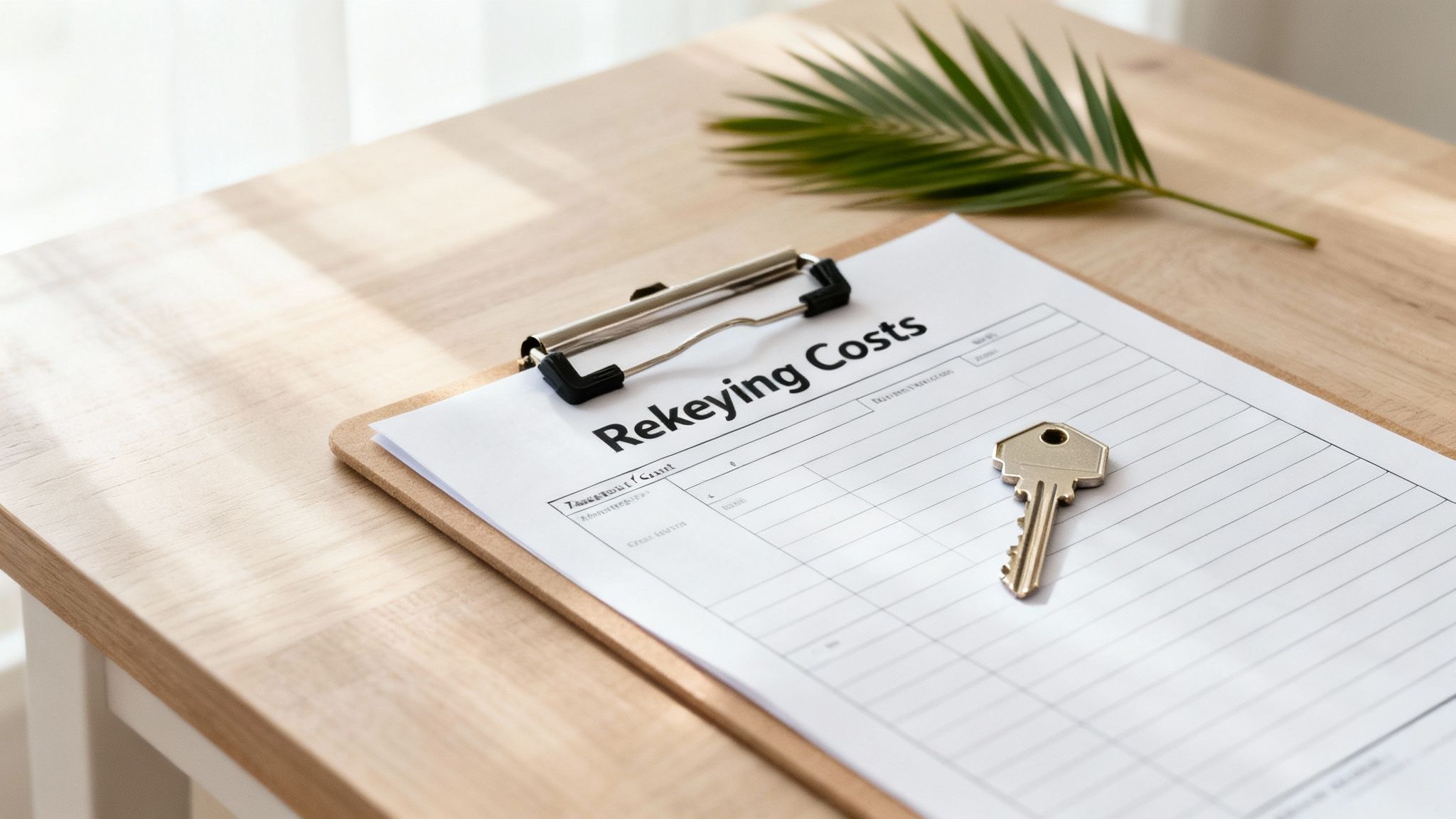
    Wondering how much it costs to rekey a house? It's a common and smart question for homeowners. The good news is, it's usually less than you might expect. Nationally, most people pay between $100 and $250 for the entire service, which covers the locksmith's visit and rekeying several locks. For residents here in Port St. Lucie, Fort Pierce, and surrounding communities, it’s an affordable and effective way to secure your home without the cost of a full lock replacement.

    Your Quick Guide to House Rekeying Costs

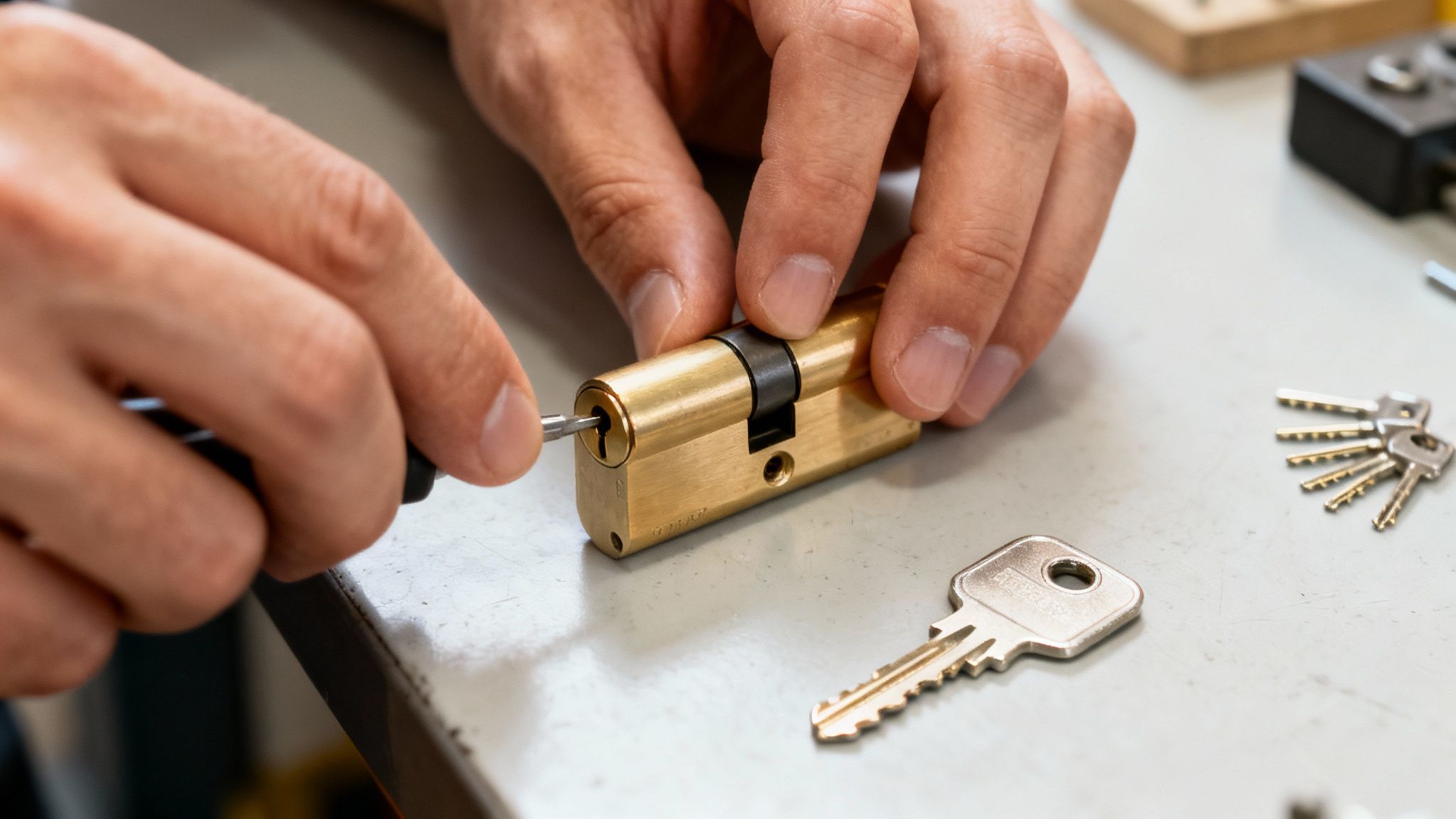
    Whether you've just moved into a new home in Vero Beach or are a landlord preparing for new tenants in a Jensen Beach rental, rekeying your locks should be a top priority. The process is simple: instead of replacing the entire lock mechanism, a professional locksmith carefully changes the small pins inside the lock cylinder. In just a few minutes, your old keys become useless, and you get a brand-new set that works perfectly. This straightforward service restores your peace of mind and control over who has access to your property.

    So, how is the final bill calculated? It typically comes down to two main charges: a service call fee and a per-lock cost. The service call fee covers the technician's travel, time, and the expertise needed to arrive at your door with all the right tools. From there, you pay a set fee for each lock cylinder they rekey. If you find yourself in a house lockout situation, don't panic. Call (772) 710-8169 for immediate help and we can get you back inside safely.

    Understanding The Numbers

    To budget effectively, it helps to look at national averages. The respected Locksmith Ledger National Average Price Survey indicates that a standard residential service call during business hours is around $85. After that, rekeying each lock cylinder typically adds $20 to $56 to the total, depending on the lock's brand and complexity.

    For a typical home on the Treasure Coast with 5 to 7 exterior doors, you’re likely looking at a total cost between $200 and $350. This is a general estimate, and you can find more details in various national cost guides.

    To make it even clearer, here’s a quick summary of what to expect.

    Estimated Rekeying Costs At a Glance

    This table breaks down the typical costs for a standard rekeying job to give you a quick reference.

    Service ComponentAverage National Cost Range
    Service Call Fee$50 – $100
    Rekeying Per Lock$15 – $40

    Remember, these are just estimates. The specific type and complexity of your locks can influence these numbers.

    The best way to know the exact cost for your home in Stuart or a neighboring community is to get a direct, local quote. For a fast, no-obligation price, just give us a call. Call (772) 710-8169 for immediate help and a transparent estimate.

    Understanding Your Locksmith Bill

    When you receive a bill for any service, you deserve to know exactly what you’re paying for. A professional locksmith invoice should be completely transparent, breaking down the costs so there are no surprises. Understanding these components helps you see the value in clear, upfront pricing and confidently answer the question, how much to rekey your house.

    The final cost is usually a sum of a few distinct parts. Think of it like a receipt from a restaurant—you have separate charges for appetizers, main courses, and drinks. A locksmith's invoice works similarly, separating the fee for getting to your location from the hands-on labor performed on each lock.

    Breaking Down the Charges

    Your bill will almost always start with a service call fee. This is a flat rate that covers the locksmith's travel expenses, fuel, and the cost of operating a mobile workshop stocked with all the necessary tools and parts. This fee ensures a qualified technician can arrive at your home in Port St. Lucie or Jensen Beach, fully prepared to solve your problem efficiently.

    Next, you'll see the per-lock labor cost. This is the price for the skilled work of rekeying each lock cylinder, which requires precision and expertise. You may notice slight price variations between lock types, as a high-security deadbolt can take more time than a standard doorknob lock.

    Finally, there might be additional fees for special circumstances. If you're locked out of your Stuart home late at night, you can expect an emergency or after-hours fee. This covers the premium for 24/7 availability, ensuring you can get help when you need it most.

    A Real-World Example in Port St. Lucie

    Let’s create a practical example. Imagine you just bought a new house in Port St. Lucie and want to rekey the locks for security. Your home has four deadbolts and two knob locks—six locks in total—and you schedule the service for a weekday afternoon.

    Here’s a sample breakdown of what a professional invoice might look like:

    • Service Call Fee: $75 (to cover travel to your location)
    • Rekeying Labor (4 Deadbolts @ $25/each): $100
    • Rekeying Labor (2 Knob Locks @ $20/each): $40
    • New Keys (2 included, 2 extra @ $5/each): $10
    • Total Cost: $225

    This type of itemized invoice is the mark of an honest, professional locksmith. It eliminates guesswork and hidden fees, so you understand exactly where your money is going. That transparency is crucial for building trust.

    At Pro-B Locksmith, we are committed to straightforward, honest pricing. Whether you need a simple rekey, a complex lock change, or even an ignition repair, we provide a clear quote before starting any work. For reliable service you can count on, call (772) 710-8169 for immediate help.

    What Really Drives the Final Cost to Rekey Your Home?

    When people ask, "how much does it cost to rekey a house," they're often surprised to learn there isn't one single answer. It’s a lot like asking how much it costs to fix a car—the final bill depends on the specific situation. Understanding these variables will help you interpret your quote and feel confident you're getting a fair price from a locksmith here in Port St. Lucie or Stuart.

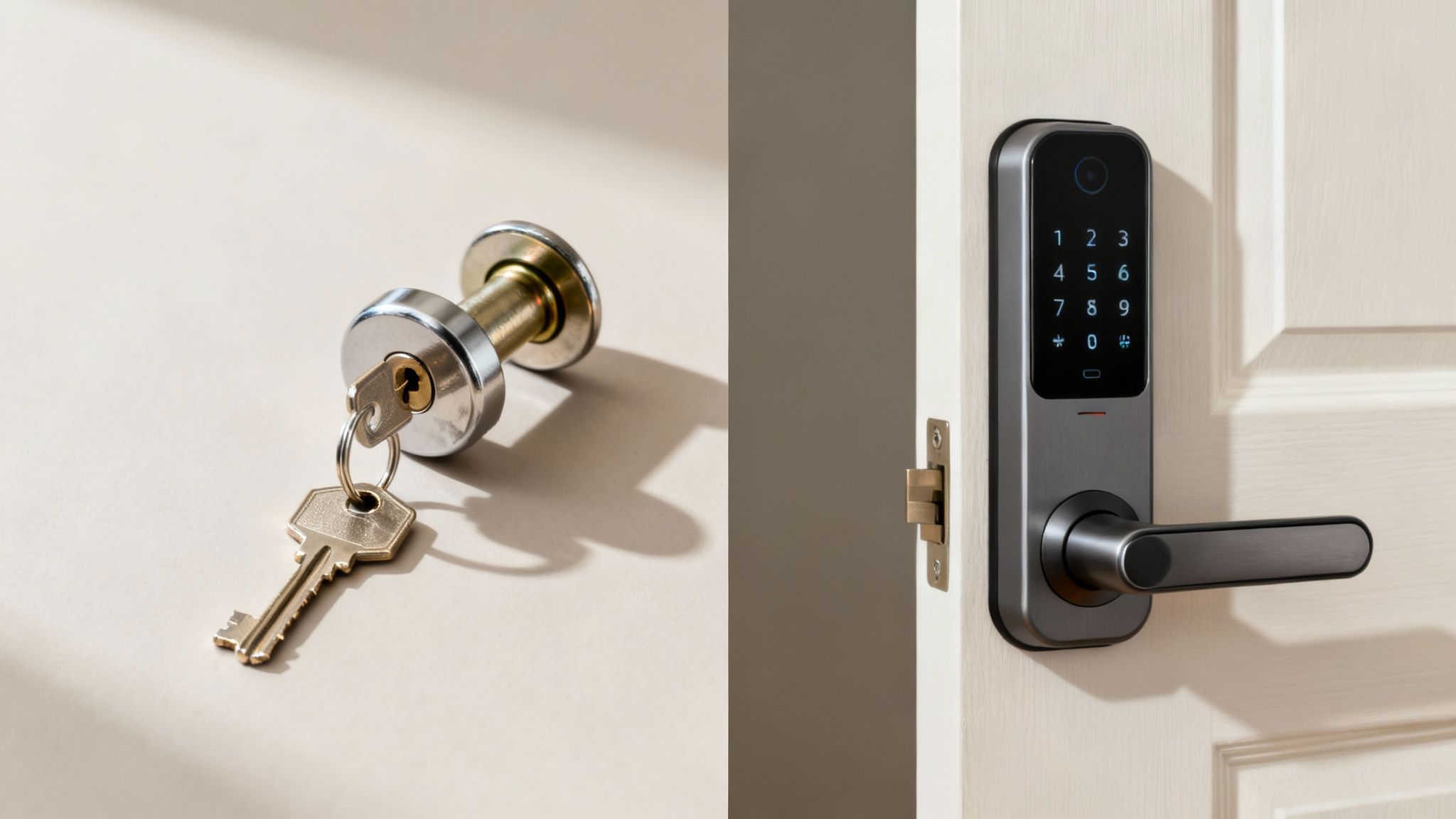
    The most significant factor is the type of locks on your doors. A standard Kwikset or Schlage lock is straightforward and quick for a professional to rekey. However, if you have high-security locks from brands like Medeco or Mul-T-Lock, the process is more complex. These locks require special tools and advanced expertise, which increases the labor cost per lock. The same applies to smart locks or electronic keypads with their intricate internal mechanisms.

    The Scope of the Job

    It might seem obvious, but the total number of locks you need rekeyed directly impacts the cost. Rekeying a small condo in Fort Pierce with only two locks will be significantly cheaper than securing a large family home in Vero Beach that has eight different lock cylinders. Each lock is a separate task, so more locks mean more time and a higher total.

    Beyond quantity, the complexity of the keying itself matters. Do you want the convenience of a single key that works for every lock in your house? Or do you need a more sophisticated master key system for a rental property in Jensen Beach? Setting up a system where a landlord's key opens all doors, but each tenant's key only opens their specific unit, requires careful planning and precision. That extra layer of customization adds to the final cost. And if you’re a property manager dealing with a house lockout, remember an emergency locksmith service is your fastest solution.

    Need help with a complex lock situation? Call us at (772) 710-8169 for immediate assistance.

    Timing and Urgency

    Finally, when you need the service can make a big difference. Scheduling an appointment during regular business hours is always the most budget-friendly option. However, if you lose your keys on a Friday night and need immediate assistance, you can expect to pay an after-hours or emergency service fee. This premium ensures a locksmith is available on-demand, providing help when you need it most.

    According to national data from Thumbtack, the typical fixed price for a rekey job falls between $191 and $225. Of course, that price can swing based on the very factors we just discussed, like how many locks you have and how complex they are. This is exactly why getting a custom quote from a local pro is the only way to know for sure. You can see how national prices vary to get a better sense of the ballpark.

    DIY Rekeying vs. Hiring a Professional

    When you're researching how much to rekey your house, picking up a DIY kit from a hardware store might seem like a clever way to save money. These kits typically cost between $15 and $30 and appear simple enough. The reality, however, is often much different.

    What begins as a simple project can quickly become a frustrating puzzle of tiny pins, springs, and unfamiliar tools. The job demands a steady hand and extreme precision. One small mistake—a pin in the wrong slot or a spring launched across the room—can permanently damage your lock. Suddenly, your attempt to save money has left your home less secure than when you started.

    The Hidden Dangers of a DIY Rekey

    Attempting a DIY rekey without proper training is filled with potential problems. We've assisted many homeowners in Stuart and Vero Beach who learned this the hard way, where a small mistake led to a larger, more expensive issue.

    • Permanent Lock Damage: The internal mechanism of a lock is delicate. Forcing a part or losing a critical spring can easily break the entire lock, forcing you to buy a new one.
    • Creating a Security Flaw: Incorrectly setting the pins can create a lock that multiple keys can open, or worse, one that's very easy to pick. You could unintentionally downgrade your own security.
    • Voiding Your Lock's Warranty: Most reputable lock manufacturers will void their warranty if the lock is tampered with or improperly serviced by an uncertified individual.
    • Wasting Time and Money: A project you thought would take an hour can easily consume an afternoon, only to end with a frustrated call to a locksmith anyway. Now you've paid for the kit and the professional service.

    So, when should you call a pro, and when is DIY a viable option? Here’s a quick comparison.

    DIY Rekey vs. Professional Locksmith

    FactorDIY Rekey KitProfessional Locksmith
    CostLow initial cost ($15-$30)Higher upfront cost
    Skill RequiredHigh. Requires patience and mechanical skill.None. The expert handles everything.
    SecurityRisky. Mistakes can compromise the lock.Guaranteed. Correctly done for maximum security.
    TimeCan be very time-consuming and frustrating.Fast and efficient, often done in under an hour.
    ToolsIncludes basic tools, but they can be flimsy.Professional-grade tools for precision work.
    WarrantyMay void the lock’s manufacturer warranty.Work is typically insured and guaranteed.

    Ultimately, the choice depends on your comfort level and expertise. But for something as critical as your home's security, the risks of a DIY mistake often outweigh the small initial savings.

    Why Professional Service is the Smarter Choice

    Peace of mind is the greatest benefit of hiring an expert. You receive guaranteed workmanship from a licensed and insured professional who has the right tools and years of experience to do the job quickly and correctly the first time.

    While a DIY kit might save a few dollars upfront, calling a professional mobile locksmith delivers far more value. A seasoned locksmith can identify underlying issues with your locks you might miss, ensure all your doors operate smoothly with one key, and complete the entire job in a fraction of the time. This expertise is what truly keeps your Port St. Lucie home secure.

    You can explore our full range of residential locksmith services to see how we help protect local homeowners. For a job done right without the DIY headache, call (772) 710-8169 for immediate help.

    When You Should Rekey or Replace Your Locks

    As a homeowner, you'll eventually face the rekey vs. replace dilemma. It's a common question, and knowing the difference can save you significant money and hassle. While rekeying is a fantastic, budget-friendly security measure, it isn't always the right solution. Let's break down which option makes the most sense for your home in Port St. Lucie.

    Think of it this way: rekeying is like changing the password for your front door. The lock hardware—the doorknob and deadbolt—remains in place. A locksmith simply reconfigures the internal pins so that old keys no longer work. It's the perfect solution when your locks are in good condition, but you don't know who might have a copy of the key.

    Scenarios Perfect for Rekeying

    Rekeying is your go-to, cost-effective solution in several common situations. It's all about giving your home’s security a fresh start without the expense of all-new hardware.

    • You Just Moved In: This is non-negotiable. You have no idea who the previous owners gave a key to—neighbors, contractors, pet sitters? Rekeying ensures you and your family are the only ones with access.
    • Lost or Stolen Keys: A missing key is a major security risk. Don't wait and worry. Rekeying immediately renders that lost key useless.
    • Tenant Turnover: For landlords in Stuart or Jensen Beach, rekeying is a fast, affordable, and essential step between tenants. It protects your property and provides security for your new renters.
    • After a Security Concern: Whether a roommate moved out on bad terms or you're simply worried someone has a key who shouldn't, rekeying provides instant peace of mind.

    When a Full Lock Replacement is Necessary

    Sometimes, the problem isn't the key—it's the lock itself. If the hardware is failing, rekeying won't fix the underlying issue. In these cases, a full lock change is the only way to ensure your home is truly secure. This involves removing the old lock mechanism entirely and installing a brand-new one.

    You should choose a full lock replacement if:

    • Your Locks are Damaged or Worn Out: Is the key difficult to turn? Does the lock feel loose, rusted, or stiff? Rekeying a broken lock is ineffective. A damaged lock is an insecure lock, and it needs to be replaced.
    • You Want a Security Upgrade: The basic builder-grade locks on most homes are not high-security. Upgrading to superior hardware—like pick-resistant or bump-proof deadbolts—is one of the smartest investments you can make in your home's safety.
    • You’re Remodeling or Changing Styles: If you're updating your home's aesthetic with new door handles or a different finish (like matte black or brushed nickel), it's the perfect time to install new locks that match your new style.

    Many homeowners are also using this opportunity to upgrade to the best smart door locks for keyless entry and enhanced convenience.

    The cost difference is significant. Rekeying a home is generally much more affordable than a full lock replacement, which requires you to pay for both the new hardware and the installation labor.

    Still not sure which path is right for you? Call (772) 710-8169 for immediate help. We can assess your locks and provide an honest, professional recommendation tailored to your needs.

    Why Choose a Local Port St. Lucie Locksmith

    When you’re locked out of your home, the last thing you want is a confusing automated phone system. A quick online search for a locksmith can be a minefield, mixing genuine local professionals with national call centers that simply dispatch jobs to subcontractors. Understanding this difference is crucial for getting fast, reliable, and fairly priced help here on the Treasure Coast.

    Think of national dispatchers as middlemen. They take your information and then try to find an available technician in your area. This often leads to long wait times, vague pricing, and a technician who may not be a dedicated expert. In contrast, a true local locksmith like Pro-B Locksmith is already part of your community. Our team lives and works here, serving Port St. Lucie, Fort Pierce, and Vero Beach every day.

    The Advantage of True Local Service

    When you choose a dedicated local company, you're more than just a job number. You're working with a business that values its local reputation and is accountable for every service call. It's a level of personal commitment that large, faceless corporations cannot match.

    • Rapid Response Times: Our mobile locksmith units are strategically positioned throughout St. Lucie County. This allows us to reach you in as little as 15-20 minutes. We’re not driving from two counties over; we're your neighbors.
    • Transparent, Upfront Pricing: We believe in honest work at a fair price. We will always provide a clear, upfront quote before any work begins, so you’ll never see surprise fees on your invoice.
    • Licensed and Insured Experts: Every technician on our team is a licensed, insured, and highly trained professional. You get the peace of mind that comes from knowing the job is done right the first time, whether it's a simple rekey, a complex ignition repair, or a key fob replacement.

    Why Proximity Matters in an Emergency

    Imagine this: it’s late at night, and you're dealing with a car lockout in a parking lot in Stuart. You need help now. This is where a local, 24/7 mobile service is essential. We are built for these urgent moments, providing immediate, professional assistance when you need it most.

    When you call a local locksmith, you’re speaking directly with the team that will be helping you. We value your safety and your time because you're our neighbor, not just another ticket in a system.

    Choosing local means you're supporting a small business while receiving faster, more personal, and more reliable service. To see our commitment to the community, check out our dedicated locksmith services in Port St. Lucie and learn how we keep our neighbors safe.

    For any lock and key emergency, day or night, Call (772) 710-8169 for immediate help.

    Your Rekeying Questions, Answered

    If you're considering rekeying your home, it's natural to have a few questions. Getting clear, practical answers is the first step toward making a confident security decision for your home in Port St. Lucie or anywhere on the Treasure Coast. Here are some of the most common questions we hear from local residents.

    How Long Does It Take to Rekey a House?

    For a professional, this is a quick and efficient job. For a standard house with about four to six locks, a skilled locksmith can typically complete the entire rekeying process in 30-60 minutes.

    The exact time can vary based on the number of locks and their complexity. As a mobile service, we arrive at your home in Fort Pierce or Vero Beach with all the necessary tools and equipment to complete the job on the spot, saving you time and hassle.

    Can All Locks Be Rekeyed?

    The vast majority of residential locks, especially from common brands like Kwikset and Schlage, can be rekeyed without any issues.

    However, there are exceptions. If a lock is extremely old, severely damaged, or from an obscure, low-quality brand, rekeying may not be possible or advisable. In these situations, a full lock change is the best way to guarantee your home's security. If you're unsure about your locks, we can assess them and provide an expert recommendation during our visit.

    A common concern is that rekeying might damage the lock, but this is a misconception. Professional rekeying does not harm your lock hardware. The process is precise and internal—we simply reconfigure the small pins inside the cylinder to match a new key. Your original lock remains perfectly intact and fully functional.

    What Happens to the Old Keys?

    Once the rekeying is complete, you will receive a brand-new set of keys. The entire purpose of rekeying is to render all previous keys completely useless.

    This provides total peace of mind, as you can be certain that any lost, stolen, or unreturned keys can no longer be used to access your home. Only you and the people you choose to give a new key to will have access.

    Have a question we didn't cover here? You can find more answers on our comprehensive locksmith FAQ page.

  • How Much Does It Cost to Program a Car Key on the Treasure Coast?

    How Much Does It Cost to Program a Car Key on the Treasure Coast?

    When you need a new car key programmed here on the Treasure Coast, you can expect the cost to run anywhere from $85 to over $450. The final price really comes down to what you drive—the make, model, and year of your vehicle—and the type of key it uses. A basic transponder key for an older car is going to be on the low end, while a new smart fob for a luxury SUV in Vero Beach will definitely be at the top of that range.

    Your Quick Guide to Car Key Programming Costs in Port St. Lucie

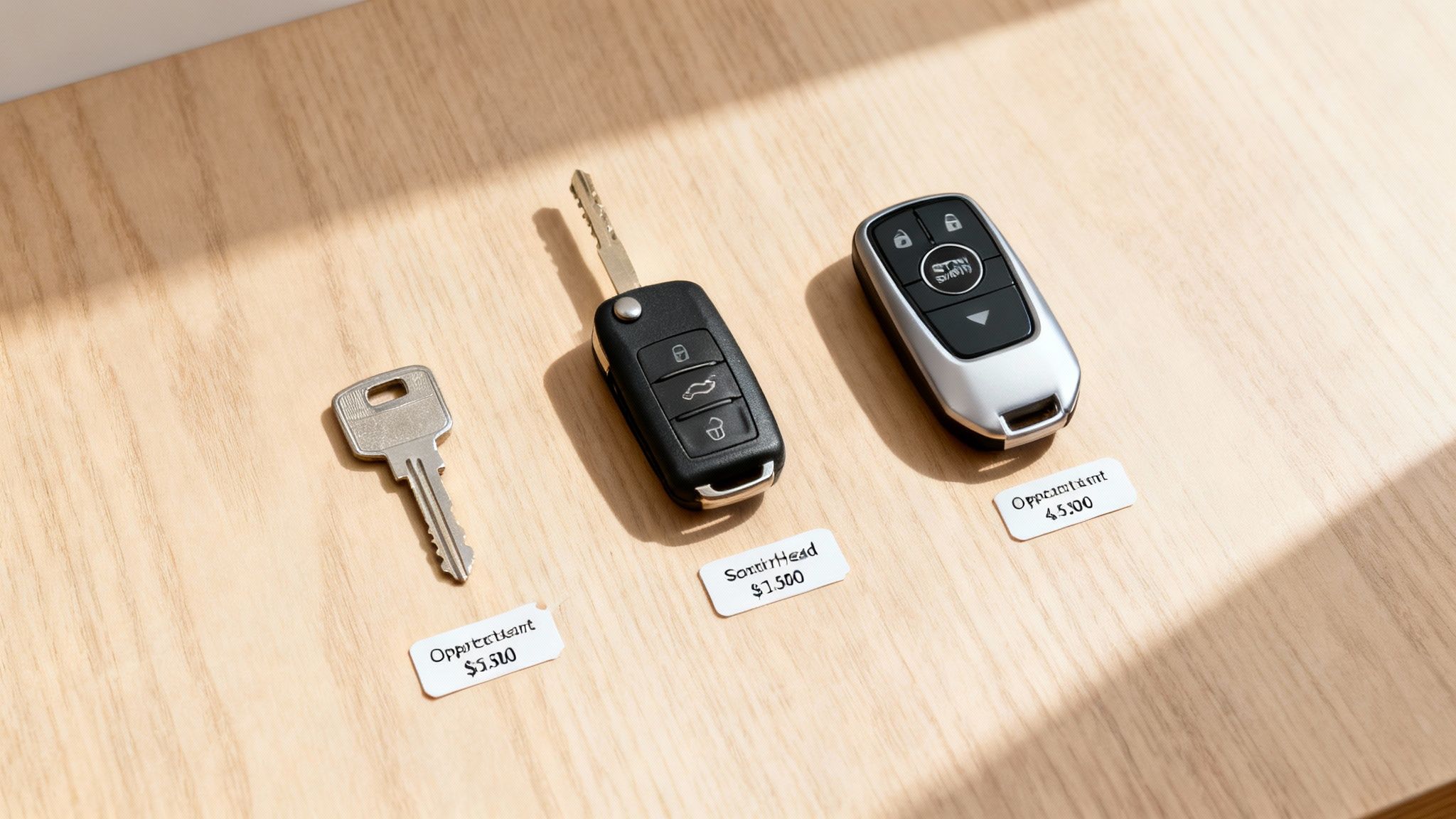
    Three car keys: a traditional, a flip remote, and a smart fob, with price tags, on wood.

    Losing a key or just trying to get a spare made can be a real pain, especially when you start seeing the prices. A lot of drivers in our local communities like Jensen Beach and Fort Pierce are shocked to find out that a modern car key is more than just a piece of metal. It’s a tiny computer that has to be electronically synced to your car to work.

    That syncing process, called programming, is where the cost comes from. A real-world example: programming a new key for a Ford Explorer in Stuart is a completely different job than for a Toyota Camry in Port St. Lucie due to their different security systems. If you're in a jam, call (772) 710-8169 for immediate help and a clear, upfront quote.

    Think of it this way: the more advanced your car’s security system, the more complex the programming. An older transponder key is a bit like pairing a simple Bluetooth speaker—pretty straightforward. But a modern smart key? That’s more like setting up a secure computer network. Each job requires completely different tools, software, and know-how.

    Locksmith vs Dealer Pricing on the Treasure Coast

    To give you a better idea of what to expect, let's look at the two main options you have: going to the dealership or calling a local mobile locksmith. As you'll see, the difference in both your wallet and your schedule can be huge.

    Dealerships almost always charge more. They have higher overhead and have to stick to the manufacturer's pricing, which inflates the cost. A mobile locksmith, on the other hand, is a more affordable and far more convenient option. We come right to you, whether you're in Port St. Lucie, Vero Beach, or Stuart, saving you the time and money it would take to get your car towed. This on-site service is a lifesaver, especially if you're stuck in a car lockout situation.

    Choosing a local, mobile locksmith doesn't just save you money; it saves you a massive amount of time. Instead of arranging for a tow truck and sitting in a dealership waiting room, you get an expert to fix the problem right in your driveway—often for up to 50% less than what the dealer would charge.

    Here's a quick comparison of what you can generally expect to pay for a new key that's been supplied, cut, and programmed.

    Estimated Car Key Programming Costs Locksmith vs Dealer

    Car Key TypeEstimated Locksmith Price (Pro-B Locksmith)Estimated Dealership Price
    Basic Transponder Key$85 – $150$200 – $350
    Remote Head Key / Flip Key$150 – $275$300 – $500
    Smart Key / Proximity Fob$225 – $450+$450 – $800+

    As you can see, the savings are significant across the board. The convenience of having a locksmith come directly to your location in places like Fort Pierce or Jensen Beach makes the choice even clearer for most people.

    Why Not All Car Keys Are Created Equal (Or Priced the Same)

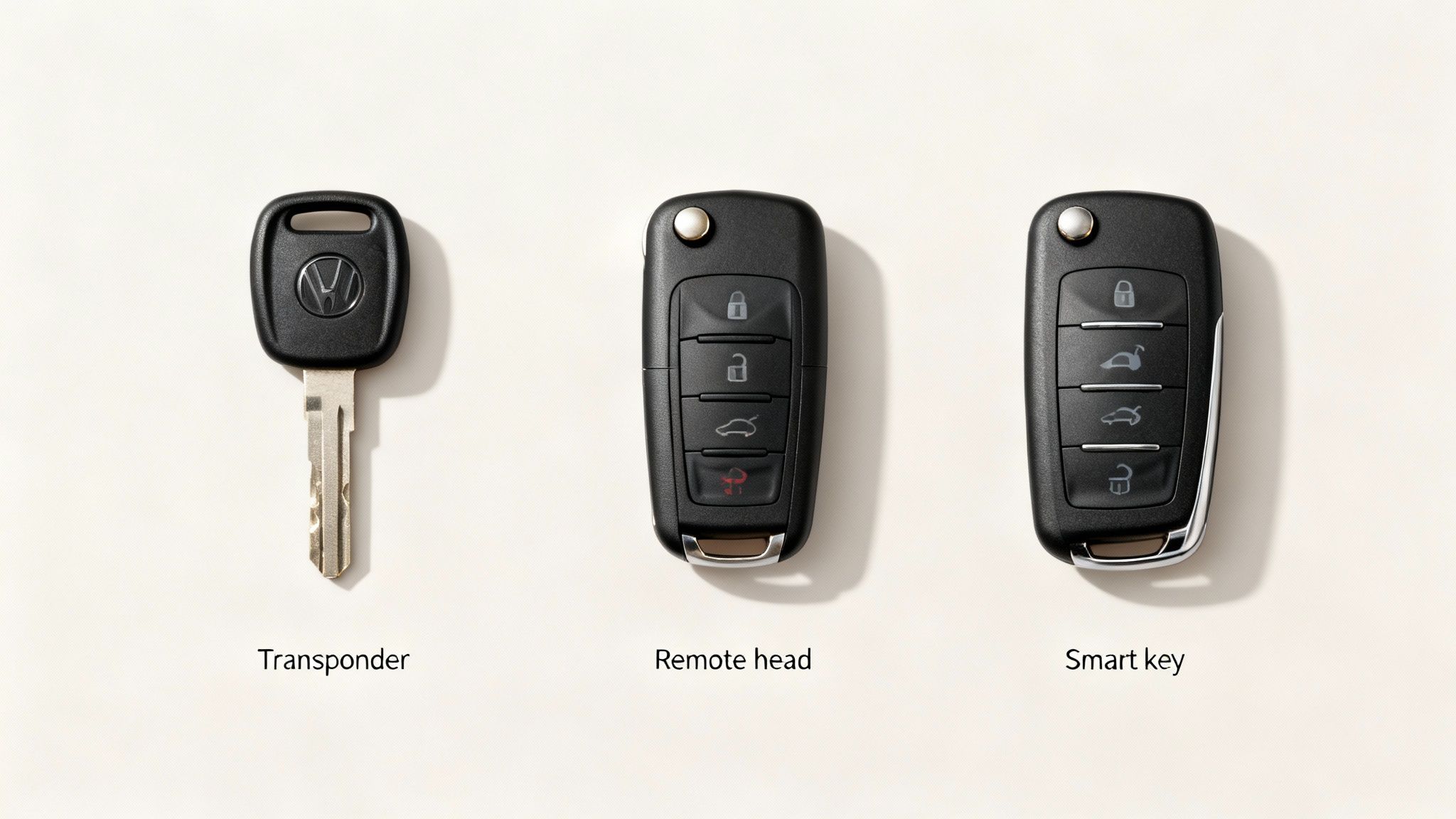
    Three black car keys displayed: a transponder, a remote head, and a smart key.

    The single biggest factor driving the cost of programming a car key is the technology hidden inside it. A simple key for a 2005 sedan in Fort Pierce has completely different guts than a smart fob for a new SUV in Vero Beach. Figuring out which type of key you have is the first step toward understanding the price.

    Here's a step-by-step way to identify your key:

    1. Basic Transponder Key: Does it look like a regular key but with a thick plastic head? That's likely a transponder.
    2. Remote Head/Flip Key: Is the key and remote all one piece, maybe flipping out like a switchblade? That's a remote head key.
    3. Smart Key/Fob: Does your car have a push-to-start button? Your "key" is a smart fob.

    The metal cut of a key is just the physical part of the equation—it lets you turn the lock. The programming is the digital handshake that gives your engine the "all clear" to start. Without that handshake, the car isn't going anywhere.

    The Basic Transponder Key

    Let's start with the simplest of the bunch: the transponder key. It might look like an old-school key, but there's a tiny microchip tucked into its plastic head. When you put it in the ignition, that chip sends a unique code to your car. If the codes match, you're good to go.

    Because the technology is pretty straightforward, programming these keys is the most affordable service we offer. They're incredibly common on vehicles you see driving all over Stuart and Jensen Beach.

    The All-in-One Remote Head Key

    A step up in complexity is the remote head key, which you might know as a switchblade or flip key. This handy device combines the transponder chip and the remote for locking and unlocking your doors into a single unit.

    Programming one of these is a two-step dance. We have to program the chip to start the car and sync the remote buttons to talk to the doors. That extra step adds a bit to the time and cost, making it a common type we see for key fob replacement.

    The Advanced Smart Key

    At the top of the tech ladder, you'll find smart keys. These are the proximity fobs for push-to-start vehicles that let you unlock the doors and fire up the engine without ever taking them out of your pocket or purse.

    As you can guess, these are the most complex and expensive to program. A smart key is basically a tiny, highly secure computer. Prices for these can vary quite a bit, typically ranging anywhere from $220 to $500. A big part of that price difference often comes down to the choice between OEM vs Aftermarket parts, which can significantly impact the final bill.

    For a precise quote on your specific smart key, the best bet is to give us a ring. Call (772) 710-8169 for immediate help.

    What Really Drives the Cost of Programming Your Car Key?

    Ever gotten a quote for a new car key and wondered why it costs what it does? It’s not just a random number. The price to program a key for a Honda Civic in Jensen Beach can be wildly different from a BMW X5 over in Vero Beach, and there are good reasons for that. Let's break down the main factors that go into your final bill so you know exactly what you’re paying for.

    Your vehicle’s make, model, and year are the biggest pieces of the puzzle. Luxury brands like BMW, Mercedes-Benz, and Audi, along with most newer cars, are packed with advanced security systems and sophisticated encryption. To program a key for one of these, a technician needs dealership-level diagnostic tools and the software licenses to go with them. That investment in technology is naturally reflected in the price. On the other hand, an older, more common domestic model will almost always be more affordable to work on.

    Do You Still Have a Working Key?

    This is a huge question that dramatically impacts the price. If you just need a spare key made, it's a relatively simple process. A technician can often "clone" the information from your working key or use it to easily add a new one into your car's computer. It's quick and straightforward.

    But an "all keys lost" situation? That's a completely different ballgame. When you have no keys at all, the locksmith has to start from square one. They need to gain access to your vehicle's security codes, generate a brand-new key from scratch, and program it so the car accepts it. Crucially, they also need to wipe the old, lost keys from the system—a critical security step so no one can find your old key and drive off with your car. This process takes more time, skill, and sometimes, specialized tools, especially if you also need an emergency ignition repair.

    When you've lost all your keys, the job goes from simple duplication to a full-blown security service. This is exactly why getting a spare key made before you lose your last one is one of the smartest and most cost-effective things you can do as a car owner.

    Other Factors That Shape the Price

    A couple of other things can move the needle on your final quote.

    • On-Site Convenience: A major advantage of calling a mobile locksmith is that we come right to you. Whether you're stuck at the Tradition shopping center in Port St. Lucie or in your own driveway in Stuart, this on-site service saves you from calling a tow truck. That tow alone could easily add $100 or more to your ordeal.
    • The Key Itself: The cost of the physical key or fob is also part of the equation. Some people try to save a few bucks by buying their own key blanks online, but that can be a real gamble. A lot of those aftermarket keys are low-quality or just plain incompatible. If a locksmith spends time trying to program a dud key you supplied, you've wasted both time and money. It's almost always safer to get the key directly from the locksmith who can guarantee it's the right one and that it will work.

    For instance, the costs for a newer vehicle like a 2017 Ford F-150 are a perfect example. The replacement fob itself might run $180, with another $190 for programming, plus a separate charge for cutting the mechanical blade inside. You can find more insights on how vehicle technology impacts these costs at remotesandkeys.com. If you find yourself in this spot, just call us at (772) 710-8169 for immediate help and a clear, upfront quote.

    Choosing the Right Service: Locksmith vs. Dealer vs. DIY

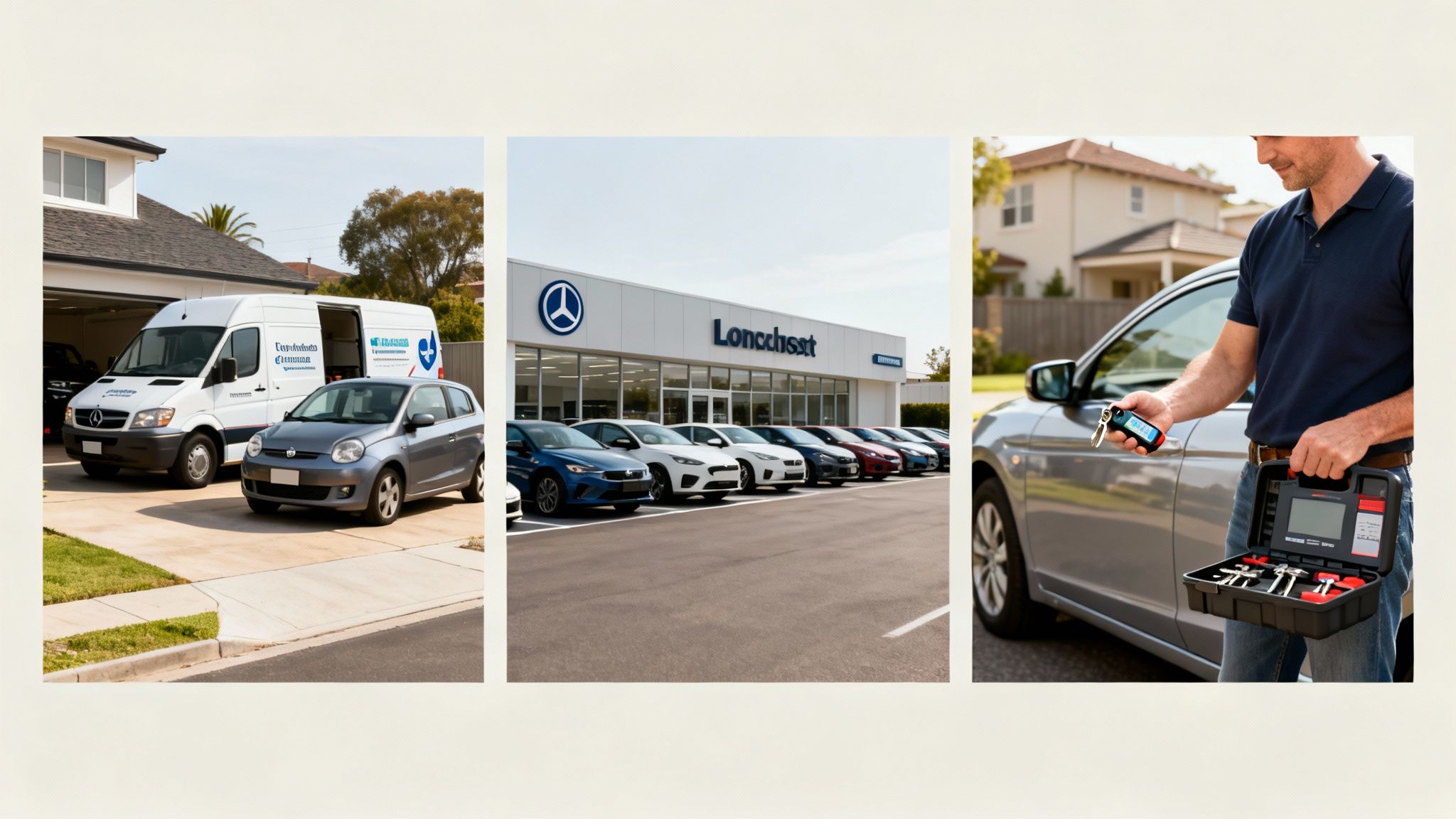
    Three images depict a mobile car service van, a car dealership, and a technician programming a car key fob.

    So, you need a new car key programmed. You've got three main roads you can go down, and your choice will have a big impact on your wallet, your time, and your overall stress level. Let's walk through the pros and cons of heading to the dealership, trying it yourself, or calling a mobile locksmith.

    Each path has its place, but for most drivers here in Port St. Lucie and across the Treasure Coast, one option consistently delivers the best combination of value and convenience. Knowing the real-world differences will help you make a smart call.

    The Dealership Experience

    For many, the first instinct is to go straight back to the car dealership. It makes sense on the surface—they have the original manufacturer equipment and specialized knowledge for your specific brand, which can feel like the safest bet.

    That feeling of security, however, comes with a hefty price tag. Dealerships are almost always the most expensive option, charging top dollar for both the key fob and the labor to program it. You also have the logistical headache of getting your vehicle to them. If you’ve lost every single key, that means calling a tow truck, which piles even more cost and hassle onto an already frustrating situation.

    The Risks of a DIY Attempt

    With a quick search online, you'll find a rabbit hole of videos and forum posts promising that programming a key yourself is a piece of cake. This can be tempting, and for some very old cars (we're talking pre-2000s), there might be a simple, on-board trick that works.

    But for any vehicle made in the last two decades, this is a huge gamble. Modern car electronics are incredibly complex. One tiny misstep in the programming sequence can scramble your vehicle's electronic control unit (ECU) or immobilizer system. What started as a plan to save a hundred bucks can instantly become a catastrophic repair bill topping $1,000.

    For modern cars, DIY key programming is like performing surgery with a kitchen knife—you might have a tool, but it's the wrong one for a delicate job. One wrong move can create a much bigger, more expensive problem than the one you started with.

    The Mobile Locksmith Advantage

    This is where a professional mobile locksmith really stands out, offering the ideal blend of expertise, convenience, and fair pricing. We bring dealership-grade diagnostic tools right to your location, whether you're stuck in your driveway in Stuart or stranded in a parking lot in Fort Pierce.

    That on-site service is a game-changer. It completely eliminates the need for a tow truck, saving you significant time and money right off the bat. Our technicians are well-versed in a huge variety of makes and models and can typically get the job done in under an hour. When you're dealing with a car lockout or need an urgent key fob replacement, there is simply no faster or more efficient way to get back on the road. Call (772) 710-8169 and we’ll come to you.

    Best of all, you get this premium service without the premium price. A locksmith's rates are far more competitive and can save you a bundle. For instance, programming a remote key for a 2016 Subaru Impreza at the dealership could run you $250-$300. A qualified locksmith can deliver the exact same result for 40-70% less. You can see more pricing comparisons on sites like remotesandkeys.com.

    To see everything we can handle, check out our guide on local automotive locksmith services.

    What to Expect During the Programming Process

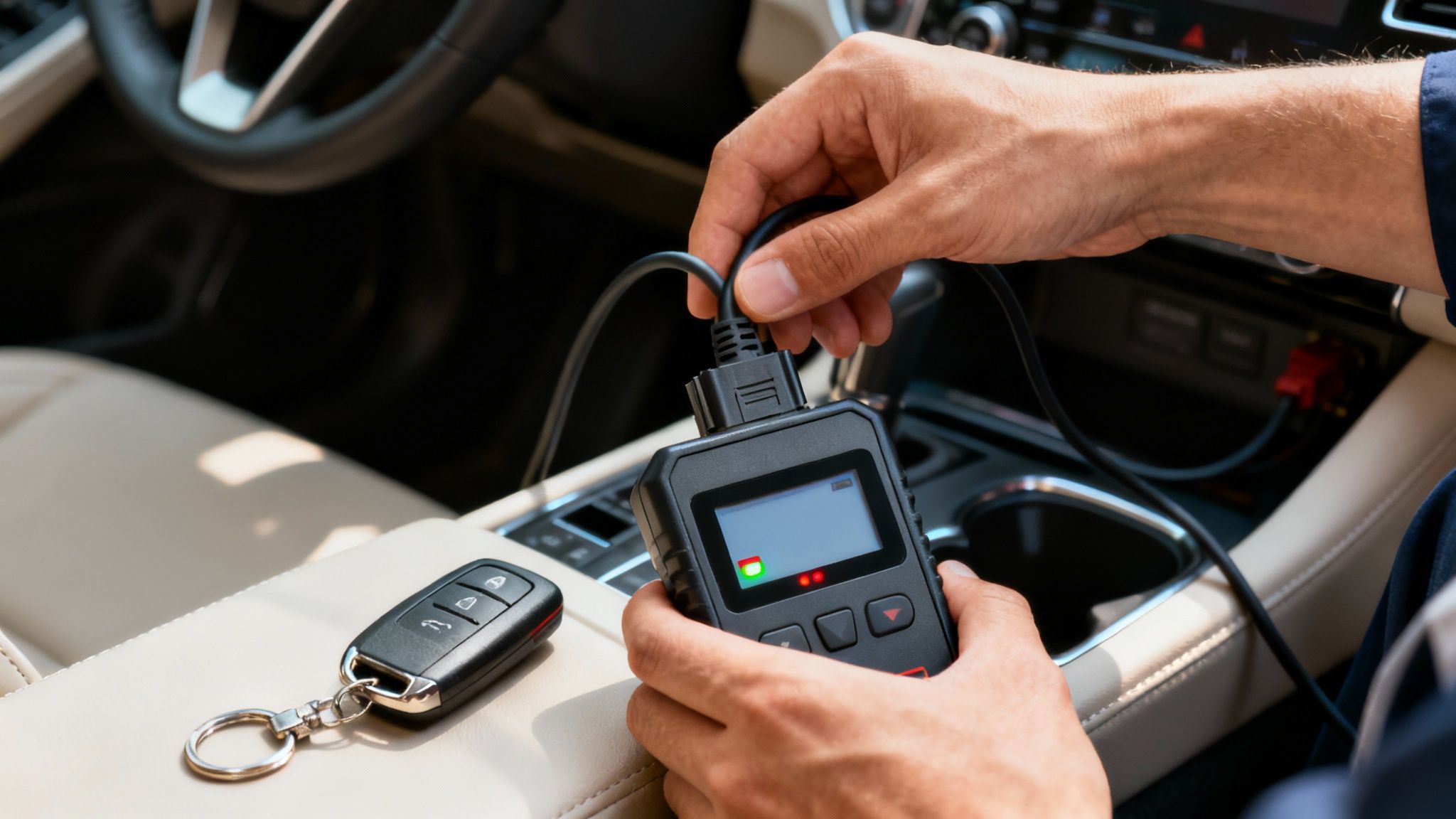
    Close-up of hands connecting a car diagnostic tool to a vehicle, with a remote car key nearby.

    So, what actually happens when a locksmith shows up to program your car key? It’s a lot more involved than just cutting a piece of metal. Understanding the steps involved helps clarify what goes into the cost you're quoted and why it requires a trained professional. Here is a practical, step-by-step explanation of the process.

    The Step-by-Step Programming Procedure

    While the specifics might change a bit from a Honda in Fort Pierce to a Ford in Vero Beach, the fundamental process is the same. Here’s a quick rundown of what our technicians do when they get to you.

    1. Verify Ownership: Before we touch anything, we have to confirm you own the car. This is a non-negotiable security measure. We'll need to see your driver's license and the vehicle's registration or title. It’s how we make sure we're helping the right person and not a potential thief.

    2. Cut the Key Blade: If your remote or fob includes a physical key, we'll cut it first. Our mobile vans are equipped with laser key cutting machines to create a perfect, factory-spec copy that will smoothly operate your doors and ignition.

    3. Connect to the Car's Brain: This is where the real magic happens. We plug a specialized diagnostic computer into your vehicle’s On-Board Diagnostics (OBD-II) port. You can usually find it just under the dashboard on the driver's side. This port is our direct line into the car's central computer system.

    4. Pair the New Key (and Erase the Old Ones): With the connection established, we access the car’s immobilizer system. We then register the new key's unique transponder signal with the vehicle. Crucially, we also wipe any old or lost keys from the car’s memory. This ensures that if someone finds your old key, they can't use it to drive away with your car.

    It's a lot like changing the password on your home Wi-Fi. You're not just adding a new device (your new key); you're also kicking off all the old, untrusted devices (your lost keys) to keep your network secure.

    This whole process shows how much locksmithing has evolved. It’s no longer just about metal and tumblers; it's a blend of mechanical skill and digital know-how, whether we're doing a simple key fob replacement, a lock change on your home, or a more involved ignition repair.

    Understanding the different locksmith services available helps you know who to call. If you find yourself in a bind, just call (772) 710-8169, and we'll get a certified technician out to you right away.

    Smart Ways to Save on Car Key Programming

    Let's face it, nobody wants to spend money on getting a car key programmed, but sometimes it's necessary. The good news is, a little planning can make a big difference to your wallet, especially if you're here on the Treasure Coast.

    Don't Wait Until It's an Emergency

    This is the single best practical tip we can offer: get a spare key made before you lose your only one. Creating a duplicate when you still have a working key is always simpler, faster, and much more affordable.

    When all keys are lost, the process becomes way more involved. We often have to start from square one, which means more labor and higher costs for you. A little foresight goes a long way.

    Should You Buy a Key Online?

    We get this question all the time in Port St. Lucie: "Can I buy a key on Amazon and just have you program it?" While it sounds like a good way to save a few bucks, it can be a real gamble.

    Many of those online keys are cheap knock-offs or simply the wrong model for your car's specific system. If that key fails to program—and many do—you're out the money for the key and you still have to pay for the locksmith's service call.

    Our Pro Tip: The most reliable and ultimately cost-effective route is to let your locksmith provide the key. We source high-quality, guaranteed-to-work keys, taking all the guesswork and risk off your plate.

    Skip the Dealership, Call a Mobile Locksmith

    If you want to see the biggest savings, your best bet is to avoid the dealership altogether. A local mobile locksmith like Pro-B Locksmith comes directly to you, whether you're at home in Stuart, at work in Jensen Beach, or stranded at the beach in Fort Pierce.

    Right off the bat, you're saving the $100+ you'd spend on a tow truck to get your car to the dealer.

    Our pricing is straightforward and almost always beats the dealership's inflated rates. Whether you're in a car lockout, need a new key fob replacement, or are dealing with a house lockout, calling a local expert is simply the smarter financial move.

    Ready to see the difference? Call us at (772) 710-8169 for a clear, upfront quote.

    Common Questions We Hear About Car Key Programming

    We get a lot of the same questions from folks here in Port St. Lucie, Vero Beach, and across the Treasure Coast. Getting straight answers can save you a lot of headache and help you know what to expect.

    Can I Just Program a New Car Key Myself?

    Honestly, for almost any car built in the last two decades, this isn't a DIY job. Modern cars have sophisticated immobilizer systems that require professional diagnostic tools to securely link a new key.

    Trying to bypass this system can easily scramble your car's computer, turning a simple key replacement into a very expensive electronic repair. While you might find online tutorials for older models, it’s always smarter—and safer—to call a professional automotive locksmith for a key fob replacement.

    How Long Does It Take to Program a New Key?

    The time can vary a bit depending on your car's make and model, but we can typically get the entire job done—cutting and programming—in about 20 to 45 minutes.

    Because we're a mobile service, we do it right on the spot, whether you're at home in Stuart or stuck in a parking lot in Jensen Beach. That’s a world of difference from a dealership, where you might have to drop your car off for half the day.

    The biggest advantage of a mobile locksmith is avoiding the tow truck. We come to you, saving you time, money, and the stress of arranging a tow, especially if you're in an emergency lockout.

    I Lost All My Keys. Do I Really Need to Get My Car Towed?

    Absolutely not! This is exactly why mobile locksmiths exist. Forget the hassle and expense of a tow truck.

    We come directly to you in our fully equipped van and can create a brand new key from scratch, right where your car is parked. It's the simplest solution for a stressful situation. For more answers to common questions, feel free to explore our full FAQ section on our website.

    If you're in the Fort Pierce area and have lost all your keys, just call (772) 710-8169 for fast, on-site service.


    When you need fast, reliable service you can trust, count on Pro-B Locksmith. For immediate assistance with any lock or key issue, visit us at https://problocksmith.com.

  • What to Do When Your Car Ignition Key Won’t Turn

    What to Do When Your Car Ignition Key Won’t Turn

    It’s a sinking feeling every driver on the Treasure Coast dreads: you slide into your car, put the key in the ignition, and… nothing. It just won’t turn. It’s a frustrating moment that can happen anywhere, from your own driveway in Port St. Lucie to a busy parking lot in Vero Beach.

    Before you assume the worst (and an expensive repair bill), take a breath. More often than not, the solution is surprisingly simple. A few quick checks can often get you back on the road in minutes. For immediate, on-site help that won’t damage your vehicle, Call (772) 710-8169 for immediate help.

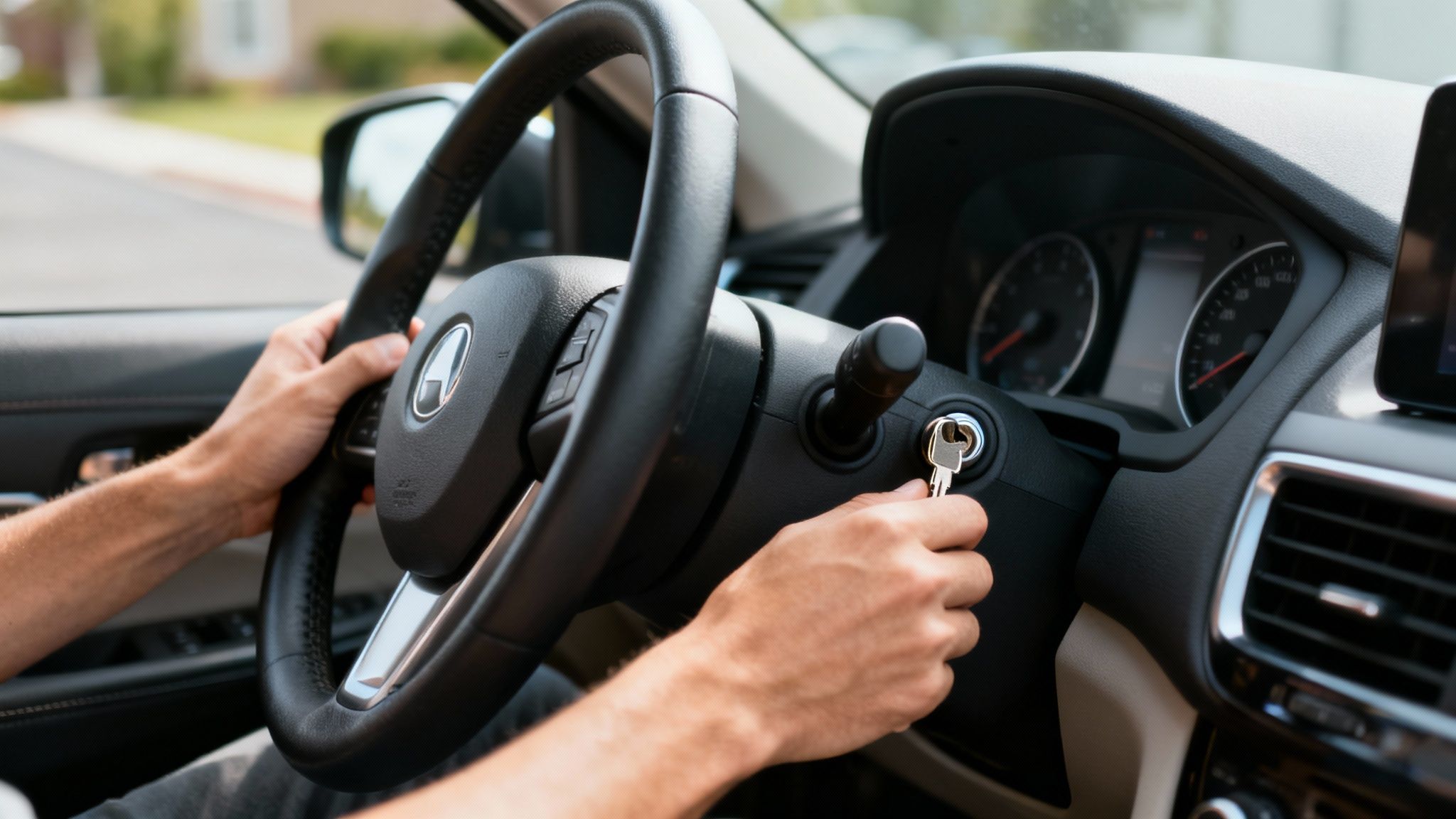
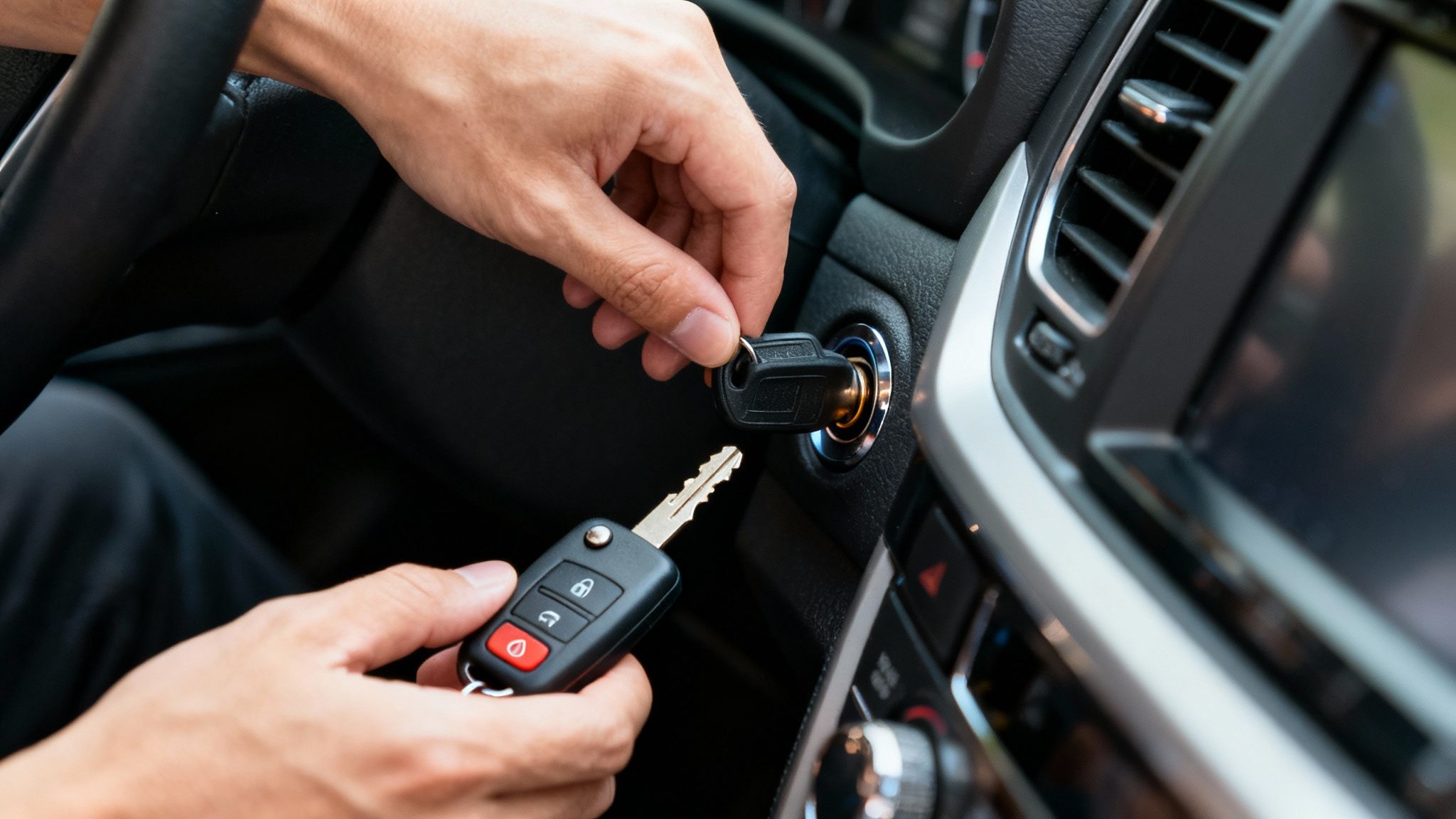
    Close-up of a person's hands turning a car key in the ignition, ready to start driving.

    Is Your Steering Wheel Locked?

    The number one culprit, by a long shot, is a locked steering wheel. It's a standard anti-theft feature that catches drivers off guard all the time in Stuart, Fort Pierce, and beyond. If you turned the wheel after shutting off the engine, a locking pin engages in the steering column, and that pin physically blocks the ignition from turning.

    So, how do you fix it? Don't force the key.

    Pro Tip: Gently wiggle the steering wheel back and forth. You don’t need to muscle it. While you're creating that slight movement, try turning the key at the same time. You should feel a distinct "click" as the lock releases. This simple trick is the most common solution.

    Double-Check Your Gear Shifter

    If the steering wheel trick doesn't work, look at your gear shifter. For safety, virtually all automatic vehicles are designed to start only when the transmission is in Park (P) or Neutral (N).

    • First, make sure the shifter is pushed all the way into Park. It might look like it's in position but could be caught just slightly out of alignment.
    • Try wiggling the gear lever a little or shifting it into Neutral and back to Park firmly. This often helps the neutral safety switch register the correct position.

    To help you figure out what's happening, we've put together a quick table matching symptoms to their likely causes. Think of it as a first-pass diagnosis you can do right from the driver's seat in Jensen Beach.

    Quick Diagnosis Checklist: What Your Car Is Telling You

    SymptomLikely CauseWhat to Try First
    Steering wheel is stiff and won't move.Steering Column LockWiggle the steering wheel back and forth while gently turning the key.
    Key turns slightly but won't go to 'ON'.Gear Selector MisalignmentConfirm the shifter is firmly in Park (P) or Neutral (N). Jiggle it.
    Key feels gritty or hard to insert.Debris or Worn Key/CylinderInspect the key and ignition for dirt. Try a spare key if you have one.
    All lights and electronics are dead.Dead BatteryThe ignition won't turn without power. Check for interior lights or try to jump-start.

    This checklist covers the most common issues we see, but it's not exhaustive. If you've run through these steps and are still stuck, the problem might be more than a simple jam.

    When your key stuck in ignition is caused by a deeper mechanical or electronic issue, trying to force it is the worst thing you can do. You risk snapping the key off in the lock, which instantly turns a frustrating problem into a much more complicated and costly one requiring professional ignition repair.

    If you’ve tried the basics and you’re stuck anywhere from Stuart to Fort Pierce, it's time to call in a professional. For immediate, on-site help that won’t damage your vehicle, call (772) 710-8169 for immediate help. Our mobile locksmiths are equipped to handle everything from ignition repair to cutting and programming a new key right on the spot.

    Common Reasons an Ignition Key Gets Stuck

    So, you’ve tried jiggling the steering wheel and made sure the car is in Park, but the key still won't budge. When the simple fixes don't work, it’s time to dig a little deeper. A key that refuses to turn is usually a symptom of a mechanical or electronic problem. Here on the Treasure Coast, from Stuart up to Vero Beach, we tend to see the same few culprits causing this headache time and time again.

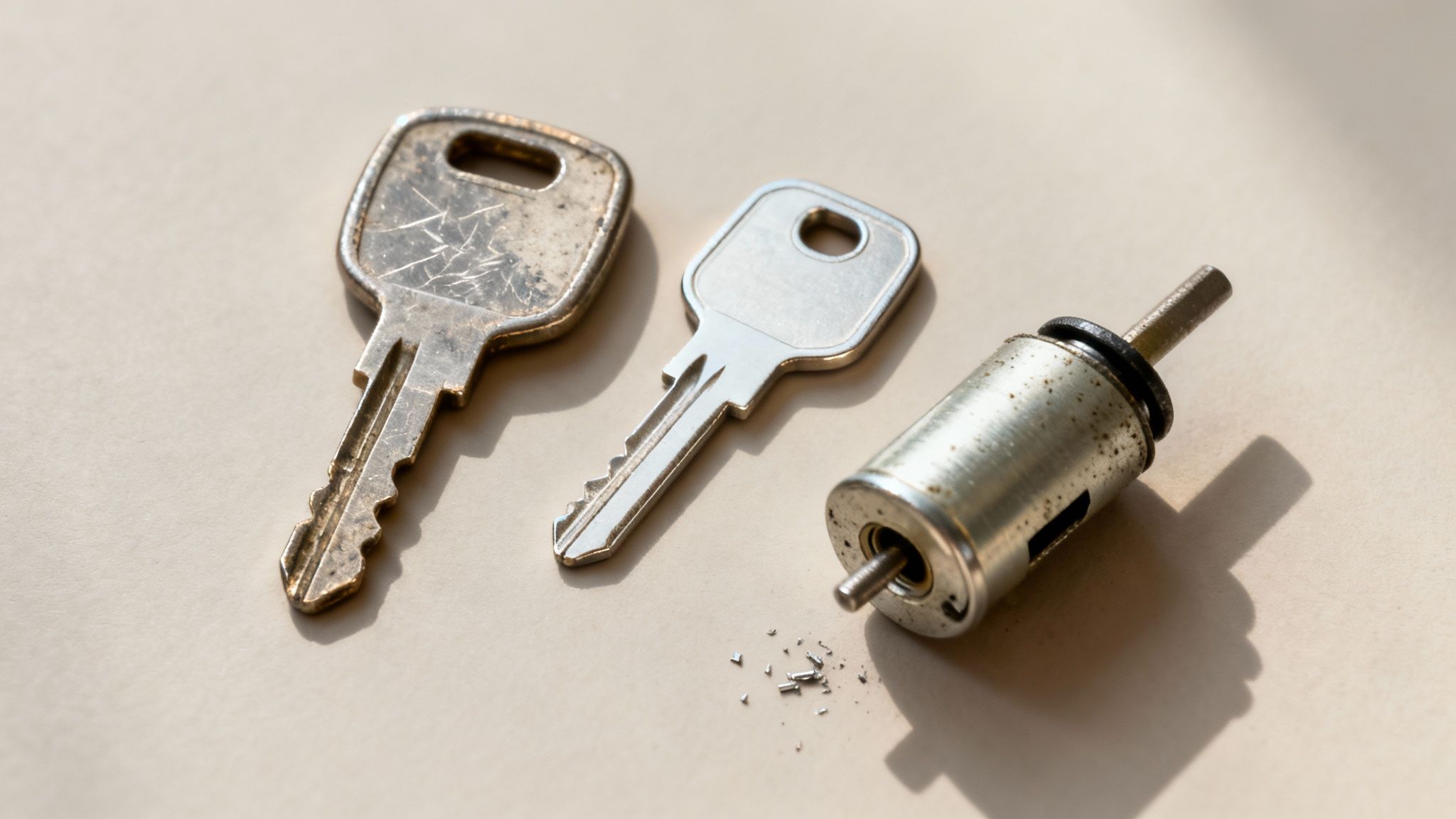
    Close-up of two metal keys and a damaged car ignition lock cylinder with metal debris.

    More often than not, the issue comes down to the two parts you use every single day: the key itself and the ignition cylinder it slides into. These components see a ton of action, and eventually, wear and tear will catch up with them.

    A Worn or Damaged Car Key

    Your car key might look fine, but after years of use, the precisely cut edges and grooves can wear down. Think of your key and ignition like a tiny, intricate puzzle. The small metal pins, called wafers, inside the lock cylinder need to be lifted to an exact height for everything to line up and turn.

    If your key is even slightly worn, it won't be able to align those wafers correctly anymore. This is a very common problem with older, all-metal keys that have been battling the Port St. Lucie sun and salt air for years. You probably noticed it getting a little tricky to turn over time before it finally gave up completely.

    Problems Inside the Ignition Cylinder

    Sometimes the key is fine, but the problem is lurking inside the ignition cylinder itself. This is a complex little mechanical device, and the humid climate we get in places like Fort Pierce and Jensen Beach can speed up corrosion and wear on its delicate internal parts.

    A few things can go wrong in there:

    • Bent or Stuck Wafers: These are the little metal plates that your key moves. If even one gets bent, jammed, or stuck, the whole cylinder is locked up. This can happen from trying to force a stubborn key or simply from old age.
    • Debris or Obstructions: You would be shocked at how much lint, sand, and other gunk can make its way into an ignition. This debris can physically block the key from going in all the way or jam the wafers.
    • General Mechanical Wear: Like any moving part on your car, the ignition cylinder just wears out. After being turned on and off thousands of times, the internal components can get sloppy, loose, or even break, leading to total failure.

    Your key and ignition cylinder are a matched set. When one starts to wear out, it puts extra stress on the other, making it wear out faster too. That's why a brand-new key sometimes won't work in a very old, worn-out ignition lock.

    If you think the problem is inside the cylinder, stop trying to force it. You could easily break a wafer, which turns a potential repair into a guaranteed replacement. Just call (772) 710-8169 for immediate help, and one of our technicians can come to you in Stuart or Vero Beach to diagnose what’s wrong without causing any more damage.

    Electronic Security System Failures

    For most cars built in the last 20 years, the issue might not be mechanical at all. Modern vehicles have sophisticated anti-theft systems that depend on clear communication between your key fob and the car’s computer.

    A common example involves the transponder chip hidden inside your key. This tiny chip broadcasts a unique security code to a receiver coil around the ignition. If the car doesn't recognize that code, its immobilizer kicks in and locks the ignition to prevent theft.

    This communication can fail for a few reasons:

    • The battery in your key fob is dead.
    • The transponder chip itself is damaged (dropping your keys is a common cause).
    • There's a glitch with the car’s receiver or main computer.

    Trying your spare key is the best first step here. If the spare works perfectly, you know the problem is with your primary key fob. Pro-B Locksmith specializes in on-site key fob replacement and programming, so we can create and sync a new, fully functional key for you right where you're parked.

    DIY vs. Professional: When to Make the Call

    So, you’re stuck in a Port St. Lucie parking lot with an ignition key that refuses to turn. The first thought that crosses most people’s minds is to just use a little more muscle. It’s a natural reaction, but it’s one of the worst things you can do. Forcing a stuck key can instantly turn a small annoyance into a massive, expensive headache. Knowing where to draw the line between a quick DIY fix and calling in a professional is key.

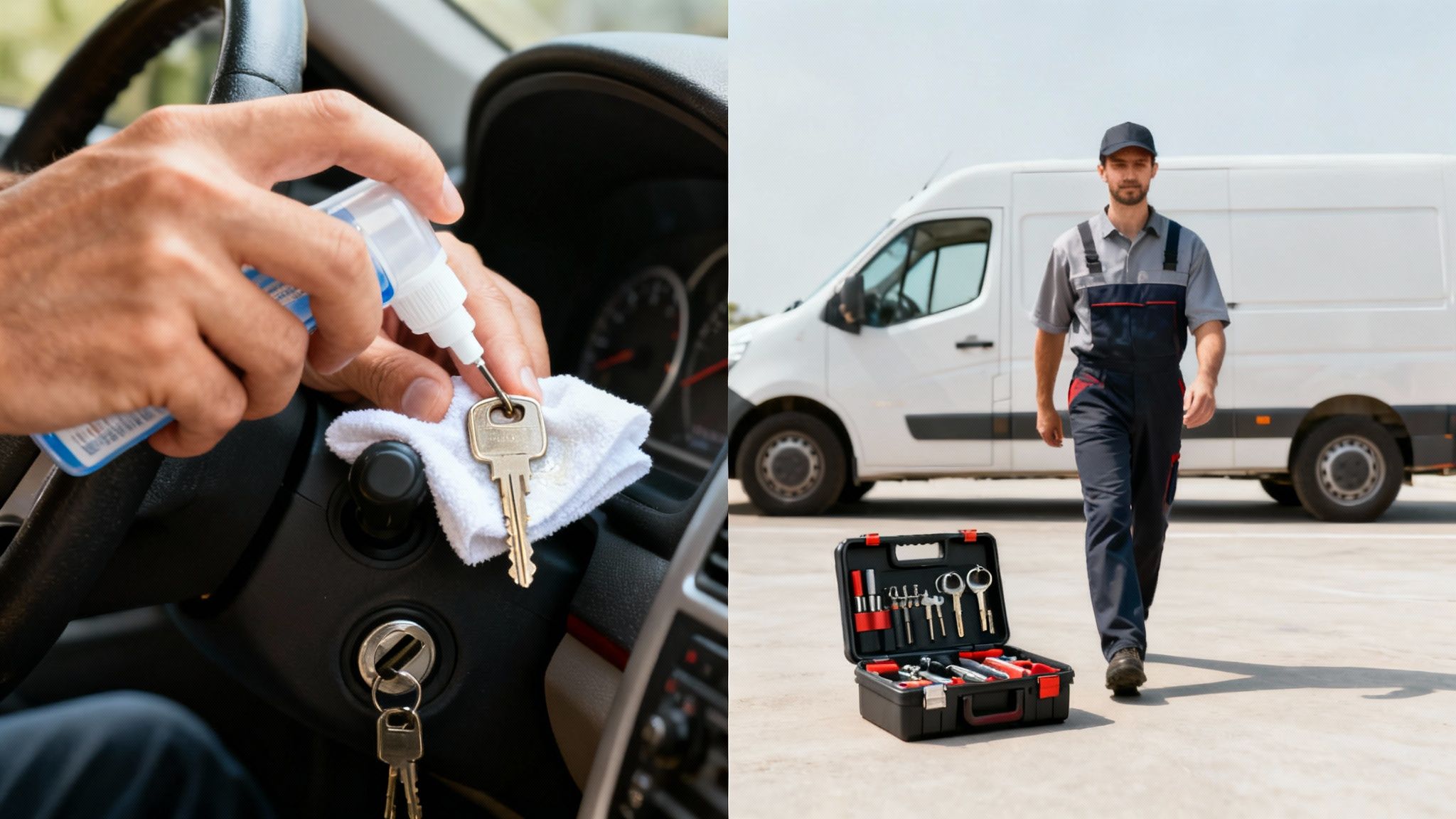
    A person lubricates a car key near an ignition, alongside a locksmith with tools and a service van.

    Before you reach for the phone, there are a couple of gentle things you can try. If you think a bit of grime might be the issue, a short burst of compressed air aimed into the keyhole can often clear out lint or debris. Another option is a tiny squirt of electronics cleaner or graphite lubricant. The keyword here is tiny—too much liquid will just attract more dirt and make the problem worse.

    Knowing When to Walk Away

    The most valuable tool in any DIYer's kit is knowing when to stop. If you find yourself reaching for a hammer to tap the key or thinking about prying things open, that's your sign to put the tools down. Modern car ignitions are complex systems tied directly into your vehicle's anti-theft immobilizer and computer.

    Trying to force it can cause a host of new, expensive problems:

    • A Snapped Key: This is the classic result of too much force. Now you don't just have a stuck ignition; you have a broken piece of metal lodged inside that requires careful extraction.
    • A Damaged Ignition Cylinder: Those tiny internal wafers are delicate. Bending or breaking them means you're looking at a full ignition repair or a complete replacement.
    • A Bricked Immobilizer: Your car's computer might interpret aggressive tampering as a theft attempt and shut everything down. Even if you fix the mechanical part, the car still won't start.

    Think of it this way: a key that feels gritty when you turn it might just need a cleaning. But a key that stops dead in the exact same spot every single time is telling you something is mechanically wrong inside. Forcing it is like trying to jam a puzzle piece where it doesn’t belong—you’ll just end up breaking the puzzle.

    When your gentle attempts don’t work, it’s time to make the smart choice. If you suspect a dead battery is the real culprit and you're not comfortable dealing with power-related issues, it might be time to look into a professional battery replacement.

    DIY vs Professional Locksmith: Which is the Right Call?

    It's tempting to save a few bucks, but sometimes a DIY attempt can cost you more in the long run. Here’s a quick breakdown to help you decide.

    Ignition ProblemDIY Risk LevelPro-B Locksmith Solution
    Steering Wheel LockLowQuick, damage-free release of the lock mechanism.
    Debris in KeywayLow to MediumProfessional cleaning without damaging internal components.
    Worn-Out KeyMedium to HighOn-site precision key cutting and programming.
    Damaged Ignition WafersHighIgnition cylinder repair or replacement without damaging the housing.
    Immobilizer/Fob FailureVery HighAdvanced diagnostic tools to sync key and vehicle, avoiding a dealer tow.

    At the end of the day, a professional locksmith has the right tools and experience to diagnose the problem correctly the first time, preventing you from accidentally causing more damage.

    The Smarter, Safer Option

    When you’re stuck in Jensen Beach or anywhere else on the Treasure Coast, calling a mobile locksmith like Pro-B Locksmith is easily the most efficient and cost-effective move. Forget calling a tow truck and waiting around for dealership hours. We come right to you. Our vans are stocked with the specialized equipment needed to figure out exactly what’s wrong, whether it's a worn key, a faulty cylinder, or a transponder chip that’s not communicating.

    Our technicians are trained to perform diagnostics and repairs right on the spot, without causing any damage. We understand how stressful an emergency like a car lockout or house lockout can be, and our team is built to handle these situations quickly and professionally.

    Ultimately, a quick phone call can save you from turning a simple fix into an expensive, multi-day nightmare. For a fast, accurate diagnosis and a damage-free solution, call us at (772) 710-8169 for immediate help.

    Why a Local Treasure Coast Locksmith is Your Best Bet

    When you’re stranded with a key that won’t turn in the ignition somewhere in Vero Beach or Port St. Lucie, your first thought might be to call the dealership. Hold that thought. There's a faster, more convenient, and often more affordable option: a true local, mobile locksmith. It's a game-changer.

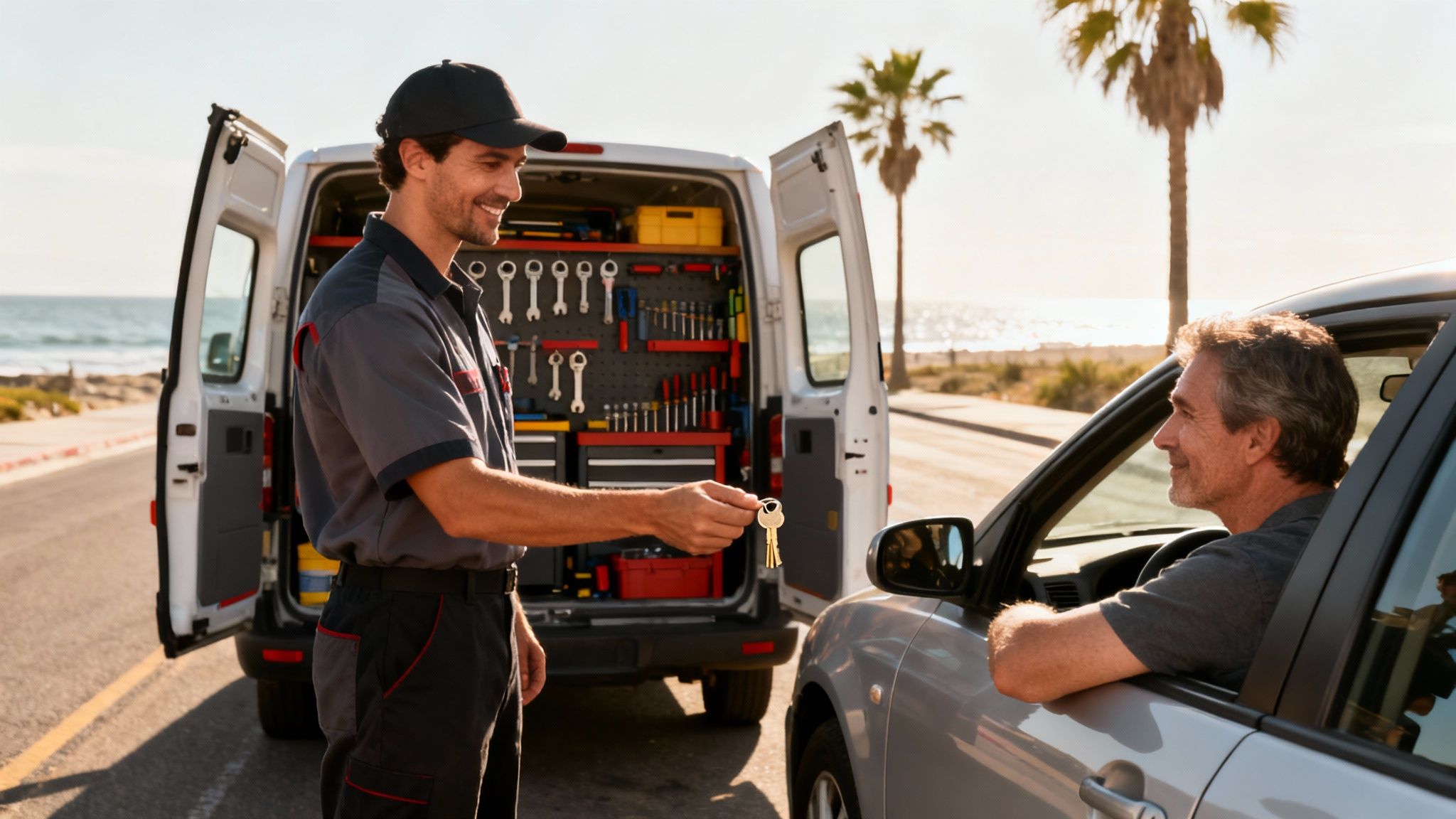
    A smiling mechanic hands car keys to a happy driver next to a service van by the ocean.

    Unlike national dispatch services that are just middlemen, Pro-B Locksmith sends our own certified technician straight to you. No subcontractors, no runaround. Our team lives and works right here on the Treasure Coast. That means when you call from Fort Pierce or Jensen Beach, we're not dispatching from a call center hundreds of miles away—we're already in your neighborhood.

    We Bring the Solution to You

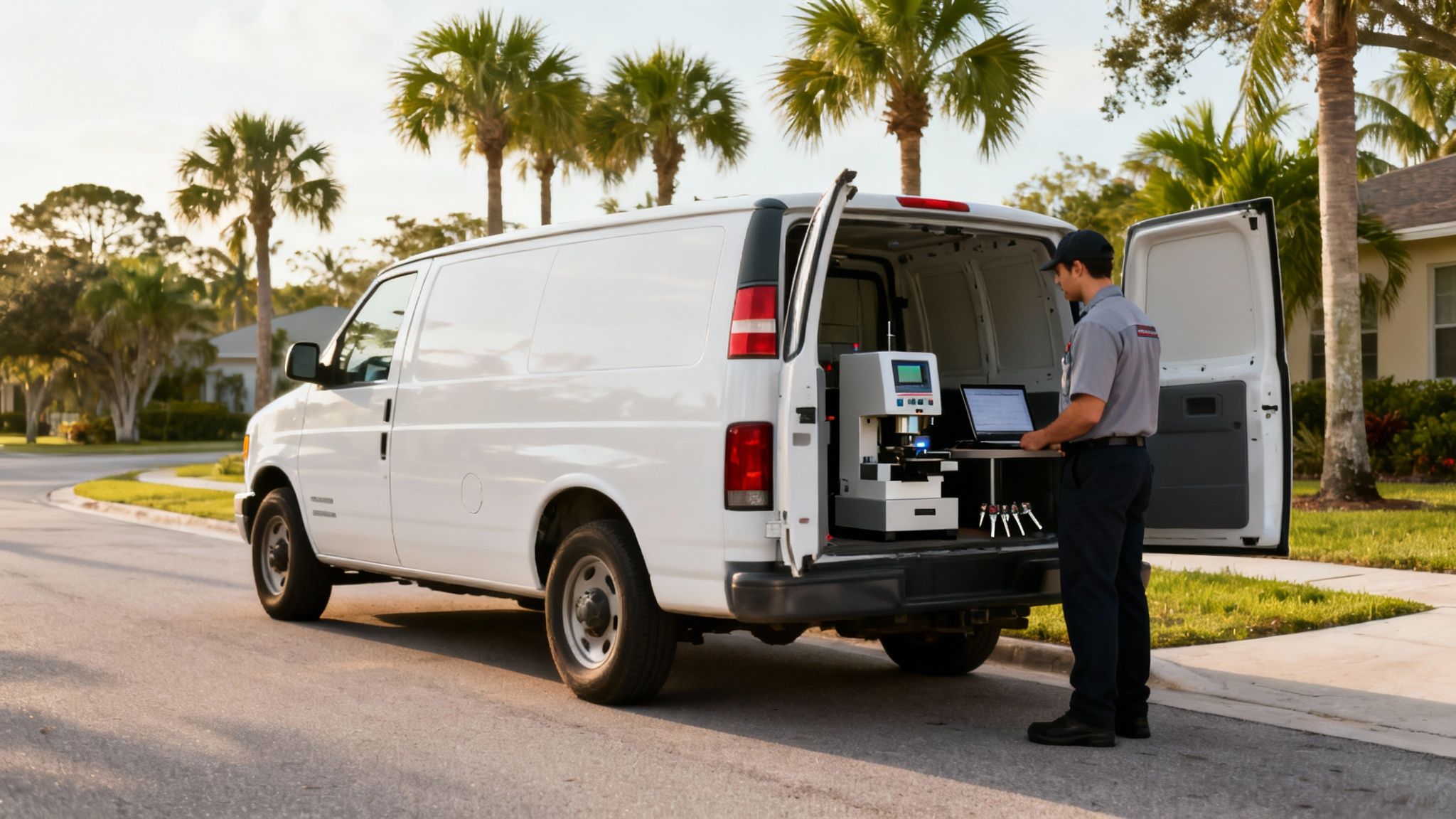
    The real magic is in our mobile workshop. Every Pro-B Locksmith van is a fully-equipped service center on wheels, stocked with the same advanced diagnostic tools and key-cutting machines you’d find at a dealership. We solve the problem right where you are, saving you the hassle and cost of a tow truck.

    Here's a look at what we can handle on the spot:

    • Ignition Repair and Replacement: We’ll figure out if your ignition cylinder just needs a simple repair or a full replacement and get it done right then and there.
    • New Keys and Fobs: Lost your key or have a dead fob? We can cut and program new transponder keys and smart fobs for almost any vehicle.
    • Advanced Diagnostics: We plug directly into your car's computer to see if the problem is mechanical (the lock) or electronic (the anti-theft system), ensuring we fix the right thing the first time.

    Think about the time this saves. A trip to the dealer can easily burn a whole day. Our goal is to get you back on the road in a fraction of that time. It's this commitment to fast, effective service that has made us the go-to for locksmith needs in Fort Pierce and across the region.

    When you choose a local locksmith, you're not just another job ticket in a national system. You're our neighbor. We get to you fast because we know the backroads, we know the communities, and we know how frustrating it is to be stuck under the Florida sun.

    Expertise That Comes to You

    Facing a car issue in Stuart is stressful enough without adding financial surprises. Dealerships have high overhead costs baked into their prices, and those national call centers can hit you with unexpected fees. With us, you get transparent, upfront pricing. You’ll know the cost before we even touch your car.

    Most people are shocked by how quickly we can get to them and solve the problem. While every call is different, we can often be on-site within 15–20 minutes on average. That’s a level of speed and personal service that’s tough to beat.

    Don't let a stubborn key derail your day. For fast, reliable service anywhere on the Treasure Coast for issues like a car lockout, ignition problems, or a lost key fob, give us a call at (772) 710-8169 for immediate help.

    How to Prevent Future Ignition Problems

    Let's be honest, the best way to deal with a key that won't turn is to never have it happen in the first place. A little bit of prevention goes a surprisingly long way in avoiding that sinking feeling when you're stuck in a parking lot somewhere in Port St. Lucie or Jensen Beach.

    Believe it or not, most drivers don’t even realize the stress they’re putting on their ignition system day in and day out.

    The Heavy Keychain Curse

    The single biggest—and easiest—fix is to address the giant, overloaded keychain. It might seem handy to have every key you own dangling from your ignition, but all that weight is constantly yanking on the cylinder as you drive. This dramatically speeds up wear and tear on the delicate moving parts inside.

    Think about it. Every pothole and bump on the roads around Fort Pierce makes that heavy bundle of keys swing and pull, slowly grinding down the lock’s internal components. The best thing you can do for your car is to slim down to just your car key, your fob, and maybe one house key. Seriously, this one change can add years to the life of your ignition.

    Beyond ditching the janitor-style keychain, a few other simple habits can help you steer clear of a future "key won't turn" emergency.

    • Keep Your Key Clean: Keys pick up an amazing amount of lint, dirt, and gunk from pockets and bags. Every now and then, just wipe it down with a clean, dry cloth. This stops you from pushing that debris straight into the ignition where it can cause the pins to jam.
    • Check for Wear: Take a good look at your car key. Are the sharp edges getting rounded off? Do you see any hairline cracks or a slight bend? These are the first signs the key is wearing out and might fail you when you least expect it.
    • Never, Ever Force It: If you feel resistance when you put the key in, just stop. Trying to force it is the fastest way to bend or break something inside the cylinder, turning a small problem into a much bigger, more expensive one.

    A healthy key and ignition should feel smooth every single time. If you start to notice it sticking, catching, or feeling gritty, that’s your car telling you it’s time to get it looked at by a pro—before you get stranded.

    Why a Professional Spare Key Matters

    Having a spare key is a no-brainer, but where you get it from is just as important. A cheap copy from a big-box hardware store often isn't cut to the precise factory specifications your car needs. Using a poorly cut key is like using the wrong tool for the job—it might seem to work for a while, but it's slowly causing damage.

    For a perfect copy that won’t harm your ignition, always go to a professional locksmith. We have the right equipment to cut and program keys that are an exact match to the manufacturer's standards, ensuring our lock change and key creation services are top-notch.

    If you’re worried about the health of your ignition or just need a reliable spare made the right way, call Pro-B Locksmith at (772) 710-8169. We'll get you sorted out right here on the Treasure Coast.

    Answering Your Ignition Questions

    We get a lot of calls from drivers around Port St. Lucie when their car key suddenly stops working. Here are some of the most common questions we hear, along with some straight answers from our years of experience. Hopefully, this clears a few things up and helps you figure out your next move.

    Can a Worn Out Key Really Stop the Ignition?

    Yes, absolutely. Think of your key and ignition as two halves of a very precise puzzle. Every time you use your key, the metal-on-metal contact ever-so-slightly wears down those sharp edges and grooves. Eventually, the key gets so rounded off that it can't lift the tiny pins inside the ignition cylinder to the exact right height anymore.

    When that happens, the lock simply won't turn. It's a dead stop. This is one of the most frequent problems we see, especially with older cars around Stuart and Fort Pierce. If you've started to feel a bit of jiggle or a "sloppy" fit when you put your key in, that's your warning sign. Getting a fresh key cut now can save you a major headache later.

    A quick tip from the pros: At Pro-B Locksmith, we don't just copy your worn-out key. We cut a brand-new one based on the factory code. That means you get a key that's back to its original, perfect specifications for a smooth, reliable turn every time.

    How Much Does Ignition Repair Cost on the Treasure Coast?

    That’s a tough one to answer without seeing the problem firsthand, as the cost really depends on what's going on and what kind of car you drive. A simple fix, like fishing a tiny piece of a broken key out of the cylinder, is going to be a lot cheaper than replacing the entire ignition switch on a newer vehicle.

    But here’s what we can tell you: calling a mobile locksmith is almost always easier on your wallet than going to the dealership. We drive to you—whether you’re stuck at home in Vero Beach or in a parking lot in Jensen Beach—so you immediately save on a tow truck. Plus, our labor rates are typically much lower than the dealer's. We'll always give you a clear, honest price upfront before we touch anything, so you know exactly what to expect.

    For a no-hassle quote right now, just give us a call at (772) 710-8169.

    My Steering Wheel Is Not Locked but the Key Still Wont Turn. Now What?

    Okay, so you've already tried wiggling the steering wheel and made sure the shifter is solidly in Park. If the key still won't budge, we can rule out the steering lock and look at the next likely culprits. The problem is almost certainly with the key itself, the ignition cylinder's internal parts, or your car's anti-theft system.

    First, take a close look at your key. Do you see any tiny cracks, or is it even slightly bent? Sometimes the damage is hard to spot. The issue could also be inside the lock mechanism—a broken wafer or a seized pin that you can't see. And if you have a modern car with a transponder key, it's possible the immobilizer just isn't getting the right signal from the chip in your key fob.

    Whatever you do, don't try to force it. That's the fastest way to turn a small problem into a big, expensive one. This is where you need a professional to diagnose the real issue without breaking something important.


    When you're stuck with an ignition problem and need fast, professional help anywhere on the Treasure Coast, give the local team a call. Pro-B Locksmith offers on-site solutions for everything from ignition repair and key fob replacement to emergency car lockouts. We are your local experts for car lockout, house lockout, key fob replacement, ignition repair, and lock change services.

  • Understanding the Cost to Replace Car Keys in Port St. Lucie

    Understanding the Cost to Replace Car Keys in Port St. Lucie

    Losing your car keys in Port St. Lucie is a real headache, but figuring out the replacement cost shouldn't make it worse. The price you'll pay can swing from as little as $75 for a basic transponder key to over $500 for the smart fobs found in newer luxury cars. It all comes down to your vehicle's age, make, model, and the technology packed inside that key.

    Luckily, you don't have to be at the mercy of dealership prices. For residents of Port St. Lucie, Fort Pierce, and the surrounding areas, a professional mobile locksmith is almost always the faster, more affordable route.

    What Is the Average Cost for a New Car Key

    Whether you’re stuck outside the mall in Stuart or dealing with a car lockout at home in Vero Beach, the first thing you're probably wondering is, "How much is this going to set me back?" The truth is, it really depends on the key.

    Think about it this way: a simple, old-school metal key is just a piece of cut steel. But today's car keys are basically tiny computers. They have sophisticated electronics inside that need to be programmed to talk to your car’s anti-theft system. That programming is where a big chunk of the cost comes from, not just the physical key itself. If you've lost your keys and are locked out, you need a solution now. Call (772) 710-8169 for immediate help and get a clear, upfront quote for a replacement key.

    A Quick Price Overview

    To give you a better idea of what to expect here on the Treasure Coast, we've put together a quick breakdown of typical costs. This should help you budget and avoid any sticker shock, whether you're in Jensen Beach, Fort Pierce, or anywhere in between.

    Estimated Car Key Replacement Costs on the Treasure Coast

    Here’s a quick overview of what you can generally expect to pay for different types of car keys when you call a mobile locksmith. Remember, these are estimates, and the final price depends on your specific vehicle.

    Key TypeAverage Cost RangeCommon Vehicle Types
    Traditional Metal Key$50 – $125Older vehicles, typically pre-2000
    Transponder Chip Key$75 – $250Most vehicles from 2000-2015
    Laser-Cut Key$150 – $350Many modern vehicles, enhanced security
    Key Fob / Remote Key$200 – $400Vehicles with remote lock/unlock features
    Smart Proximity Key$250 – $600+Push-to-start ignition systems

    As you can see, the technology inside the key is the real driver of the price. That's why a key fob replacement for a 2005 Honda Civic is a world apart from a new smart key for a 2022 Ford Explorer. Knowing this helps you understand the quote you receive and steer clear of the inflated prices you’ll often find at a dealership.

    Why Your Car Key Type Dictates the Price

    Ever wondered why replacing the key for a new SUV in Stuart can set you back hundreds of dollars, but a key for an old sedan from the '90s is barely a blip on your budget? It has nothing to do with the car's brand or the metal in the key. It all comes down to the technology packed inside.

    To really understand the wild differences in the cost to replace car keys, you have to look at how keys have evolved. Think of it like this: an old-school car key is just a piece of metal, a simple mechanical tool. But today's smart fobs? They're more like tiny, secure computers that have a complex digital handshake with your car before it will even think about starting. That technological leap is the real reason for the price difference.

    If you're not sure what kind of key you have or just need a straight answer on the cost, the best thing to do is ask an expert. For a fast, no-nonsense quote here in the Port St. Lucie area, just call (772) 710-8169 for immediate help.

    The Foundation: Basic Mechanical Keys

    Let's start at the beginning with the traditional, all-metal key. If your car was made before the late 1990s, this is probably what you have. There are no chips, no batteries, no electronics whatsoever. Security is all in the cut—the unique pattern of grooves on the blade has to perfectly match the pins in your car's locks and ignition.

    Getting a new mechanical key made is simple. A locksmith can cut a new one from your original or by using your car's lock code. Since there's no programming needed, these are by far the cheapest keys to replace. It's a common job we do for folks with classic cars around Fort Pierce and Vero Beach.

    The Game Changer: Transponder Keys

    The first big jump in car key tech was the transponder chip. This tiny chip, usually hidden in the plastic head of the key, completely changed vehicle security. It might not look like much, but it's a powerful anti-theft device.

    Here’s a practical, step-by-step explanation of how it works:

    1. You insert the key into the ignition.
    2. Your car's onboard computer sends a low-frequency radio signal to the key.
    3. This signal powers up the transponder chip inside the key's head.
    4. The chip responds by sending back a unique, pre-programmed code.
    5. If the car's computer recognizes the code, it allows the engine to start. If not, the engine is immobilized.

    This simple chip was a massive blow to car thieves. It made hotwiring a car or using a cheaply copied key a thing of the past, making vehicles dramatically more secure.

    This is why transponder keys cost more than basic metal ones. It's now a two-part process: first, we cut the key blade, and second, we have to program the chip to talk to your car. That programming requires specialized diagnostic gear that a professional automotive locksmith keeps in their van.

    Increased Complexity: Laser-Cut and Remote Head Keys

    As cars got smarter, so did the keys. Laser-cut keys, also known as sidewinder keys, are a great example. Instead of having teeth on the edge, they have a winding groove cut into the flat side of the blade. They're thicker and much harder to copy without high-tech machinery, adding another layer of security.

    Around the same time, remote head keys and key fobs became the norm. These merge the transponder key with buttons for locking and unlocking the doors. While super convenient, you're adding more electronics into the mix, which can break or need programming, pushing the replacement cost up. A broken remote can be just as frustrating as a lost key.

    The Modern Standard: Smart Proximity Fobs

    Today, most new cars on the roads of Jensen Beach and Port St. Lucie come with smart proximity fobs. These are the keys that work with push-to-start ignitions, the ones you can just leave in your pocket or purse.

    A smart fob is always broadcasting a low-level signal. When you get close to your car, it recognizes the fob's unique signal, letting you unlock the door by touching the handle and start the engine with a button press. The communication between the fob and the car is heavily encrypted, making it incredibly secure.

    Of course, all that technology comes at a price. These are the most expensive keys to replace by a long shot. While a dealership might charge $300-$600 or even more for a new smart fob, a local locksmith can provide the same key fob replacement service for significantly less. You're not just buying hardware; you're paying for a complex programming service to securely sync that fob to your specific vehicle.

    What Really Goes into the Final Price of a New Car Key?

    So, you know what kind of key you have. That’s a great start, but it’s only one piece of the puzzle. A few other big things can swing the final price you pay, sometimes by a lot. From the logo on your car’s hood to what time you realize your keys are gone in Fort Pierce, these details matter more than most people think.

    A lot of people in Port St. Lucie get tripped up on this next part. When you get a new key, you're not just paying for one thing; you’re paying for two. There's the cost of the physical key itself, and then there’s the cost for the service to get it talking to your car. It’s a package deal. If you’re stuck right now and just need a straight answer on price, call (772) 710-8169 for immediate help and a clear, upfront quote.

    Your Car’s Make, Model, and Year

    The specific car you drive plays a huge role in the cost. A key for a common Ford or Chevy is pretty straightforward. The technology has been around for a while, the key blanks are easy to get, and that helps keep the price down for our customers in Stuart and Jensen Beach.

    But if you drive a German luxury car—think BMW, Mercedes-Benz, Audi, or Volkswagen—it's a whole different ball game. These brands use their own unique, heavily encrypted systems to make it harder for anyone but them to make keys.

    • Proprietary Tech: They guard their key systems like a trade secret. This means the keys and the software needed to program them are just flat-out more expensive.
    • Specialized Tools: To program a key for a high-end European car, a locksmith needs specific, often brand-exclusive equipment. That gear is a major investment, and it naturally factors into the cost of the job.
    • Dealership Monopoly: Luxury dealerships love to keep a tight grip on key replacements, which lets them charge a premium. A good mobile locksmith can always beat their price, but the starting cost for the key itself is just higher from the get-go.

    And don't forget the year. A key for a 2022 model is almost guaranteed to be a more complex (and expensive) smart key than the one for its 2012 predecessor, even if it's the exact same model.

    The Key vs. The Programming: Breaking Down the Bill

    It’s really important to see your bill as two separate parts that get added together: the hardware and the labor.

    1. The Physical Key or Fob: This is what you hold in your hand. A basic transponder key blank might only be $20-$40. On the other end, a fancy proximity key fob for a newer vehicle could run $150-$250 or more just for the part.
    2. The Programming Service: This is the hands-on labor. It’s the fee for the technician to hook up their computer to your car and sync the new key with its security system. This step is non-negotiable for any car made in the last two decades. Without it, the key is just a useless piece of plastic. This service is also essential if you're dealing with ignition repair issues, as the key and ignition must communicate properly.

    A new key you buy online is just a pricey paperweight until it’s been properly programmed. The real value—and a big part of the cost—is in the expert service that securely pairs it to your specific car.

    This is a practical tip for drivers in Vero Beach and beyond: trying to "do it yourself" with modern car keys usually doesn't work out. You can easily buy a fob on the internet, but you’ll still end up having to call a professional to do the one thing you can't: the programming. We often get calls from customers in Stuart who have a key but need us to actually make it start their car.

    When You Need Help Now: Emergency and After-Hours Calls

    Let’s be honest, keys don't get lost between 9 and 5 on a Tuesday. It’s always late on a Saturday night at the Fort Pierce marina or right before you have to leave for an early flight from Vero Beach. When that happens, you need emergency service.

    Like any 24/7 service, most locksmiths have a surcharge for calls that come in outside of regular business hours—think nights, weekends, and holidays. That extra fee covers the technician being on-call and ready to roll at a moment's notice. It might add to the total, but it’s what makes it possible to get you out of a jam right then and there. This is far better than being stranded, paying for an expensive tow, and waiting until a dealership opens on Monday morning.

    Dealership vs. Mobile Locksmith: Which Is the Smarter Choice?

    When your car keys go missing, you’re faced with two main options: call the dealership or find a local mobile locksmith. Your first instinct might be to go straight to the dealer—after all, they sold you the car. But in our experience, that's often the slower, pricier, and more frustrating path, especially when you're already stressed out.

    Making the right call here can save you a surprising amount of time, money, and hassle. Let’s break down the real-world differences so you can see why, for most drivers in Port St. Lucie and across the Treasure Coast, a mobile locksmith is almost always the better bet.

    Cost: The Most Important Factor

    Let’s get straight to the point: the cost to replace car keys is nearly always lower with a mobile locksmith. Dealerships have massive overhead—the fancy showroom, the huge service bays, the sales team. All of that gets baked into the price of everything they do, including making you a new key.

    Think of it this way: going to the dealership is like buying a product from a high-end boutique in a mall. You’re paying a premium for the brand name and the location. A mobile locksmith, on the other hand, is a specialist who runs a lean operation and comes directly to you. They don't have all that expensive fluff, and those savings get passed right on to you.

    On average, you can expect to pay 30-50% less by choosing a locksmith for the exact same key and programming service. If you're stuck in Fort Pierce and need a fast, affordable fix, call (772) 710-8169 for immediate help and get a clear, upfront price.

    Convenience: Where the Locksmith Wins Big

    Now, let's talk about convenience, because this is where the two options aren't even in the same league.

    • The Dealership Experience: First, you have to prove ownership, which is standard. But then the real headache begins: you have to somehow get your car to them. If you’ve lost your only key, that means calling and paying for a tow truck, which easily adds another $100 or more to your total bill. Once your car is finally there, you're on their schedule. You might wait days for an appointment, have to leave the car all day, and then figure out a ride home.

    • The Mobile Locksmith Experience: You make one phone call. A certified technician comes to you—whether you’re at home in Vero Beach, at your office in Stuart, or stranded in a parking lot in Jensen Beach. They cut and program your new key right there on the spot from their fully-equipped van. The whole job is often finished in under an hour.

    It really boils down to this: Do you want to bring your car and your problem to a building and wait, or do you want the solution to come directly to you and fix it on the spot?

    A mobile locksmith service is designed from the ground up to solve your problem with as little disruption to your day as possible. That’s a game-changer when you’re dealing with the stress of lost keys or a car lockout.

    Speed: When You Simply Can't Wait

    Time is another huge factor. A dealership’s service department is juggling oil changes, transmission work, and major engine repairs. A key replacement, to them, is often a low-priority task. It's not uncommon to wait for hours, if not an entire day, for them to get to your vehicle.

    A mobile locksmith, however, specializes in keys and locks. When you call, your problem is their priority. They are dispatched with the sole mission of getting you back on the road. This speed is invaluable in an emergency. Instead of waiting for the dealership to open Monday morning, you can get help 24/7.

    Here’s a quick side-by-side look at how they stack up for residents of the Treasure Coast:

    FeatureCar DealershipMobile Locksmith (Pro-B Locksmith)
    CostSignificantly higher due to overheadMuch more affordable, often 30-50% less
    ConvenienceRequires towing your car to their locationComes directly to you, wherever you are
    SpeedCan take hours or days for an appointmentOn-the-spot service, usually under an hour
    AvailabilityStandard business hours (Mon-Fri, 9-5)24/7 emergency service, including nights/weekends
    ServicesPrimarily key replacement for their brandKey replacement, car lockout, ignition repair, etc.

    Ultimately, while a dealership can certainly get the job done, a professional mobile locksmith delivers a faster, more convenient, and more affordable solution every time. You get dealership-quality service at your location, saving you the extra expense and logistical nightmare of a tow truck and a long wait.

    A Simple Step-by-Step Guide to Getting a New Car Key

    That sinking feeling when you realize your car keys are gone is the worst. But getting a replacement doesn't have to be a nightmare. Whether you're stuck at home in Port St. Lucie or stranded in a Stuart parking lot, knowing the right steps turns a major headache into a minor inconvenience.

    Let’s walk through exactly what to do. The key is to stay calm and have a plan. With the right info, a professional mobile locksmith can solve this problem faster than you might think and get you back behind the wheel.

    Step 1: Gather Your Car's Vitals

    Before you pick up the phone, take a minute to pull together a few crucial details. Having this information ready from the get-go helps any locksmith give you an accurate price and bring the right equipment. Think of it as a practical pre-call checklist.

    Here’s what you’ll need:

    • Your Vehicle Identification Number (VIN): This is your car's unique 17-digit fingerprint. You can find it on your insurance card, registration paperwork, or on the driver's side of the dashboard where it meets the windshield.
    • Make, Model, and Year: Is it a 2018 Ford F-150 or a 2020 Honda Accord? This detail tells the locksmith what kind of key and security system they’re dealing with.
    • Your Precise Location: Be specific. An address in Jensen Beach or the name of the shopping plaza in Fort Pierce helps the technician find you without any delays.

    Having this ready makes the first call smooth and efficient. If you’re in a jam right now in Port St. Lucie or the surrounding area, just call (772) 710-8169 for immediate help.

    Step 2: Make the Call and Get a Clear Quote

    With your vehicle info in hand, it’s time to call a local mobile locksmith. Clearly explain your situation—did you lose all your keys, or do you just need a spare? Provide the VIN, make, model, and year you just looked up.

    A professional locksmith will use these details to give you a firm, upfront price. This quote should be all-inclusive, covering the service call, the new key or fob itself, and the labor for cutting and programming. This is a critical step in understanding the true cost to replace car keys with no surprises later on.

    A trustworthy local locksmith will always give you a complete quote over the phone. Be wary of vague pricing—it's often a red flag for a scam. Always insist on an all-in price before you agree to anything.

    Step 3: On-Site Key Cutting and Programming

    Once you’ve given the green light, a technician will head your way. This is where the magic of a mobile locksmith service really shines. A fully equipped van, essentially a workshop on wheels, pulls up to your location.

    Here's the step-by-step process:

    1. Verification: For your security, the technician will first verify your identity and ownership of the vehicle.
    2. Key Cutting: Using your VIN, they'll look up the exact key code for your car and cut a new key blade with a specialized machine right in the van.
    3. Programming: This is the final, most important step. Using a diagnostic tool that plugs into your car, they will sync the new key's transponder chip with your vehicle's immobilizer.
    4. Testing: They will test the new key thoroughly to ensure it starts the car and that all remote functions (lock, unlock, trunk) work perfectly. This process also deactivates any lost keys from working, securing your vehicle.

    The whole process, from arrival to driving away, is often done in under an hour, whether you're in Vero Beach or anywhere on the Treasure Coast.

    Why Port St Lucie Trusts a Local Locksmith

    When you’re locked out of your car, the last thing you want is to be routed through a national call center. You know the drill—they take your info and farm it out to some random subcontractor, leaving you to wonder who’s coming and when. It's a frustrating, impersonal process.

    That’s where a true local locksmith makes all the difference. We’re not a faceless company; we’re your neighbors here in St. Lucie County. Our reputation is built right here in Port St. Lucie, Fort Pierce, and Stuart, one customer at a time, on a foundation of trust and reliability.

    Rapid Response Across the Treasure Coast

    Every minute you're stuck feels like an eternity. We get it. That’s why we’ve built our entire operation around speed. Our technicians are stationed right here in the area, allowing us to hit an average response time of just 15-20 minutes across Port St. Lucie, Fort Pierce, Stuart, Jensen Beach, and Vero Beach.

    Instead of paying for a tow truck to drag your car to the dealership and then waiting days for an appointment, our mobile workshop comes straight to you. We solve the problem on the spot, getting you back on the road in a fraction of the time.

    Our service vans are essentially locksmith shops on wheels, stocked with the same advanced key cutting and programming machines the dealerships use. We can handle just about anything right where you are.

    Our Core Automotive & Residential Services Include:

    • Car Lockout Service: We use safe, non-destructive techniques to get you back inside without a scratch.
    • House Lockout Service: Locked out of your home? We can get you back in quickly and safely.
    • Key Fob Replacement: We can cut and program new fobs for almost any make or model on-site.
    • Ignition Repair: If your key won't turn, we can diagnose and fix or replace the ignition.
    • Lock Change: We offer complete lock change and rekeying services for your home or business.

    Upfront Pricing and 24/7 Availability

    Nobody likes surprise fees, especially during a stressful situation. We believe in being completely transparent with our pricing. Honesty is the best policy, and for a local business focused on car keys, solid automotive shop marketing starts with earning your trust. We’ll tell you the full cost to replace car keys before we start any work.

    Car key problems don't stick to a 9-to-5 schedule, and neither do we. Whether it's a house lockout late on a Friday night in Jensen Beach or a lost car key on a Sunday morning in Vero Beach, we're available 24/7 to make sure you're never left stranded.

    When you're in a jam and need an expert you can depend on, call (772) 710-8169 for immediate help. You can also meet our dedicated team of professionals and learn more about our services on our locksmith Port St Lucie page.

    Frequently Asked Questions About Car Key Replacement

    Losing your car keys or having them stop working can feel like a major headache, and it's natural to have a lot of questions. To help drivers across the Treasure Coast, we've put together some straight-to-the-point answers for the questions we hear most often in Port St. Lucie, Fort Pierce, and Vero Beach. Our goal is to clear up the confusion and give you the confidence you need to handle the situation.

    Can A Locksmith Make A Key Without The Original?

    Yes, absolutely. This is a very common situation, and a professional automotive locksmith is fully equipped to handle it. Even if you've lost the one and only key to your car, we can create a brand-new one from scratch.

    Our technicians use your car's Vehicle Identification Number (VIN) to look up the specific key code needed. We cut the new key right there on the spot. Then, we program the new transponder chip to sync up with your car's security system, making sure the new key works perfectly and the old, lost key is locked out for good.

    If you’ve lost your only key in Port St. Lucie or the surrounding areas, there's no need to panic. Call (772) 710-8169 for immediate help, and we'll create a new key for you right where you are.

    How Long Does It Take To Get A New Car Key Made?

    This is where a mobile locksmith really shines. A trip to the dealership can often mean leaving your car there for the better part of a day. In contrast, a mobile technician can usually get the entire job done—from arriving at your location in Fort Pierce or Vero Beach to cutting and programming the new key—in well under an hour. We are focused on solving your problem quickly and efficiently.

    Is It Cheaper To Use A Locksmith Or The Dealership?

    In nearly every case, calling a qualified automotive locksmith is going to be much easier on your wallet. Dealerships have massive overhead costs, and they pass those on to you by charging premium prices for the key itself and the programming labor.

    A mobile locksmith provides the exact same quality keys and professional programming but at a fraction of the cost. We can often save you 50% or more, and you won't have the extra hassle and expense of towing your car. We offer a solution-focused service that is both professional and affordable.

    Trust is a huge part of our business, which is why we're always transparent about the final cost to replace car keys. To foster trust within the community, understanding Why Online Reviews Matter For Florida Businesses is crucial for local locksmiths.

    What Should I Do If My Key Fob Battery Is Dead?

    Don't worry, car manufacturers have a backup plan for this. Here’s a practical tip: most key fobs contain a hidden mechanical key inside. You can usually find a small release button or switch on the fob that lets you slide it out. This physical key will let you unlock your car door the old-fashioned way.

    To start the car, many vehicles have a designated spot—often on the steering column or in the center console—where you can place or hold the dead fob. The car's sensors can still recognize the chip even without battery power, allowing you to start the engine and get going. If you're still having trouble, it might be an ignition repair issue, which we can also help with.

    For more detailed answers and information, you can explore the other questions in our comprehensive FAQ section.

  • How to Disable Anti Theft Systems: A Practical Guide for Car Owners

    How to Disable Anti Theft Systems: A Practical Guide for Car Owners

    That blinking red light on your dashboard or a car alarm that just won't quit can bring your day to a grinding halt. Often, the problem is a simple communication glitch that you can fix yourself. Before you panic, try a quick reset: leave the key in the 'on' position for about 10-15 minutes, or use the physical key to lock and then unlock the driver's door. These simple actions can often resynchronize the system, especially if the issue is just a dead battery in your key fob, getting you back on the road without needing a mechanic.

    Understanding Why Your Anti-Theft System Is Triggered

    Car interior with a remote key on the armrest and a blinking red security light.

    When your car's anti-theft system activates unexpectedly, it's rarely a sign of a major mechanical failure. It’s more like a communication error between your key and your car. For drivers across Port St. Lucie, Fort Pierce, and the surrounding areas, identifying these common triggers is the first step toward a fast solution, turning a potential crisis into a minor inconvenience.

    Usually, the problem boils down to a few common culprits that interrupt the digital handshake between your key's transponder chip and your vehicle's immobilizer.

    Common Causes of a Faulty Anti-Theft Light

    From our experience helping drivers in the Vero Beach and Stuart communities, one of the most frequent issues is a dead or dying key fob battery. That fob does more than just unlock doors; it contains a transponder chip that transmits a unique security code to your vehicle. If the battery is too weak to send this signal, your car assumes an unauthorized person is trying to start it and activates the anti-theft system, preventing the engine from turning over.

    Another common source of trouble is the main car battery. When the vehicle's battery is low on charge or failing, it can cause a wide range of electrical issues. The anti-theft system is particularly sensitive to voltage fluctuations and may interpret a sudden drop as a tampering attempt, triggering an alarm or immobilizing the engine.

    Pro Tip: Before assuming the worst, always start with the simplest fix. A $5 key fob battery can often resolve a problem that a dealership might charge hundreds of dollars to diagnose. If you're in a car lockout situation because of a faulty fob, a professional locksmith can provide a quick key fob replacement.

    Physical damage is another possibility. We've all dropped our keys, and a hard fall can easily damage the delicate transponder chip inside, rendering it unreadable by your car. Similarly, a worn-out door lock cylinder or a faulty ignition switch might fail to send the correct signal to the security module, confusing the system and triggering the anti-theft response.

    Knowing what to look for makes troubleshooting much easier. Here are the main reasons your system is likely acting up:

    • Dead Key Fob Battery: The fob lacks sufficient power to transmit the security code.
    • Weak Car Battery: Low voltage from the main battery is causing system errors and false alarms.
    • Damaged Transponder Chip: The chip inside your key is broken, preventing your car from recognizing it.
    • Faulty Ignition or Door Lock: A mechanical problem in the lock or ignition is sending incorrect signals.

    If you find yourself stuck in Stuart or Jensen Beach with a car that won't start due to a security light, don't panic. If these simple checks don't work, a professional locksmith can diagnose the problem. For more complex issues like a damaged transponder chip or a full ignition repair, Call (772) 710-8169 for immediate help.

    Simple Resets You Can Try Right Now

    A person's hands inserting a car key into the ignition while holding a remote key fob.

    Before you start worrying about an expensive repair, let's try a few simple resets. We’ve seen these tool-free methods work countless times for drivers throughout Stuart, Port St. Lucie, and Fort Pierce, and they are surprisingly effective at resolving common glitches.

    The goal is to re-establish the communication link between your key and your car's computer. These resets act like a quick re-introduction to get them talking again.

    The 10-Minute Ignition Reset

    This is the first procedure we recommend to anyone facing an anti-theft issue, and for good reason—it works on a vast range of vehicle makes and models.

    1. Insert your key into the ignition.
    2. Turn the key to the "On" position, where the dashboard lights illuminate, but just before the engine cranks.
    3. Leave the key in this position for 10 to 15 minutes. During this time, the car’s security system is re-learning the unique code from your key's transponder chip.
    4. After the time has passed, turn the key completely off, wait a few seconds, and then try starting the engine.

    More often than not, this simple, step-by-step process resolves the issue. If it doesn't, don't worry—there are other physical resets you can try.

    Using Your Door Lock and Key Fob

    Sometimes, the solution involves using the door lock or key fob to jolt the system out of its error state. This is especially useful if the car alarm is blaring.

    • The Door Lock Method: Get out of the car and ensure all doors are closed. Insert your physical key into the driver's side door lock and turn it to lock the doors manually. Immediately turn it to unlock them. This physical action can override the alarm and reset the security system.
    • The Panic Button Trick: On your key fob, press and hold the red "panic" button for a few seconds until the alarm sounds, then press it again to turn it off. This can sometimes clear the glitch that has the security module stuck.

    A Real-World Example: Imagine you're leaving a show in downtown Fort Pierce at night, and your car won't start because of that flashing security light. Before you even think about calling for a tow, try the 10-minute ignition reset. We've seen this practical tip save local residents time, money, and a lot of stress.

    These resets are your first line of defense. They are completely safe, require no technical skills, and solve the most common communication errors that trigger anti-theft systems. However, if you've tried these methods and are still stranded, it might be time for professional help. A worn-down key or a failing ignition switch can mimic an anti-theft problem, and forcing it can cause more damage. For expert diagnostics on an ignition repair or a quick key fob replacement, Call (772) 710-8169 for immediate help anywhere in Vero Beach and the surrounding Treasure Coast area.

    Digging a Little Deeper: Your Car's Battery and Fuses

    A gloved mechanic tightens a car battery terminal with a wrench, with fuses on a tray.

    When the simple resets don't solve the problem, the next logical step is to check your car's electrical system. From our hands-on experience in Port St. Lucie, a weak or dying battery is a primary cause of anti-theft system malfunctions. The intense Florida heat significantly shortens battery life, leading to unexpected electrical issues.

    Your vehicle's security system requires a stable, consistent power supply. If the voltage drops, the system's computer can interpret it as a tampering attempt and put the car into lockdown mode. Here, we'll walk through a "hard reset" and how to check the relevant fuse—both are practical steps most car owners can handle.

    Performing a Hard Battery Reset

    This process reboots your car's entire electronic system. By disconnecting the power completely, you force all modules to shut down and restart, which often clears the persistent glitch causing the anti-theft issue. You will need a wrench that fits your battery terminals, typically a 10mm or 12mm.

    Here is a step-by-step explanation:

    1. Safety First: Turn the car off and ensure it's in Park. Wear safety glasses and gloves as a precaution.
    2. Disconnect the Negative Terminal: This is a critical step. Always start with the negative (black) terminal to prevent accidental shorts. Loosen the nut with your wrench and carefully lift the cable clamp off the post. Secure it to the side so it cannot touch the terminal again.
    3. Wait 15-20 Minutes: Let the car sit without power for at least 15-20 minutes. This allows the capacitors in the onboard computers to fully discharge, clearing their short-term memory.
    4. Reconnect and Test: Reconnect the negative terminal, making sure the clamp is secure. Now, try starting the car. This simple procedure is often all that's needed.

    A Quick Heads-Up: Disconnecting the battery will reset your radio presets and clock. However, it will not erase your key's programming, as that data is stored in non-volatile memory.

    Checking the Anti-Theft Fuse

    Sometimes, the issue is as minor as a blown fuse. If the alarm is sounding continuously, pulling its dedicated fuse is the quickest way to silence it and may also help reset the system.

    Your vehicle will have at least one fuse box, often located under the hood, near the driver's side footwell, or in the glove compartment. Your owner's manual will show the exact location, and the fuse box cover usually has a diagram. Look for a fuse labeled "Security," "Alarm," or a similar term. Use a fuse puller (often included in the box) or a pair of small pliers to remove it. Hold the fuse up to the light; if the metal wire inside is broken, it's blown and needs to be replaced with a new one of the exact same amperage.

    The market for growth of vehicle anti-theft technology is expanding rapidly because these systems are increasingly complex. If you've performed these electrical checks and your car still won't start, you might be dealing with a more serious issue like a faulty ignition switch. For these deeper problems that require professional tools, such as an ignition repair or a car lockout service in Fort Pierce or Vero Beach, it's best to call an expert.

    Don't risk causing further damage. Call (772) 710-8169 for immediate help.

    Knowing When to Call a Professional Locksmith

    While trying a few DIY resets is a smart first step, knowing when to stop is just as important. Some anti-theft system problems are not DIY-friendly. Attempting to bypass a modern immobilizer or fix complex electrical issues without the right tools and knowledge can lead to frying your car's Engine Control Unit (ECU)—a mistake that can turn a frustrating situation into a repair bill costing thousands.

    So, when should you call a professional? If your key is physically broken, the fob is damaged, or you've exhausted all the reset methods in this guide without success, it's time to call. The same applies if you see persistent security error codes on your dashboard or suspect the ignition switch itself is failing.

    When DIY Becomes a Risk

    Modern vehicles, especially the push-to-start models common in Jensen Beach and Stuart, use sophisticated encrypted security systems. These are not simple circuits you can trick. They require specialized diagnostic equipment to communicate with the car's computer, reprogram a key, or troubleshoot the immobilizer. Trying to force a solution, such as hotwiring a car with a modern security module, is a recipe for disaster. You won't start the car, but you can easily cause permanent electrical damage and void your warranty.

    Here are a few common scenarios where you should call a professional:

    • You've Tried Everything: You have performed the key cycle, disconnected the battery, and checked the fuses, but your car remains immobilized.
    • The Key is Damaged: The transponder chip inside your key is fragile. If the key has been broken, cracked, or exposed to water, the chip is likely compromised.
    • Ignition Switch Feels Faulty: If the key gets stuck, won't turn smoothly, or the electronics flicker when you jiggle it, this points to a failing ignition switch.
    • The Car is Giving You a Warning: Modern cars often display specific error messages. If you see "Service Anti-Theft System" or "Key Not Detected," it's time for a professional diagnostic scan.

    Vehicle anti-theft technology is a massive global market for a reason—it's designed to be robust. When a dead fob or a glitchy proximity key leaves you stranded, you're up against advanced systems that require equally advanced tools to fix.

    DIY vs Professional Locksmith: When to Make the Call

    Deciding whether to continue troubleshooting or call an expert can be tough. This table provides clear, practical guidance based on common symptoms.

    SymptomRecommended Action (DIY)When to Call Pro-B Locksmith
    Car won't start after a battery jumpTry the key-in-door or ignition cycle reset methods first.If resets fail and the security light remains on or flashing.
    Key fob is unresponsiveReplace the fob battery. This is a simple, inexpensive first step.If a new battery doesn't solve the problem or the fob case is damaged.
    Security light is flashing rapidlyDisconnect the vehicle's battery for 15-20 minutes to perform a hard reset.If the light continues to flash after the battery is reconnected.
    Key is physically broken or crackedDo not attempt to glue it. This can damage the ignition.Immediately. We can extract broken pieces and perform a key fob replacement on-site.
    "Key Not Detected" warning on dashTry holding the fob directly against the push-to-start button while pressing it.If the car still won't recognize the key or if this happens consistently.
    Ignition is stuck or hard to turnGently wiggle the steering wheel back and forth while turning the key.If the ignition remains locked or feels gritty; this indicates a need for ignition repair.

    While 24/7 roadside assistance services can provide a tow, a mobile locksmith offers a specialized, on-the-spot solution. Our team has the specific tools needed to handle complex security systems without causing further damage.

    Learn more about how our https://problocksmith.com/automotive-locksmith/ can resolve these issues efficiently. Don't risk turning a small inconvenience into a major repair. If you're stuck anywhere on the Treasure Coast, call (772) 710-8169 for immediate help from a certified technician.

    Your Best Local Solution on The Treasure Coast

    Service technician working on a laptop with specialized equipment inside a white van on a sunny street.

    When your car’s anti-theft system mistakes you for a thief, you're left stranded. You need a fast, reliable, and local expert—not a long wait for a dealership appointment or an expensive tow. This is where a professional mobile locksmith service becomes your best asset.

    Pro-B Locksmith is a local business dedicated to serving Port St. Lucie and the entire Treasure Coast, from Stuart to Vero Beach. We bring the solution directly to you, whether you're at home, work, or stuck in a parking lot, with a rapid response time.

    A Mobile Workshop for Today's Car Key Problems

    Our service vans are more than just transportation; they are fully equipped mobile workshops. We've invested in advanced equipment, including laser key cutters and OEM-level diagnostic programmers, allowing us to handle even the most complex jobs on-site. This means we can provide a wide range of locksmith services wherever you are, including:

    • Key Fob Replacement: We can cut and program new smart fobs, push-to-start remotes, and traditional transponder keys for most major car brands.
    • Car Lockout Service: If you're locked out due to a key or system malfunction, we use non-destructive techniques to get you back in.
    • Ignition Repair: We can repair or replace faulty ignition switches that are causing anti-theft issues.
    • House Lockout and Lock Change: Our expertise extends beyond vehicles. We also provide residential services to keep your home secure.

    We deliver dealership-quality work without the dealership prices or the hassle of a tow. You can often save hundreds of dollars compared to what a dealer would charge for the exact same service. Our promise is simple: clear, upfront pricing with no hidden fees.

    The technology behind these systems is constantly evolving, as shown in recent market data analysis. That's why having a trusted, local expert is so important. If you’re stuck anywhere from Jensen Beach to Fort Pierce, you don't have to face it alone. We have technicians ready to assist you across all of our Treasure Coast service areas.

    For immediate, 24/7 help from a local, certified professional, Call (772) 710-8169 for a fast, reliable solution.

    Common Questions About Car Anti-Theft Systems

    It's completely normal to have questions when your car's security system is acting up. We receive calls every day from residents in Port St. Lucie, Fort Pierce, and Stuart with these concerns, so let's address some of the most common ones.

    Can I Permanently Disable My Car's Anti-Theft System?

    While it might be technically possible on older vehicles, it's a very bad idea. Permanently disabling a factory immobilizer can void your car insurance and makes your vehicle an easy target for theft. Modern anti-theft systems are deeply integrated with the car's main computer (ECU). Attempting to bypass it can cause a cascade of electronic failures that are far more expensive to fix than the original problem. The best approach is to have a professional diagnose and repair the root cause, whether it's a faulty key fob, a bad sensor, or a software glitch.

    Will Disconnecting The Car Battery Erase My Key Programming?

    This is a common concern, but you don't need to worry. In virtually all modern vehicles, disconnecting the battery will not erase your key's programming. This critical security information is stored in the car’s immobilizer module on what's called non-volatile memory, which retains data without power. While you will likely need to reset your radio stations and clock, your key will still be programmed to your car. Disconnecting the battery is a safe and effective troubleshooting step.

    How Much Does Fixing An Anti-Theft System Problem Typically Cost?

    The cost depends entirely on the specific issue. If the problem is a dead battery in your key fob, the fix costs only a few dollars. For more complex services, such as a full key fob replacement including cutting and programming a new transponder key, the cost typically ranges from $150 to $400, depending on your car's make and model. While this may sound significant, it is almost always more affordable than the same service at a dealership in Vero Beach or Stuart. At Pro-B Locksmith, we provide a clear, upfront price before any work begins, so there are no surprises.

    The goal is always to fix the underlying problem, not just bypass the system. A professional locksmith can diagnose the issue quickly, protecting your car's sensitive electronics and saving you from a major headache.

    For more answers to common questions, please visit our FAQ page.


    If you're dealing with an uncooperative anti-theft system, Pro-B Locksmith is here to help. Whether you need a straightforward quote or emergency service anywhere on the Treasure Coast, Call (772) 710-8169 for immediate help.

  • Frozen Locks on a Car Door: A Port St. Lucie Driver’s Guide

    Frozen Locks on a Car Door: A Port St. Lucie Driver’s Guide

    It's a frustrating moment: you're ready to go, but your car door lock is frozen solid. The key won't turn, or maybe it won't even go in. While this is rare on the Treasure Coast, a sudden cold snap can catch anyone off guard. The good news is you can usually solve this without damaging your vehicle.

    The safest ways to thaw a frozen lock involve using a commercial de-icer spray, a little bit of alcohol-based hand sanitizer on the key, or gently warming the metal key blade with your hands.

    What you must never do is use brute force or pour hot water on the lock. Both can cause serious, expensive damage. When you're stuck in Port St. Lucie, Fort Pierce, or anywhere nearby and need a fast, guaranteed-safe solution, calling a professional locksmith is always the smartest move. If you're dealing with a car lockout due to ice, Call (772) 710-8169 for immediate help.

    Surviving a Surprise Florida Freeze on the Treasure Coast

    A surprised man looks at his white car door covered in frost and ice crystals.

    It’s not something we expect around here, but when a cold snap hits the Treasure Coast, drivers from Port St. Lucie to Fort Pierce are often caught completely unprepared. You head out for your morning commute in Stuart, coffee in hand, only to find your car door lock is completely seized by a thin, stubborn layer of ice.

    This isn’t just a rare annoyance; it's a surprisingly common problem during those brief cold spells. We've seen that an estimated 20-25% of all winter-related vehicle lockouts stem from frozen mechanisms. Trying to force the issue with the wrong approach often leads to an average of $150 in damages—a costly mistake for a simple problem. Learn more about the factors affecting modern car doors.

    Why Do Car Locks Freeze in Florida?

    Even a mild Florida freeze can cause havoc, thanks to our high humidity. All that moisture in the air—from recent rain, a car wash, or even heavy morning dew—finds its way into the tiny, intricate parts of your car's lock.

    Once the temperature dips below 32°F overnight, that trapped moisture expands as it turns to ice. This effectively jams the delicate tumblers and pins, making it impossible for your key to turn. A simple car lockout can escalate fast.

    For example, a client in Vero Beach recently tried to force their key into a frozen lock on their SUV. The key snapped off, turning a simple fix into a much more complex extraction and potential ignition repair. Trying to force the key can easily lead to:

    • A key snapping off inside the lock—a much bigger headache.
    • Permanent damage to the internal lock mechanism.
    • A bent or broken key that could damage your ignition.

    Key Takeaway: The best approach is to be gentle. If the lock doesn't yield with a careful attempt, stop right there. Forcing it is a gamble that rarely pays off. For a guaranteed safe solution in Jensen Beach or Stuart, calling a pro ensures you get back in your car without risking an expensive repair bill.

    Quick Guide: Safe vs. Unsafe Frozen Lock Methods

    It's easy to panic and try the first thing that comes to mind, but some common "hacks" can do more harm than good. Here’s a quick, practical breakdown of what to do and what to avoid.

    Safe MethodWhy It WorksUnsafe MethodRisk of Damage
    Lock De-Icer SprayAn alcohol-based formula melts ice quickly without harming components.Pouring Hot WaterCan cause thermal shock, cracking paint, and refreeze, making it worse.
    Hand SanitizerThe alcohol content works like a de-icer, breaking down the ice.Forcing the KeyHigh risk of snapping the key, bending it, or breaking the lock's internal pins.
    Gently Warming the KeyA warm metal key transfers just enough heat to thaw the tumblers.Using a ScrewdriverAlmost guaranteed to scratch the paint and damage the delicate lock mechanism.

    When in doubt, stick to the methods on the left. They are designed to solve the problem without creating a new, more expensive one, like needing a full lock change.

    When you need immediate, damage-free help for a frozen locks car door, call the team at Pro-B Locksmith. You can reach us at (772) 710-8169. We’re the trusted local experts for any automotive lockout in the Port St. Lucie area and beyond.

    Safe DIY Methods to Unfreeze Your Car Lock

    A person sprays lock on a snow-covered car door handle with a glowing key.

    Finding yourself locked out of your car in Jensen Beach or Stuart because of a frozen lock is incredibly frustrating. The first impulse is often to just jam the key in and force it. But as local locksmiths, we can tell you that's a quick way to snap a key or wreck the lock mechanism.

    Before you get aggressive with it, take a breath. Here are a few practical, step-by-step ways to thaw that lock using things you probably have right now, without risking damage to your car's paint or internal parts.

    The absolute best tool for the job is a commercial lock de-icer. It's made specifically for this situation, containing alcohol to melt ice fast while also lubricating the lock's tiny moving parts. A quick spray directly into the keyhole is all it takes. Give it about 30 seconds to work its magic before gently trying your key again.

    Using Household Items for a Quick Thaw

    No de-icer spray in your glove box? No problem. A few common household items can get you out of a jam.

    • Alcohol-Based Hand Sanitizer: That little bottle of sanitizer you carry around is a perfect substitute. Its high alcohol content works just like a de-icer. Just squeeze a small amount onto your key, slide it into the lock, and give it a gentle wiggle to help the alcohol break down the ice.
    • Warm Your Key: Sometimes, a little body heat is all you need. Tightly cup the metal blade of your key in your palm for a minute or two. This simple trick can transfer just enough warmth to the lock's tumblers to free them up. You might need to do it a couple of times. Avoid using a lighter, as you can melt the plastic housing and damage the transponder chip inside.

    Pro Tip: One thing you should never, ever use is salt or saltwater. Yes, it melts ice, but salt is incredibly corrosive. It will eat away at the metal components inside your lock, causing them to rust and seize up for good. You’ll be trading a temporary problem for a much more expensive one.

    Applying Gentle External Heat

    If you have access to a power source, a hairdryer can be your best friend. The trick is to apply gentle, indirect heat to avoid damaging your car’s finish.

    Put the hairdryer on its lowest heat setting and keep it about six to eight inches away from the door. Don't just blast one spot; keep the warm air moving across the lock and handle area. This slow-and-steady approach prevents the kind of sudden temperature change that can crack paint or warp plastic trim. After a minute or two, the ice should be gone.

    If you’ve tried these DIY tricks a couple of times and the lock still won't budge, it's a sign the ice is packed in there pretty deep. At this point, forcing the issue will likely end with a broken key or a busted lock. If you're in Vero Beach or nearby and need a fast, guaranteed solution, it's time to call in the pros.

    For immediate help with any car lockout, Call (772) 710-8169 and a professional from Pro-B Locksmith will get you back on the road safely.

    The Dangers of Forcing a Frozen Lock

    A close-up of a broken car key stuck in a frosty white car door lock, highlighting winter damage.

    When you're standing in the cold with a frozen car door lock in Vero Beach, your first instinct is probably to just jam the key in and turn harder. It seems like the obvious solution, but this is a decision that almost always backfires and leads to a much bigger headache.

    Forcing that key can easily snap the blade right off, leaving a broken piece stuck deep inside the lock mechanism. Just like that, you’ve gone from a simple frozen lock to a complex extraction job that could even require a full lock replacement. The internal pins and tumblers are delicate—they simply can’t handle the pressure of being forced against solid ice. You risk bending those components, which means the lock might never work properly again, even after it thaws.

    Common Mistakes That Cause Costly Damage

    It's not just brute force that gets people into trouble. Some of the most common "quick fixes" you might find online can be just as destructive.

    • Pouring Hot Water: This is a classic bad idea. The sudden temperature shock from hot water hitting a freezing cold car can crack your paint or even shatter your window. Worse, that water is just going to refreeze, often making the problem even more severe by creating a thicker layer of ice inside the lock.
    • Using Metal Tools: Prying at the lock or door with a screwdriver or knife is a surefire way to scratch your paint and gouge the door frame. You could also destroy the weather stripping, which will lead to frustrating leaks and drafts down the road.

    DIY attempts on frozen locks go wrong more often than they go right. In fact, data shows that these attempts damage the latch in about one out of every five cases, leading to average repair bills of $200-$300. The risk is even higher for older vehicles, which are 15-20% more likely to have worn-out seals that let moisture in. You can discover more insights about automotive door module market trends if you're interested in the data behind it.

    If you’ve tried gently warming the key or using a proper de-icer and it’s still not budging, stop. Any more force is likely to turn a minor inconvenience into an expensive ignition repair or lock change.

    If you’re stuck in Fort Pierce or Stuart, don’t take the chance. For fast, damage-free help with a frozen locks car door, just give us a call. Call (772) 710-8169 for immediate help.

    When It's Time to Call in a Pro: Your Mobile Locksmith Solution

    A uniformed technician uses a tool to work on a silver van's door handle by the beach.

    Let’s be honest. When you’re stuck outside in the cold and your DIY attempts have failed, the last thing you want is a long wait or a surprise bill. A local mobile locksmith is almost always the faster, safer, and more affordable choice for a frozen locks car door.

    At Pro-B Locksmith, we're not just a dispatcher sending someone out. We're your neighbors, right here on the Treasure Coast.

    Our vans are basically workshops on wheels. We roll up with everything needed to solve the problem right there, including professional-grade de-icing agents that work instantly without damaging your car's paint or sensitive lock parts. We'll get you back in your car on the spot, whether you're in Port St. Lucie, Fort Pierce, or Stuart. This is far more efficient than waiting for a tow truck for a simple car lockout.

    Our Promise: We're on the scene in an average of just 15-20 minutes across the Treasure Coast. No sitting around for hours, no hidden fees—just fast, honest service from a certified technician who actually knows the area.

    More Than Just a Frozen Lock

    Sometimes, a frozen lock isn't the real problem. The intense cold can zap a key fob battery, making it seem like the lock is stuck when it's actually an electronic issue. This is where our experience really shines. Dispatched from St. Lucie County, we bring advanced diagnostic tools that can pinpoint and fix key fob problems, even for push-to-start remotes.

    Think about this: industry data shows that around 25% of frozen door incidents are complicated by a key fob malfunction. Taking that to a dealership can easily cost over $300 and might even require a tow. We can handle key fob replacement right where you are for a fraction of that cost. The technology in locks is always evolving, as you can see from trends in the automotive door latch market, and we stay ahead of it.

    From simple lockouts to complex electronic keys and even a house lockout, our expertise means you only need to make one call. We are the go-to solution for locals who need fast, reliable help.

    When you're locked out and need an expert you can trust, call (772) 710-8169 for immediate help. You can also learn more about our emergency lockout services and how we can assist.

    How to Prevent Frozen Car Locks

    An ounce of prevention is worth a pound of cure, and that’s especially true when you’re trying to avoid getting locked out in the cold. Instead of wrestling with a frozen locks car door on a chilly Port St. Lucie morning, you can take a few simple steps to keep them working perfectly. Just five minutes of prep work before a cold snap hits can save you a world of frustration.

    The whole game is about keeping moisture out of the lock mechanism. Moisture is the real enemy here, especially with our humid Treasure Coast air. When that moisture gets inside and freezes, it expands and jams up all the tiny, delicate parts of your lock.

    Your Proactive Prevention Checklist

    Here is a practical, step-by-step checklist to stop ice from forming by getting rid of moisture and sealing off entry points.

    • Step 1: Lubricate Your Locks: Before the temperature really starts to drop, grab some silicone-based or graphite lubricant and give a quick spray directly into the keyhole. This creates a water-repellent coating that stops ice from ever getting a grip on the lock's internal parts.
    • Step 2: Dry the Weather Stripping: After a car wash or on a damp, rainy day, take a quick minute to wipe down the rubber seals around your car door with a dry cloth. This simple step can keep the entire door from freezing shut against the frame.
    • Step 3: Cover Your Car: Honestly, a good car cover is one of the best defenses you have. It acts as a physical shield, protecting your locks and doors from overnight dew, frost, and freezing rain.

    Expert Insight: Lubricating your locks isn't just about preventing freezes. It also keeps all those internal pins and tumblers moving smoothly, which helps extend the life of the lock and reduces normal wear and tear over time.

    These straightforward strategies are your best first line of defense. For more ideas on getting ready for colder weather, these general winter protection tips offer some great advice that goes beyond just your car. And if you ever run into a more complicated lock problem, you can learn all about our automotive locksmith services and see how we help drivers all over the region.

    Answering Your Questions About Frozen Car Locks

    Even with a solid plan, you might run into tricky situations with frozen locks. We get calls about these "what if" scenarios all the time from drivers across the Treasure Coast. Here are some quick, no-nonsense answers to the most common questions we hear.

    Can I Use WD-40 on a Frozen Car Lock?

    This is a big one. While it seems like a good idea, and WD-40 is great at displacing water, it's not the best choice for your locks in the long run. Over time, it actually attracts dust and grit, which can gum up the delicate pins inside the lock mechanism and cause even bigger headaches down the road.

    Think of it as a last-resort, get-you-in-the-car-once fix. A dedicated graphite-based lock lubricant or a commercial de-icer is always the better, safer bet. If you do use WD-40 in a pinch, make it a point to clean and properly lubricate the lock later.

    My Key Fob Stopped Working—Is the Lock Frozen?

    It's easy to get these two mixed up. The culprit could be your lock, but it could just as easily be your key fob. Cold weather absolutely drains key fob batteries, drastically weakening their signal.

    Here’s a step-by-step check:

    • Step 1: Try your manual key.
    • Step 2: If the key won't turn, your lock is almost certainly frozen solid.
    • Step 3: If the manual key works perfectly but the fob does nothing, you're looking at an electronic issue.

    Pro-B Locksmith can figure this out for you right on the spot in Port St. Lucie. We handle key fob replacement and battery changes for a lot less than the dealership will charge you. Just give us a call at (772) 710-8169 for a quick diagnosis.

    Real-World Scenario: We got a call from a client in Stuart who was convinced their lock was frozen solid. When our tech arrived, the manual key turned without a problem. It turned out to be a dead fob battery—a five-minute fix that saved them a ton of money and a frustrating trip to the dealer.

    The Lock Is Unfrozen, but the Door Is Still Stuck Shut. What Now?

    Ah, the classic frozen-door-seal problem. This happens when moisture gets between the rubber weather stripping and the car's metal frame, basically gluing the door shut in freezing temperatures.

    Whatever you do, don't just yank on the handle! You can easily tear the weather stripping, which leads to annoying wind noise and water leaks. Instead, try giving the door a firm push from the outside, right around the edges. That pressure is often enough to break the ice seal. If that fails, you can carefully trace the outline of the door with a plastic scraper, but never use metal. If it's still stuck, it's time to call a professional to avoid a costly repair.

    How Much Does It Cost to Unfreeze a Car Lock?

    Calling a professional locksmith in the Fort Pierce area is almost always cheaper than paying for repairs after trying to force a frozen lock. At Pro-B Locksmith, we're all about upfront, honest pricing for our car lockout services.

    The final cost will depend on where you are and the complexity of the situation, but we promise you'll never see a hidden fee. Give us a ring for a fast, no-obligation quote.


    When a frozen lock or any other car key emergency has you stuck, don't risk damaging your vehicle. For fast, reliable, and professional help anywhere on the Treasure Coast, you can count on Pro-B Locksmith. Visit us at https://problocksmith.com to see how we can get you back on the road.

  • Car Key Stuck in Ignition Honda Civic? A Practical Guide for Treasure Coast Drivers

    Car Key Stuck in Ignition Honda Civic? A Practical Guide for Treasure Coast Drivers

    That sinking feeling when you turn off your Honda Civic and the key just… won't… budge. It’s a surprisingly common issue, and your first instinct might be to panic or yank on it. Don't. More often than not, this isn't a sign of a catastrophic failure but a simple safety feature kicking in at an inconvenient moment.

    Before you start picturing expensive repair bills, let's walk through the most likely culprits. A few simple checks are usually all it takes to get you on your way, whether you're in Port St. Lucie or Jensen Beach.

    So, Why Is Your Honda Civic Key Really Stuck?

    A person's hand holding a Honda car key above the car's gear shift and steering wheel.

    It’s a frustrating moment, whether you're parked at home in Port St. Lucie or grabbing groceries in Fort Pierce. The good news is that your car's built-in safety interlocks are probably the cause. These systems are specifically designed to stop you from, say, leaving the car in gear or with an unlocked steering wheel. They're doing their job, just a little too well this time.

    When your car key is stuck in the ignition of a Honda Civic, it almost always boils down to one of these four issues. Once you know what you're looking for, you can often solve it in seconds without damaging the ignition.

    The Steering Wheel Lock is Activated

    This is the number one cause we see on the Treasure Coast. If you turned the engine off while putting even the slightest pressure on the steering wheel, you likely engaged the lock. It’s a security feature that immobilizes the steering wheel and, as a side effect, holds your key hostage.

    Your Car Isn't Really in Park

    Your Civic has a shift interlock that physically prevents the key from being removed unless the transmission is securely in the Park (P) position. The shifter might look like it's in Park, but if it isn't fully seated, the system won't release the key. It needs to be all the way in.

    The Battery is Weak or Dead

    Modern cars are all about electronics. If your battery is dead, the ignition switch simply doesn't have the power it needs to electronically release the key. This is a huge issue in the Florida heat, especially if the dome light seems dim or you accidentally left your headlights on.

    The Key Itself is the Problem

    Keys don't last forever. Over years of use, they can get bent, worn down, or develop tiny burrs along the edges. These little imperfections are more than enough to snag on the delicate tumblers inside the ignition cylinder, causing a jam. This is a common service we handle, right alongside key fob replacement and house lockout solutions.

    My Best Advice: Before you do anything else, take a breath. Whatever you do, don't use brute force to yank the key out. The absolute last thing you want is a broken key snapped off inside the ignition—that turns a simple fix into a much bigger, more expensive problem requiring professional ignition repair.

    To help you troubleshoot, here’s a quick table that sums up where to start.

    Quick Checklist for a Stuck Honda Civic Key

    Common CauseWhat to CheckQuick Fix Solution
    Steering Wheel LockCan you turn the steering wheel? If it's locked solid, this is likely the issue.Gently turn the steering wheel from side to side while simultaneously wiggling the key and trying to turn it. You should feel it release.
    Not in ParkLook at the gear shift indicator. Is it clearly and firmly in the "P" position?Firmly press the brake, shift the car into Neutral (N), and then push it decisively back into Park (P). Listen for a click.
    Dead BatteryAre the dashboard lights, dome light, or headlights dim or completely off?Try jump-starting the car. If the car starts and the key comes out, you've found the problem. Get your battery tested.
    Worn/Damaged KeyInspect your key. Does it look bent, chipped, or excessively worn down?Try your spare key if you have one. If the spare works perfectly, it's time to get a new key cut.

    This checklist covers more than 90% of the stuck key scenarios we encounter in the Vero Beach area.

    If you’ve tried these quick fixes and you're still stuck, don't force it. That's when it's time to call in a professional. For safe key extraction or ignition repair in the Stuart or Jensen Beach area, a skilled locksmith is your best bet. Call (772) 710-8169 for immediate help.

    Common Ignition Issues in Older Honda Civics

    If you're behind the wheel of an older Honda Civic, you know it's a car that just keeps going. But after years of reliable service, some quirks are bound to pop up, and the ignition system is a prime candidate. We get a lot of calls here in the Vero Beach and Stuart areas from folks with Civics from the 90s and early 2000s, all saying the same thing: "My key is stuck, and I can't get it out."

    It’s rarely a random fluke. More often than not, it's a known issue tied directly to the car's age and a few specific design characteristics. Knowing why your model is prone to this is the first step to fixing it.

    Close-up of a car key stuck in a rusty Honda ignition cylinder on a wet blue dashboard.

    Thermal Sensitivity in Early Models

    Here's a weird one we see in early '90s Civics: they can get sensitive to the cold. The metal components inside the ignition cylinder contract just enough in chilly weather to clamp down on the key, trapping it tight.

    Picture this: you're in Port St. Lucie trying to get to work on a cool morning. You jump in your trusty '91 Civic, but the key won't come out of the ignition. You jiggle it, you pull, but it’s stuck solid. This isn't just you—it’s a well-documented problem. Many drivers have found their keys get jammed when it's cold, only for the problem to vanish once the car warms up after 10-15 minutes of idling. You can read more stories about how temperature affects older ignitions on this automotive forum.

    Real-World Example: We had a customer in Jensen Beach with a 1994 Civic who had this exact issue. Every winter morning, the key was stuck. Every afternoon, it worked fine. The small temperature shift was causing the lock tumblers to seize. A professional cleaning and a bit of specialized graphite lubricant did the trick—no expensive replacement needed.

    Failing Wafers in 7th Generation Civics

    Another culprit, especially in 7th-generation Civics (model years 2001-2005), is worn-out internal lock wafers. Your ignition isn’t just a simple hole; it’s filled with a series of tiny, flat metal plates called wafers. For your key to turn and come out, every single one has to line up perfectly.

    After thousands of starts, these wafers inevitably wear down. Their edges get rounded or develop burrs, causing them to catch and jam. This prevents the key from turning back to the "off" position, which is the only position where it can be removed. This is by far the most common reason we see a car key stuck in a Honda Civic ignition.

    You might notice a few warning signs before it gets completely stuck:

    • The key feels gritty or rough when you turn it.
    • You find yourself having to jiggle the key more and more.
    • Eventually, the key gets stuck for good and won't turn all the way back.

    If you think this is happening, the absolute worst thing you can do is force it. You can easily bend those delicate wafers, snap your key off in the ignition, or destroy the cylinder. What could have been a straightforward repair suddenly becomes a full replacement. For non-destructive key extraction and expert ignition repair, call (772) 710-8169 for immediate help. Our mobile team offers services from car lockout assistance to a full lock change for your home or business.

    Troubleshooting a Stuck Key Yourself—Safely

    Alright, so the simple jiggle-and-turn trick didn't work. Before you start thinking about expensive repairs, let's dig a little deeper with a more methodical approach. The key here is to diagnose the problem, not to force the key out. Applying too much muscle can quickly turn a simple jam into a costly ignition replacement.

    First things first, let's get a good look at what's going on.

    Hands illuminating a Honda car key in the ignition with a flashlight, tool kit nearby.

    A Deeper Look at Your Shifter and Park Sensor

    Your Honda Civic has a safety feature called a shift interlock solenoid. In simple terms, it's a mechanism that physically locks your key in place unless it knows for certain the car is in Park. But what if the car is in Park and the key is still stuck?

    This often points to a faulty sensor. The car's computer isn't getting the "all clear" signal that it's safe to release the key. This is a surprisingly common headache, especially in Civics from the 2000s era. In fact, our own mobile locksmith logs show that a misaligned or failed park sensor is the culprit in roughly 40% of stuck-key calls for these models in the Port St. Lucie area. If you want to learn more about this specific Honda quirk, you can find some great details on this automotive repair site.

    Check Your Steering Wheel Lock Again

    I know we touched on this already, but it’s worth a second, more deliberate attempt. That steering wheel lock is a surprisingly strong anti-theft device, and it can bind the ignition with a tremendous amount of force if the wheels were turned even slightly when you shut the car off.

    • Step 1: Get a firm grip on the steering wheel with both hands.
    • Step 2: Try to turn the wheel back and forth. You’re not trying to make a full turn, just a few millimeters of movement in each direction. It’s more of a firm, rocking motion.
    • Step 3: As you're rocking the wheel, gently try to turn and pull out the key.

    This back-and-forth movement is usually enough to relieve the tension on the locking pin inside the steering column, which should free up the ignition cylinder and let the key slide out.

    Real-World Example: We had a customer in Fort Pierce who was certain his ignition was shot. He'd parked his Civic on a slight hill with the wheels turned into the curb. That tiny bit of constant pressure from the tires was all it took to engage the lock with an iron grip. One firm turn of the wheel while wiggling the key, and it popped right out. He was back on his way in minutes.

    Inspect the Key and Test the Battery

    Before we go all-in on blaming the ignition, let's rule out two other common suspects: the key itself and your car’s battery.

    Examine Your Key
    Grab a flashlight or use your phone's light and take a hard look at your Honda key. Do you see any issues?

    • Is it bent, even slightly?
    • Are there any small cracks or burrs along the edges?
    • Are the teeth looking worn down or rounded?

    A damaged key can easily get snagged on the delicate wafers inside the ignition cylinder. If you have a spare key, now is the perfect time to try it. If the spare works perfectly, you've found your problem and need a key fob replacement.

    Check the Battery Power
    A dead or dying car battery can cause all sorts of weird electrical gremlins, including preventing the shift interlock solenoid from disengaging. An easy way to check is to turn on your headlights. Are they bright and strong, or are they weak and dim? Dim headlights are a classic sign of a low battery.

    If you've tried all these steps and your car key stuck in ignition Honda Civic problem isn't resolved, it's time to stop. Pushing it further risks breaking the key off in the ignition, which is a much bigger problem. For safe, professional ignition repair in the Port St. Lucie area, it's best to call in an expert.

    Call (772) 710-8169 for immediate help.

    Knowing When to Call in a Professional Locksmith

    While you can often solve simple key jams yourself, there's a fine line between a quick fix and a problem that needs a pro's touch. Trying to force the issue when your car key is stuck in a Honda Civic ignition can quickly turn a minor annoyance into a major, expensive repair. Knowing when to stop is key to protecting your car from further damage.

    If you’ve run through the basics—jiggling the steering wheel, making sure you're in Park, and checking the battery—and that key is still stubbornly stuck, it's time to take a step back. Applying more force is a gamble that almost never pays off.

    Signs It’s a Deeper Mechanical Problem

    Some symptoms are dead giveaways that you're dealing with an internal failure, not just a simple jam. These are the red flags telling you that a professional locksmith isn't just a good idea—it's your safest and most effective option.

    Keep an eye out for these clear indicators:

    • The key is visibly bent or broken. A damaged key will never line up correctly with the ignition's internal wafers. Trying to force it is the fastest way to snap it off inside the cylinder.
    • The ignition cylinder feels loose or wobbly. This points to damaged internal housing or mounting brackets. There’s no fixing that without taking the ignition apart.
    • The key turns freely but the car doesn’t start. When the key just spins without engaging the engine, it usually means the connection between the cylinder and the ignition switch itself is broken.

    In these situations, attempting a DIY key extraction without the right tools is a recipe for disaster. You can easily destroy the ignition cylinder, turning a simple extraction into a full, costly replacement.

    Don’t Risk a Bigger Repair Bill

    Forcing a stuck key can snap the blade clean off, leaving a piece deep inside the ignition that’s impossible to get out without specialized tools. You could also mangle the delicate wafers inside the lock, which means you’ll be paying for a brand new cylinder.

    Think about it: you pull into your driveway in Jensen Beach after a long day, turn off your 2004-2005 Honda Civic, and the key just won't come out. This is a classic symptom of a failing split wafer lock design. Those 7th-generation Civics are notorious for this issue; it's estimated that 8-10% of surviving vehicles from that era have experienced wafer jamming. You can see just how common this is in repair videos detailing this specific common Honda ignition problem. It's a known mechanical failure that requires real expertise to fix right.

    If you're in the Port St. Lucie or Fort Pierce area and recognize any of these more serious symptoms, the smartest move is to put down the pliers and pick up the phone. An experienced automotive locksmith can figure out what’s really wrong without causing more harm. Our mobile techs can handle everything from a simple key fob replacement to a complex on-site ignition repair. You can learn more about our complete automotive locksmith services and see how we can get you back on the road.

    For immediate, non-destructive help that won’t leave you stranded, call (772) 710-8169 for immediate help.

    So, You've Called a Locksmith. Here’s What Happens Next.

    I get it. Calling a locksmith can feel a little nerve-wracking, especially when you’re already stressed out with a key stuck in your Honda's ignition. When you call us for help anywhere from Fort Pierce to Vero Beach, I want to pull back the curtain and show you exactly how we handle these jobs. No mystery, no surprises—just a clear, professional process to get you back on the road.

    A mobile locksmith kneels, using a tool on a grey Honda Civic's door lock in a parking lot with his service van open in the background.

    From the moment our technician pulls up—whether you're in a busy Stuart parking lot or your own driveway in Jensen Beach—our process is methodical. We don’t just grab a tool and start pulling. Our first move is always a careful diagnosis.

    Our Professional, Step-by-Step Process

    This initial assessment is everything. Our technician will systematically check all the likely culprits: the gear shifter, the steering wheel lock, and the condition of the key itself. We bring specialized scopes and diagnostic tools that let us peek inside the ignition cylinder without causing any damage. This helps us quickly figure out if we're dealing with a worn-out wafer, a dead interlock solenoid, or something else entirely.

    Once we’ve pinpointed the problem, we move on to the extraction. This is where experience really counts. Using a set of professional-grade key extraction tools, we can gently and safely work the key out of the ignition. It’s a delicate operation that’s a world away from brute-forcing it with a pair of pliers, which almost always damages the sensitive internal components.

    When you're stranded, the last thing you need is a surprise bill or a technician who can't finish the job. Our mobile workshops are fully equipped to handle everything on-site, providing a complete solution that saves you the time, hassle, and high cost of a dealership tow.

    A Complete Solution, Wherever You Are

    With the key finally out, the job isn't done. The last step is making sure this doesn't happen again. Based on what we found during the diagnosis, we'll recommend a permanent fix, and the best part is, we can handle it all right then and there.

    Our mobile vans are basically workshops on wheels, capable of:

    • Ignition Cylinder Repair: If the wafers inside are just a bit worn or out of line, we can often repair the cylinder. This is usually the most budget-friendly option.
    • Ignition Replacement: For cylinders that are too far gone, we carry high-quality replacements and can install a new one for you on the spot.
    • New Key Fob Replacement: Was the old key bent, broken, or just worn out? We can cut and program a brand-new transponder key or key fob for your Honda Civic right there.

    This ability to provide a full fix in one visit is what we're all about. If you're stuck in any kind of car lockout, you can learn more about our emergency lockout services designed to get you moving again, fast.

    When you have a car key stuck in a Honda Civic ignition, don’t wait and hope it gets better. Call (772) 710-8169 for immediate help, and let our mobile team bring the solution right to your car door.

    Common Questions About Stuck Honda Civic Keys

    Even after trying a few fixes, you probably still have some questions. We get calls about this all the time from Honda owners in Port St. Lucie, Stuart, and the surrounding areas, so I've put together answers to the most common things people ask when their key won't budge.

    How Much Does It Cost to Get a Stuck Key Removed in Port St Lucie?

    The honest answer is: it depends. If your key is in one piece and the ignition cylinder is okay, we can usually get it out pretty quickly with some special tools. That's a simple extraction, and it's on the lower end of the price scale.

    But if the cylinder itself is busted and needs to be repaired or completely replaced, the cost will go up. The good news is, we always give you a clear, upfront price before we touch anything. Calling a mobile locksmith like us is almost always cheaper than going to the dealership, especially since you won't have to pay for a tow.

    Can You Make a New Honda Civic Key on the Spot?

    Yes, absolutely. That's one of the best things about calling a mobile locksmith—our vans are basically workshops on wheels. We can solve the entire problem right where you are.

    • Older Civics: We can cut and program traditional transponder keys without an issue.
    • Newer Models: We've got the tech to program modern key fobs and push-to-start remotes, too.

    So whether your key is bent, broken, or just too worn out, we can make you a brand-new one on site. It doesn’t matter if you're stuck in your driveway in Fort Pierce or in a parking lot in Stuart. This is a core part of our key fob replacement service.

    Will Trying to Remove the Key Myself Damage My Car?

    Gently wiggling the steering wheel or double-checking that the gear shift is all the way in Park is perfectly fine. In fact, those are the first things you should try, and they won't cause any damage.

    The real trouble starts when you get aggressive.

    Using pliers to yank the key, jamming a screwdriver in there to pry it out, or spraying something like WD-40 into the ignition is a recipe for disaster. You can easily wreck the delicate parts inside the cylinder, turning a simple extraction into a costly replacement. If the easy tricks don't work, it's always smarter to stop and call for help.

    How Long Does an Ignition Repair or Replacement Take?

    I know you've got places to be. A simple key extraction can be done in just a few minutes once we arrive.

    If the job is more complex, like an ignition repair or a full cylinder swap, you can typically expect it to take about an hour from start to finish. We're all about getting the job done efficiently and correctly right at your location so you can get back on the road.

    Have more questions? You can always check out our full locksmith FAQ page.
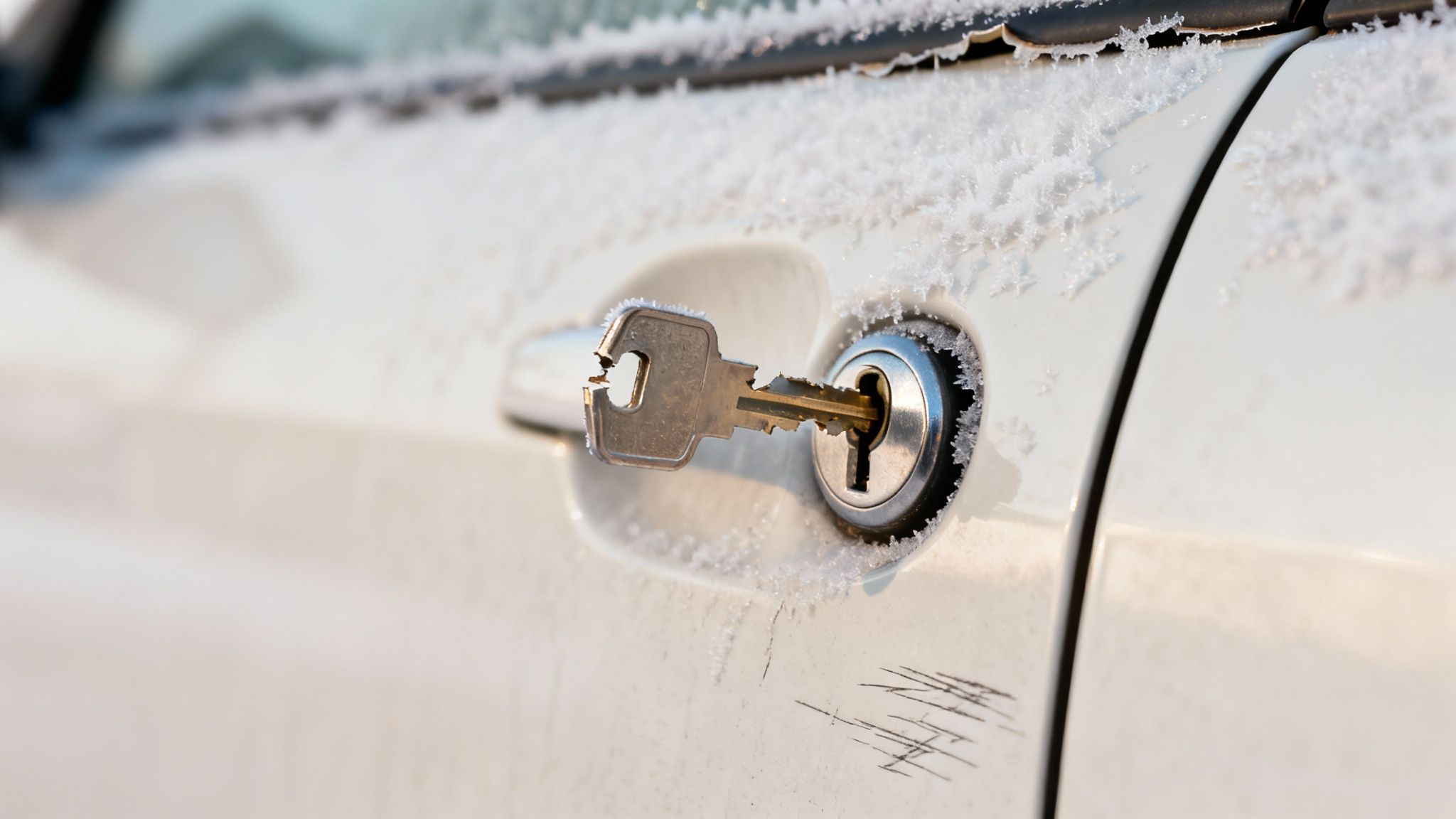

    When you need fast, professional help for a stuck key or any other lock and key issue, trust the local experts. For everything from emergency car lockouts and house lockouts to key fob replacement, Pro-B Locksmith is ready to assist. Call (772) 710-8169 for immediate help across the Treasure Coast.

  • I Lost My Car Keys What To Do: Fast Help in Port St. Lucie & the Treasure Coast

    I Lost My Car Keys What To Do: Fast Help in Port St. Lucie & the Treasure Coast

    That sinking feeling when you realize your keys are gone—it’s a universal gut punch. Whether you’ve just finished a day at Jensen Beach or you’re in a Port St. Lucie parking lot, the sudden absence of that jingle can send a wave of panic through you.

    But take a deep breath. A frantic, chaotic search is the last thing you need right now. A clear head is your best tool for getting this sorted out quickly. If you're in a car lockout situation and need help now, Call (772) 710-8169 for immediate help.

    A young man stands next to a car, holding a phone, at sunset with palm trees.

    Before you start tearing apart your car or calling for help, pause. The first few minutes are about two things: your personal safety and your car's security. If you're in a sketchy, poorly lit area in Fort Pierce late at night, your first move isn't to look for keys—it's to get yourself to a safe, well-lit spot. Your car can wait.

    The First 15 Minutes: A Step-by-Step Guide

    Once you're safe, it's time to play detective. Don't just wander around hoping to spot them. Instead, you need to actively retrace your steps from the last 30-60 minutes. This mental replay is surprisingly effective and often leads to a "eureka!" moment.

    The moment of realization can be overwhelming. To cut through the noise, here's a quick checklist to guide your first critical actions. It's the same process our technicians recommend when they get that first distressed call.

    Your First 15 Minutes Checklist for Lost Car Keys

    Action StepWhy It's ImportantLocal Tip for the Treasure Coast
    Stop and BreathePrevents panic, which clouds judgment and leads to ineffective searching.Whether you're at the crowded Tradition Square or a quiet Stuart park, a calm mind is your best asset.
    Secure Your LocationIf your car is unlocked and you're in a busy public place, it's a security risk.At busy spots like the Vero Beach Outlets, lock your car if you can. If not, stay nearby while you search.
    Mentally Retrace StepsYour short-term memory holds the key. Recreating your last actions often reveals the exact moment of loss.Think: "Did I have them walking out of Publix? Did I set them on the roof while loading groceries?"
    Conduct a 'Circle Search'Methodically search the immediate area around your car and the path you just walked.Check under your car, near the curb, and along the path from the storefront to your parking spot.

    Following these steps methodically transforms a chaotic search into a structured process. It prevents you from overlooking obvious spots and helps you regain a sense of control. We once had a customer in Port St. Lucie who was adamant they'd lost their keys at the beach, only to find them right beside their car door after realizing they’d dropped them while grabbing their kid’s backpack from the back seat. This is a real example of how a calm, step-by-step search can solve the problem.

    Your memory is your best initial search tool. Instead of asking "Where could my keys be?" ask "What was the last thing I did?" This shifts your focus from endless possibilities to a concrete timeline of events, often revealing the exact moment the keys were misplaced.

    If a thorough search of your pockets, bag, and immediate surroundings comes up empty, don't give up just yet. This is just the first phase. The next logical move is to check for a spare. But if you’ve exhausted these initial steps and you're truly stuck, knowing your emergency lockout options is the next critical step to getting back on the road.

    The Hunt for a Spare Key Before You Call for Help

    Okay, before you hit the panic button and assume your keys are gone forever, take a deep breath. The first, and often overlooked, step is a thorough search for a spare. It sounds obvious, but in the heat of the moment, it's easy to forget. Finding that spare is by far the quickest and cheapest way to get back on the road in Port St. Lucie or the surrounding areas.

    A person's hand retrieves car keys from a coat pocket hanging on a wall hook.

    Start with the usual spots inside your home—the key hook by the door, that infamous kitchen "junk drawer," or on your nightstand. If you strike out there, it's time to dig a little deeper into those places that seemed like a great idea at the time.

    Creative Places to Look for a Spare Key

    We’ve all stashed a key somewhere we thought we’d never forget. Think back. Before you declare yourself locked out, do one last sweep of these surprisingly common hiding spots:

    • Seasonal Items: Go through the pockets of your winter coats, that old ski jacket, or even a beach bag from last summer.
    • In Other Vehicles: Is it possible you tucked a spare in the glove box or center console of another car in the driveway? It happens more than you think.
    • Trusted Contacts: Did you ever give a spare to a family member, a good neighbor, or a close friend in nearby Stuart or Vero Beach for emergencies? A quick text or call could be your solution.
    • Hidden Holders: Remember that magnetic key box you bought years ago? Check under the bumper or wheel well of your vehicle (or even another family car).

    If you’ve gone through every nook and cranny and still come up empty-handed, then it's probably time to call in a professional. But at least you've covered all your bases first.

    What to Do If You Find a Spare But Suspect Theft

    Finding your spare is a huge relief, but the story might not end there. If you have a nagging feeling your main set was stolen and not just misplaced, you have a security risk on your hands. The spare gets you moving again, but it doesn't protect your car from the person who has the original.

    In this situation, your car is still vulnerable. The smartest move is to call a professional locksmith right away to talk about rekeying your vehicle's locks. This process re-tunes the lock cylinders so the old, stolen key is useless, instantly neutralizing the threat.

    This is a much more affordable solution than replacing all the locks and it brings immediate peace of mind. If you're anywhere from Fort Pierce to Jensen Beach and find yourself in this spot, call (772) 710-8169 for immediate help. Our services, including car key replacement and ignition repair, are designed to secure your vehicle quickly.

    Understanding Your Car Key and Why It Matters

    When you call a locksmith and say, "I've lost my car keys," the very next thing we'll ask is, "What kind of key was it?" It’s the single most important detail we need. The difference between a simple metal key and a modern smart fob is huge, and knowing what you had is the key (pun intended) to getting you back on the road fast here on the Treasure Coast.

    Four different car keys, including a traditional metal key and three modern remote fobs, on a grey surface.

    The days when any hardware store could copy your car key are long gone. Most keys today are tiny, sophisticated pieces of tech designed to keep your vehicle secure. When you can give us the right info upfront, it guarantees our locksmith shows up with the correct tools and key blanks, which saves everyone time and a whole lot of frustration.

    Breaking Down Modern Car Keys

    Think of your key as the gatekeeper to your car's security system. Each type talks to your car in a different way, which completely changes how we make a replacement. This step-by-step breakdown will help you identify what you have:

    • Step 1: Traditional Metal Keys: These are the old-school, all-metal keys you’d see on cars made before the year 2000. They’re the simplest to replace. A skilled locksmith can cut a new one just by looking at your car's locks or using the VIN.
    • Step 2: Transponder Keys: These look almost like traditional keys but have a thick plastic head. Hidden inside that plastic is a tiny microchip. When you turn the key, the chip sends a unique code to your car. If the code doesn't match, the car's immobilizer kicks in and the engine won't start—even if the key is cut perfectly.
    • Step 3: Remote Head Keys / Switchblade Keys: This is where convenience meets security. These keys combine the transponder chip with remote buttons (lock, unlock, panic) all in one unit. Replacing one is a two-step process: we have to cut the metal blade and then program both the remote and the transponder chip.
    • Step 4: Smart Keys / Proximity Fobs: The standard for most new, push-to-start vehicles. These fobs let you unlock the doors and start the engine without ever leaving your pocket or purse. They communicate with the car using a more complex signal and require highly specialized equipment to program.

    Knowing your key type isn't just about us being nosy—it's about efficiency. When a customer can tell us, "I lost the smart key for my 2019 Nissan in Stuart," our tech knows exactly which programmer and fob to grab. It turns a potential day-long ordeal into a quick, on-the-spot fix.

    The Power of the Transponder Chip

    Losing a modern car key is such a pain precisely because of how advanced they've become. The global automotive key market is absolutely massive, driven by this high-tech security. That little transponder chip has been a game-changer in theft prevention. In fact, studies have shown that vehicles with transponders are up to 90% less likely to be stolen because a thief can't just hotwire the engine.

    That anti-theft system is brilliant… until you’re the one locked out. That’s when you need a professional who has the tech to program a new key to your car's computer.

    Whether you're in Port St. Lucie or Vero Beach, just have your vehicle's make, model, and year handy when you call. If you're not sure what kind of key you had, don't worry—we can usually figure it out from that information. Just call (772) 710-8169 for immediate help, and we’ll get a technician on the way to get you moving again.

    Why a Local Mobile Locksmith Is Your Best Call

    When you're standing there, keys gone, and your car is just a useless hunk of metal, the next call you make is critical. A lot of people's first instinct is to call the car dealership, but that's almost always the slowest and most expensive path you can take.

    For anyone stuck in Port St. Lucie, Fort Pierce, or anywhere on the Treasure Coast, a local mobile locksmith is, without a doubt, your best bet.

    A service technician hands car keys to a smiling customer leaning from a white van.

    The biggest advantage is simple: we come to you. Forget arranging for a pricey tow truck to drag your car to a dealership where you'll just end up waiting for an appointment. Our mobile units are dispatched right to your location, whether you're at the Vero Beach Outlets or in a random parking lot along US-1 in Stuart. We cut out the tow and the tedious wait.

    Think of our service vans as workshops on wheels. They're kitted out with the same high-tech machinery the dealerships have, letting us cut and program anything from a basic transponder key to a complex push-to-start smart fob, right there on the spot.

    The Clear Advantages of Choosing Local and Mobile

    Going with a local mobile locksmith like Pro-B Locksmith is about more than just convenience. It’s about getting back on the road faster, keeping more money in your wallet, and getting help from a real person who knows the area.

    Let's talk about the real-world difference. A dealership might tell you it's a two-day wait and hand you a bill for over $500—and that’s before you pay the tow truck driver. We can often get you sorted and driving away in under an hour, for a fraction of that cost.

    This isn't a niche service anymore. The demand for on-site key replacement has exploded, turning it into a multi-billion dollar industry where local experts are the go-to choice. In fact, the market for automotive key blanks is projected to grow from $5.36 billion in 2024 to $5.61 billion in 2025, which shows just how often this happens to people. You can read more about the industry's growth in this car key programmer market analysis.

    Choosing a mobile locksmith isn’t just a Plan B; it’s the superior strategy. You save time by avoiding a tow, save money with lower service fees, and get back to your life faster. It's the difference between a minor inconvenience and a major ordeal.

    Get Faster Service by Being Prepared

    Want to make the process even quicker? Having a few key pieces of information handy when you call us is a huge help. It lets our technicians verify you as the owner and pull the right key codes before they even head your way.

    When you Call (772) 710-8169 for immediate help, try to have this info ready:

    • Vehicle Identification Number (VIN): This is the single most important piece of info we need. You can find it on your insurance card, vehicle registration, or etched on the driver's side dashboard where it meets the windshield.
    • Make, Model, and Year: Simply saying "it's a 2019 Honda Accord" tells us exactly what kind of key or fob we're dealing with.
    • Proof of Ownership: When our tech arrives, they'll need to see your driver's license and registration or title. It's a critical security step to make sure we're making a key for the car's actual owner.

    Having this ready helps us give you a more accurate quote right over the phone and guarantees our tech shows up with the correct key blank and programming tools for the job. It's the last little step that turns a nightmare lockout into a quick, professional fix. You can learn more about our specialized automotive locksmith services and see everything we can do to help.

    Proactive Strategies to Prevent Future Lockouts

    That feeling of relief when you finally get back into your car is the perfect time to make sure you never have to go through that stress again. Once the immediate crisis is over, a few simple, practical tips can save you a world of trouble down the road.

    The single most effective thing you can do? Get a spare key made right away. Seriously, don't put it off. Having a duplicate turns a potential day-ruining disaster into a minor hiccup. At Pro-B Locksmith, we can cut and program a spare on the spot, whether you're in Port St. Lucie or Vero Beach, often getting you sorted in just a few minutes.

    Smart Storage and Modern Tech

    Of course, having a spare key doesn't do you much good if you can't find it when you need it. The kitchen junk drawer might seem like the obvious choice, but let's think a little more strategically.

    • A Trusted Friend or Family Member: This is usually your best bet. Leaving a spare with a reliable neighbor or a family member in a nearby town like Stuart means help is just a phone call away.
    • A Secure Spot at Home: If you keep it at home, think of a place that’s logical but not obvious. Tucking it away with your important documents in a fireproof safe is a great option.
    • Embrace Technology: For your primary set of keys, a Bluetooth key finder is a game-changer. These little tags clip right onto your keyring and sync with an app on your phone. You can make them ring or see their last known location on a map.

    Even simple physical tools can make a difference. For example, a quality leather key holder gives your keys a dedicated home, making them harder to absentmindedly leave behind.

    When a New Key Isn't Enough: Rekeying Your Vehicle

    There's a big difference between losing your keys and having them stolen. If you suspect theft, simply getting a new key made won't secure your vehicle. The old key is still out there, and so is your car's vulnerability.

    In this situation, you need to rekey your car's locks and ignition.

    Rekeying isn't about replacing all the hardware. It's a much smarter process where we adjust the internal tumblers of your existing locks. This makes them work with a brand-new key, instantly rendering the old, stolen one useless. It’s a fast, affordable way to regain total peace of mind.

    It's no secret that car keys are getting more advanced. The automotive digital key market hit a staggering USD 4.63 billion in 2024 and is only expected to grow. Still, about 25% of drivers rely on physical fobs, which means lockouts are still incredibly common. Losing one of these modern fobs in Jensen Beach and going to the dealership can be a painful expense, often costing $300-$800. A mobile locksmith can program a replacement for you right where you are, for a fraction of that cost. You can learn more about the growth of the automotive digital key market and see why having a reliable backup plan is so critical.

    If you think your keys were stolen or you're ready to set up a solid security plan, give us a call. Call (772) 710-8169 for immediate help. We can rekey your vehicle or create that all-important spare, ensuring you're prepared for whatever comes next.

    Your Questions About Lost Car Keys Answered

    After the initial panic of losing your car keys wears off, the questions start rolling in. It’s completely normal. I’ve heard these same concerns from drivers all over the Treasure Coast, so let’s clear up a few of the most common ones.

    The cost to replace a car key in places like Port St. Lucie or Stuart can really swing from one end of the spectrum to the other. A basic, old-school metal key is one thing, but a modern smart key fob for a push-to-start car is a different beast entirely, mainly because of the complex programming involved.

    The biggest factor driving the price is the technology packed inside your key. A transponder key has a tiny security chip that has to be programmed to talk to your car’s computer. That’s a far more technical job than just cutting a piece of metal, and it’s why we always need your car's make, model, and year to give you a solid quote.

    Will My Car Insurance Cover This?

    This is a big one. Will your insurance policy foot the bill? The short answer is: maybe. Some comprehensive policies do cover lost or stolen keys, but you’ll almost certainly have to deal with a deductible.

    Frankly, if you have a high deductible—and $500 is pretty common—it's often faster and more affordable to just call a mobile locksmith directly. Insurance claims can drag on, but if you need to get back on the road today, just Call (772) 710-8169 for immediate help.

    Can a Locksmith Make a Key Without the Original?

    Yes, absolutely. This is what a professional automotive locksmith is trained for. We don’t need the old key to make you a brand-new one from scratch.

    Our technicians use your car’s Vehicle Identification Number (VIN) to look up the exact code needed to cut a new key blade. Then, using specialized diagnostic tools right there on-site—whether you're in Fort Pierce or Vero Beach—we program the new key's transponder chip or fob so it syncs perfectly with your car's security system. Our expertise covers everything from simple car lockouts and key fob replacements to complex ignition repair.

    You can dive deeper into this and other common questions on our FAQ page.


    When you're stuck in a car key crisis on the Treasure Coast, you need a local expert you can count on. Pro-B Locksmith offers fast, 24/7 mobile service to get you back behind the wheel without the dealership’s prices or long waits. From Port St. Lucie and Fort Pierce to Vero Beach and Stuart, we provide reliable car lockout, house lockout, key fob replacement, and lock change services. For fair, upfront pricing and service that comes right to you, visit us at https://problocksmith.com.

  • How to Unlock a House Door: Quick, Safe Steps When Locked Out

    How to Unlock a House Door: Quick, Safe Steps When Locked Out

    It's a feeling we all know. That stomach-dropping moment when you hear the click of the door shutting, only to realize your keys are still inside. Before you start eyeing a window and calculating the cost of a replacement, take a deep breath. There are safer, non-destructive ways to get back into your house, and for many common locks, the solution is simpler than you might think.

    That Sinking Feeling of Being Locked Out

    There’s nothing quite like it—standing on your own porch in Port St. Lucie, staring at the door you can't open. Your mind starts racing. Is that back window unlocked? Did I ever give a spare key to my neighbor? It's easy to jump into panic mode, but the best thing you can do is pause and think clearly.

    This guide is for everyone across the Treasure Coast, from Fort Pierce to Jensen Beach, who’s ever faced this frustrating situation. We'll walk you through some practical, safe methods you can try yourself before you even think about doing something that could cause expensive damage.

    Your Immediate Action Plan

    First things first: your safety is the priority. Take a quick look around. Is it late at night? Are you in a well-lit, familiar area? Sometimes the best move isn't a DIY trick, but calling in a professional who can get you inside quickly and safely.

    Before you go any further, run through this quick checklist:

    • Do a full perimeter check. Go around and methodically try every single door and window. You’d be surprised how often a first-floor bathroom window or a sliding back door is left unlatched.
    • Call a trusted contact. If you've ever given a spare key to a friend or neighbor in Stuart or Vero Beach, now's the time to make that call. It could be the simplest fix.
    • Identify your lock. Take a look at what you're up against. Is it a basic spring-latch doorknob, or a high-security deadbolt? The type of lock you have will really dictate whether a DIY approach is even on the table.

    Remember, trying to force a lock or, worse, breaking a window can turn a simple lockout into a major headache with a hefty repair bill. The goal here is to get back inside without leaving a trail of destruction.

    You're not alone in this situation. The residential segment makes up a huge 38% of the total revenue for the locksmith industry. This is driven by homeowners needing help with lockouts, repairs, and security upgrades, showing just how often people rely on professionals for fast, secure access. You can dig deeper into these locksmith industry trends on marketintelo.com.

    When it comes down to it, if you feel unsafe, it’s getting dark, or the lock just won't budge, don't hesitate. For any house lockout, the most reliable move is often the easiest one. Call (772) 710-8169 for immediate help and a fast, damage-free solution.

    Identify Your Lock to Find the Right Solution

    Before you grab a credit card or a bobby pin, stop and take a good look at your lock. The methods for getting back inside depend entirely on what kind of hardware is standing between you and your couch. Using the wrong technique isn't just a waste of time; it’s a great way to wreck your lock, your door, or both.

    The homes we see across Stuart and Jensen Beach have a mix of everything, from basic knobs to high-tech smart locks. Each one has its own quirks and vulnerabilities.

    What Kind of Lock Are You Dealing With?

    Chances are, you're looking at a spring-latch lock if it's a standard doorknob. This is the classic angled bolt that pops into the doorframe. These locks often have a tiny "dead latch" pin that’s supposed to stop someone from jimmying it open. The problem? Over time, doors settle and frames shift, creating just enough of a gap to make that security feature useless.

    Deadbolts, on the other hand, are a different beast entirely. They use a solid steel bolt that throws deep into the frame, making them immune to the simple shimming tricks that can work on a spring latch. If you're locked out by a deadbolt, your DIY options just got a lot smaller.

    Here's a quick rundown of what you'll typically find on the Treasure Coast:

    • Spring-Latch Knob: Your standard doorknob with a keyhole. The latch is wedge-shaped, which allows the door to click shut. This is the prime candidate for the "credit card trick."
    • Deadbolt: This is a separate, more robust lock, usually located above the knob. It operates with a key or a thumb-turn, and the bolt is a thick, rectangular block of metal. Trying to force this is a good way to splinter your doorframe.
    • Smart Lock: Keypads, Bluetooth, fingerprints—these locks are great until the battery dies or the electronics glitch. If you have a car lockout at the same time and your phone with the app is inside, you’re in a tough spot. Prying one of these off will destroy the expensive internal components and likely gouge your door.

    Matching DIY Methods to Your Lock Type

    To make things easier, here's a quick guide to help you choose the right approach. Trying to shove a credit card against a deadbolt will only get you a broken credit card. This table will point you in the right direction.

    Lock TypeBest DIY MethodRequired ToolSuccess Probability
    Interior Doorknob (Push-Button/Twist Lock)Pin or PaperclipA sturdy paperclip or thin wireHigh
    Exterior Doorknob (Spring-Latch)Credit Card / LoidingA laminated, flexible cardLow to Medium
    Deadbolt (Single or Double Cylinder)None—Call a ProProfessional Locksmith ToolsVery Low
    Smart Lock (Dead Battery)Emergency Key or 9V BatteryThe physical key or a 9V batteryHigh (if you have the tool)
    Sliding Glass Door LockBypass with a toolA thin, rigid tool or wireLow

    Keep in mind that "Success Probability" is just an estimate. It can change based on the lock's condition, the door's alignment, and your own technique.

    Attempting to bypass a high-security lock or smart lock without the right tools and expertise is a recipe for disaster. What starts as a simple house lockout can quickly turn into a need for a complete lock change and door repair.

    If you’re staring at a heavy-duty deadbolt or a smart lock that just won't cooperate, it's time to put the tools down. The risk of a $500 repair job to fix a damaged door isn't worth it. For these tougher situations in Vero Beach or Fort Pierce, the smart move is to call in a professional. A certified Pro-B Locksmith technician can get you inside quickly without leaving a scratch. Call (772) 710-8169 for immediate help.

    Safe Ways to Open a Locked Door Without a Key

    Alright, so you've taken a look at your lock and are ready to try a few tricks to get back inside. Let's walk through some proven, non-destructive techniques. The key here is patience and a light touch—brute force is your enemy and will only lead to a bigger, more expensive problem.

    These methods are designed specifically for the common spring-latch locks we see on homes all over Port St. Lucie and Fort Pierce.

    It's crucial to understand that these tricks are for spring latches only. If you're up against a deadbolt, stop right now. Trying to bypass a deadbolt this way is a waste of time and you'll almost certainly damage the door, the frame, or the lock itself.

    The Classic Card Trick for Spring Latches

    You've seen it in movies, and believe it or not, the "credit card trick" can actually work on the right kind of spring-latch lock. The idea is to slide something thin and flexible between the door and the frame to force the angled latch bolt back into the door.

    First things first: do not use your actual credit card. It's far too valuable, too rigid, and it will probably snap.

    Instead, grab something you don't mind sacrificing, like a laminated library card, an old gift card, or even a flexible plastic loyalty card. You need that perfect combination of flexibility and stiffness to apply pressure without breaking.

    Here's a step-by-step example of how to give it a shot:

    • Step 1: Create a Gap: Start by pulling the door handle toward you. This can create just enough space between the door and the frame for you to work with. Sometimes, this simple action disengages the deadlatch (that little pin next to the main latch), which is exactly what you need.
    • Step 2: Insert the Card: Find the sweet spot right above the doorknob and slide the card into the gap, angling it down toward where you feel the latch is.
    • Step 3: Wiggle and Push: Now for the finesse. As you push the card deeper, jiggle the doorknob back and forth. This movement can relieve pressure on the latch and help the card find its way behind the angled part.
    • Step 4: Bend and Pry: Once you feel the card make contact with the slanted edge of the latch, bend the card away from the knob while pushing forward. Your goal is to use the card as a wedge to retract the bolt.

    Just last week, we helped a homeowner in Fort Pierce who used this exact technique on their garage service door and avoided a late-night service call. It took them a few tries, but they got in. If you hit a solid wall of resistance or the card gets stuck, don't force it. It likely means the lock is properly set or the door is misaligned.

    Using a Bobby Pin or Paperclip

    For simpler interior doors—think a push-button bathroom or bedroom lock—a bobby pin or paperclip can be your best friend. This method is all about manipulating the lock's internal pins, almost like a miniature version of lock picking.

    You'll need to create two makeshift tools: a tension wrench and a pick.

    • Tension Wrench: Take a bobby pin or a sturdy paperclip and bend it into a tight 'L' shape. This tool applies a tiny bit of rotational pressure on the lock cylinder, just like a key would.
    • Pick: Straighten out a second bobby pin or paperclip, but leave a very small upward bend at the tip. This is what you'll use to gently "rake" or lift the pins inside.

    If you've been fiddling with either of these methods for more than a few minutes, or if the lock feels completely seized up, it's time to stop. Breaking a tool off inside the lock cylinder instantly escalates a simple lockout into a much more serious problem, often requiring a full lock change.

    When these DIY tricks don't work, it’s not a failure on your part—it just means you have a good, secure lock doing its job. For a guaranteed, damage-free entry anywhere from Vero Beach to Stuart, your best bet is to call (772) 710-8169 for immediate help from a professional locksmith.

    When to Stop and Call a Professional Locksmith

    There's a real sense of victory in solving a problem yourself, we get it. But when you're locked out of your own home, knowing when to put the tools down is just as important as knowing how to use them. A DIY attempt gone wrong can turn a simple inconvenience into a costly nightmare involving a busted lock, a splintered doorframe, and a much bigger headache.

    If you’ve been struggling with a lock for more than a few minutes with zero progress, take that as your cue. Pushing your luck usually means you're up against a tougher lock than you realized, or worse, you're causing damage inside the cylinder. Instead of getting frustrated, it’s safer and often quicker to call a pro.

    Scenarios Demanding a Professional

    Some situations are immediate red flags. Trying to force these locks isn't just a bad idea—it's a recipe for permanent damage.

    • High-Security Deadbolts: These aren't your average locks. They're built with things like anti-pick pins and hardened steel specifically to stop simple tricks from working. Trying to force one is a guaranteed way to break the whole mechanism.
    • Smart Lock Malfunctions: Your smart lock is dead, and the backup key is nowhere to be found. You tried the 9-volt battery trick to no avail. Stop right there. Prying that thing off the door will absolutely destroy the delicate electronics inside. Services like key fob replacement or smart lock diagnostics are best left to experts.
    • Jammed or Rusted Locks: Does the key feel gritty when you turn it? Is the lock stiff, or completely seized up? That’s a clear sign of internal failure. Brute force will only make it worse.
    • Broken Key in the Lock: This one’s a classic. A piece of your key snaps off inside the lock. Your first instinct might be to grab tweezers, but that usually just pushes the fragment deeper. This is a common reason people call for ignition repair in their cars, and the principle is the same for house locks—it requires specialized extraction tools.

    The second you feel serious resistance or hear an awful crunching sound, just stop. A skilled locksmith has specialized tools designed to open your door in minutes without leaving so much as a scratch. Call (772) 710-8169 for immediate help anywhere on the Treasure Coast.

    The locksmith industry is surprisingly big, with around 29,304 registered businesses in the U.S. alone. What that means for homeowners in Vero Beach or property managers in Port St. Lucie is that a reliable expert is never far away. All that competition keeps us on our toes, ensuring you get a fast, professional response when you need it most. You can dig into more locksmith marketing statistics on amraandelma.com if you're curious.

    At the end of the day, calling a pro is an investment in protecting your property. Instead of risking damage, a certified technician gets you back inside quickly and safely, guaranteed. You might also want to read our guide on what to expect during an emergency lockout service.

    How to Prevent Future Lockouts

    Getting back inside is a huge relief, but the real win is making sure it never happens again. Instead of just trying harder to remember your keys, it's time to build a smarter system. A few simple habits and some strategic upgrades can all but eliminate the chance of another lockout.

    The simplest, old-school solution is still one of the best: create a trusted key network. Leave a spare with a reliable neighbor in Port St. Lucie or a family member who lives nearby in Stuart. In many cases, this is your fastest and cheapest way back in the door.

    Smart Habits and Physical Backups

    We all know hiding a key under the doormat is a terrible idea. But there are much smarter alternatives. Think about a magnetic key holder tucked away in a completely non-obvious spot on your property, or better yet, a combination lockbox secured to a fixed object.

    Of course, the best offense is a good defense, and that starts with your daily routine:

    • Create a "Key Spot." Get a specific bowl, hook, or tray right by the door where your keys always go. Make it a rule: keys land there the moment you walk in and you grab them from there right before you leave.
    • Do the "Pocket Pat." Train yourself to do a quick pat-down every single time you pull the door closed. Phone? Wallet? Keys? It takes two seconds and can save you hours of frustration.

    A proactive approach to your home's entry points is the best way to prevent lockouts. Upgrading your hardware and creating reliable backup plans means you're prepared for the unexpected, rather than just reacting to it.

    Upgrading to Keyless Entry Solutions

    For the ultimate lockout prevention, nothing beats going keyless with a modern smart lock. Just imagine never needing to carry a key again.

    These are a total game-changer, especially for busy families in Vero Beach or landlords with rental properties in Fort Pierce. You can create temporary codes for guests and service people, a permanent code for your family, and track who comes and goes.

    We specialize in installing these high-tech systems. We can help you pick a durable, reliable keypad or smart lock that fits your door and lifestyle, ensuring it's set up professionally and securely. To explore your options, you can learn more about our full range of residential locksmith services.

    Beyond the lock itself, many homeowners are also boosting their property's defenses by installing a robust home security system for an added layer of protection.

    Don't forget maintenance. An old, sticky, or damaged lock is an accident waiting to happen. A quick service call for a lock change or rekey can keep everything working smoothly. If you're ready to ditch keys for good, call (772) 710-8169 and we can walk you through the best smart lock options.

    Your House Lockout Questions Answered

    When you're stuck on your own porch, a million questions can race through your mind. We've heard just about all of them from folks here in Port St. Lucie and across the Treasure Coast. Here are some clear, straightforward answers to the most common ones.

    Will Trying to Unlock My Own Door Damage the Lock?

    It absolutely can. While sliding a flexible gift card into a standard spring-latch lock is a low-risk move, grabbing the wrong tool can go sideways fast.

    Trying to force a screwdriver or even a stiff credit card can easily misalign the internal pins, gouge your doorframe, or break the latch mechanism entirely. For anything tougher than a simple latch—like deadbolts or high-security locks—DIY attempts are almost guaranteed to cause damage that’ll force you into a full lock change.

    The moment you feel any real resistance, stop. That's your lock telling you it's time to call a pro.

    How Much Does a Locksmith Cost in Port St. Lucie?

    The honest answer? It depends. The cost can shift based on the time of day, how far you are in areas like Fort Pierce or Stuart, and how complex your lock is. A reputable local locksmith will always give you a clear, upfront price over the phone with no hidden fees.

    Be wary of national dispatch services that often tack on surprise charges. A local expert gives you a reliable quote directly, so you know exactly what to expect. A standard house lockout service is almost always far cheaper than fixing a busted door or window.

    For a precise, no-obligation quote for your situation, Call (772) 710-8169 for immediate help.

    Is It Better to Rekey or Change Locks After Losing Keys?

    If you've lost your keys and you're worried about who might find them, rekeying is almost always the best option. Rekeying isn't about replacing the hardware; it's about changing the internal pins of your existing lock so it works with a new key.

    This simple adjustment makes the old, lost key completely useless. It's much faster and more cost-effective than buying and installing brand-new locks. We can handle a rekey on the spot, giving you new keys and peace of mind without the expense of a full replacement.

    My Smart Lock Battery Died. What Can I Do?

    This is a modern-day lockout nightmare, but you have a couple of options. First, check if your smart lock has a hidden backup keyway—many do, often tucked under a small cover.

    Some models also have two small metal contacts on the outside. Touching a fresh 9-volt battery to these terminals for a few seconds can give it just enough juice to accept your code and unlock.

    If neither of those tricks work, don't try to pry the lock off. A locksmith has specialized tools to power or bypass the lock without destroying your expensive hardware. For more answers, check out our locksmith FAQ page.
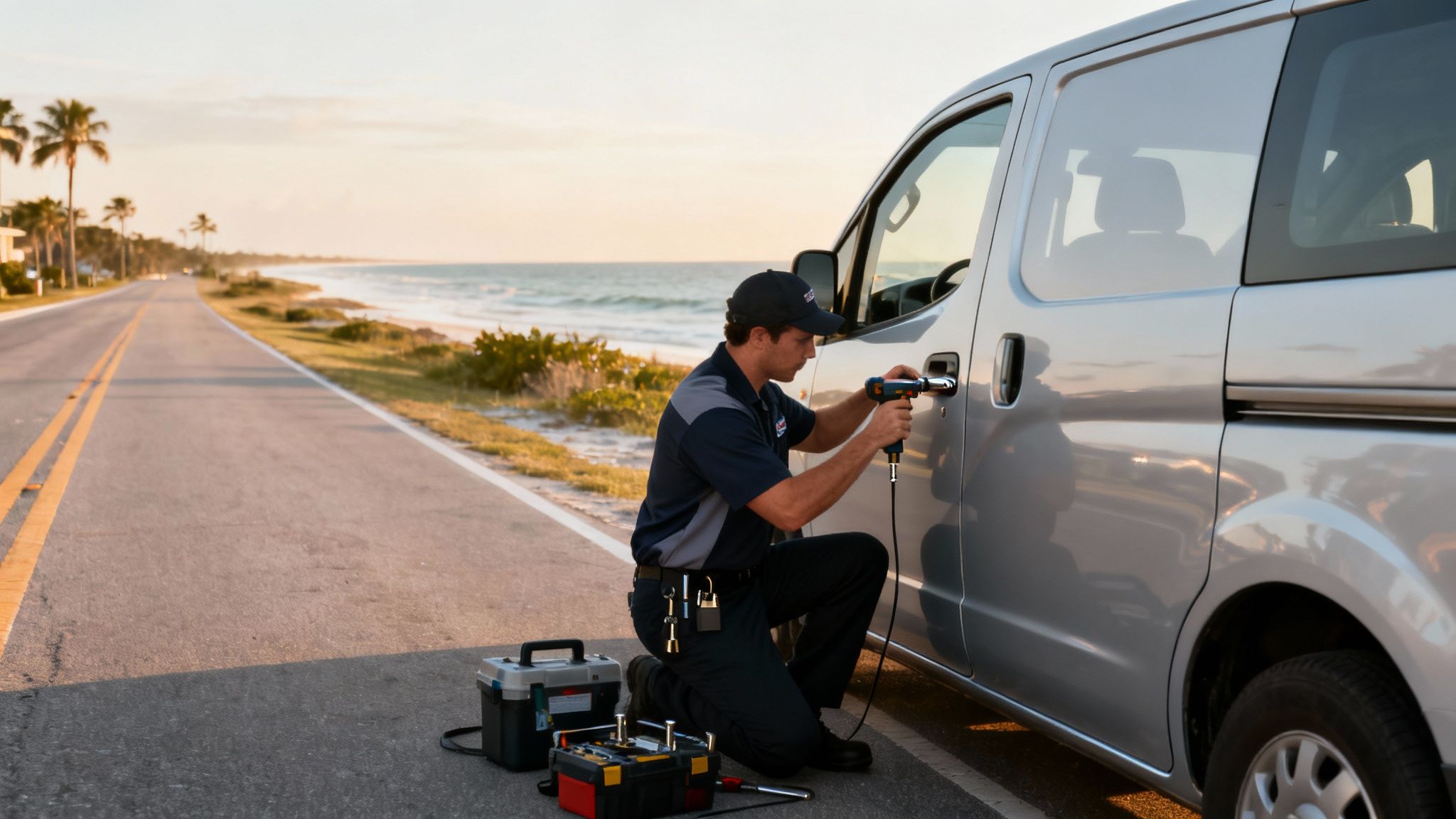
  • Understanding the Average Cost to Rekey Locks in Port St. Lucie

    Understanding the Average Cost to Rekey Locks in Port St. Lucie

    When you're looking to secure your property in Port St. Lucie, one of the most common questions we get is about cost. For a standard home in the Port St. Lucie, Fort Pierce, or Stuart area, the average cost to rekey locks usually falls somewhere between $80 and $200. This estimate typically covers the service call fee plus the work on a few different locks, making it a practical and budget-friendly way to boost your home's security.

    What to Expect for Lock Rekeying Costs on the Treasure Coast

    A document titled "Rekeying Costs" on a clipboard with a house key and a green leaf on a wooden table.

    Knowing the costs upfront means you can plan your budget without any last-minute surprises. If you live in Port St. Lucie, Fort Pierce, Vero Beach, or the surrounding communities, a rekeying bill from a professional locksmith is usually broken down into two simple parts: a one-time service call fee and a charge for each lock cylinder. This keeps the pricing straightforward, whether we're working on a single door in your Jensen Beach condo or securing your entire house in Stuart.

    The service call fee covers our travel time and expenses to get to your location. Think of it as the cost of bringing our mobile workshop right to your doorstep, which generally runs from $50 to $100 during standard business hours.

    From there, the actual rekeying of each lock cylinder—the part where you insert the key—costs between $15 and $35. So, you can see how rekeying a house with three doors is going to be significantly more affordable than a full lock change.

    Estimated Rekeying Costs in Port St. Lucie and Surrounding Areas

    To give you a clearer picture, here’s a quick table summarizing what you might expect to pay for professional rekeying services on the Treasure Coast.

    Service TypeAverage Cost RangeNotes
    Mobile Service Call Fee$50 – $100Covers travel to your location during business hours.
    Standard Lock Cylinder$15 – $35 per lockApplies to most residential deadbolts and doorknobs.
    Typical Home (3 Locks)$95 – $205 TotalIncludes service call fee and rekeying three locks.

    Of course, these are just estimates. A more complex high-security lock might be a bit more, but this gives you a solid starting point. For a precise quote tailored to your exact needs in Port St. Lucie, your best bet is to give us a call.

    Nationwide, homeowners find rekeying to be a great value, with typical projects landing between $191 and $225. It's no surprise—rekeying an entire home often costs 40-50% less than a full lock replacement. This is why it’s one of the first practical steps new homeowners take.

    Here at Pro-B Locksmith, we believe in being completely transparent with our pricing. We serve communities all across the Treasure Coast, which you can see in our Treasure Coast service areas. We'll always give you a clear, upfront cost so you know exactly what to expect before we start the job. No hidden fees, just honest, local, and reliable work.

    What Does It Really Mean to Rekey a Lock?

    Close-up of a person's hands using a tool to rekey or repair a brass door lock cylinder.

    Many homeowners in Port St. Lucie and Fort Pierce assume that if you need new keys, you have to replace the entire lock on your door. Thankfully, that's rarely true. Lock rekeying is a much smarter, quicker, and more budget-friendly way to secure your property.

    Here's a practical way to think about it: rekeying is like changing the password to your online accounts. You're not deleting the account (the lock itself), you're just making sure the old password (the old key) no longer works. It's that simple.

    Our professional locksmiths follow a clear, step-by-step process: we carefully remove the lock cylinder and change its internal mechanism. We swap out the tiny pins and springs inside, rearranging them into a new, unique pattern. This new configuration only works with a brand-new key we cut for you on-site. Your doorknobs and deadbolts don't change at all, which saves you a ton of money on hardware.

    The whole process is incredibly efficient. A skilled technician can rekey a standard lock in just a matter of minutes.

    When Is Rekeying the Right Call?

    So, when does it make sense for a homeowner in Vero Beach or Stuart to rekey? We see the same handful of situations pop up constantly all over the Treasure Coast.

    • You Just Moved In: This is our most common reason for a rekey in Port St. Lucie. You have no idea who the last owners gave a spare key to. It could be anyone—neighbors, painters, a dog walker from three years ago. Rekeying on day one is the only way to be certain you're the only one who has access.
    • A Key Is Lost or Stolen: It happens to everyone. In fact, over 20 million house and car keys get lost every year in the U.S. alone. If a key vanishes, rekeying is the fastest way to restore your security—and your peace of mind.
    • A Tenant Moves Out: For any landlord in Jensen Beach or Fort Pierce, this is an absolute must-do between renters. It’s a basic, non-negotiable step to protect your investment and keep your new tenants safe.
    • You Want to Simplify: Tired of that massive, jangling keychain? If your locks are from the same brand, we can often rekey them all to work with a single master key. One key for every door in your Port St. Lucie home.

    Rekeying is a foundational security measure. It's the most direct and cost-effective way to control exactly who has access to your property, rendering all previous keys useless.

    Whether you're in Port St. Lucie dealing with a lost key or settling into a new home in Vero Beach, rekeying is almost always the answer. If you find yourself in a spot where you feel your home’s security is at risk, Call (772) 710-8169 for immediate help. We’ll get you squared away in no time.

    What Goes Into the Final Cost of a Rekey?

    Pinning down the exact price to rekey your locks isn't as simple as a flat fee. It's a bit like getting a quote for a paint job—the final cost depends on the size of the house and the complexity of the work. Several key variables come into play, and understanding them will help you know exactly what you’re paying for when you get a quote from a locksmith in Jensen Beach or Fort Pierce.

    The biggest driver of the price is, without a doubt, the total number of lock cylinders that need to be rekeyed. People often forget that a single door with both a doorknob and a deadbolt actually has two separate cylinders. A practical example: if your Port St. Lucie home has three exterior doors, you could easily be looking at six cylinders, and the cost will scale up from there.

    The complexity of your locks is another huge factor. Rekeying a standard Schlage or Kwikset lock on a home in Stuart is a straightforward, everyday job for any experienced locksmith. But if you’ve invested in high-security locks, smart locks, or have beautiful antique hardware, the game changes. These require more time, specialized tools, and a higher level of skill, which naturally affects the price.

    Lock Type and Service Time

    The brand and quality of your hardware, like premium Emtek door hardware, can also nudge the price up. More intricate, high-end locks simply demand more careful and time-consuming work to rekey properly.

    Then there’s the timing of your service call. Just like any other emergency service, when you call matters. A scheduled appointment on a Tuesday afternoon is going to cost less than an urgent house lockout call late on a Saturday night in Vero Beach. Our 24/7 mobile service is always ready to roll, but after-hours, weekend, and holiday calls do include an emergency fee to get a technician dispatched to you immediately.

    The good news is that the national average cost to rekey residential locks has stayed pretty consistent, usually falling between $50 to $150 per lock. This stability helps homeowners in Port St. Lucie plan for security upgrades without worrying about surprise price jumps. You can find more details about locksmith pricing trends on securitylocksmithokc.com.

    Here at Pro-B Locksmith, we believe in being upfront and clear about our pricing. Whether it's a simple rekey or a more complicated situation where you might also need an ignition repair for your car, we’ll walk you through every line item on the quote. Our mobile locksmiths are fully equipped to handle just about anything on the spot, making the whole process transparent and hassle-free.

    Not sure what your job involves? Just give us a call. We’ll figure it out together. Call (772) 710-8169 for immediate help and a no-nonsense quote.

    Should You Rekey or Completely Replace Your Locks?

    Traditional key lock with a brass cylinder and key versus a modern smart digital door lock with a keypad.

    When it's time to tighten up your property’s security, you'll face a fundamental question: should you rekey the locks or replace them entirely? This is a common dilemma for homeowners and business owners all over the Treasure Coast, and the right answer really depends on your specific needs—your budget, the age of your locks, and what you’re trying to achieve.

    Here’s a simple way to frame it: rekeying is a security refresh, while replacing is a hardware upgrade.

    If your locks are in great physical shape but you're worried about who might have a key, rekeying is a fantastic, budget-friendly choice. On the other hand, if your locks are old, broken, or you're ready for a modern system like a smart lock, then a full replacement is the only way forward.

    Cost and Security Showdown: Rekeying vs. Replacing Your Locks

    Let's dig into the details with a real example. Imagine you just bought a beautiful home in Port St. Lucie. The deadbolts are high-quality and work perfectly, but you have no idea how many keys are floating around from the previous owners. In this case, rekeying is the smart play. It secures your home without the unnecessary expense of new hardware.

    Now, picture moving into an older property in Stuart where the locks are rusty and jiggle in the door. You have to fight with the key every time you use it. Here, a lock change isn't just a suggestion—it's a necessary investment in your peace of mind and daily convenience.

    To help you weigh your options, this table breaks down the key differences between these two essential locksmith services.

    FactorLock RekeyingLock Replacement (Change)
    CostMuch more affordable. You’re only paying for the technician's time and new keys.More expensive. You're buying brand-new hardware on top of the installation labor.
    SecurityExcellent. Rekeying renders all previous keys useless, making the lock just as secure.A major upgrade if you're moving to high-security locks or smart technology.
    TimeQuick and efficient. A professional can often rekey several locks in under an hour.A longer process that involves removing old hardware and fitting the new locks.
    HardwareYour existing doorknobs and deadbolts stay, keeping your home's aesthetic consistent.A chance to get brand-new hardware that can update or change the style of your doors.

    Ultimately, choosing correctly means you're not overspending on a replacement you don't need, nor are you putting a "band-aid" on a lock that's truly failing.

    The bottom line is this: rekeying protects you from people (anyone with an old key), while replacement protects you from problems (a worn-out or outdated lock).

    Making the Right Call for Your Property

    So, how do you decide? Here’s a practical step-by-step checklist based on your situation.

    Go for rekeying when:

    • You’ve lost a set of keys or think a copy is in the wrong hands in Port St. Lucie.
    • You're moving into a new home, apartment, or business location in Fort Pierce or Vero Beach.
    • You’ve had a roommate, tenant, or employee move out of a property in Stuart.
    • You want the convenience of having one key work for all your doors.

    Opt for a replacement when:

    • Your locks are visibly rusted, damaged, or a pain to operate.
    • You want to upgrade to something more secure, like a keypad or smart lock.
    • You're renovating and want your door hardware to match a new design style.
    • Your existing locks are from different brands and can't be keyed alike.

    If you're still on the fence about what's right for your home in Jensen Beach or Vero Beach, a little expert advice can go a long way. A quick consultation can save you both time and money. For a personalized recommendation and a clear, upfront quote, Call (772) 710-8169 for immediate help. We’ll figure out exactly what you need to feel safe and secure.

    Why Labor Is the Biggest Cost in Commercial Rekeying

    A technician with a toolbox approaches numbered doors, with a branded service van parked nearby.

    For business owners and property managers on the Treasure Coast, the math for rekeying locks is completely different than for a homeowner. A house might have three or four locks. But a commercial property in Port St. Lucie or Fort Pierce could easily have dozens—or even hundreds. When you're working at that scale, the real cost isn't the tiny pins and springs inside the locks; it's the specialized labor needed to handle the project efficiently.

    Imagine a multi-unit apartment complex in Stuart or a large office building in Vero Beach. Rekeying 50 different doors is a logistical puzzle, not just a matter of making 50 new keys. This kind of job demands careful planning and precision to ensure business or tenant life isn't turned upside down.

    The Complexity of Commercial Projects

    What really drives up the time and expertise needed is the creation of a master key system. This is a far cry from a simple rekey. It's a sophisticated hierarchy where one key—the master—can open all 50 doors, while each individual tenant key can only open its designated lock.

    Setting up a system like this is a detailed, step-by-step process that requires local expertise:

    • Detailed planning: We work with you to map out exactly who gets access to what areas of your Port St. Lucie business.
    • Precise pinning: Each lock cylinder must be meticulously pinned to accept both its unique key and the master key.
    • Careful record-keeping: A secure system depends on knowing exactly how it's structured for future needs and security audits.

    This isn't a job for just any locksmith; it requires a certified technician who understands the security needs of businesses in our area. That expertise and the time it takes to implement it correctly are what you're really investing in.

    When you're talking about large-scale projects, the labor costs can be eye-opening. An analysis of a commercial facility with 500 doors found that labor expenses alone hit $57,500—that's 75% of the entire rekeying bill. This shows just how much efficient, expert labor impacts the average cost to rekey locks for businesses. You can see a full cost comparison of rekeyable versus traditional locks on info.instakey.com.

    At Pro-B Locksmith, we get the unique pressures that businesses from Jensen Beach to Vero Beach face. Our technicians specialize in managing these complex commercial rekeying jobs quickly and with minimal disruption. We'll work with you to design a master key system that’s secure, efficient, and built for your property's specific needs.

    If your security needs go beyond a simple rekey, we've got you covered there, too. Find out more about our complete commercial locksmith services, from panic bar installation to modern access control systems. When you can’t afford downtime or security risks, Call (772) 710-8169 for immediate help.

    Why Choose Pro-B Locksmith in St. Lucie County?

    When you're researching the average cost to rekey locks, remember that price is only part of the equation. The quality of the service and the trustworthiness of the locksmith you call are just as crucial, especially when you need help fast in Port St. Lucie or Fort Pierce.

    Choosing a dedicated, local locksmith over a big, faceless national company makes all the difference. We're not some distant call center; we're your neighbors, living and working right here on the Treasure Coast.

    Being local is our biggest strength. It’s how we can promise rapid 15-20 minute response times across Port St. Lucie, Fort Pierce, and Jensen Beach. When you're in a jam, you need someone who is already around the corner, not miles away. We believe in being straight with our customers, which is why we always provide clear, upfront pricing before we start. No surprises, no hidden fees—just practical, local solutions.

    We're More Than Just Rekeying Specialists

    While rekeying is one of our most popular services, our skills go much further. Our vans are fully-stocked mobile workshops, ready to tackle just about any lock and key issue you can throw at us right on the spot, whether you're in Stuart or Vero Beach.

    • Complete Automotive Locksmith Services: Need your house locks rekeyed? While we're there, we can also take care of a car key fob replacement or sort out a tricky ignition repair. It’s all about solving your problems in one convenient visit, saving you the headache of making multiple calls.
    • Ready for Any Emergency, Day or Night: We're on call 24/7 because emergencies don't stick to a 9-to-5 schedule. Whether you've had a house lockout after a late dinner in Port St. Lucie or a car lockout on your way to work in Stuart, we'll be there.
    • Total Security Upgrades: Sometimes, a rekey isn't enough. If your hardware is old or worn out, we can perform a full lock change, fitting your doors with modern, high-security locks to truly secure your home.

    When you call Pro-B Locksmith, you're choosing peace of mind. Our licensed and insured technicians are committed to providing professional, reliable service every single time, making sure your property is safe and secure.

    Don't gamble with your family’s safety. For a fast, professional locksmith who truly understands the Treasure Coast, trust the local experts.

    Call us at (772) 710-8169 for immediate help and a free, no-obligation quote today.

    Common Questions About Lock Rekeying

    Even after breaking down the costs, you probably still have a few questions. That’s completely normal. Here are some quick, straightforward answers to the things we get asked most often by folks here in the Port St. Lucie, Fort Pierce, and Vero Beach areas.

    Can Any Lock Be Rekeyed?

    For the most part, yes. If you have standard deadbolts or doorknobs from popular brands like Schlage or Kwikset, rekeying is almost always a practical option.

    The only real exceptions are typically very old, obscure, or badly damaged locks where finding the right parts is next to impossible. Our technicians can tell you for sure once they see your hardware in person. For more in-depth answers, you can always check out our detailed FAQ page.
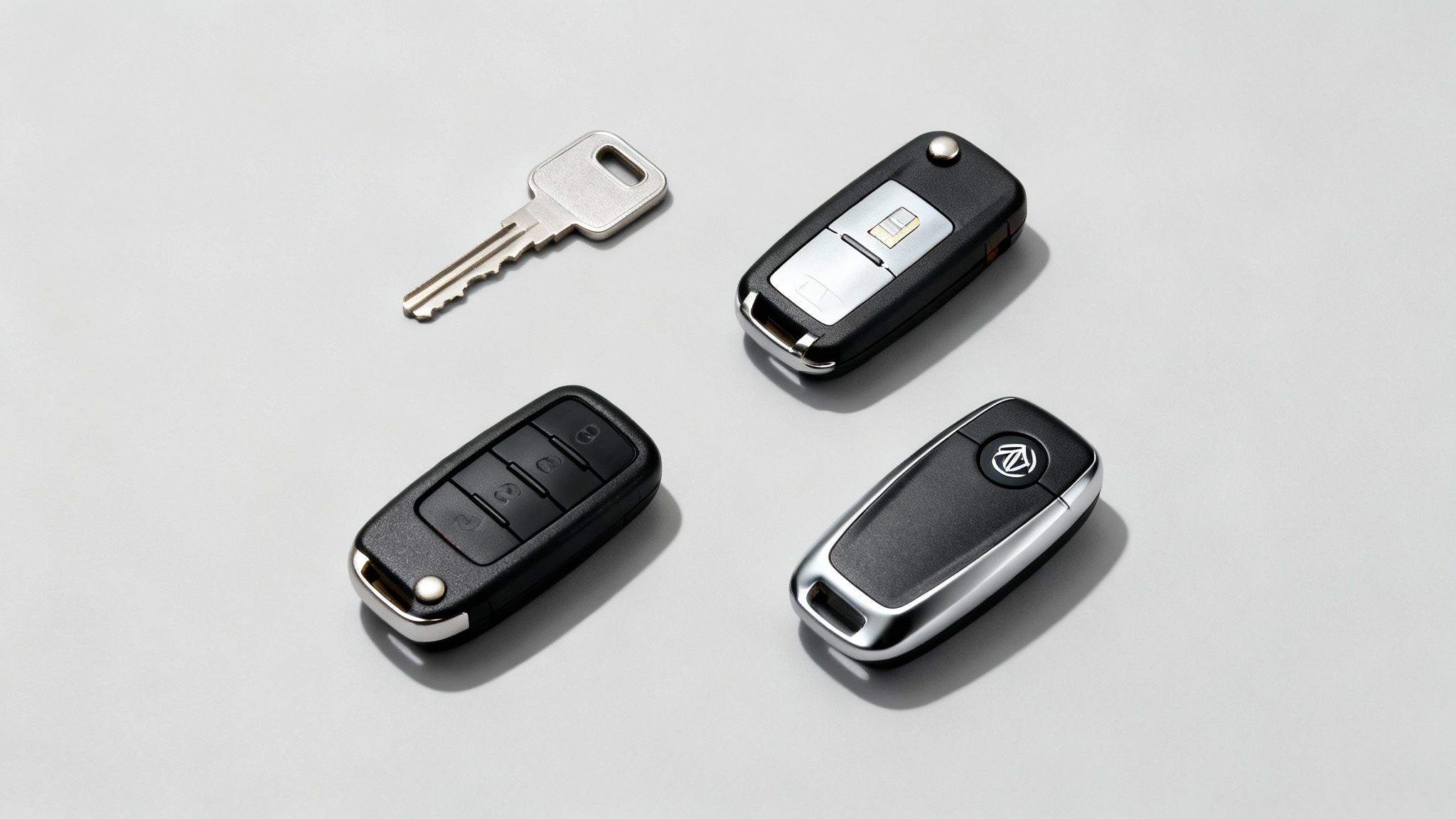
    How Long Does Rekeying Take?

    You'll be surprised how fast it is. A skilled professional can rekey a single lock cylinder in just a few minutes. For a typical Vero Beach or Port St. Lucie home with three or four doors, we're usually in and out in under an hour. It's a quick, convenient fix that barely interrupts your day.

    Is a Rekeyed Lock as Secure as a New One?

    Absolutely. From a security standpoint, a professionally rekeyed lock is just as secure as a brand-new one. The step-by-step process involves changing the lock's internal pins to work with a new key. The old keys become useless, but the strong, reliable hardware you already have stays right where it is.

    When you're settling into a new place, getting the locks sorted should be at the top of your list. It's a key part of these stress-free moving organization tips that ensures your home is secure from the moment you move in.

    The most important takeaway is that rekeying gives you immediate control over your property's access. You'll know for certain that you and your family are the only ones with keys to your home.

    What Other Services Can You Help With?

    While we're at your place in Port St. Lucie or Stuart, we can tackle other lock and key issues in the same visit. Our vans are basically workshops on wheels, fully stocked to handle just about anything.

    Need help with a car lockout? We can get you back in. Lost your remote? We can create a key fob replacement right there. Car won't start because of a key issue? We even handle tricky ignition repair jobs. We're here to be your one-stop solution for any lock problem you run into on the Treasure Coast.


    When you need fast, reliable, and transparent locksmith services on the Treasure Coast, trust the local experts at Pro-B Locksmith. Visit us at https://problocksmith.com or call (772) 710-8169 for immediate, professional help.