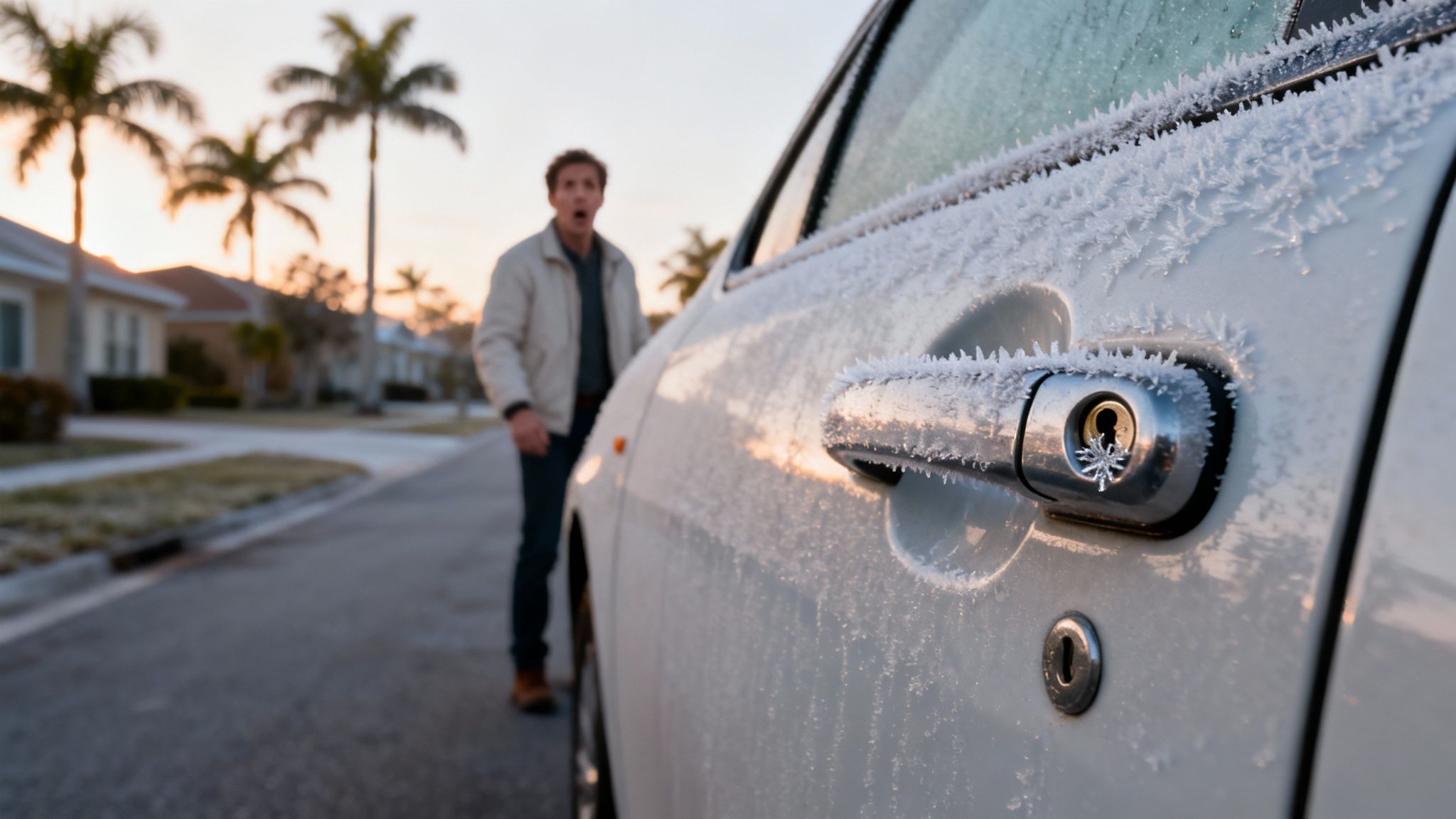
It sounds unlikely for the Sunshine State, but a sudden cold snap can absolutely leave you with a frozen car door lock. It all comes down to Florida's infamous humidity, which gets trapped inside your car's lock mechanism. When the temperature plummets overnight—something we see in Port St. Lucie, Fort Pierce, and Vero Beach more often than you'd think—that moisture turns to ice and jams everything up.
Why Florida Weather Can Freeze Your Car Door Locks

Most people assume frozen locks are a problem for snowy, northern climates. The reality is, the Treasure Coast's unique weather pattern creates the perfect storm for this exact issue. We get those warm, humid days followed by surprisingly chilly nights, especially when a cold front rolls through Stuart or Jensen Beach.
That big temperature swing is the real troublemaker. Moisture from the air, a heavy morning dew, or even leftover droplets from an afternoon shower can easily find their way into the tiny crevices of your car's lock cylinder. Once the thermometer dips to freezing, that trapped water expands as it becomes ice, seizing the delicate metal pins inside the lock.
A Real Example: A Frosty Morning in Port St. Lucie
You don't need a blizzard for this to happen. All it takes is a little moisture and a temperature drop to 32°F (0°C). According to automotive experts, even a single, minuscule droplet freezing inside the key slot is enough to expand and lock the mechanism solid.
Just last winter, we received a call from a homeowner in a Port St. Lucie community who was completely locked out. The previous day was warm and damp, but overnight temperatures dropped to the low 30s. The moisture from the air had frozen solid inside her driver-side lock. This is a real-world example of how our local weather can cause unexpected lockouts. You can find more details on how frozen car locks happen and ways to prevent it.
This is exactly why someone in Stuart or Jensen Beach can wake up to a clear, frosty morning and find their key simply won't turn. The problem isn't a huge block of ice; it's a tiny bit of it in the absolute worst spot.
More Than Just the Lock Cylinder
The keyhole isn't the only part of your door that can freeze up. A few other spots are just as vulnerable and can keep you from getting into your car:
- The Door Seal: Moisture that settles between the rubber gasket and the metal door frame can freeze solid, essentially gluing your door shut.
- The Handle Mechanism: Water can also sneak inside the door handle assembly itself, freezing the moving parts and stopping it from unlatching the door, even if you manage to unlock it.
Dealing with a car lockout from a frozen lock is maddening, especially with a morning commute looming. If you've tried a few quick tricks and nothing is working, whatever you do, don't force the key. That’s a surefire way to snap it off and create a much bigger headache. Call (772) 710-8169 for immediate help and we'll get you in without damaging your vehicle.
Knowing that humidity is the real enemy helps you understand why the simple DIY fixes we're about to cover actually work. It also makes it clear when you're better off calling a professional for a car lockout to avoid a very costly mistake, which could even lead to needing an ignition repair down the line.
Safe DIY Methods To Unfreeze Your Car Lock

When you're standing in the cold, staring at a frozen car door lock, your first instinct might be to just force the key. Don’t do it. That’s a fast track to snapping your key right off in the lock, turning a small annoyance into a real headache that definitely requires a locksmith.
With a little patience and a couple of things you probably have nearby, you can get back in your car without causing any damage. It’s all about using the right tool for the job—even if that "tool" is something from your purse.
The Hand Sanitizer Solution
That little bottle of alcohol-based hand sanitizer you carry around is a fantastic secret weapon against frozen locks. Why? The high concentration of isopropyl alcohol acts as a de-icer, melting the ice that’s jamming up the pins inside your lock.
Here's a step-by-step guide:
- Apply a small squirt of hand sanitizer directly onto the blade of your car key.
- Gently insert the key into the frozen lock.
- Slowly and carefully wiggle the key back and forth. Do not try to turn it yet.
- Remove the key, reapply sanitizer if needed, and repeat until it slides in smoothly. The alcohol will transfer into the lock and melt the ice.
Gently Applying Heat to the Key
No hand sanitizer? No problem, as long as you have a traditional metal key. You can use a lighter or a match to gently warm the blade of your key for a few seconds. The goal is to make it warm to the touch, never red-hot. Getting it too hot can melt the plastic on your key's head or, even worse, damage the lock's internal parts.
Once warm, slide the key into the lock and just hold it still for about 30 seconds. The metal will transfer heat to the lock's tumblers and melt the ice. You may have to repeat this a couple of times to fully thaw it, but it’s a classic trick that works.
Critical Safety Note: Never, ever use a flame on a modern smart key or key fob. The direct heat will fry the internal chip, leaving you with a very expensive key fob replacement bill. This trick is strictly for old-school, all-metal keys. If you have a modern key and you’re stuck in Fort Pierce, the safest bet is to call (772) 710-8169 for immediate help.
Comparing DIY De-Icing Methods
Not all DIY fixes are created equal. Here’s a quick breakdown to help you choose the best approach for your situation.
| Method | Effectiveness | Potential Risks | Best For |
|---|---|---|---|
| Hand Sanitizer | High | Low; generally safe for paint and locks. | Quick, on-the-spot fixes when you have it handy. |
| Warm Key | Moderate | High; risk of damaging fobs, plastic, or the lock itself. | Traditional, all-metal keys only. Use with extreme caution. |
| Commercial De-Icer | Very High | Very Low; formulated to be safe for cars. | Keeping in your home or garage for a reliable, purpose-built solution. |
| Hot Water | Low | High; can refreeze quickly and damage paint/seals. | Not recommended. The risk of making the problem worse is high. |
While a warm key can work in a pinch, you can see why having a purpose-built de-icer or even just a bottle of hand sanitizer is a much safer bet.
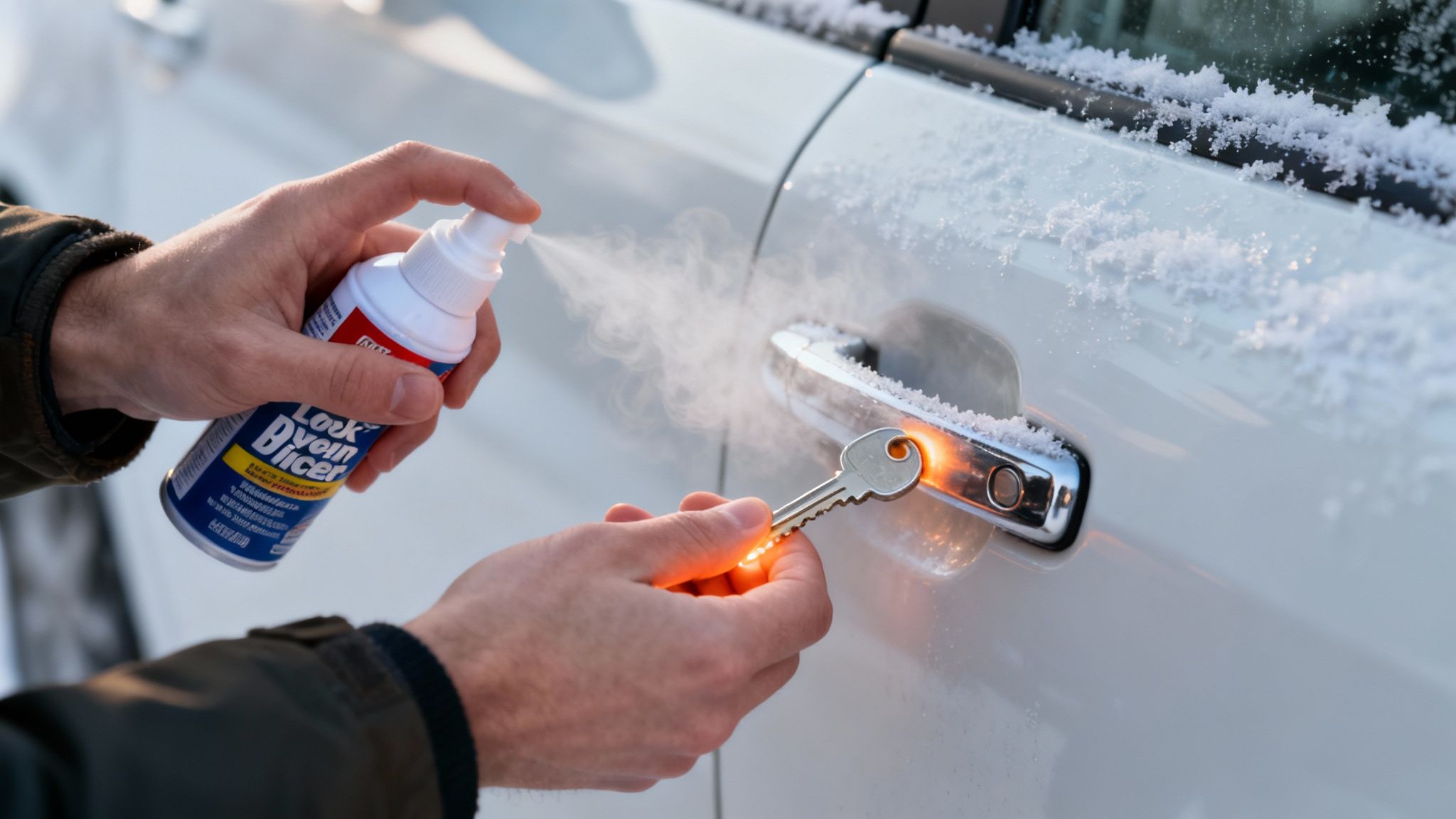
Using a Commercial De-Icing Product
For a surefire solution, nothing beats a dedicated commercial de-icing spray. It’s worth picking one up at a local Stuart auto parts store and keeping it in your garage, especially for those surprise Florida cold snaps. These products are specifically formulated to melt ice fast without damaging your car's finish or the lock mechanism.
Most come with a thin straw-like nozzle that lets you spray the de-icer directly into the keyhole. This gets the formula right where it needs to be. It also works wonders if the rubber seal around your door is frozen shut—a quick spray along the seam can help break the ice bond. If your DIY efforts aren't working, it could point to a more serious problem like a worn-out ignition, which might require professional ignition repair.
Common Mistakes That Lead to Costly Repairs

When you’re staring at a frozen door lock on your car, what you don't do is just as critical as what you do. It’s easy to let frustration take over, but those impulsive decisions can turn a minor headache into a major repair bill. We’ve heard countless stories from drivers right here in Fort Pierce and Port St. Lucie who accidentally made the problem a whole lot worse.
A simple frozen lock can quickly spiral into a several-hundred-dollar ordeal. Before you reach for the first tool you can find, let’s walk through the common missteps that can seriously damage your vehicle.
The Hot Water Myth
It seems like a good idea in theory, right? Pour hot water on the ice, and it melts. Unfortunately, this is one of the most damaging things you can do to your car. That sudden, extreme temperature change can easily crack a window or blister the clear coat on your paint job.
And it gets worse. That water doesn't just vanish. It runs down your door and seeps right back into the lock mechanism and rubber seals. Once the temperature drops again, it refreezes—this time creating an even thicker, more stubborn layer of ice. This is a very common mistake we see in Vero Beach, turning a one-time problem into a recurring one.
There's a persistent myth that hot water is a quick fix, but it's a gamble that rarely pays off. According to AAA warnings, using hot water can crack 1 in 10 windshields due to thermal shock. It's a risk not worth taking.
The Dangers of Brute Force
Another gut reaction is to simply overpower the ice. This usually means jiggling the key aggressively, trying to force it to turn, or prying at the door handle with a screwdriver. This approach almost always ends badly.
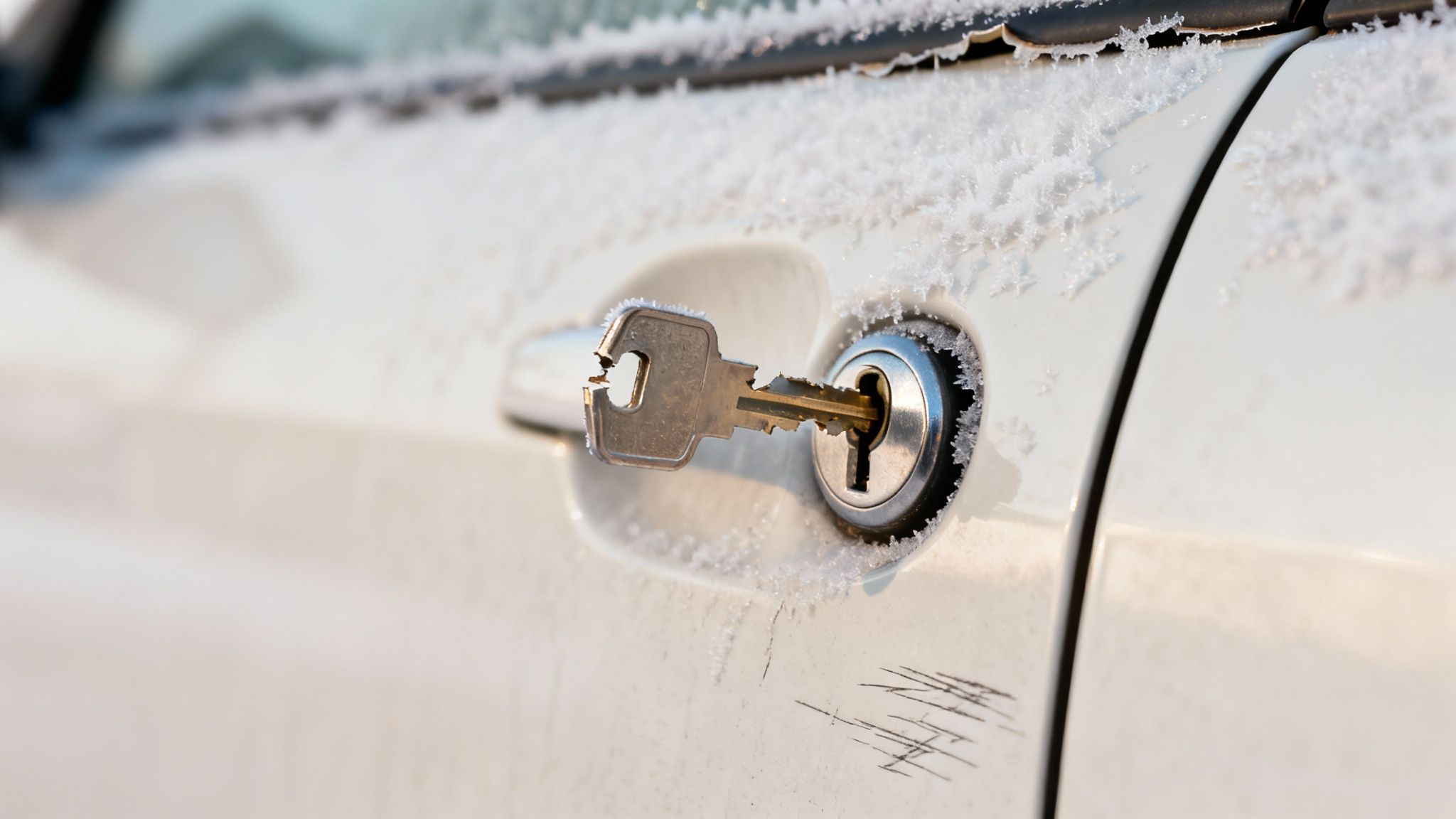
When you force a key, you’re putting incredible stress on metal that’s already brittle from the cold. The most common result? A key that snaps off right inside the lock. Now you're dealing with a professional extraction and likely a new key. A screwdriver is just as bad—it will scratch your paint and can permanently damage the delicate lock cylinder, leading to a full lock change.
Ignoring the Risk of Costly Damage
Trying to force your way into a car with a frozen lock is a high-stakes gamble. Studies by automotive experts show that roughly 1 in 4 attempts to force open a frozen door results in a broken handle or latch mechanism. Those repairs can easily average between $200 and $500. You can find more details on these common mistakes with frozen locks.
If you've tried the safe DIY methods and that lock still won't budge, it's time to stop. Don't risk a broken key or a damaged door. If you find yourself in this jam anywhere from Vero Beach to Jensen Beach, the smartest move is to pick up the phone. For immediate, damage-free assistance with any car lockout, Call (772) 710-8169 for immediate help. Our mobile locksmiths can get you back in your car safely without turning a small problem into an expensive one.
How to Prevent Frozen Door Locks in the Future

Dealing with a frozen door lock on your car is a miserable way to start the day, especially on a surprisingly chilly morning here in Vero Beach or Fort Pierce. While there are plenty of quick fixes, the best solution is always prevention. A few smart, proactive steps can make sure this problem never happens to you in the first place.
It all boils down to one thing: moisture control. Since trapped humidity is the real enemy here, your best defense is creating a barrier against it. That’s where a quality lubricant comes in, shielding the delicate inner workings of your lock.
The Power of Silicone Lubricant
Your number one tool in this fight is a silicone-based lubricant spray. Here's a simple, practical step-by-step for local residents:
- Before a forecasted cold snap, take a minute to spray a small amount directly into the lock cylinder.
- Slide your key in and turn it back and forth a few times.
- This simple action spreads the lubricant evenly across all the internal pins and tumblers.
This does two crucial things:
- It displaces moisture: Silicone is fantastic at pushing existing water out of the lock.
- It creates a barrier: The spray leaves behind a thin, protective film that stops new moisture from getting in and freezing.
And don't stop at the lock. Give the rubber seals around your doors some attention, too. A quick spray of silicone on a cloth wiped along the gaskets will keep them from freezing shut to the car's frame.
A common mistake I see is people grabbing any old lubricant. It’s critical to use the right stuff. Heavy oils and even standard WD-40 can attract dirt and grime over time, which eventually gums up the lock and can lead to bigger problems like needing an ignition repair. Always stick with a clean, moisture-resistant silicone or graphite lubricant designed for this purpose.
Small Habits That Make a Big Difference
Beyond lubricants, a few simple habits can dramatically lower your risk. For instance, if you wash your car on a cool day in Stuart, be extra diligent about drying the door handles, locks, and rubber seals. Any leftover water is just asking to freeze overnight.
The impact of this kind of proactive care is huge. During the brutal 2021 Texas freeze, an estimated 10% of 15 million drivers were stranded by frozen locks. Experts also point out that automotive seals without proper lubrication degrade 20% faster, turning them into perfect traps for ice. Taking a few moments to use a silicone spray can prevent 85-95% of these frustrating incidents. You can find more insights on how preventative measures avoid costly issues on economictimes.com.
Ultimately, a good schedule of overall preventative maintenance is your best defense. If your locks are already feeling stiff, it might be time for a professional to take a look. This is true for your home as well; if you're experiencing lock issues, you might need a service like a house lockout or lock change. Learn more about our full range of automotive locksmith services to keep your vehicle secure.
When It’s Time to Call an Emergency Locksmith
While a lot of quick fixes can get you out of a jam with a simple frozen door lock on your car, some situations are a clear signal to stop and call for help. Pushing your luck can turn a small annoyance into a major, expensive repair. Knowing when to put down the de-icer and pick up the phone is the smartest move you can make.
Listen to what the lock is telling you. If your key meets a hard stop or you feel a grinding sensation, that’s not ice—that’s likely a damaged internal mechanism. Trying to force it is a surefire way to snap the key or destroy the lock cylinder. And if your key has already broken off in the lock? That’s a definite "game over" for DIY.
The Key Fob Complication
Modern cars add a whole new layer of guesswork. Imagine your key fob just stops working on a chilly Port St. Lucie morning. It's easy to assume the battery is dead, but the cold itself can seize the physical lock, which stops the electronic signal from doing its job.
So what are you dealing with? Is it the battery, the lock, or the fob itself? Instead of playing a guessing game in the cold, a quick call to a professional can solve the mystery. We have the gear to test your fob's signal, safely thaw the mechanism, and even handle an on-the-spot key fob replacement if that’s the real problem—usually for a lot less than you'd pay at the dealership.
Why Calling a Mobile Locksmith is Your Best Bet
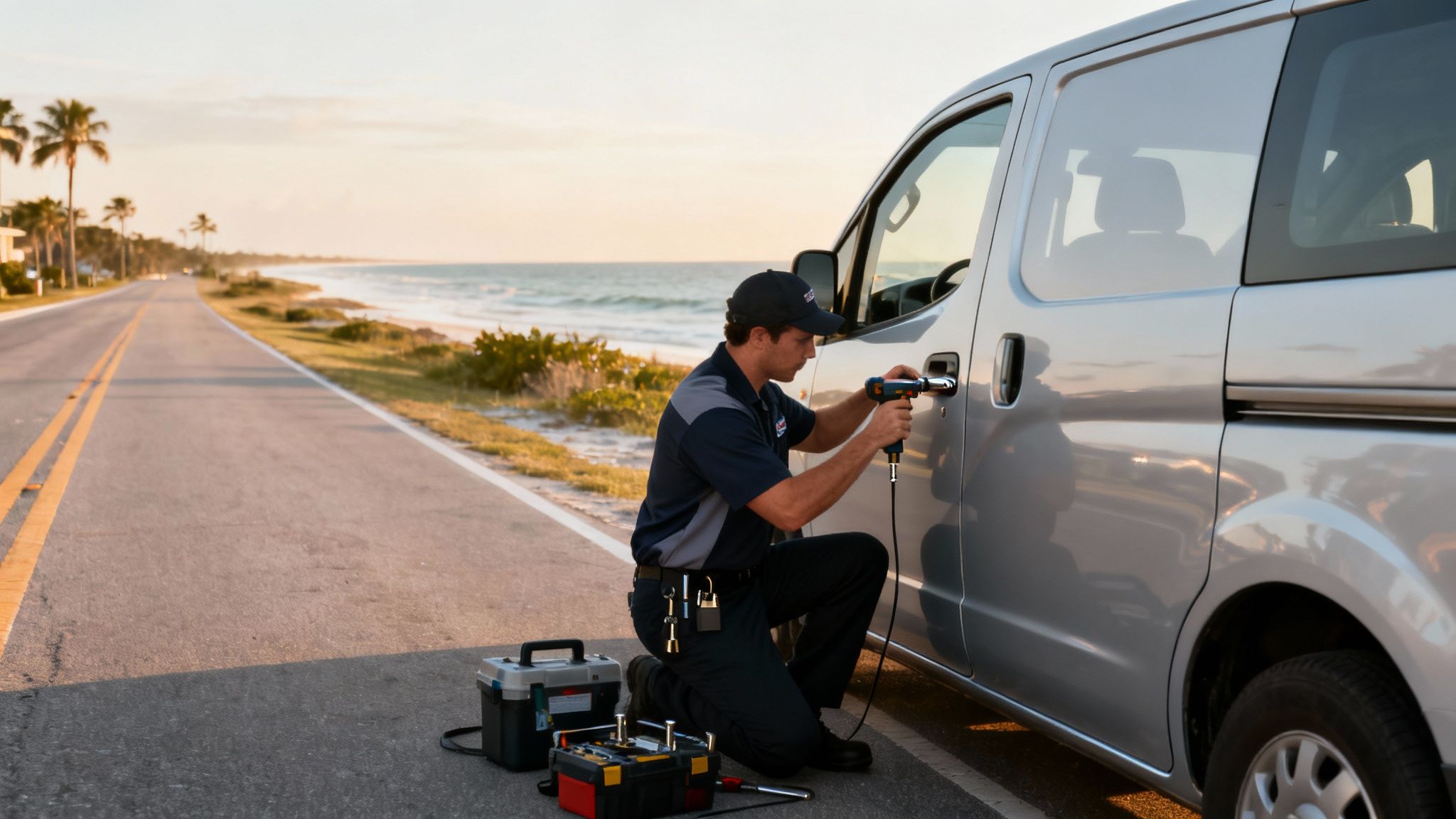
When you're stuck, the last thing you want is a long wait. Calling a mobile locksmith here on the Treasure Coast means an expert comes directly to you, whether you’re stuck in your driveway in Stuart, a parking lot in Jensen Beach, or on the side of the road in Fort Pierce.
Here’s why it’s the better call in these tricky situations:
- Local Expertise: We know the specific challenges of our humid, coastal climate. We're not a generic national chain; we're your neighbors.
- The Right Tools: We use professional, non-destructive tools designed to get you in without a single scratch to your paint, weather stripping, or the lock itself.
- Comprehensive Services: Sometimes a frozen lock is just the tip of the iceberg. Our technicians can spot and fix related issues right then and there, from a basic car lockout to a more involved ignition repair or even a full lock change.
- A Guaranteed Fix: Why waste time and risk damage with methods that might not even work? You get a fast, guaranteed solution that gets you back in your car and on with your day.
Don't let a moment of frustration turn into a repair bill that costs you hundreds. If you've tried the gentle methods and that lock still won't give, or if you're looking at a key broken in the door, it’s time to call in a pro.
For fast, damage-free help anywhere in St. Lucie County, Call (772) 710-8169 for immediate help. We handle everything from a stubborn frozen lock to house lockout situations. If you're locked out right now, check out our specialized emergency lockout services to see how we can get you back on the road quickly.
Your Questions About Frozen Car Locks Answered
Even when you do everything right, a surprise cold snap on the Treasure Coast can leave you with a few head-scratchers. We get calls about this all the time. Here are some quick, no-nonsense answers to the most common questions we hear from folks in Vero Beach, Stuart, and across the area when they're dealing with a frozen door lock on a car.
Is WD-40 a Good Choice for a Frozen Lock?
That's probably the number one question we hear, and our professional answer is "no," at least not for the long haul. Sure, WD-40 can displace water in a pinch and might get you in your car, but it’s not a true lubricant.
The real problem is that over time, it becomes sticky. It attracts dust, dirt, and gunk, which eventually gums up the delicate pins inside your lock. You might solve a small problem today only to create a much bigger, more expensive one down the road, potentially leading to a needed lock change.
A far better choice for both unfreezing and preventing future issues is a silicone or graphite-based lubricant. These sprays are specifically made for locks—they lubricate the moving parts and repel moisture without leaving behind that sticky residue.
My Key Fob Won't Work. Is the Lock Frozen?
It’s a strong possibility. If the mechanical parts inside the door are literally encased in ice, the signal from your fob won't be able to move them. It’s like telling your arm to lift something when it’s stuck in a cast; the brain is sending the signal, but the hardware simply can't respond.
But don't forget about the fob itself. Extreme cold is brutal on small batteries and can drain your key fob's power, making its signal weak or killing it completely. So you’ve got two potential culprits. Our mobile techs in Jensen Beach and Stuart can figure this out in minutes, whether it’s a frozen mechanism or just a dead fob needing an on-the-spot key fob replacement.
When your key fob gives up in the cold, don't automatically assume your car's entire locking system is shot. If you’re not sure, it's always smarter to call (772) 710-8169 for immediate help than to risk damaging the door by forcing it.
Can I Use Warm Water Instead of Hot Water?
Please don't. We strongly advise against using water of any temperature on a frozen lock or window. Even lukewarm water can create a rapid temperature change, and that thermal shock is enough to cause micro-cracks in your car’s paint and even the glass.
Worse yet, that water has to go somewhere. It will run down into every tiny crevice in the lock and door seals, and then it will refreeze. You’ll often end up with a thicker, more stubborn layer of ice than you started with. It's one of those "quick fixes" that almost always backfires and makes the problem worse. This is a real issue we see in the Fort Pierce area every winter.
For more answers to common questions about vehicle security, feel free to check out some of the frequently asked locksmith questions on our website.
When a simple fix doesn't cut it, Pro-B Locksmith is ready to help. Our mobile technicians serve the entire Treasure Coast, providing fast, damage-free solutions for everything from car lockouts to key fob replacements. Get professional help now by visiting https://problocksmith.com.