

Before you dive into programming a transponder key, you first need to get what you’re actually working with. This isn't your grandpa's simple piece of cut metal. A transponder key is a small but mighty security device, housing a tiny microchip that has a wireless conversation with your car's engine immobilizer. That digital "handshake" is precisely why a copy from the local hardware store won't start your engine. For drivers in Port St. Lucie, Fort Pierce, and Vero Beach, understanding this technology is the first step to solving a lost or broken key problem.
What Is a Transponder Key and Why Does It Need Programming?
If you're driving around Port St. Lucie or Fort Pierce, chances are you've been using a transponder key for years without a second thought. Most cars built after the mid-1990s have them. It might look like a regular key with a plastic head, but its real job goes way beyond just turning the lock.
Tucked inside that plastic head is a tiny glass or carbon chip holding a unique, factory-programmed serial number. When you put the key in the ignition, your car’s computer sends out a low-frequency radio signal.
This signal wakes up the chip, which then sends its unique code back to the car. If the code is a perfect match to the one stored in the vehicle's immobilizer, you're good to go—the engine starts. If it doesn't match, or if no code is sent, the engine won't start, period. That's the core of why programming is so critical: you have to formally introduce the key's chip to the car's computer so they recognize each other. Whether you need a simple duplicate or a full key fob replacement, this programming step is non-negotiable.
The Little Chip That Changed Car Security
Transponder technology wasn't just another bell or whistle; it was a game-changer born out of necessity. Back in the late '80s and early '90s, car theft was out of control, with over 1.6 million vehicles stolen in the US in 1991 alone. Thieves could pop a lock and be gone in under a minute.
Everything changed with the introduction of systems like the one in the 1995 Chevrolet Corvette. These small, battery-free chips slashed theft rates by as much as 70% for equipped vehicles. For a deeper dive, it's worth exploring the history of transponder keys.
Telling Your Keys Apart
With all the different keys out there today, it’s easy to get them mixed up. Here’s a quick guide for drivers in Stuart and Jensen Beach:
- Traditional Metal Key: Just a simple, non-chipped key for older cars. You can get one copied anywhere. It offers zero electronic security.
- Transponder Key: This is the one with a chip hidden in the plastic head. It must be programmed to your vehicle to start the engine.
- Remote Key Fob: Think of this as a transponder key with extra features. It has the same security chip but also includes buttons for locking, unlocking, or popping the trunk. The remote part and the transponder chip are often programmed separately.
- Smart Key (Proximity Key): The key for push-to-start cars. You just need it inside the vehicle; you don't have to insert it. It uses a more advanced system but still relies on that same programmed "handshake" to work.
Key Takeaway: Programming is what forges the secure digital bond between your specific key and your car. Without that pairing, the key is just a fancy piece of plastic that might unlock the doors but will never get you down the road.
If you've ever had a car lockout because a key suddenly failed, a damaged transponder chip is a likely suspect. This is a common issue we see in the Jensen Beach and Stuart areas.
Knowing this can save you a lot of headaches. If your key turns in the ignition but the car just won't start, the problem might not be your engine at all—it could be a communication breakdown between the key and the car. If you're in Vero Beach and stuck in this situation, don’t stress. Call (772) 710-8169 for immediate help, and we can diagnose and fix it right where you are.
So, You Want to Program Your Own Transponder Key? Here's How It Can Be Done
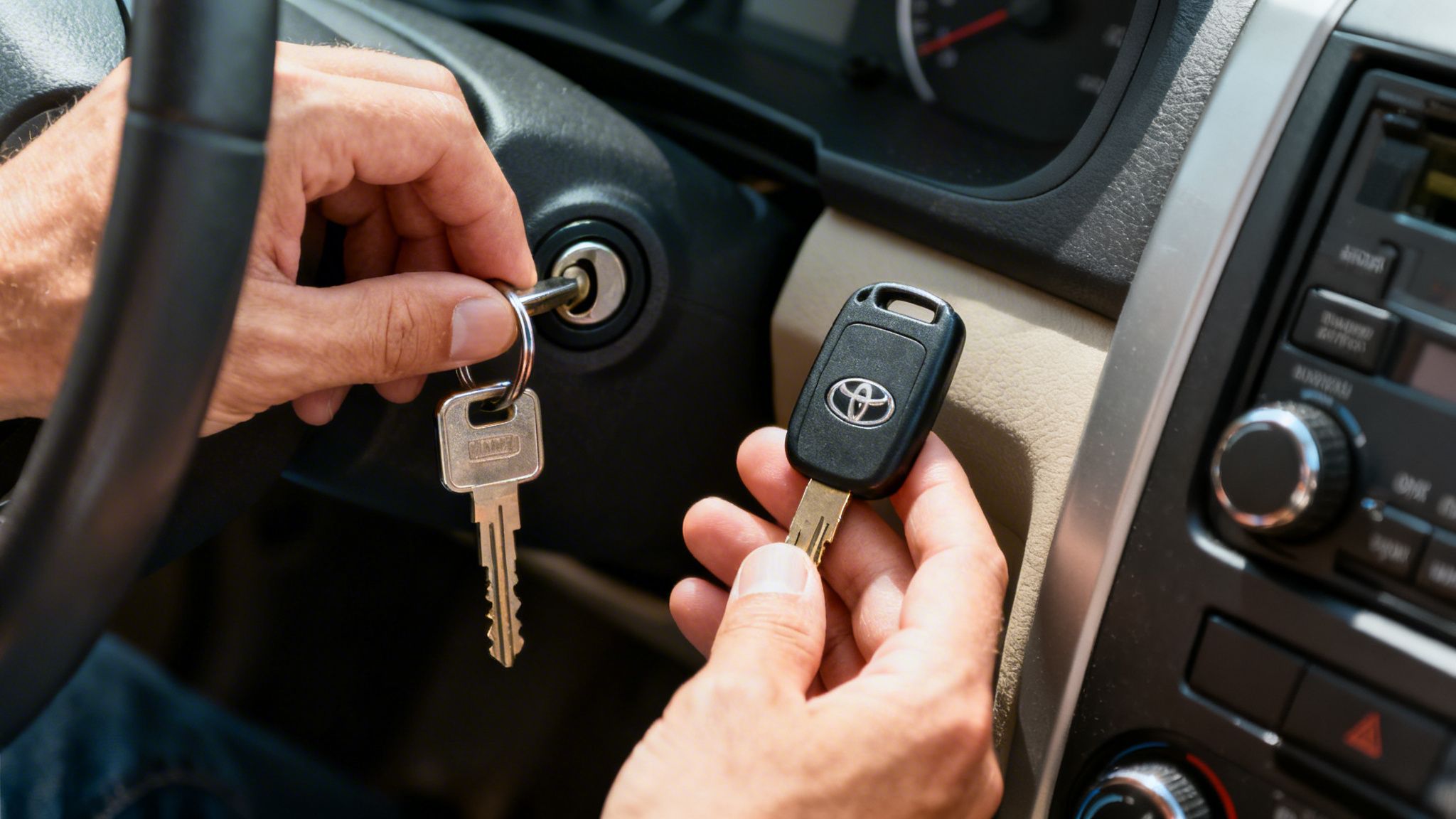
For the hands-on car owner in Jensen Beach or Stuart, the idea of programming your own transponder key is pretty tempting. And honestly? For some cars, especially older domestic models, it's absolutely doable. You can save yourself a trip to the dealership and their steep fees, turning a headache into a satisfying Saturday afternoon project.
These methods almost always involve a specific, timed "dance" of key turns and button presses that kick your car's computer into learning mode. But I have to be clear: this isn't a universal trick. Your success hinges entirely on your car's make, model, year, and—this is the big one—how many working keys you already have.
The Two-Key Programming Method
One of the most common DIY tricks I see is the "two-key" method. This was a go-to for a lot of Ford, Lincoln, and Mercury vehicles back in the early 2000s. The name says it all: you must have two already programmed, working keys. You're essentially using those two keys to vouch for the new one.
Let's walk through a real-world example, say for an older Ford F-150. It usually goes something like this:
- First, you'll put the first working key in the ignition and turn it to "On"—don't start the engine. Wait for the little security light on the dash to go out, which takes about three seconds.
- Next, turn it off and pull it out. You've got about five seconds to pop in the second working key and turn it to "On." Again, wait for that security light to go off.
- Turn that second key off and remove it. Now, within ten seconds, grab your new, unprogrammed key and turn it to the "On" position.
- Keep your eye on the security light. It should light up for a few seconds and then go out. If it does, congratulations—you've just successfully programmed the new transponder chip.
This sequence is the car's built-in security check. It confirms that someone with two valid keys is authorizing a new one. If you mess up the timing, don't panic. The car will just exit programming mode, and you can start the process over.
The Single-Key Method for Certain Models
A bit less common, but still out there, is the "one-key" method. You’ll sometimes find this on certain Chrysler, Dodge, and Jeep models. More often than not, this procedure is actually for programming the remote's lock and unlock buttons, not the transponder chip itself, but sometimes the two are connected.
This process involves its own unique sequence of turning the ignition and pressing buttons on the fob. It's incredibly specific to the vehicle, so you'll absolutely need the exact instructions from your owner's manual or a source you trust online. If you're in Fort Pierce fumbling with a tricky sequence that just won't take, that's usually a sign that professional equipment is required. Instead of getting frustrated, just Call (772) 710-8169 for immediate help, and we'll get it programmed right the first time.
The Big Risks of Going It Alone
While these DIY methods can be lifesavers, they come with some serious limitations and potential pitfalls, especially for those of us on the Treasure Coast who can't afford to be without our cars.
Crucial Warning: If you've lost all your keys, DIY programming is off the table. Period. An "all keys lost" situation requires specialized diagnostic tools that talk directly to the car's immobilizer system. That's a job strictly for a professional auto locksmith or the dealership.
Another huge problem I see all the time is the quality of the key itself. It's tempting to buy those super cheap aftermarket keys online, but you often get what you pay for. They frequently use low-grade transponder chips that are just plain unreliable.
- Programming Failure: The cheap chip might not even respond to the car's programming sequence, leaving you with a key that does everything but start the engine.
- Intermittent Problems: Worse, it might program successfully, only to fail you weeks later in a Vero Beach parking lot when you least expect it.
- "Bricking" Your Car's Computer: This is the nightmare scenario. A faulty key or an incorrect programming sequence can, in rare cases, corrupt your car’s engine control unit (ECU). That's an astronomically expensive repair that makes the cost of a professional key look like pocket change. The risk is much higher with newer or European models.
For most modern cars—especially from brands like BMW, Audi, Toyota, and Honda—the advanced encryption they use makes DIY methods a non-starter. For these vehicles, your best and safest bet is always to call a professional for a reliable key fob replacement and programming.
DIY vs Professional Key Programming
Deciding whether to tackle this yourself or call in a pro can be tough. Here’s a quick breakdown to help you choose the right path for your situation.
| Factor | DIY Programming | Pro-B Locksmith Service |
|---|---|---|
| Cost | Lower upfront cost (just the key blank). | Higher initial cost, but includes a high-quality key and guaranteed success. |
| Time | Can be quick (15-30 mins) if it works; hours of frustration if it doesn't. | Typically fast (under an hour). We come to you in Port St. Lucie, Fort Pierce, etc. |
| Required Tools | Your existing keys, the new key, and precise instructions. | Professional-grade diagnostic tools and key cutting machines. |
| Vehicle Compatibility | Limited, mostly older domestic models. | Virtually all makes and models, including modern and high-security vehicles. |
| Risk Factor | Moderate to high. Risk of failure, intermittent issues, or even ECU damage. | Extremely low. We carry insurance and guarantee our work. |
| "All Keys Lost" | Not possible. | Yes, this is one of our specialties across the Treasure Coast. |
Ultimately, while a successful DIY job feels great, the peace of mind that comes with a professionally programmed key that's guaranteed to work is often worth the investment.
Knowing When to Call a Professional Locksmith
While tackling a project yourself can be satisfying, sometimes you have to know when to fold 'em. When it comes to your car's security, DIY methods have a very clear ceiling. The real skill is knowing the difference between a project you can handle in your driveway and a job that absolutely requires a specialist. This is that moment to put down the tools and pick up the phone.
There are a few scenarios that are immediate red flags for any DIY attempt. If you’ve lost all your keys, for example, there’s simply no workaround. You need a pro who can generate a brand-new key from scratch and program it to your vehicle’s computer. The same goes for a key with a broken transponder chip—no amount of fancy ignition turning is going to fix a physically damaged component.
And if you're cruising around Vero Beach or Stuart in a BMW, Mercedes, Audi, or another high-end European car, just stop right there. Their advanced encryption systems are specifically designed to lock out unauthorized programming. Accessing them safely requires sophisticated, dealership-level diagnostic tools.
The Pro-B Locksmith Advantage On the Treasure Coast
This is where the value of a mobile locksmith really shines. While the temptation to save a few bucks with a DIY method is understandable, knowing when to call for professional locksmith services specializing in transponder keys can save you a world of time and frustration. At Pro-B Locksmith, we bring the workshop to you, whether you're stranded in Port St. Lucie, Fort Pierce, or Jensen Beach.
Our mobile service vans are basically workshops on wheels, loaded with:
- Sophisticated Diagnostic Tools: We plug directly into your car's OBD-II port to communicate securely with the immobilizer system.
- Precision Key-Cutting Machines: We can cut a perfect physical key blade on-site, matched exactly to your car's locks and ignition.
- A Full Stock of High-Quality Keys: Forget gambling on cheap knock-offs from the internet. We carry reliable, guaranteed transponder keys and fobs for most makes and models.
This on-the-spot service means you get to skip the tow truck fees and the ridiculously long wait times you’d face at a dealership. We turn a frustrating, day-ruining event into a quick and efficient fix, right where you are. Our services include not just key programming but also help with a car lockout, house lockout, and lock change.
Why Professional Tools Are Non-Negotiable
Automotive security is always evolving, and the market reflects that. The global automotive key market was valued at over $7.1 billion in 2025 and is expected to more than double by 2035. This boom is almost entirely driven by transponder keys, which command a massive 91.8% market share because they just work. With over 80 million vehicles produced annually worldwide, the demand for precise programming tech is only going up. You can dig into the numbers yourself in the full automotive key market analysis.
To stay ahead of the curve, professionals rely on advanced gear like the Autel IM608 or top-tier Launch scanners. These are the tools needed for complex keys that transmit VIN data—something that, until recently, only dealers could handle. It’s this exact technology that allows our mobile technicians on the Treasure Coast to cut and program a key in as little as 15-20 minutes. That's a critical service, considering an estimated 70% of cars on the road since 1995 need it.
If your DIY attempt has backfired, or if you've lost your only key, don't risk messing with your car's sensitive electronics. One wrong move can lead to a fried ignition or, even worse, a damaged Engine Control Unit (ECU). Instead of taking that risk, make the smart call.
Call (772) 710-8169 for immediate, on-the-spot key programming. Our expert team provides reliable solutions across the Treasure Coast, getting you back on the road safely and without the dealership price tag. To see how we operate locally, check out our work as a locksmith Port St. Lucie.
What Happens When a Professional Programs Your Key?
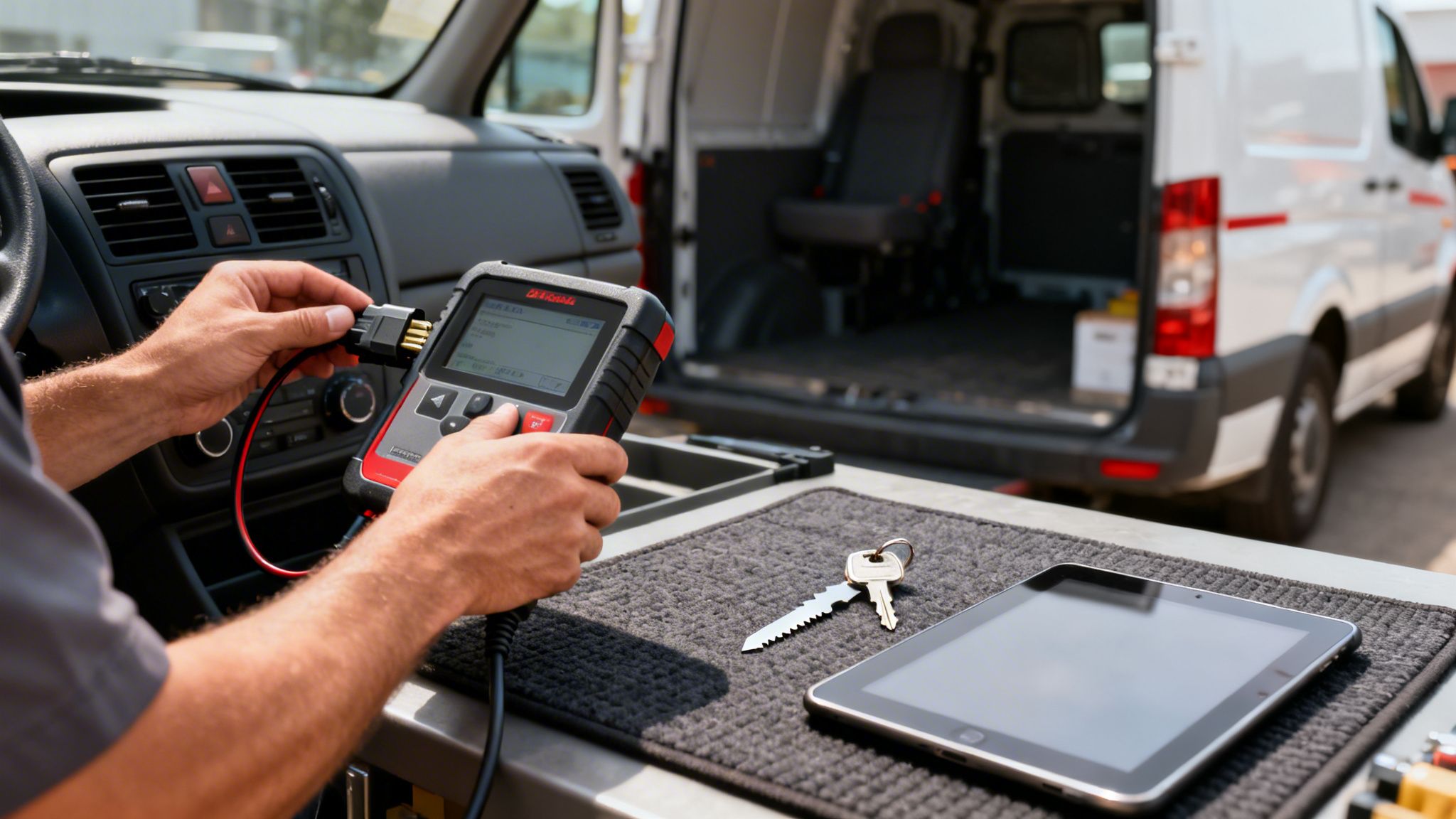
When our mobile locksmith van arrives at your spot in Port St. Lucie or Jensen Beach, you're getting a dealership-level service without the wait or the trip. It's a precise blend of technical skill and hands-on expertise, all designed to be quick, secure, and completely transparent.
Before a single tool comes out, our first step is always to verify vehicle ownership. This is an absolute must for security. We'll ask to see your ID and vehicle registration to confirm you're the rightful owner. It's how we protect your property and prevent any unauthorized access.
Once we’ve confirmed everything, we get to work on the physical key. If your key has a blade, we don't just trace a copy. We use professional-grade laser cutters to mill a new blade to factory specifications. This precision ensures a perfect fit, preventing future problems like a jammed ignition or broken key that could lead to more costly ignition repair.
Tapping into Your Vehicle’s Computer
With the key blade perfectly cut, it's time for the high-tech part: the programming. This is where our specialized diagnostic equipment comes into play. Our technician will locate your vehicle's OBD-II port, usually tucked away under the dashboard on the driver's side.
This port is our direct line into your car’s central computer. By connecting our programmer, we get secure access to the immobilizer system—the part of your car that remembers which keys are allowed to start the engine. It’s a delicate procedure that requires the right software and experience to navigate the vehicle's system without causing any glitches.
Next, we put your vehicle into "learning mode" through our diagnostic tool. This tells the car it's about to be introduced to a new, authorized key. We then transmit the unique code from the new transponder chip and sync it with the immobilizer. It’s this digital handshake that tells your engine it’s okay to start.
Erasing Old Keys for Your Security
One of the most important steps, especially if you've lost all your keys, is managing the car’s memory. We don't just add a new key; we also delete any old, lost, or stolen keys from the system.
Key Security Takeaway: When we erase old keys, that lost key you dropped in a Fort Pierce parking lot becomes useless. It might fit the lock, but it won't start the engine. This gives you complete peace of mind, knowing only the keys you have will work.
This is a critical security measure that’s often overlooked. It essentially resets your vehicle's security, ensuring that only you have access. Many of our customers in Vero Beach and Stuart tell us how reassuring this is, especially after misplacing a key.
The whole on-site process is built for your convenience. From cutting the key to the final programming and testing, we can usually have you back on the road in under 30 minutes. No towing, no long waits at the dealership.
If you ever need a new transponder key and want an expert to handle it right, don't hesitate. Call (772) 710-8169 for immediate help. To see everything we can do, from lockouts to complex key creation, check out our automotive locksmith services and see how we help drivers across the Treasure Coast.
Troubleshooting Common Transponder Key Issues
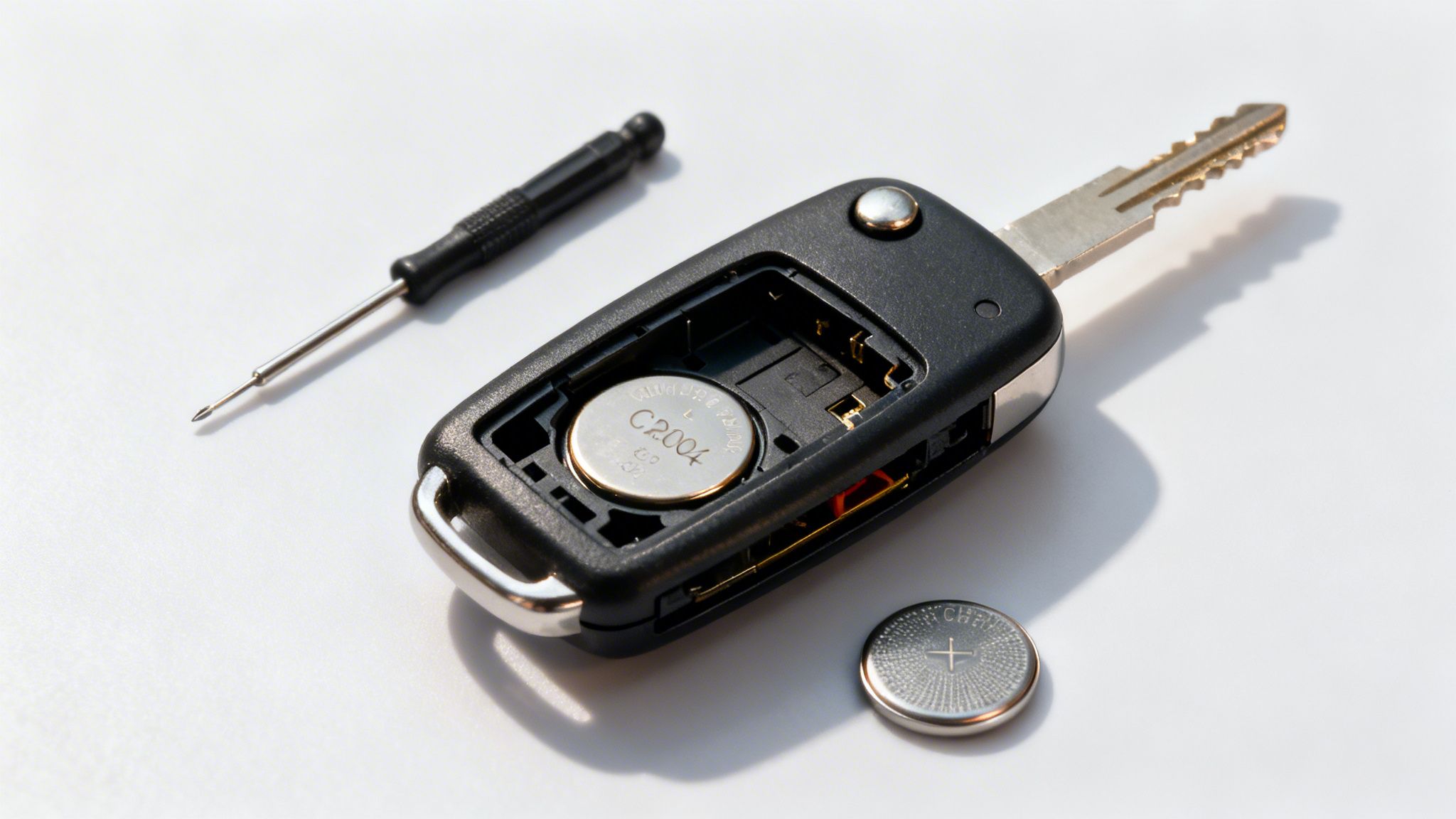
Even a perfectly programmed key can give you headaches. One minute you're running errands, the next you're stranded in a Port St. Lucie parking lot because your car refuses to start. It's incredibly frustrating, but nine times out of ten, the problem is one of a few common culprits.
The first signs of trouble are often subtle. You might see a "Key Not Detected" message pop up on the dashboard, or the engine will crank but never actually turn over. Sometimes the key only works after a few tries. These aren't just random glitches; they’re clear symptoms that something is wrong with the key or the car's security system.
Is It Just a Dead Battery?
Before you assume the worst, always check the simplest thing first: the battery. If your key has remote buttons for locking and unlocking the doors, a dead battery is the most common reason for failure.
Now, it's important to know that the battery does not power the transponder chip itself. That chip works passively. However, a dying battery can sometimes create electronic interference that messes with the car's ability to read the chip. Replacing the small coin battery is cheap, quick, and solves a surprising number of issues. Most fobs pop open with a small screwdriver, and you can grab a new battery (usually a CR2032 or similar) at any store in Stuart or Vero Beach.
The Problem of a Damaged Chip
If a fresh battery doesn’t fix the problem, you're likely looking at a damaged transponder chip. These little chips are tough, but they're not invincible. A hard drop onto concrete or even repeated exposure to a strong magnet can be enough to fry the delicate electronics inside.
Here's an easy way to check. Grab your spare key. If the spare starts the car right up with no problems, you've found your answer—the chip in your main key is shot. Unfortunately, a damaged chip can't be repaired. You'll need a full key fob replacement.
Pro Tip: Dropped your key in water? Don't panic just yet. Immediately pop it open, take out the battery, and bury all the parts in a bowl of dry rice for at least 24 hours. This little trick has saved countless keys from permanent water damage.
Ignition Issues vs. Key Failure
What if neither of your keys works? In that case, the problem probably isn't the key at all. It's likely an issue with the car's ignition system. The antenna ring that sits around the ignition cylinder is what "talks" to your key, and if that part fails, no key will work.
Watch for these signs of a failing ignition:
- The key feels stiff or gets stuck when you try to turn it.
- Your dashboard lights flicker as you turn the key.
- The car starts but then immediately shuts off.
Knowing whether you have a bad key or a bad ignition is critical. A new key won't fix a broken ignition, and vice-versa. This is where professional diagnostics make all the difference. If you're in Fort Pierce and stuck in this situation, Call (772) 710-8169 for immediate help. Our mobile techs can test your key and your vehicle's ignition system to find the real cause, providing expert ignition repair on the spot if needed.
This kind of diagnostic work shows just how far car security has come. Back in the mid-1990s, transponders were a high-end feature on cars like the 1995 Corvette. Today, they're a security standard on over 90% of all modern vehicles, a change driven by the need to combat rising car theft. This technology has been a game-changer. Here in Port St. Lucie, professional locksmiths now rely on sophisticated tools to handle today's keys, giving you dealership-quality service right where you're parked. You can learn more about the evolution of car key technology to see just how advanced these systems have become.
Answering Your Transponder Key Questions
Drivers all over the Treasure Coast have questions about transponder keys, and frankly, there's a lot of confusing information out there. We get calls about this every day, so let's clear up some of the most common things people ask.
What’s the Cost to Program a Transponder Key in Port St Lucie?
The price tag for programming a new key can really swing depending on what you drive. A newer luxury car with a sophisticated security system is naturally going to be on the higher end compared to an older, more common model.
That said, calling a mobile locksmith is almost always going to be easier on your wallet than going to the dealership. Dealerships have massive overhead costs, and that gets baked into your bill. As a local mobile service for Port St. Lucie, Stuart, and the surrounding areas, we can cut those costs down, often saving you up to 50% on the whole job. We give you a straightforward price upfront, no games. For a quick quote on your specific car, just Call (772) 710-8169 for immediate help.
Can You Program a Key I Bought Online?
Absolutely. We get this question a lot from folks in Jensen Beach and Stuart who find a deal on a key blank online. We're happy to try and program it for you.
Just a friendly heads-up, though: it comes with some risk. We've seen many of these aftermarket keys fail because they're built with cheap transponder chips. Sometimes they won't program at all, and other times they'll just quit on you a few weeks down the road. If the key you have doesn't take, don't worry. Our vans are stocked with high-quality, guaranteed keys we can cut and program right then and there.
How Long Does This Whole Process Take?
We know you've got places to be. Our entire service is built around getting you back on your way as fast as possible.
From the moment our technician arrives at your car—whether you're at home in Vero Beach or stuck at work in Fort Pierce—the actual work is surprisingly fast. Cutting the new blade and programming the chip to sync with your vehicle's computer usually takes just 15 to 30 minutes.
Do I Need a Tow Truck If I've Lost All My Keys?
No, you definitely don't! This is a huge relief for most people and one of the biggest perks of calling a mobile locksmith. Losing every key you have is stressful enough without adding a tow bill to the mix.
Think of our locksmith vans as complete workshops on wheels. We drive to you, wherever you are on the Treasure Coast, and create a brand-new, working key from scratch. This saves you the time, headache, and serious expense of towing your car to a dealer.
We turn a major ordeal into a simple fix right on the spot. If you have other questions, you can always find additional information on our FAQ page.
Need a transponder key programmed fast without the dealership prices? The expert team at Pro-B Locksmith brings reliable, guaranteed service right to your vehicle in Port St. Lucie, Fort Pierce, Vero Beach, Stuart, and Jensen Beach.

