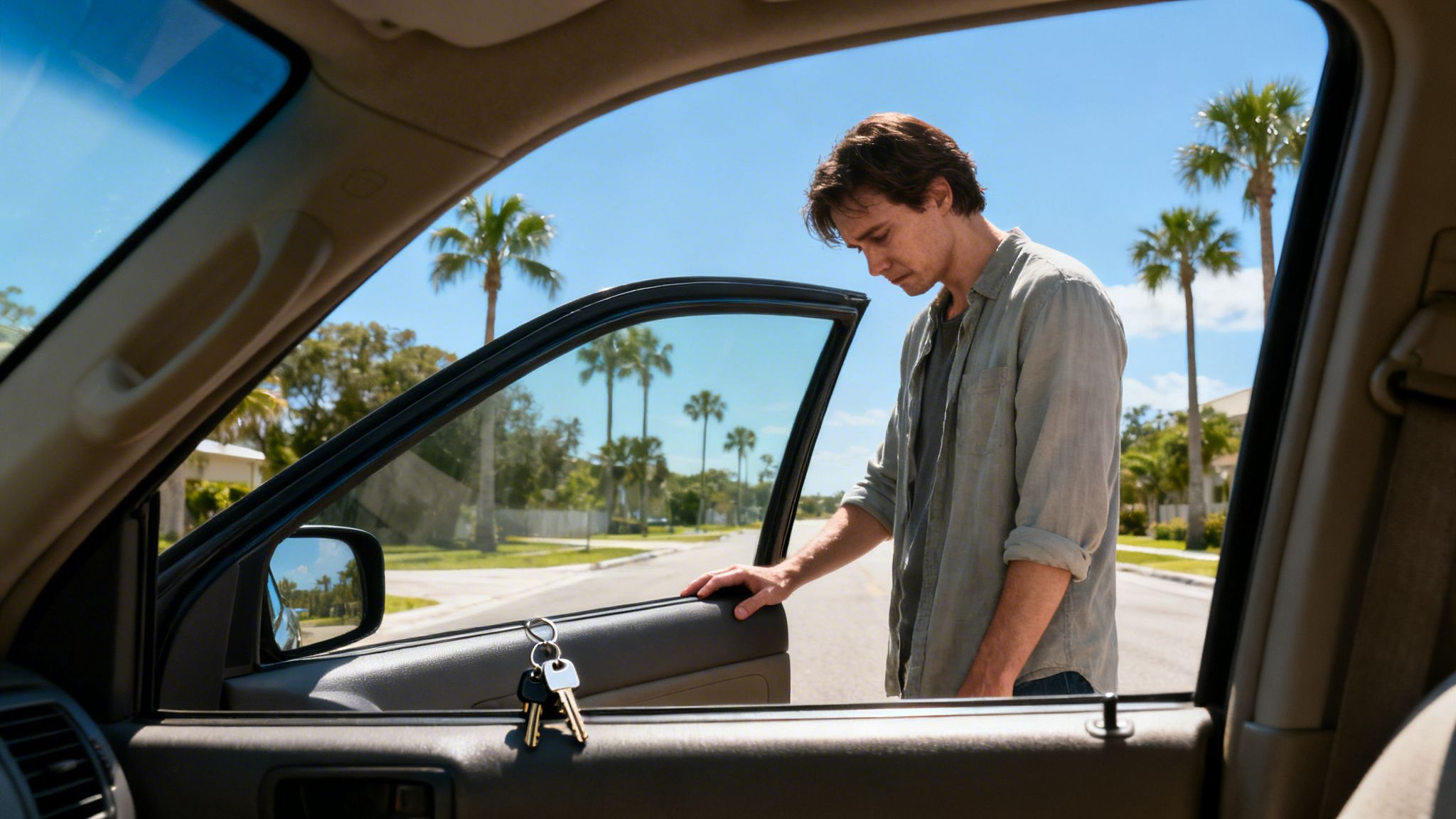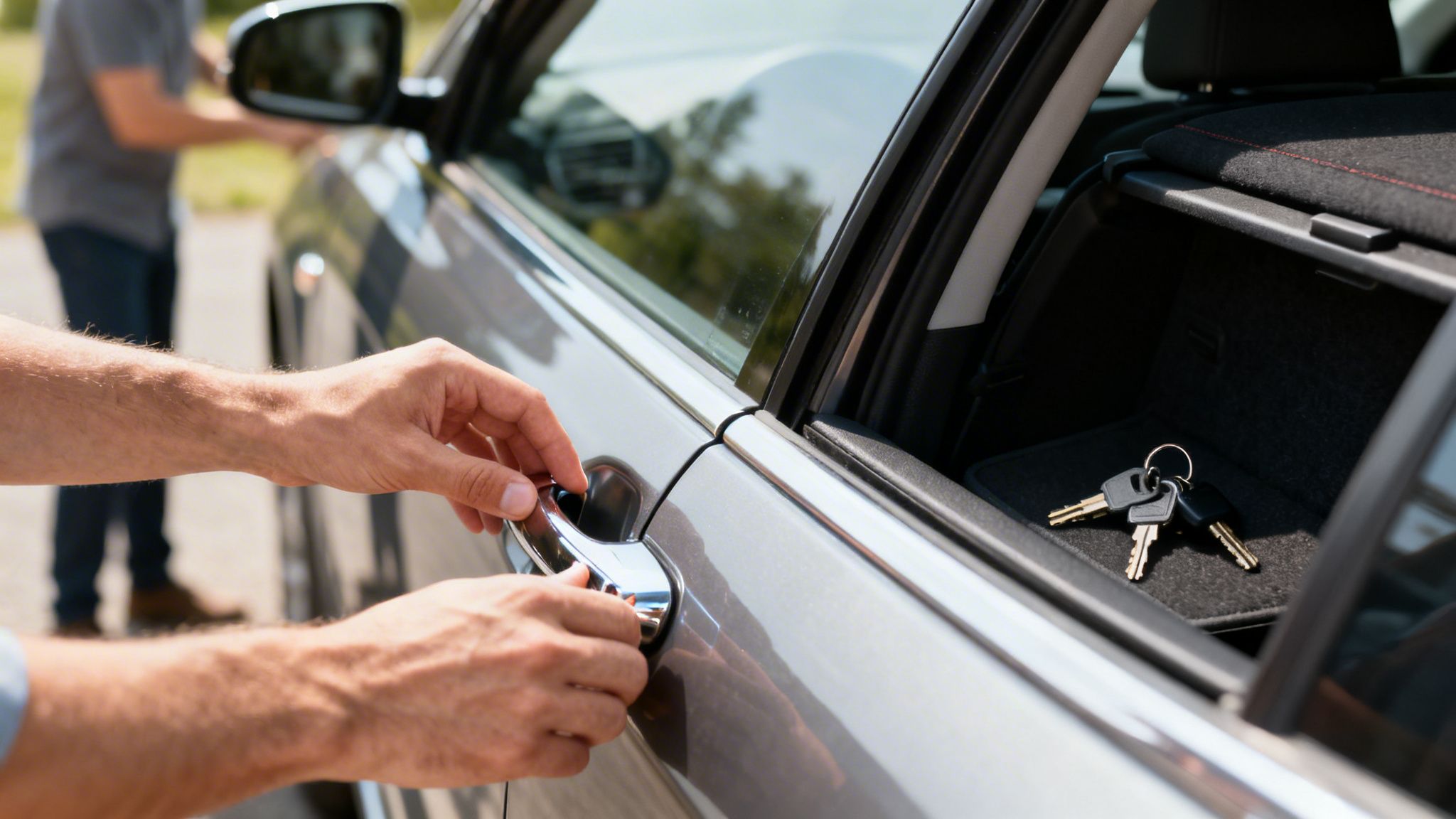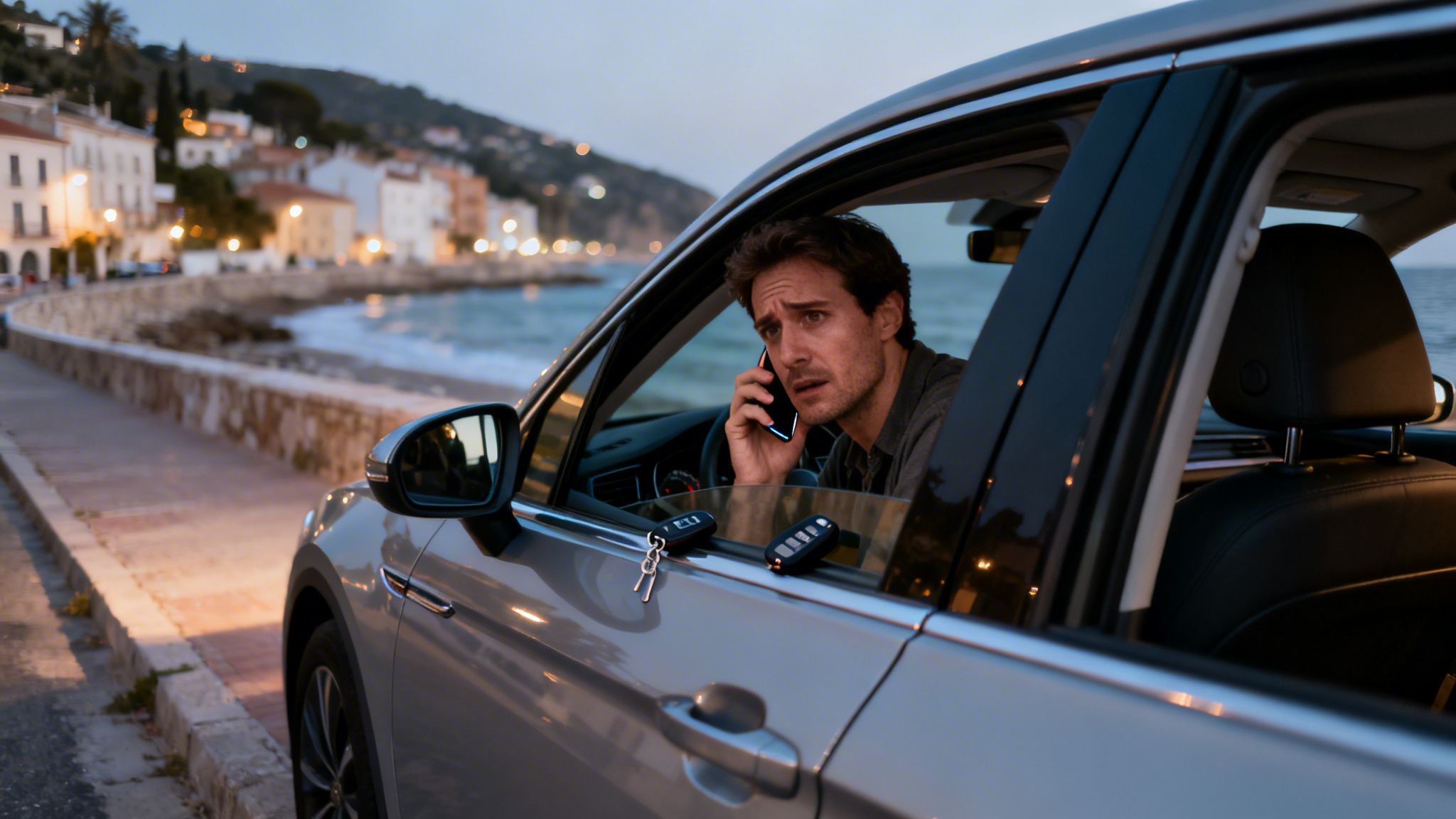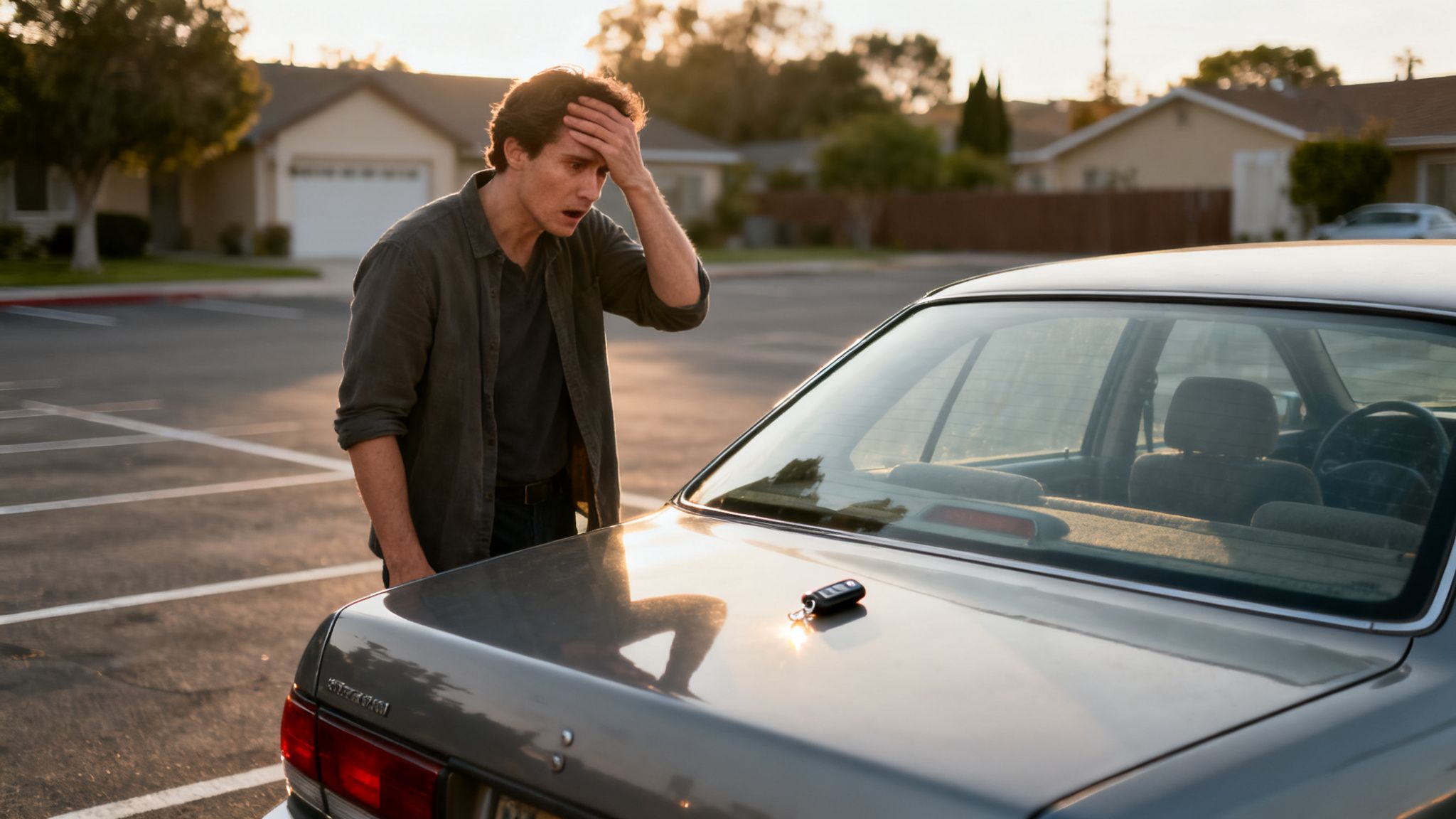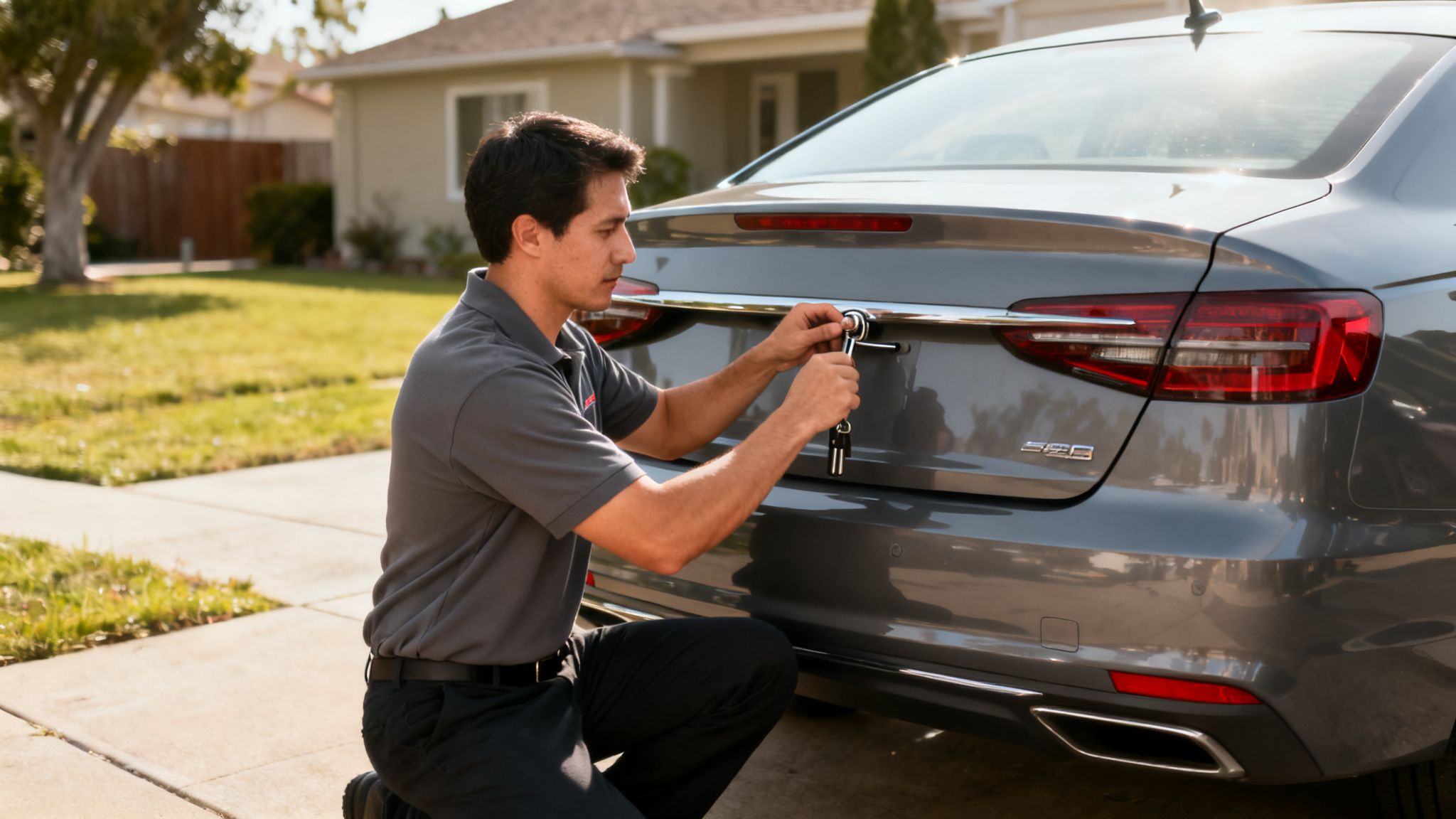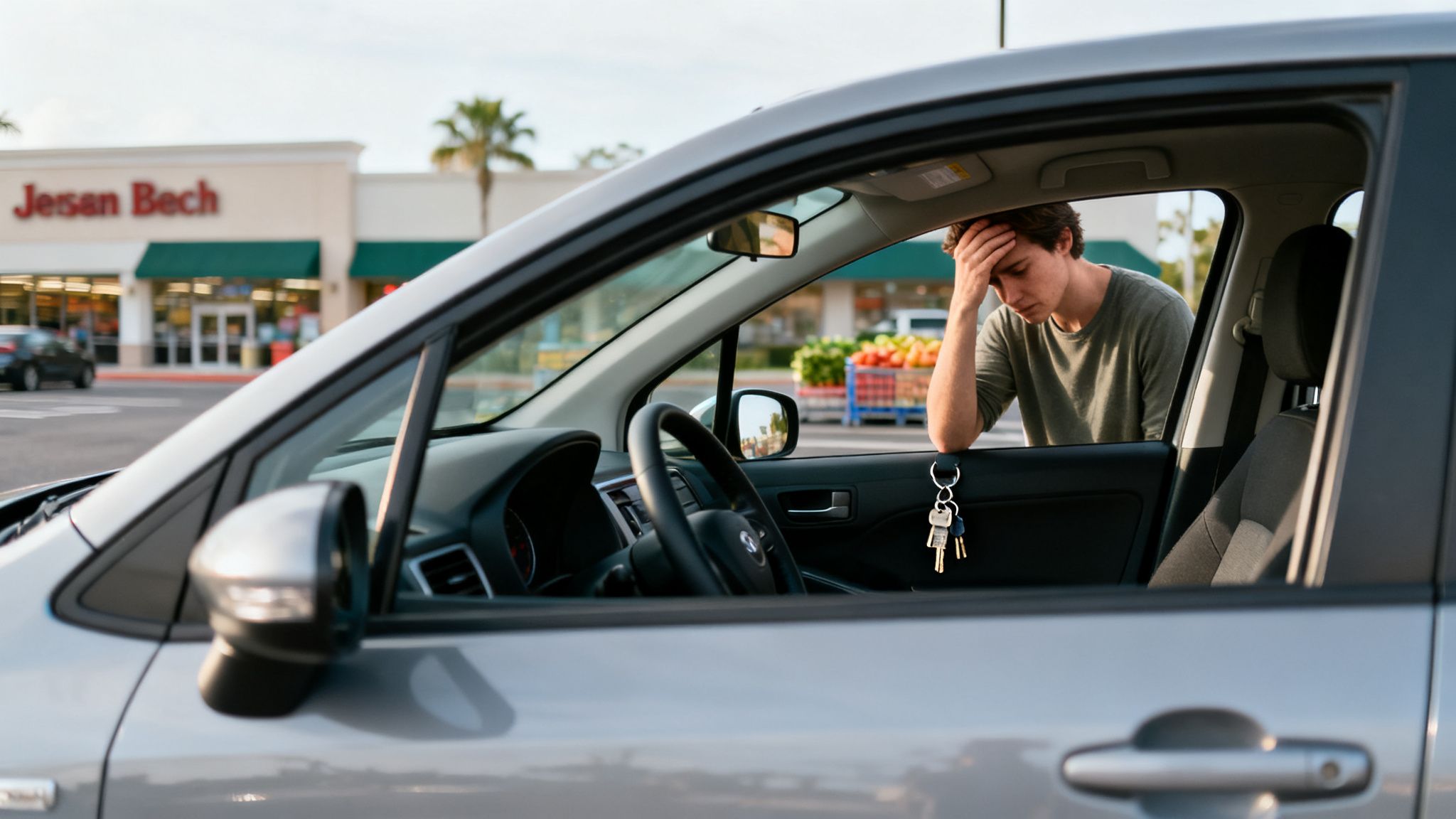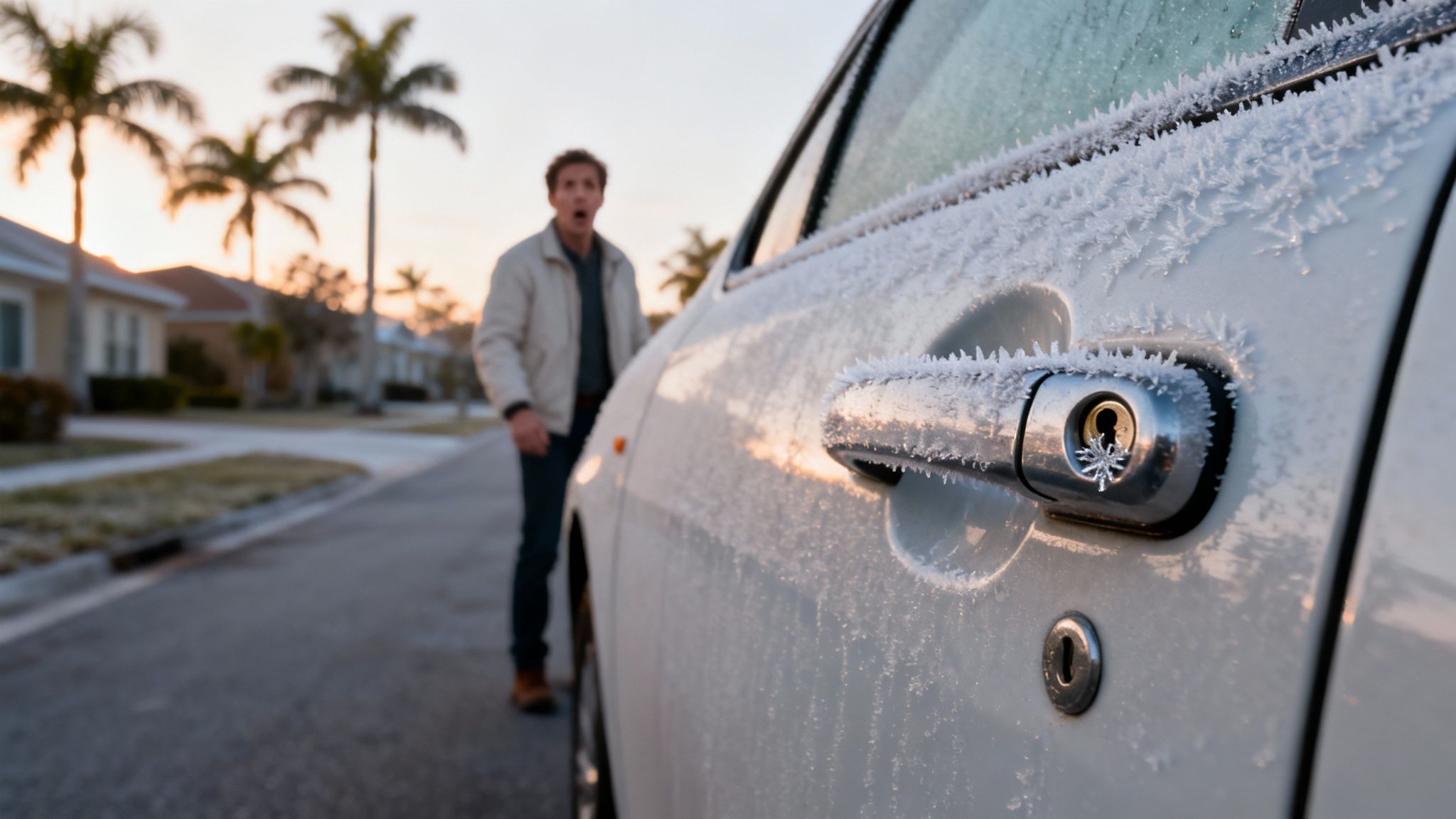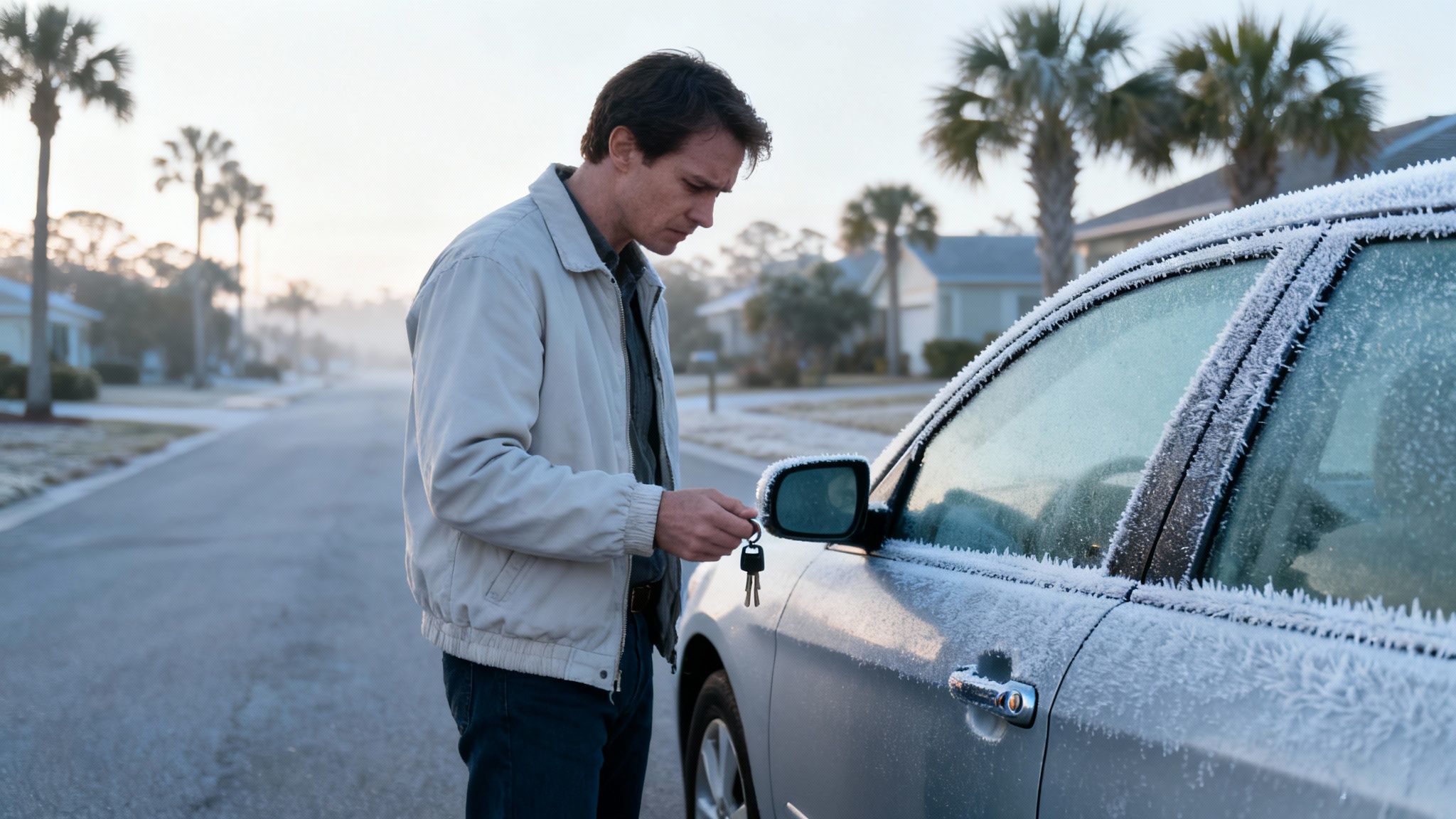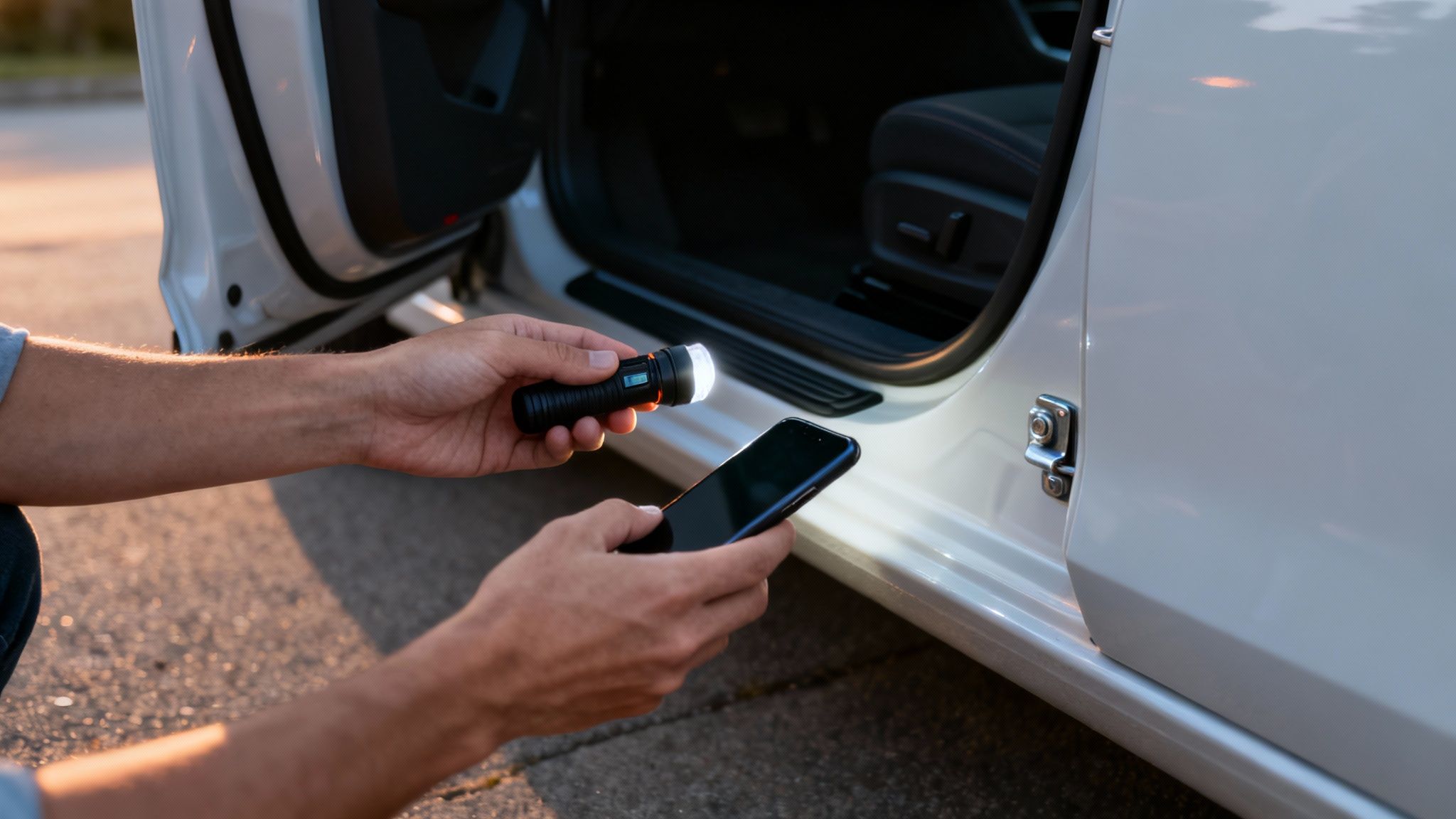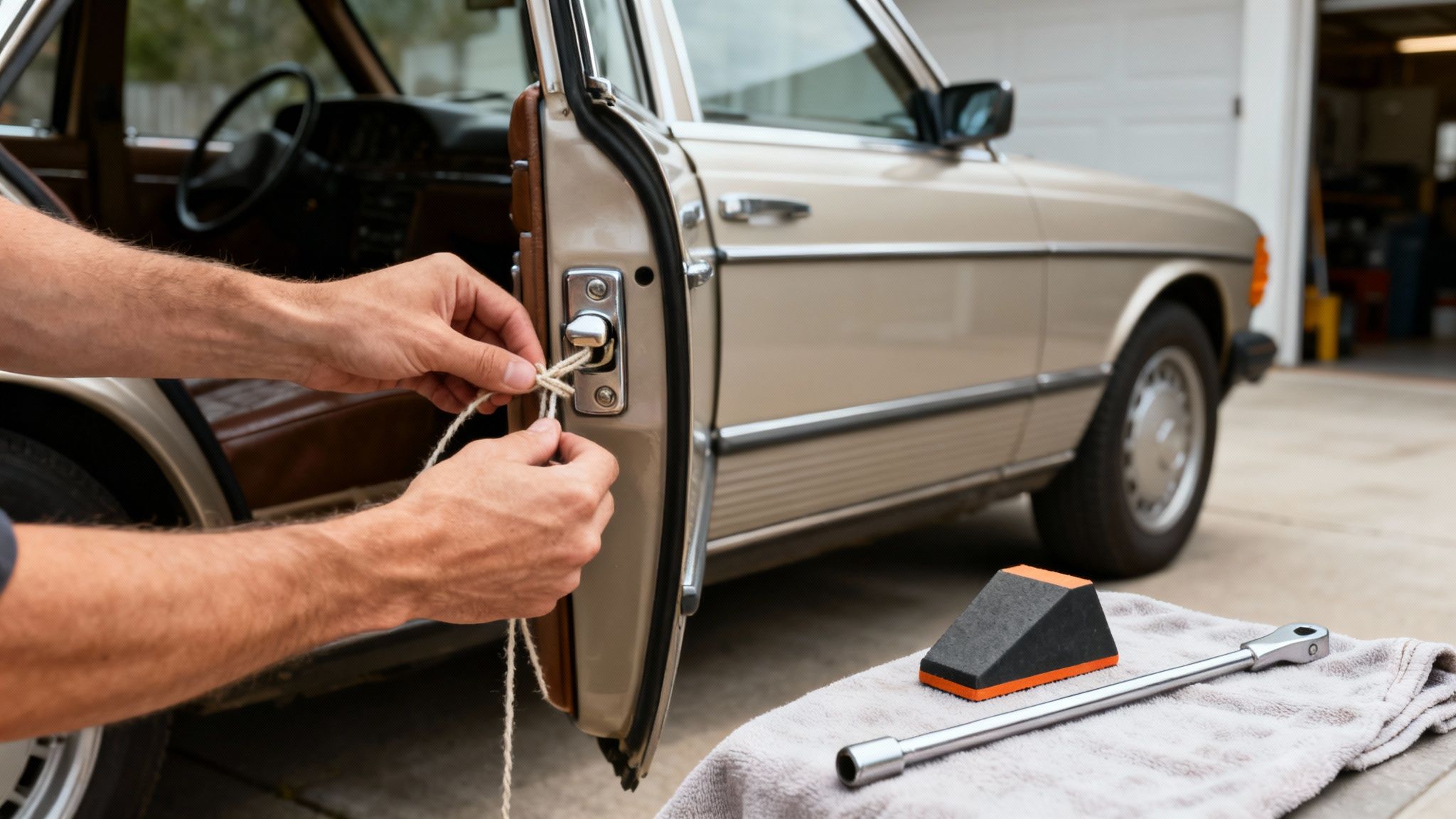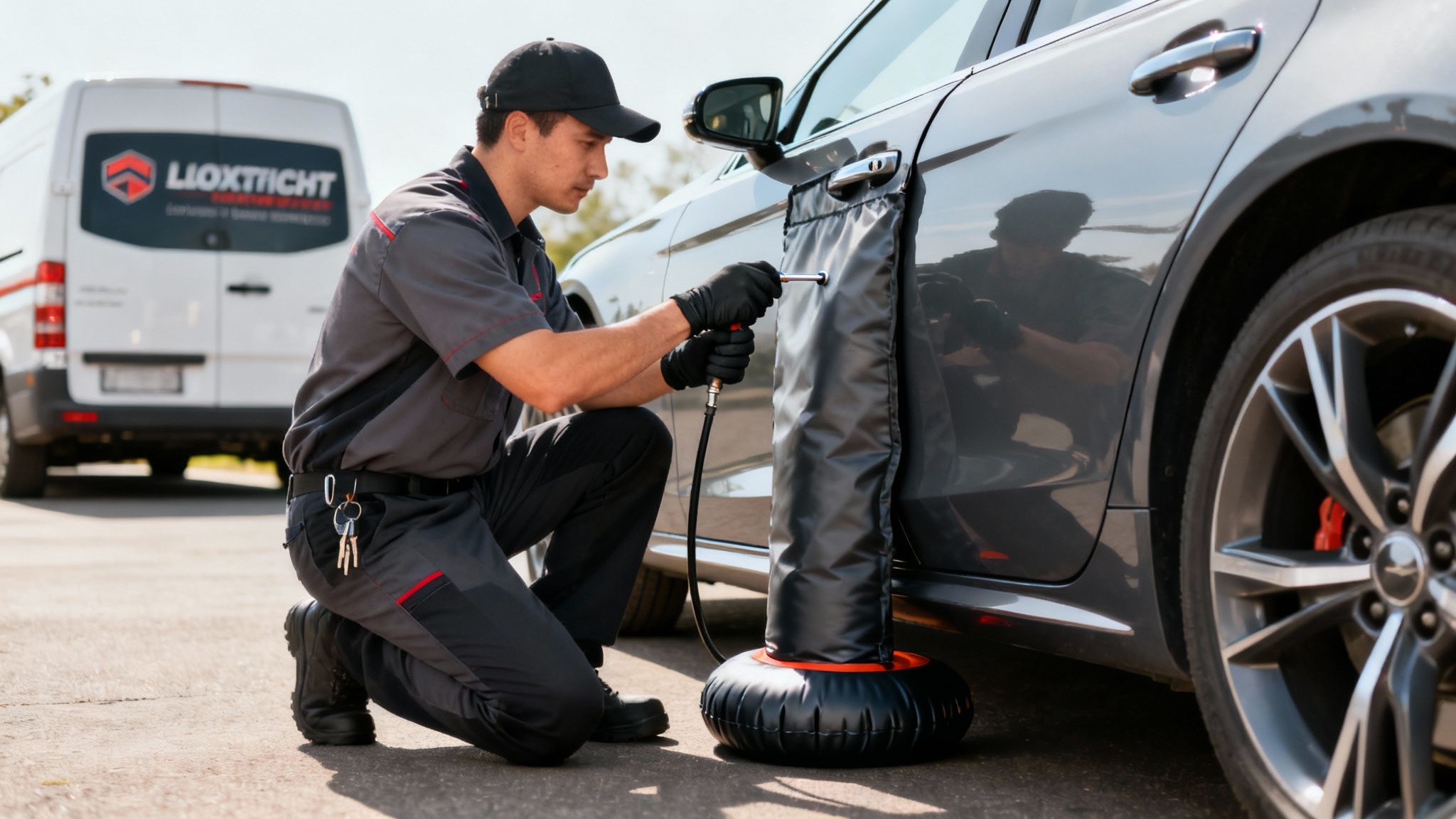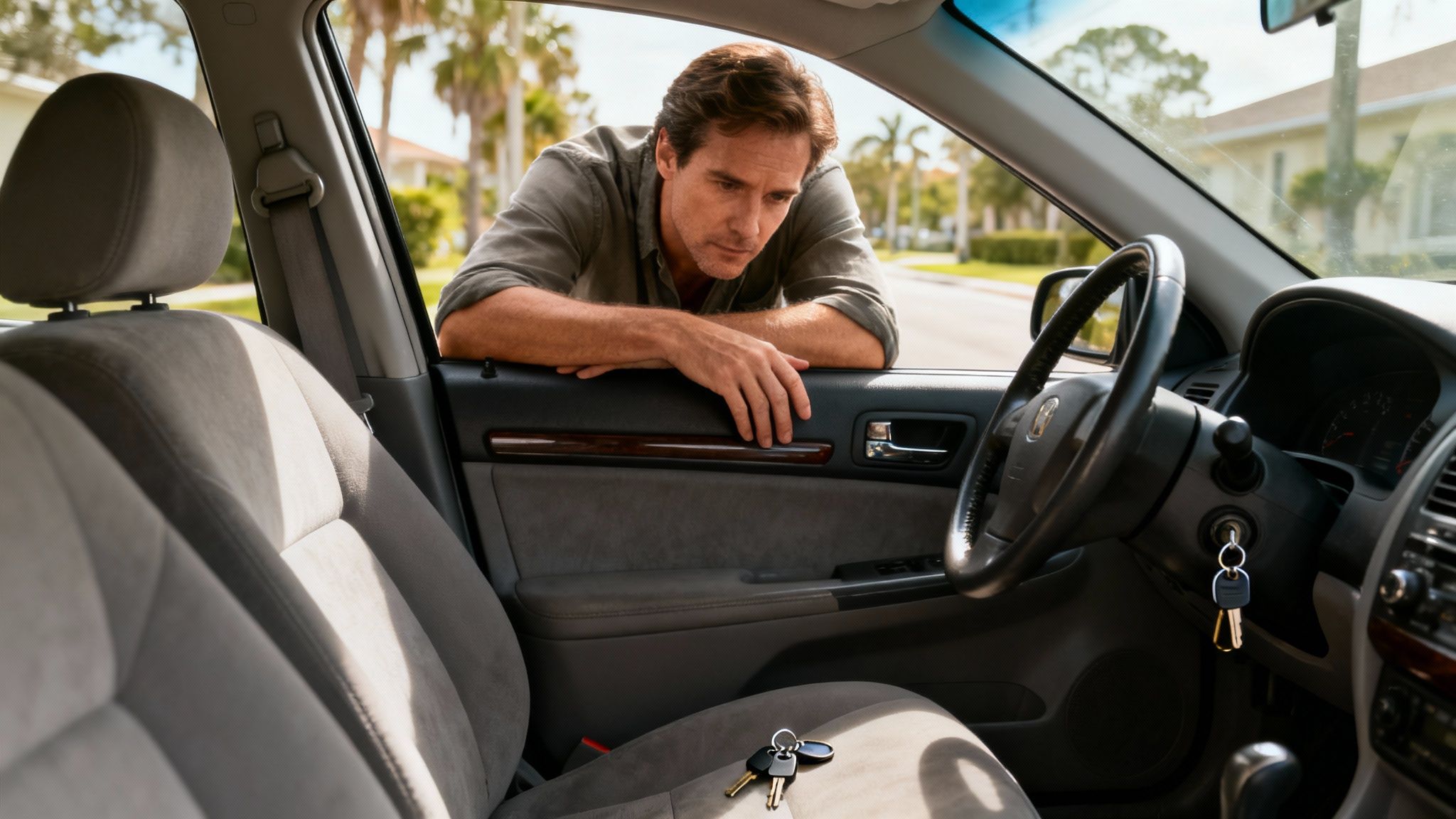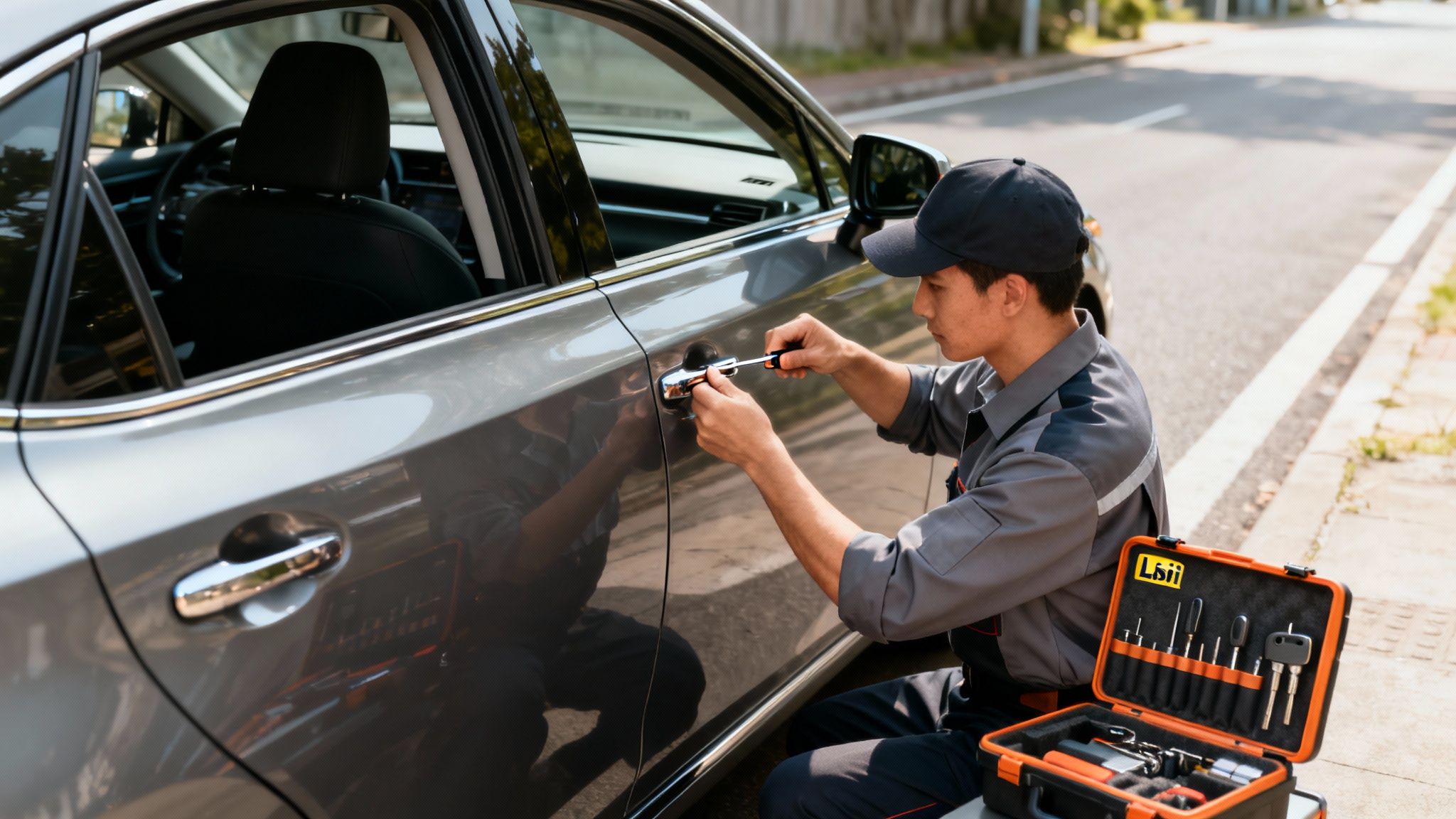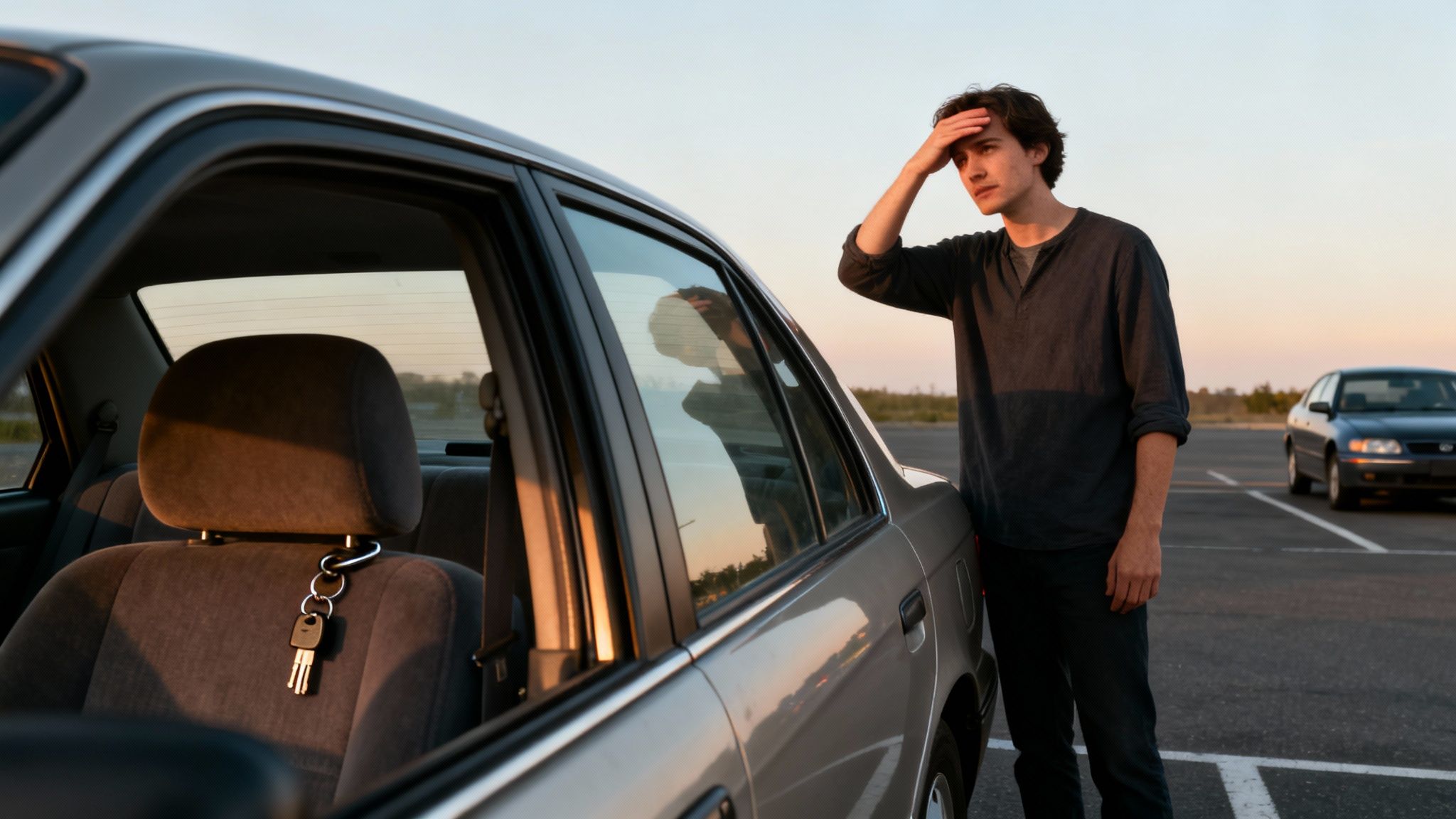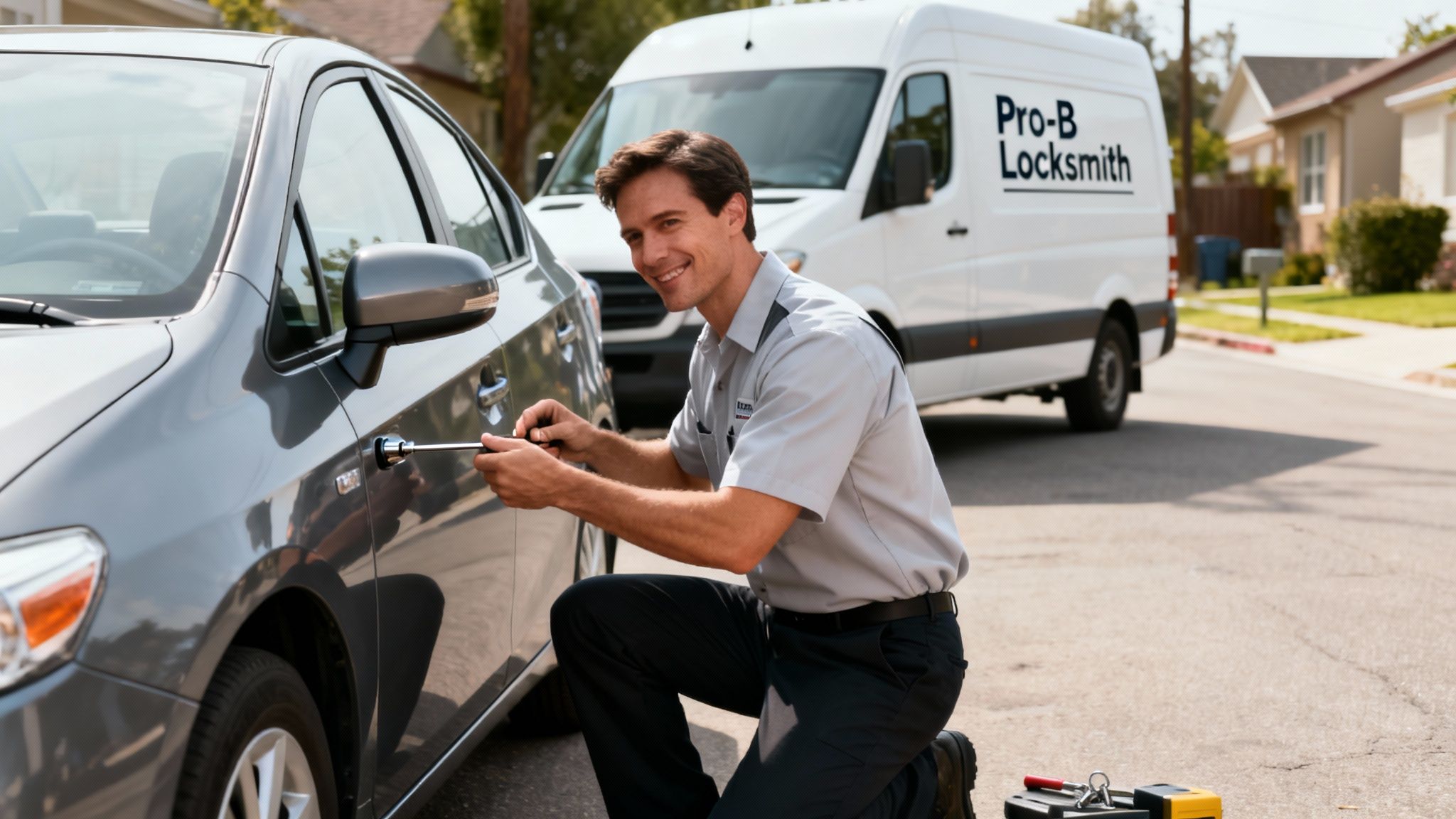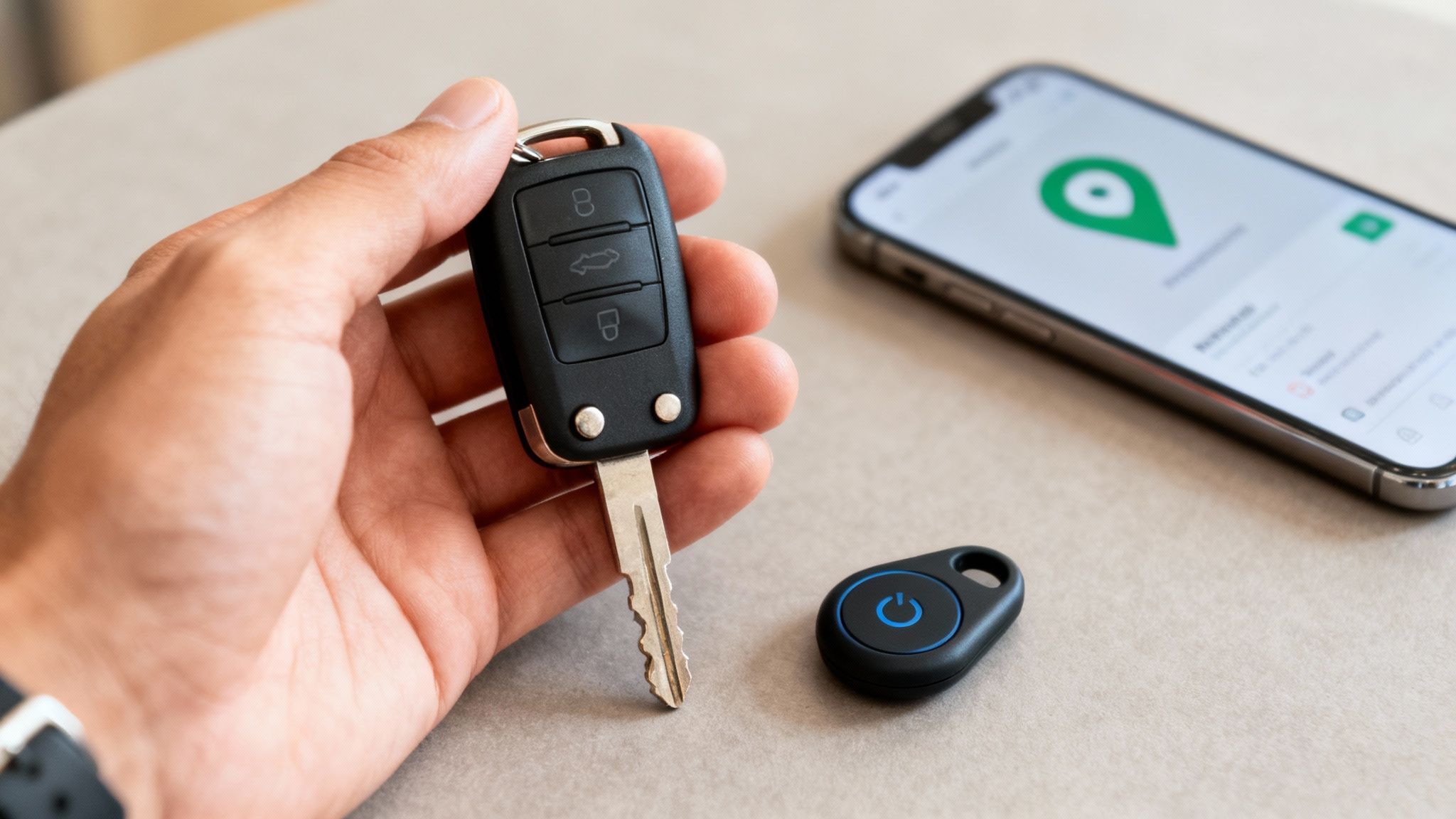
It’s a moment we all dread. You stick your key in the car door, give it a turn, and… nothing. The lock doesn’t budge. When your car door won't open with your key, it can strand you anywhere from a quiet street in Vero Beach to a busy parking lot in Stuart. The problem is almost always one of three things: a worn-out key, a gunked-up lock cylinder, or a mechanical part that’s given up inside the door.
The first step is to determine if the key actually turns. If it won't turn, your problem is likely the key or the lock cylinder itself. But if it spins freely without unlocking, the issue is buried deeper inside the door panel. If you're stuck and need professional help right now, Call (772) 710-8169 for immediate help anywhere on the Treasure Coast.
Diagnosing Why Your Car Key Stopped Working
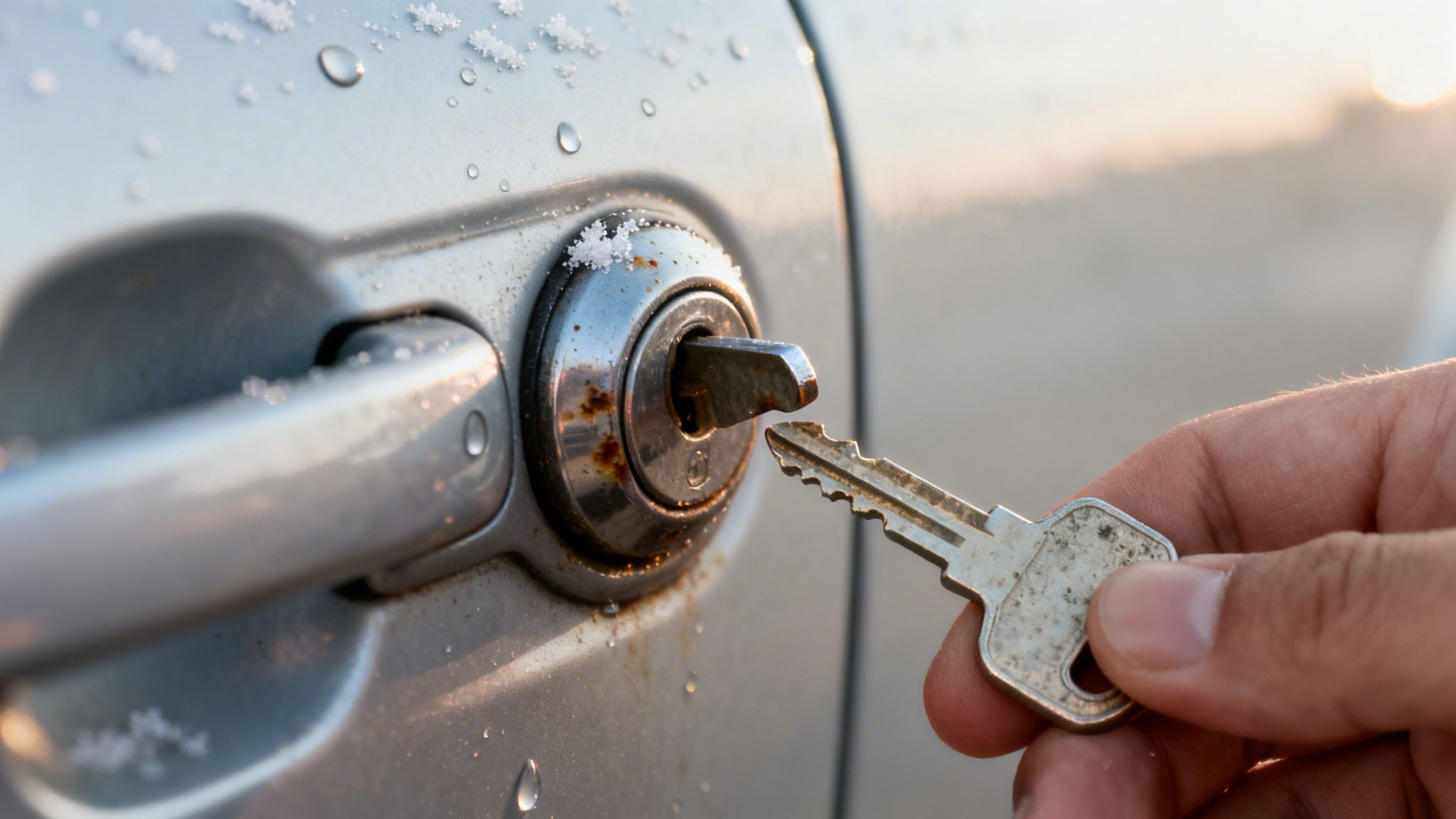
This is an incredibly common headache for drivers here on the Treasure Coast. You’re standing there, key in hand, and the door simply refuses to cooperate. Before you can fix it, you have to play detective to figure out what’s actually broken.
This isn't just a minor annoyance; it’s a huge part of what we do as local automotive locksmiths. Vehicle lockouts and key failures make up about 15-20% of all our emergency calls, with worn keys and busted lock cylinders leading the pack. We see cylinder failure all the time in vehicles over five years old, and our humid, salty air in places like Port St. Lucie, Fort Pierce, and Jensen Beach only makes things worse by speeding up corrosion. For a deeper dive into why manual keys fail, the data on CarParts.com offers some great insights.
Differentiating The Symptoms
The most important question is a simple one: does the key turn in the lock? Your answer immediately narrows down the list of potential culprits.
- Key won't turn at all (or gets stuck): This almost always means the problem is with the physical key or the pins inside the lock cylinder.
- Key turns freely, but nothing happens: This is a tell-tale sign that something has disconnected inside the door.
Think about it this way. After a hot, humid day in downtown Fort Pierce, the salt in the air can cause the delicate pins in your lock to seize. That’s a classic external lock issue. On the other hand, if your key just spins around and around with zero resistance, the problem is definitely internal. A real-world example we see often is the linkage clip breaking inside the door of older model F-150s, a common truck in our area.
Pro Tip: Your spare key is your best diagnostic tool. If the spare works fine, your main key is probably just worn out. If neither key works, the lock is the problem. This one simple step can save you a ton of guesswork.
To help you quickly identify the issue, we put together this simple diagnostic chart. Just match your symptom to the likely cause.
Quick Diagnostic Chart: Why Your Key Isn't Working
| Symptom | Potential Cause | Recommended First Step |
|---|---|---|
| Key feels gritty and won't turn. | Dirty or corroded lock cylinder. | Apply a small amount of graphite lubricant or silicone spray into the lock. |
| Key turns 360 degrees with no resistance. | Disconnected or broken linkage rod. | The door panel will need to be removed to reattach or replace the rod. This is a job for a professional. |
| Key is visibly bent or worn down. | Damaged key. | Try your spare key. If it works, you need a new key cut. |
| Key only turns partially or gets stuck. | Worn key or damaged lock pins. | Wiggle the key gently while applying light turning pressure. Do not force it. |
This chart should give you a solid starting point. Once you have a better idea of the cause, you can decide on your next move.
Common Culprits Behind a Failed Car Lock
Let's look at the most frequent reasons your key might suddenly fail you, based on what we see every day here on the Treasure Coast.
Worn or Damaged Key
Think about how many times you use your car key. Over the years, all that twisting and turning wears down the precision-cut grooves. Eventually, they just don't line up with the tumblers anymore. A slightly bent key—maybe from opening a box in a pinch—can also be the culprit.
Dirty or Corroded Lock Cylinder
This is a huge problem in coastal towns from Jensen Beach to Vero Beach. Sand, dust, salt, and road grime find their way into the lock, and our humidity turns it all into a sticky paste that seizes the pins and corrodes the metal parts.
Disconnected or Broken Linkage Rod
Inside your door is a slender metal rod that connects the lock cylinder to the actual latch. If that rod pops off or snaps, turning the key does absolutely nothing. The cylinder spins, but the message to unlock never reaches the latch. A key that turns with no resistance is a strong indicator of this.
If you've already tried your spare and ruled out a simple key problem, whatever you do, don't try to force it. You'll likely snap the key off in the lock, turning a frustrating situation into a much more expensive one.
When you're stuck and not sure what to do, just give us a call. Our mobile locksmiths can get to you quickly in Port St. Lucie, Fort Pierce, and beyond, diagnose the real problem, and open your door without causing any damage. Call (772) 710-8169 for immediate help.
Safe DIY Fixes You Can Try First
Before you start worrying about expensive repairs or trying something that could scratch your paint, take a breath. There are a few simple, safe things you can try first. More often than not, especially here on the Treasure Coast where humidity and grime are a constant battle, the fix is easier than you think.
But a word of caution from experience: if you feel the lock binding up or the key feels like it’s about to break, stop immediately. Trying to force a stuck lock is the quickest way to snap a key, turning a simple car lockout into a much bigger and more expensive problem.
Clean and Lubricate the Lock Cylinder
Think about all the fine dust, sand, and salty air that gets kicked up around Jensen Beach and Fort Pierce. Over time, that gunk works its way into your car's lock cylinder, causing the tiny internal pins to get sticky and refuse to move. A good cleaning is often all it takes.
You have to use the right stuff, though. Don't just grab any old can from the garage.
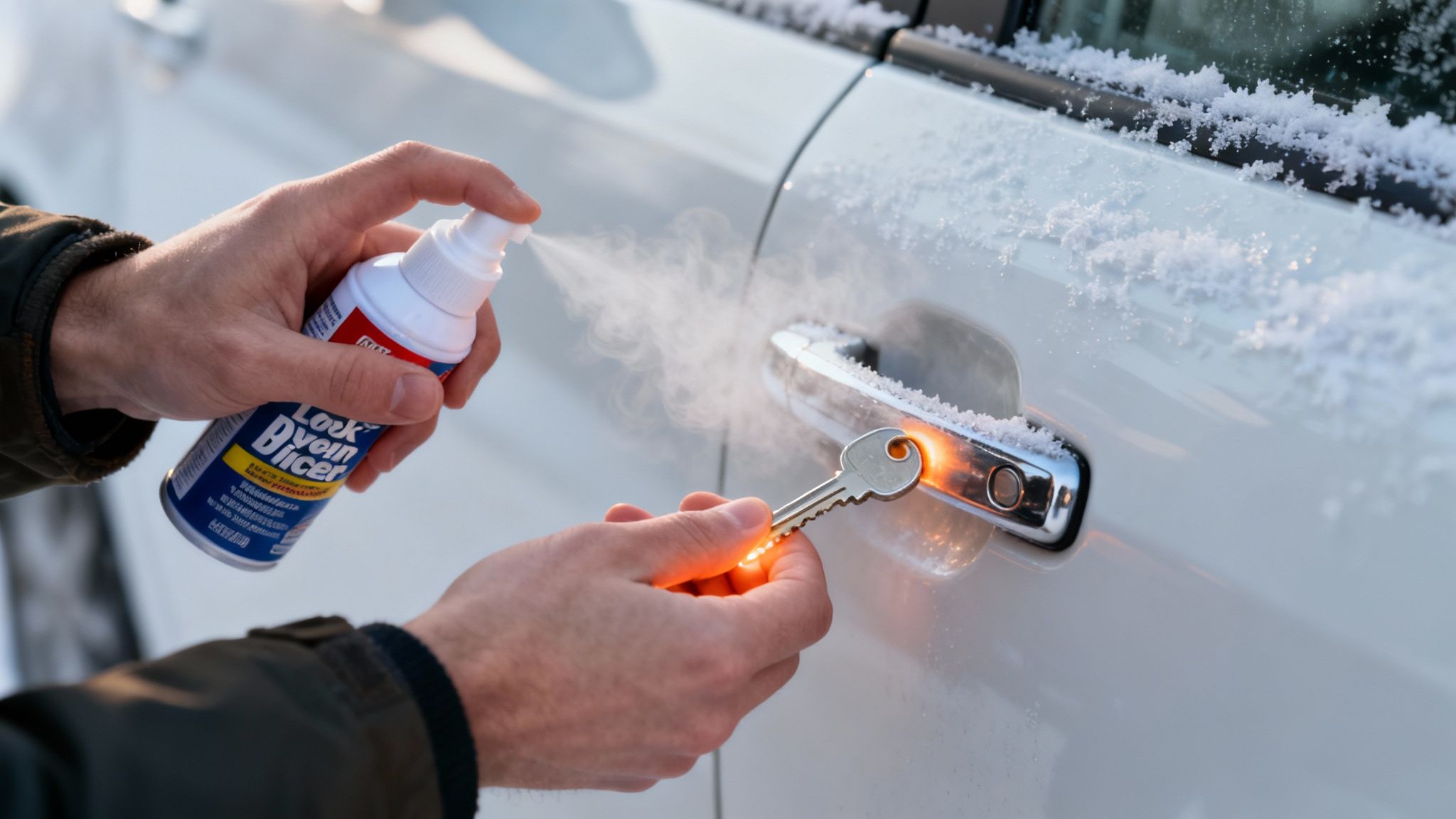
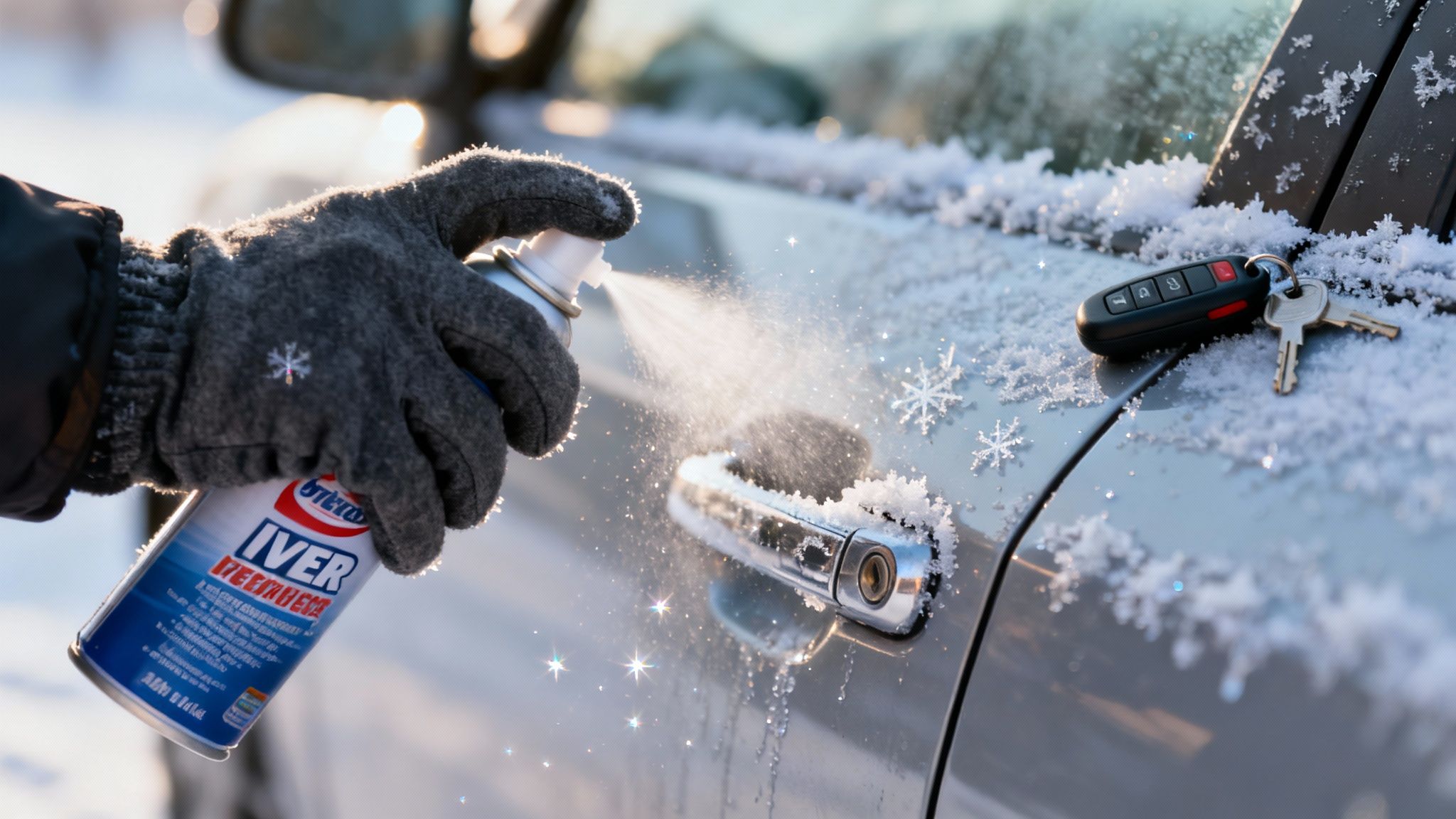
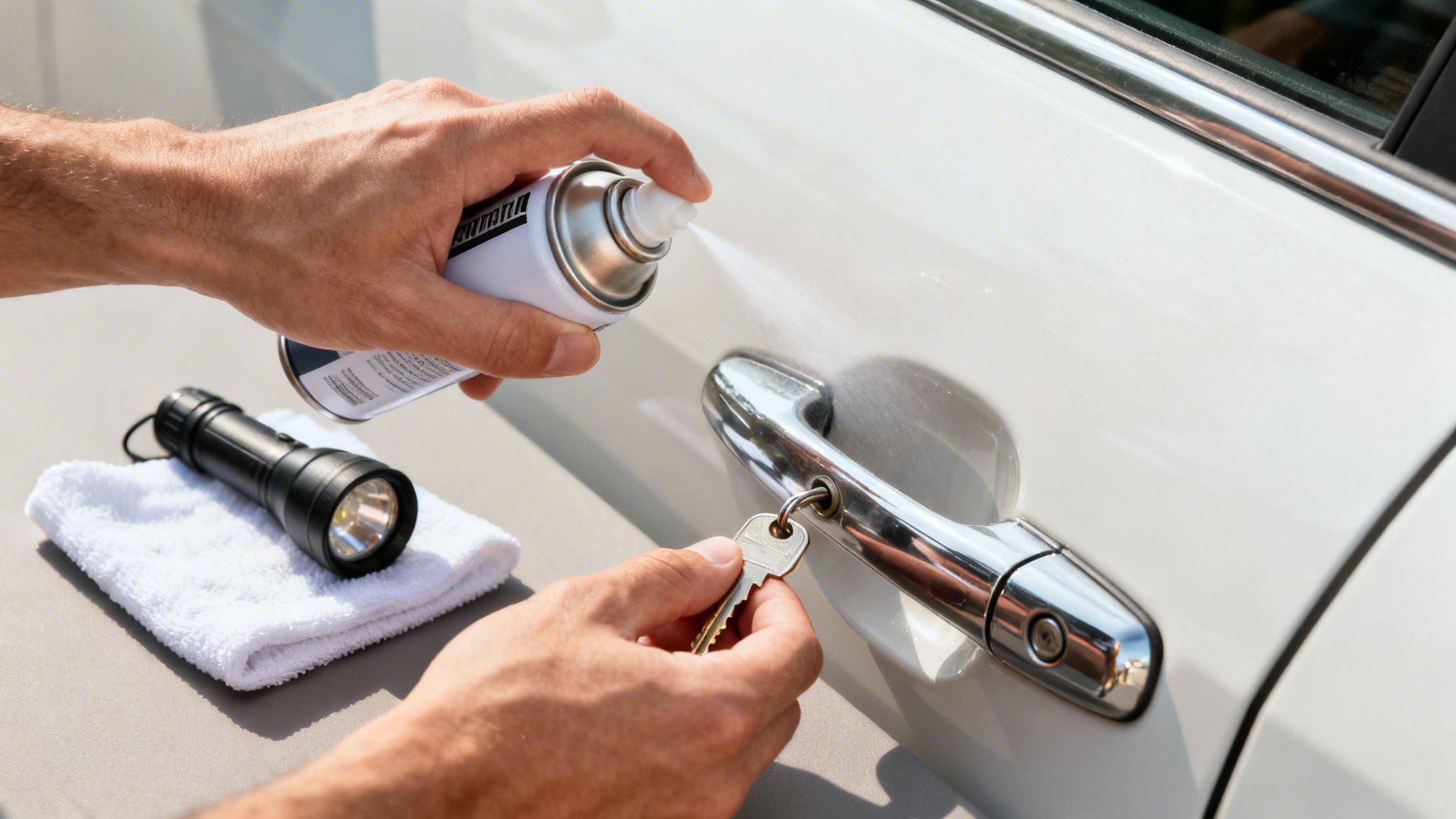
- Silicone-Based Lubricant: This is my top recommendation. It lubricates smoothly and drives out moisture without leaving a sticky residue that attracts more sand and dirt.
- Graphite Lubricant: This is a classic dry lubricant for a reason. It's a fine powder that's fantastic for freeing up stuck lock pins without creating a wet mess inside.
Crucial Warning: Do not use WD-40 as a lock lubricant. I see this mistake all the time in the Port St. Lucie area. While it might work for a few minutes by displacing water, it isn't a true, long-lasting lubricant. It will eventually dry out and create a gummy film that makes the initial problem much worse.
Applying it is easy. Just stick the little red straw from the spray can directly into the keyhole and give it a quick, one-second squirt. Slide your key in and out a few times to work the lubricant onto all the pins, then try turning it again.
Inspect Your Key and Try the 'Jiggle'
Next, take a hard look at your key. After years of bouncing around on a keychain, the precisely cut edges can become worn down and rounded. The best way to check is to compare it to your spare key. If your daily key looks noticeably smoother, that's probably the culprit.
When a key is worn, it can't lift the internal tumblers to the exact height needed to unlock the door. Sometimes, a little finesse is all you need.
Start by inserting the key all the way into the lock. Then, while applying very gentle pressure in the direction you'd turn to unlock it, give the key a subtle jiggle up and down or rock it slightly. That tiny bit of movement can help the worn parts of the key catch the pins just right.
The secret is light pressure. Too much force will just jam it worse or, even worse, snap the key right off in the lock. If it doesn't work after a couple of gentle attempts, it’s time to move on.
Check Your Key Fob Battery
This might seem odd if you're using the physical key, but in many modern cars, everything is connected. A completely dead battery in your key fob can sometimes trigger weird electronic glitches in the car’s anti-theft system, which may prevent the manual lock from working correctly.
Swapping the battery is a cheap and easy way to rule this out. Most fobs pop open with a small screwdriver, and the battery type (often a standard CR2032 coin cell) will be printed right on the old one. If a new battery doesn't help, you've at least eliminated one possibility.
If none of these fixes get your door open, it's a solid sign that the problem is mechanical and inside the door itself—a disconnected rod or a completely seized lock mechanism. Pushing your luck at this stage will only lead to damage. For a quick, professional fix anywhere from Vero Beach to Stuart, call (772) 710-8169 for immediate help. Our mobile locksmiths will get to you fast, figure out the problem on-site, and get it sorted without damaging your car, whether it needs a complex ignition repair or a straightforward lock change.
Knowing When to Call a Professional Locksmith
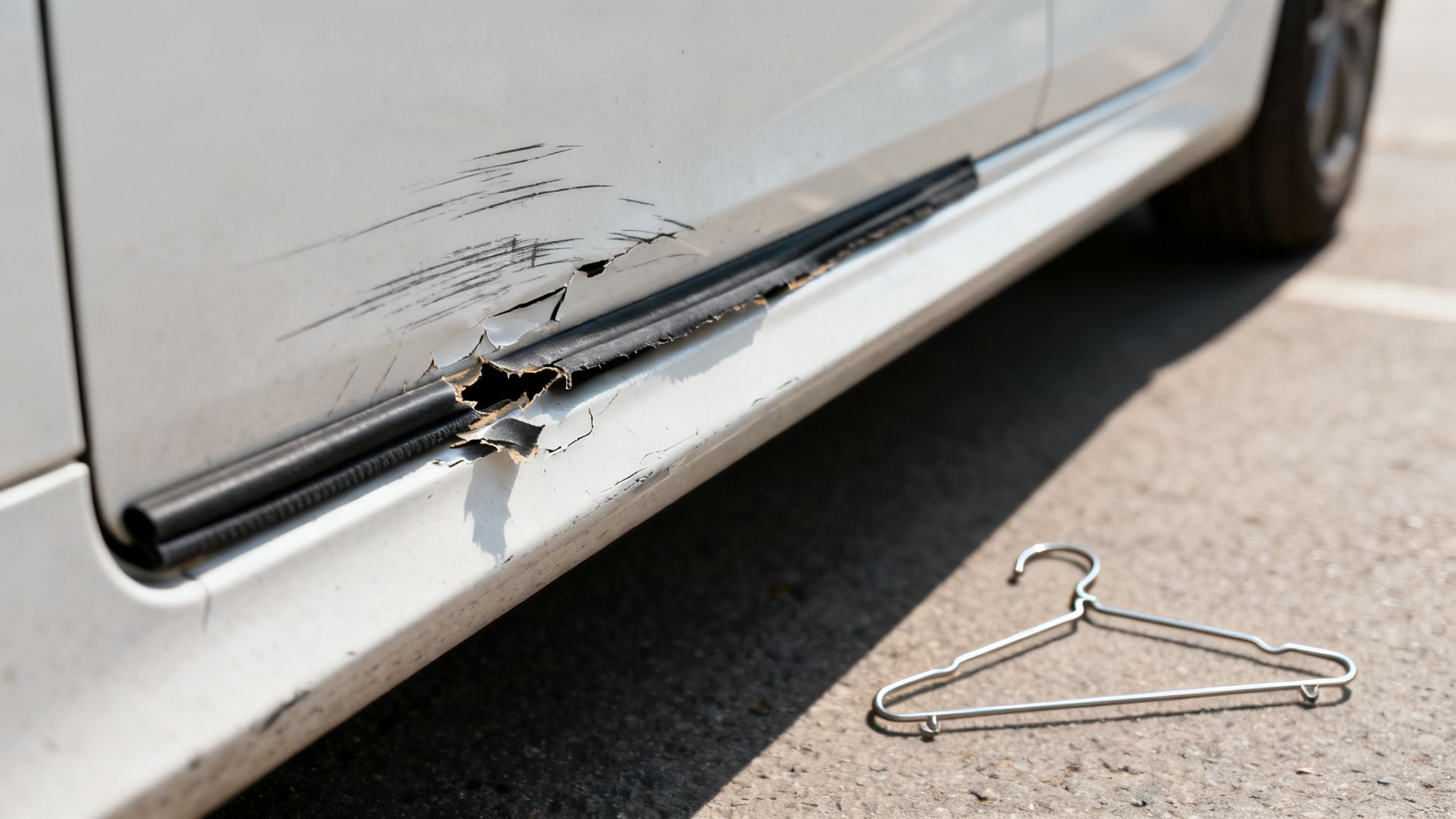
Look, DIY fixes are great for minor hiccups. But there’s a fine line between being resourceful and making things a whole lot worse. Pushing your luck with a stubborn lock can quickly escalate a simple lockout into a major repair bill for a new lock cylinder, a torn-up door panel, or a nasty paint scratch. Knowing when to put the tools down and pick up the phone is the smartest move you can make.
Sometimes, the problem is more serious than just a little rust or a worn key. If you spot fresh scratches around the keyhole or signs someone tried to pry the door, you might be looking at damage from a failed break-in attempt. Forcing a key into a compromised lock will only cause more internal damage and could leave your vehicle vulnerable.
Red Flags That Demand a Locksmith
There are a few scenarios where trying to fix it yourself is a guaranteed recipe for disaster. If you hit any of these roadblocks, your very next step should be calling a certified locksmith. Trust me, continuing to wiggle and force it is how you end up with a key snapped in half and a much bigger problem.
These situations call for specialized tools and a technician who actually knows what’s going on inside your car door.
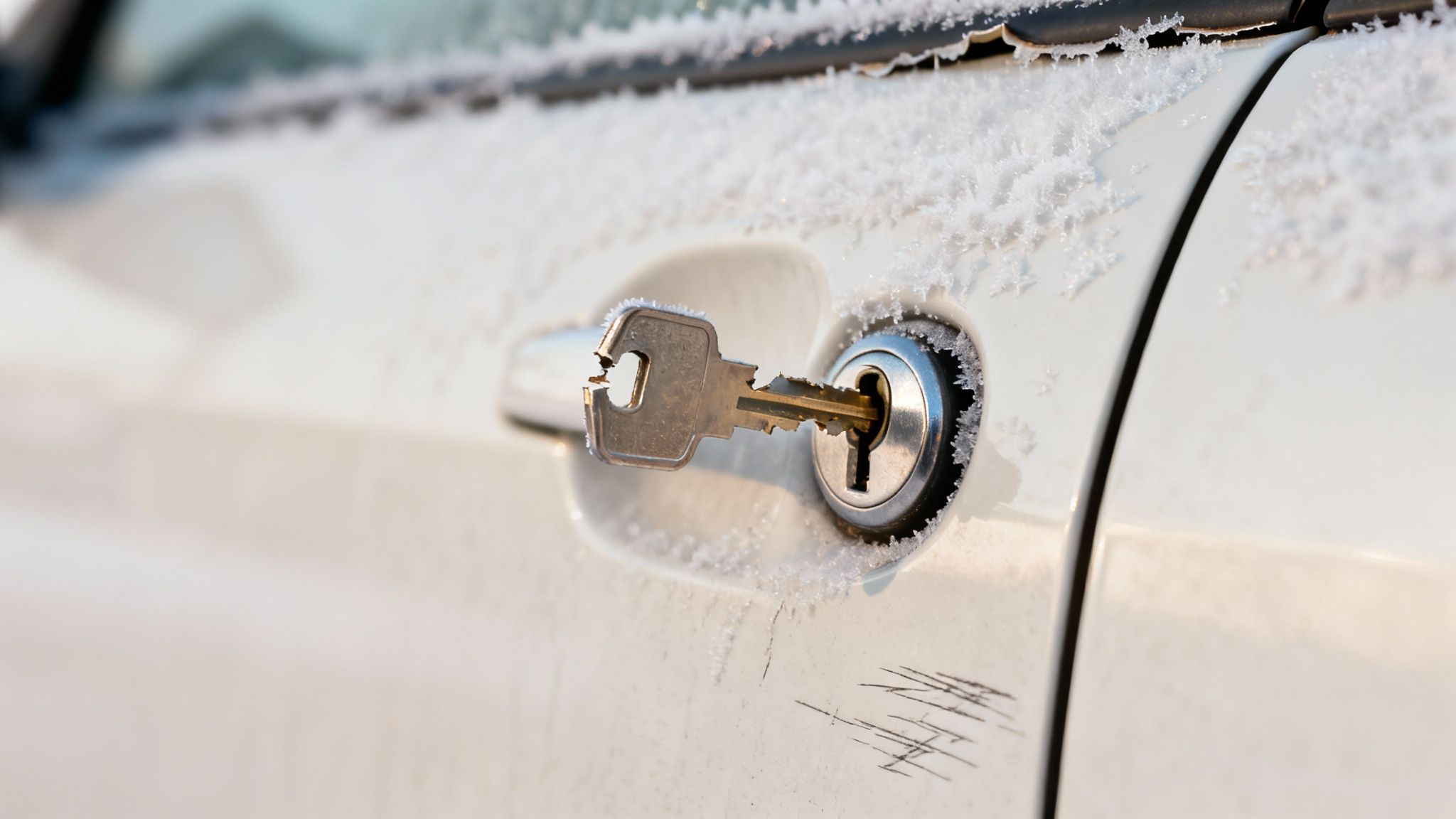
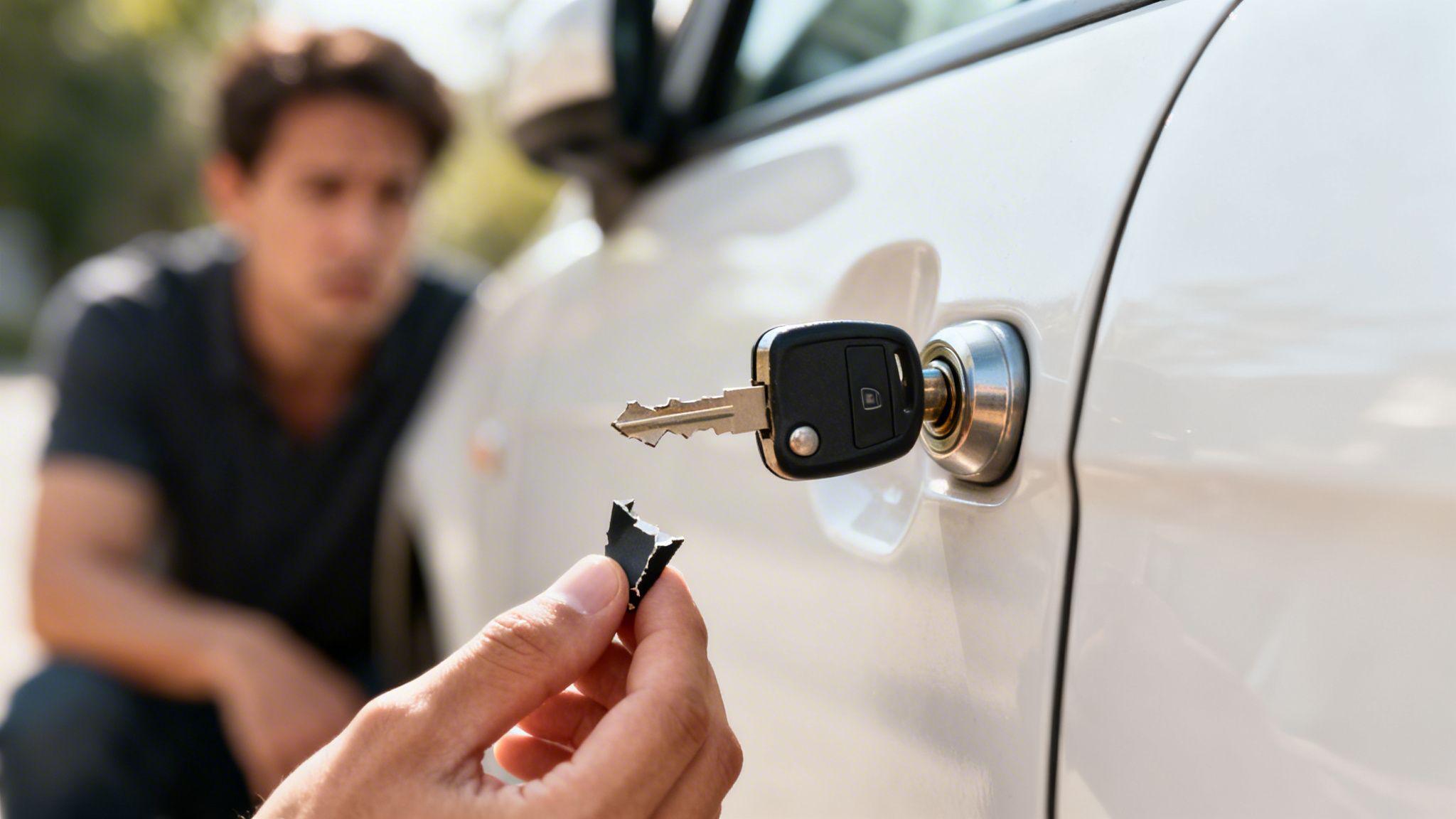
The Key Snaps Off in the Lock: This is an immediate, tools-down moment. Don't grab the pliers or tweezers. You're far more likely to push the broken piece deeper into the lock, making it a nightmare to get out. We have specific extraction tools to pull out the fragment without destroying the lock.
The Lock Cylinder is Completely Seized: You've tried lubricant, but the key won't budge. Not even a millimeter. It feels like it’s set in concrete. This points to a major internal failure, like broken pins or severe corrosion. Any more force is going to break the key or the entire cylinder.
Visible Damage from a Break-In Attempt: See deep gouges, dents, or metal shavings around the keyhole? Stop right there. The internal linkage is probably bent or broken. A pro needs to open the door and assess the security of the lock mechanism itself.
The Key Turns Freely with No Result: As we mentioned earlier, this is a classic sign of a disconnected linkage rod inside the door. The door panel has to come off to fix it, and that’s a delicate job. It’s incredibly easy to crack the panel or break the clips if you don’t know what you’re doing.
A snapped key is the lock’s way of telling you to stop. Don't turn a simple lockout into a $300-$500 bill for a new lock assembly. A professional lockout service costs a fraction of that and comes with a no-damage guarantee. If your car door won't open with the key despite trying these safe methods, Call (772) 710-8169 for immediate help.
Why a Local Mobile Locksmith is Your Best Bet
When you’re stranded in a Stuart parking lot or stuck in your own Vero Beach driveway, you don’t just need help—you need it fast. This is exactly where a local, mobile locksmith makes all the difference. For anyone across the Treasure Coast, we are your on-the-ground solution.
When you need a professional, finding a trustworthy local business can be tough. Many people search for companies that follow an ultimate local SEO checklist, which helps good locksmiths stand out. It’s why we focus on being a true local service. We’re not a faceless national call center that farms out jobs to random contractors. Our technicians are right here in St. Lucie County, ready to roll.
Here’s what that means for you:
- Rapid Response Times: We know Port St. Lucie, Fort Pierce, and the side streets of Jensen Beach like the back of our hand. That’s how we can guarantee an average response time of just 15-20 minutes.
- Guaranteed Non-Destructive Entry: Our certified pros show up with the right tools to get you in without a single scratch. We treat your vehicle with care, as if it were our own.
- Upfront, Transparent Pricing: When you call, we give you a clear, honest quote. No games, no hidden fees. The price we say is the price you pay. Period.
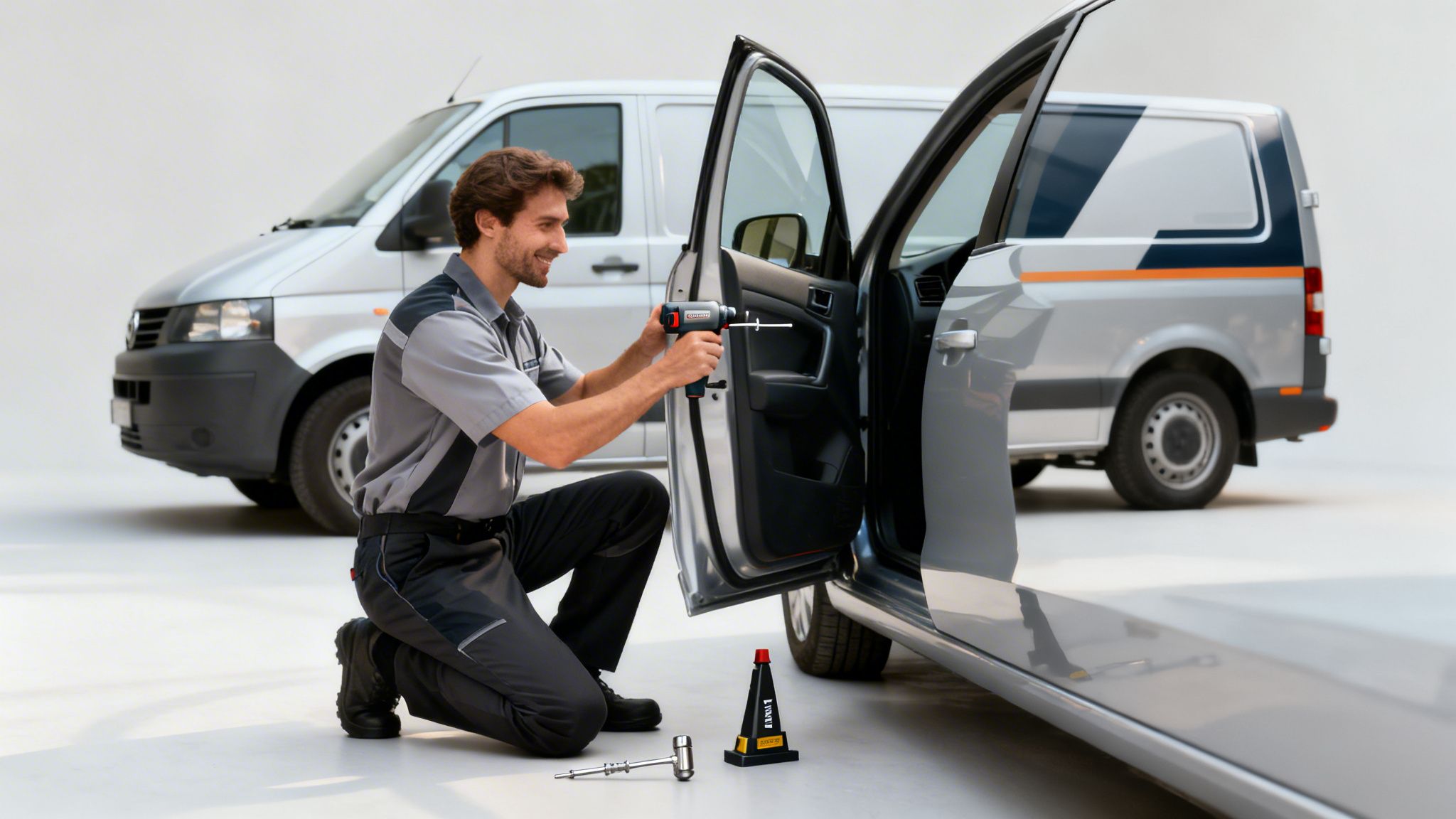
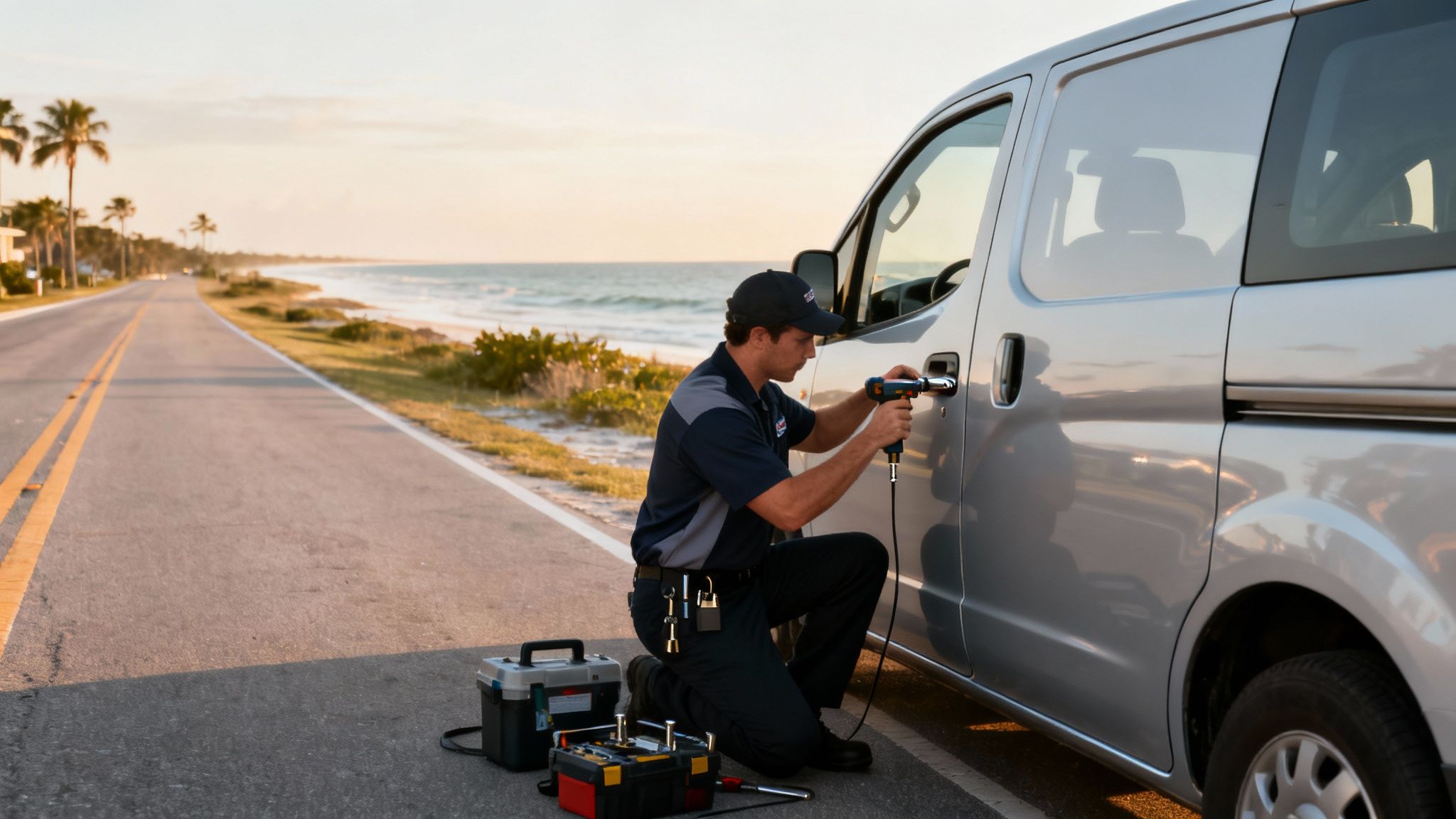
- Comprehensive On-Site Services: We don't just unlock your door and leave. Our van is a mobile workshop. We can cut a new key, program a fob, or even help with an ignition repair or a house lockout on the spot. Learn more about our full range of automotive locksmith services and how we can solve your problem for good.
What to Expect from a Mobile Locksmith Service Call
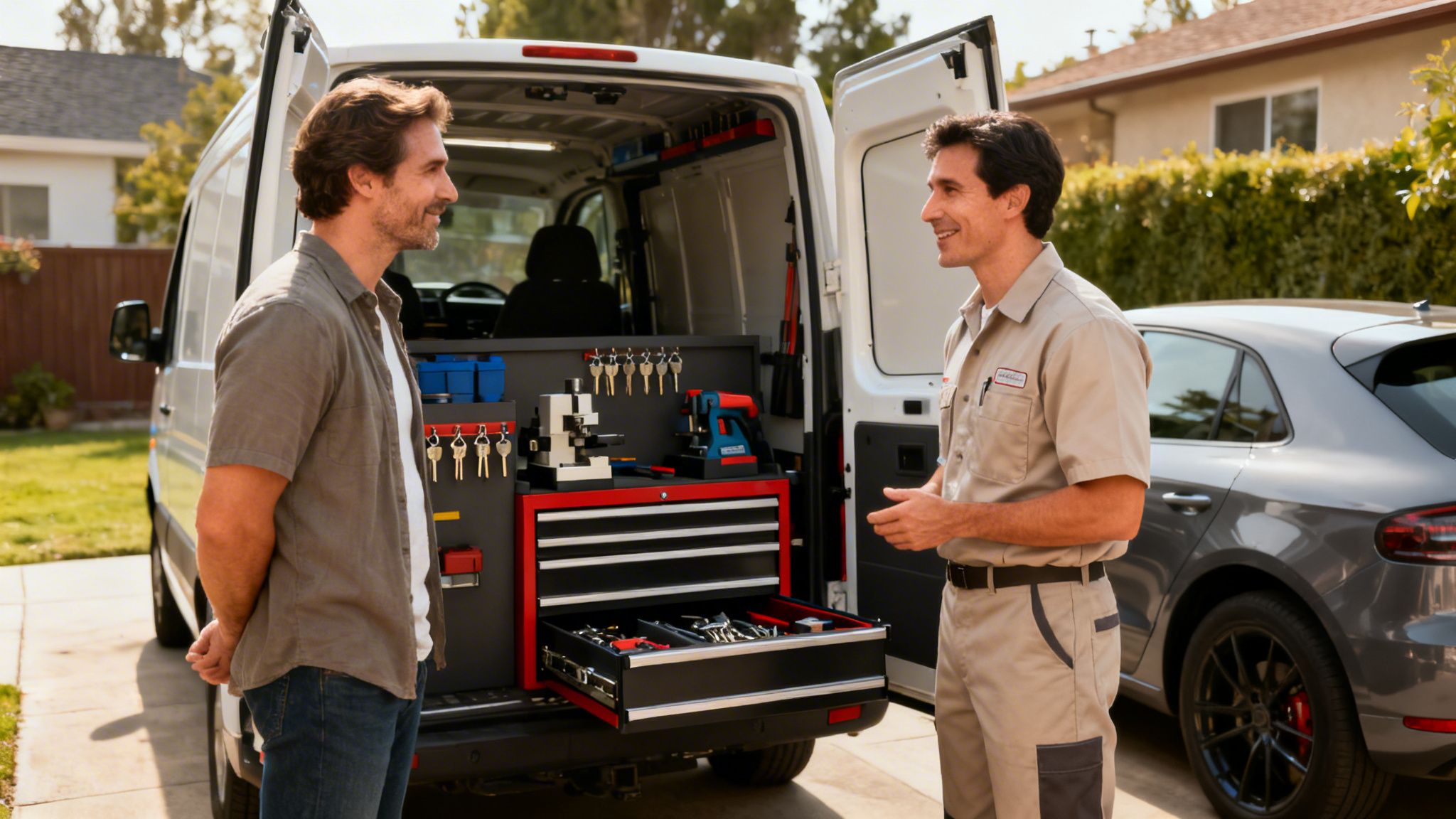
We get it. Calling a locksmith when you’re stranded and locked out of your car is stressful. You just want back inside, and you’re worried about hidden costs or long waits. That’s why we believe in being completely transparent about our process, so you know exactly what’s happening every step of the way.
It all starts with your phone call. When your car door won’t open with the key, the last thing you want is a vague estimate from a faceless call center. A true local locksmith will ask a few quick, specific questions to understand the situation, give you a clear price range right over the phone, and provide a real ETA.
The Arrival and On-Site Diagnosis
Our fully equipped van will pull up to your location, whether you’re stuck in a Vero Beach shopping center or in your own driveway in Jensen Beach. Because our technicians are your neighbors in St. Lucie County, they know the fastest routes to get to you.
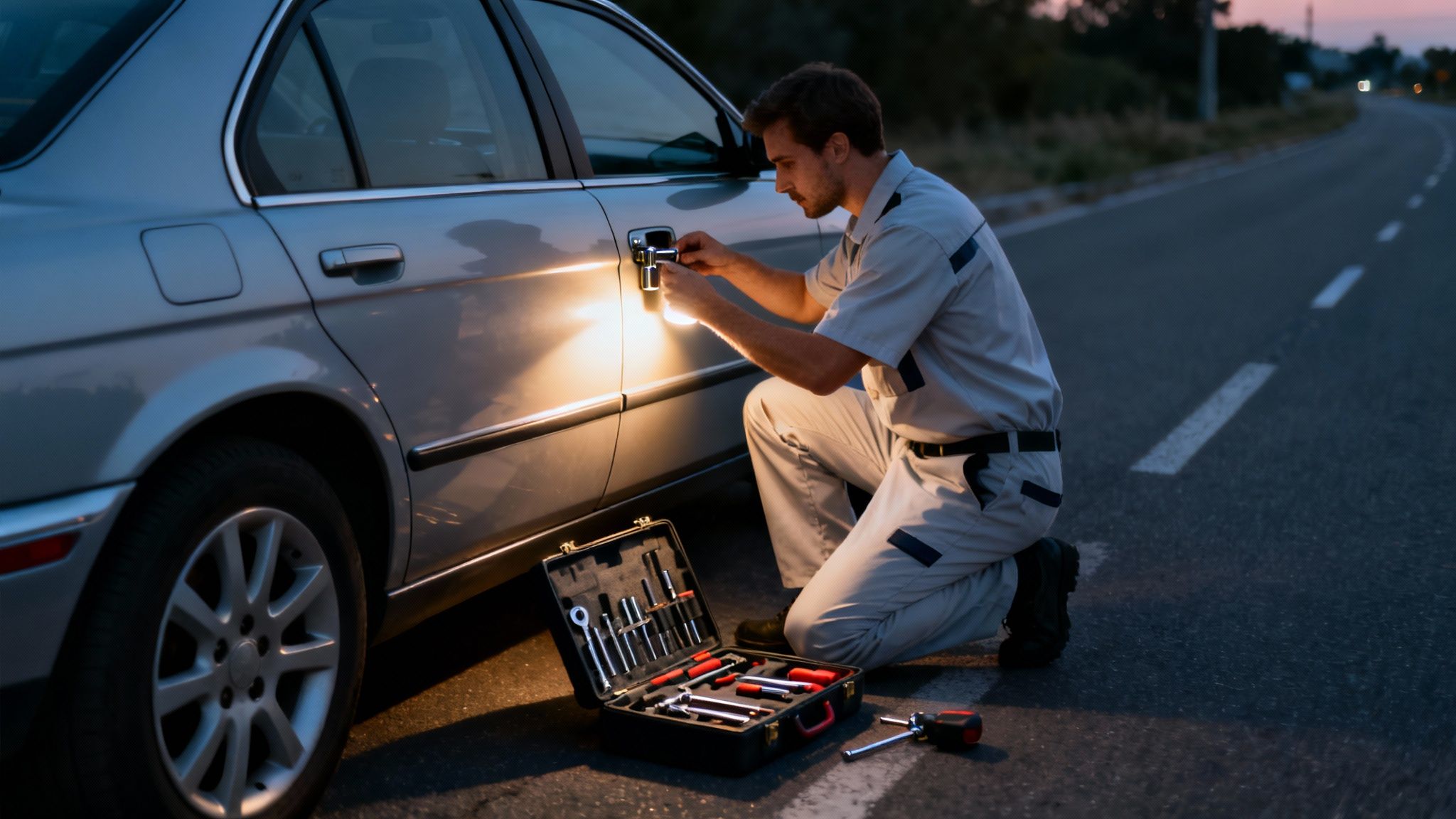
The first thing we do—before any tools come out—is a quick but professional diagnosis. Our technician will take a look at your lock and key, listen to what happened, and confirm the root cause of the problem. This step is crucial. It ensures we’re applying the right fix, saving you from unnecessary work or surprise costs.
That on-the-spot assessment is what separates a seasoned professional from a rookie. It's about solving the actual problem, not just prying the door open.
Our Comprehensive On-Site Capabilities
Once we’ve identified the issue, our technician will walk you through the solution and confirm the price one last time before getting started. Our mobile workshops are basically a complete lock and key shop on wheels, ready to handle almost any automotive issue right then and there.
Our on-the-spot services include:
- Non-Destructive Entry: We use specialized tools to safely unlock your door without a single scratch to your paint or weather stripping.
- Key Extraction: If your key snapped off in the lock, we can skillfully remove the broken piece without damaging the cylinder.
- Lock Cylinder Repair or Replacement: For locks that are damaged beyond repair, we can fix or install a brand-new cylinder on the spot.
- Key Fob Replacement: We can cut and program new transponder keys, smart keys, and fobs for nearly any make or model, right from our van.
If the culprit is an internal part, like a disconnected linkage rod, our techs have the skill to carefully remove the interior door panel, make the repair, and put it all back together perfectly. Our goal is a permanent solution, not a temporary patch.
When you’re locked out, you have a few options. You could call your dealership and pay for a tow, or dial a random 1-800 number and roll the dice. A local, accountable locksmith is the faster, more affordable, and transparent choice. Call (772) 710-8169 for immediate help from a team that actually serves your community.
Pro-B Locksmith vs Car Dealership vs National Call Center
When you're staring at a locked car door, knowing who to call makes all the difference in your time, budget, and stress level. Here’s a quick breakdown of your main options in the Port St. Lucie area.
| Service Feature | Pro-B Locksmith (Local) | Car Dealership | National Call Center |
|---|---|---|---|
| Response Time | 15-20 minutes on average across the Treasure Coast. | Hours or days; requires towing your vehicle to them. | Unpredictable; depends on the subcontractor they find. |
| Pricing | Upfront and transparent over the phone. | High labor rates plus potential towing fees. | Often quotes a low base fee with multiple hidden charges. |
| Service Location | We come to you anywhere in Stuart, Fort Pierce, etc. | You must get your vehicle to their service center. | A random contractor is dispatched to your location. |
| Accountability | Locally owned and operated; we answer to our community. | Accountable, but often bureaucratic and slow. | Little to no accountability; the call center is just a middleman. |
| Services Offered | Car lockout, ignition repair, key fob replacement, lock change, and more on-site. | Full service, but often requires a scheduled appointment. | Limited; typically only basic lockout services. |
Ultimately, choosing a local mobile team like Pro-B Locksmith means you're choosing speed, straightforward pricing, and real accountability. We’re not just some random contractor; we’re your neighbors. If you’re ever in a bind, you can learn more from our guide on emergency lockout services.
Keeping Your Car Locks Working Smoothly on the Treasure Coast
Let’s be honest, the best way to deal with a car lockout is to never have one in the first place. A little proactive care for your car's locks is worlds easier—and a lot cheaper—than making a frantic call when your car door won't open with your key. Here on the Treasure Coast, we're in a constant fight against humidity, salt air, and intense sun, all of which are brutal on a car's delicate mechanisms.
Spending just a few minutes on maintenance every six months can be the difference between a smooth start to your day and being stranded in a parking lot, whether you're in Stuart, Port St. Lucie, or Fort Pierce.
Fight Back Against Salt and Humidity with Lubrication
That salty, humid air we love so much on Hutchinson Island? It’s the number one enemy of your car's lock cylinders. It works its way inside, causing the tiny metal pins and springs to corrode, rust, and eventually seize up completely. I’ve seen it happen hundreds of times.
Fortunately, the fix is simple. Lubricate your door locks every six months with the right stuff.
- Graphite Spray: This is what the pros use. It’s a dry lubricant, so it won’t attract the sand and dust that’s a constant here in our beach communities.
- Silicone Spray: This is another great option. It’s fantastic at displacing moisture and keeps everything moving freely without leaving behind a sticky residue that gums up the works.
Just give a quick spray directly into the keyhole. Then, slide your key in and out a few times to work the lubricant all the way in. That’s it. This tiny step is your best defense.
Always, Always Have a Spare Key
A spare key isn't just a convenience; it's your first and best diagnostic tool. If your main key suddenly stops working, the first thing you should do is try the spare. If it works, you know the problem is the original key. If it doesn't, the issue is likely with the lock or the car's security system. And if you need a new key fob replacement, we can often cut and program one for you on the spot.
It helps to know what kind of key you have:
- Mechanical Keys: Simple, old-school metal keys. They're the easiest and most affordable to duplicate.
- Transponder Keys: These have a small chip inside that talks to your car. The engine won't start if the car doesn't get the right signal, even if the key blade turns.
- Key Fobs & Smart Keys: These are the keys that give you remote entry and push-to-start convenience.
Storing that spare is critical. Please don't keep it on the same ring as your primary key! Give it to a trusted partner or family member, or tuck it away somewhere safe at home. Getting locked out is frustrating, but getting locked out while your spare key sits uselessly inside the car is a special kind of pain.
Lighten Your Keychain
That massive, jangling collection of keys and gadgets you have hanging from your car key? It might look cool, but it’s slowly killing your ignition. All that weight puts constant downward pressure on the lock cylinder every time you drive.
Over time, this strain wears down the delicate components inside both your ignition and your door locks. If your key is already starting to feel sticky or hard to turn in the ignition, that’s a major warning sign. It might be time to look into an ignition repair before it fails entirely and leaves you stranded. Do your car a favor and keep your car key on its own, lightweight ring.
Taking these small steps will save you a world of trouble down the line. But if you do find yourself in a jam, remember that a local expert who knows the challenges of our coastal climate is ready to help. Call (772) 710-8169 for immediate assistance.
Your Top Car Lock Questions, Answered
When your car door suddenly won't open, it's easy to feel stuck and unsure of what to do next. We get it. From Port St. Lucie up to Jensen Beach, we field calls every day from drivers dealing with this exact headache. To help, we've compiled answers to the questions we hear most often.
Will a Locksmith Damage My Car?
This is a huge concern for many people, and a valid one. The answer is a firm "no"—as long as you call a properly trained and certified professional. At Pro-B Locksmith, we specialize in non-destructive techniques that leave your vehicle completely unharmed.
We don’t show up with a crowbar. Our technicians use highly specialized tools designed to work with the delicate mechanisms inside your lock, essentially picking it safely and skillfully. We treat every car like it’s our own, and our first priority is always getting you inside without leaving a single scratch or sign that we were ever there.
Is It Cheaper to Use a Locksmith or Go to the Dealership?
For almost any lockout, lock repair, or key replacement, calling a mobile locksmith is the smarter, more cost-effective choice. Dealerships usually mean you have to get your car towed to their shop, which immediately adds a towing bill and a lot of waiting around to your problem. On top of that, their labor rates are almost always higher.
Because we're a mobile service, we come straight to you, whether you're in Fort Pierce or Stuart. This saves you a ton of time and money right off the bat. Our on-the-spot services, like making a new key fob replacement or handling an ignition repair, can easily cost up to 50% less than a dealership would charge for the same job.
We believe in honest, transparent pricing. When we give you a quote over the phone, that's the price you pay—no hidden fees or last-minute surprises. It’s just how we do business here in our community.
My Key Turns, But the Door Stays Locked. What's Going On?
Ah, the classic sign of an internal mechanical failure. It’s not your key, and it's probably not the lock cylinder itself. Inside your door, a thin metal piece called a linkage rod connects the lock cylinder to the actual latch that keeps the door shut.
When that rod breaks or simply pops off its connector, you get this exact problem. The key turns the cylinder just fine, but the message to unlock never makes it to the latch. We see this all the time. Our locksmiths can fix it by carefully removing the interior door panel to either reattach the rod or replace the small broken part. It's usually a quick fix for a trained technician.
I've Lost All My Car Keys. Can You Still Make Me a New One?
Yes, absolutely. An "all keys lost" situation is one of our most common service calls. Even if you don't have a single key for us to copy, we have the technology and expertise to create a new one from scratch, right where you are.
Our mobile units are equipped to handle everything on-site:
- Key Cutting: We use your car's specific lock code and advanced machinery to cut a brand-new physical key blade that's a perfect match.
- Transponder Programming: Nearly all modern car keys have a security chip. We'll program the new key's chip so it communicates correctly with your vehicle's anti-theft system.
- Fob and Smart Key Creation: We can also program new remote-head keys, key fobs, and push-to-start smart keys for most makes and models.
So, whether you're stranded in your driveway in Vero Beach or in a parking lot somewhere else on the Treasure Coast, we can get a new key in your hand without the tow truck and dealership wait. If you have more questions, feel free to check out our FAQ page.
If you're staring at a locked car door, holding a broken key, or just can't get where you need to go, don't hesitate. Pro-B Locksmith provides fast, honest, and professional service across the Treasure Coast. Call (772) 710-8169 for immediate help or visit us online at https://problocksmith.com to learn more.