Author: 745050pwpadmin

  • How to Rekey a Door Lock: A Guide for Treasure Coast Homeowners

    How to Rekey a Door Lock: A Guide for Treasure Coast Homeowners

    Just moved into a new home in Port St. Lucie or lost a set of keys? Securing your property is priority one, and rekeying your locks is the smartest first step.

    Rekeying is a simple process where a locksmith changes the internal pins of your lock cylinder. The result? Your new key works perfectly, and any old keys become instantly useless. It’s a fast, affordable, and effective way to secure your home in Fort Pierce, Vero Beach, Stuart, or Jensen Beach without the expense of replacing all your door hardware.

    Why Rekeying Is a Smart Security Move for Your Home
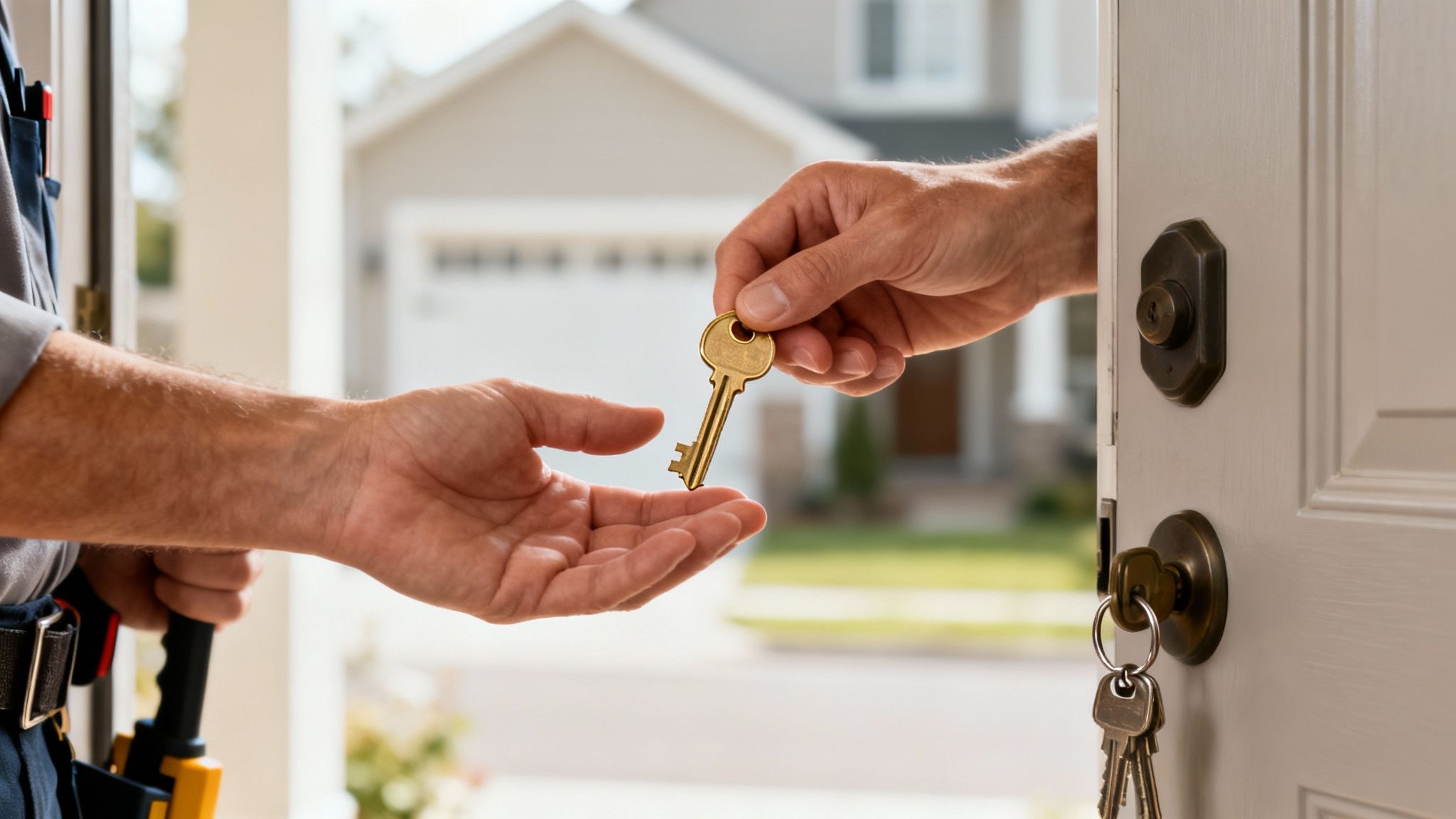
    A hand passing a golden house key to another hand in front of a new home.

    When you get the keys to a new home or rental in Fort Pierce or Vero Beach, you're inheriting a bit of a mystery. Who else has a copy? The list could include former owners, previous tenants, their family members, or contractors.

    Instead of the costly and time-consuming project of replacing every single lock, rekeying offers a much more practical solution.

    The real benefit here is peace of mind. By rekeying, you regain absolute control over who has access to your property. It’s a powerful first step in making a new house truly your secure space. If you've just moved, dealing with a house lockout because an old key is missing is the last thing you want. Call (772) 710-8169 for immediate help if you find yourself in a bind.

    Rekeying vs. Replacing: What’s the Difference?

    Homeowners often use "rekeying" and "lock change" interchangeably, but they are fundamentally different services. A lock change means the entire mechanism is swapped out—the knob, the deadbolt, everything.

    Rekeying, however, is more precise. A locksmith only works on the internal components, leaving your existing hardware perfectly intact. This difference significantly impacts your wallet and your schedule.

    • It’s more cost-effective. You're not buying new locksets, just paying for a professional service.
    • It saves time. A skilled locksmith can rekey a standard lock in minutes. A full replacement takes much longer.
    • It’s convenient. Want one key for your front door, back door, and garage? We can rekey them all to match, simplifying your keychain.

    A rekey is one of the most common and essential home security services we provide. On average, homeowners can save 60-70% by rekeying instead of buying new locks. A professional rekey might run $50-$150 per door, while a full lock change can easily be $200+. The savings add up quickly.

    When Is Rekeying the Right Call?

    Most often, the decision to rekey is triggered by a specific life event. For our clients in Stuart and Jensen Beach, a few common scenarios always point to rekeying as the best immediate solution.

    Did you lose a set of keys? Had a roommate or tenant move out? Even an attempted break-in is a huge red flag. In any of these cases, rekeying should be your top priority to eliminate a potential security gap.

    Now, if your locks are old, rusted, or malfunctioning, a full lock change is the better move. It’s also the right choice if you want to upgrade to a more secure or stylish lock. For most other situations, rekeying delivers the same security boost for a fraction of the cost.

    Still not sure what's best for your home? Our residential locksmith services are designed to help you make an informed decision. Call (772) 710-8169 for immediate help and professional advice.

    Getting Your Hands on the Right Lock Rekeying Tools

    Alright, let's talk tools. Before you even think about disassembling that lock, you must have everything ready. Trying to improvise your way through a rekeying job is a recipe for disaster, leaving you with a pile of tiny parts and an unlocked door. This isn't a job for just a screwdriver; you absolutely need a proper rekeying kit.
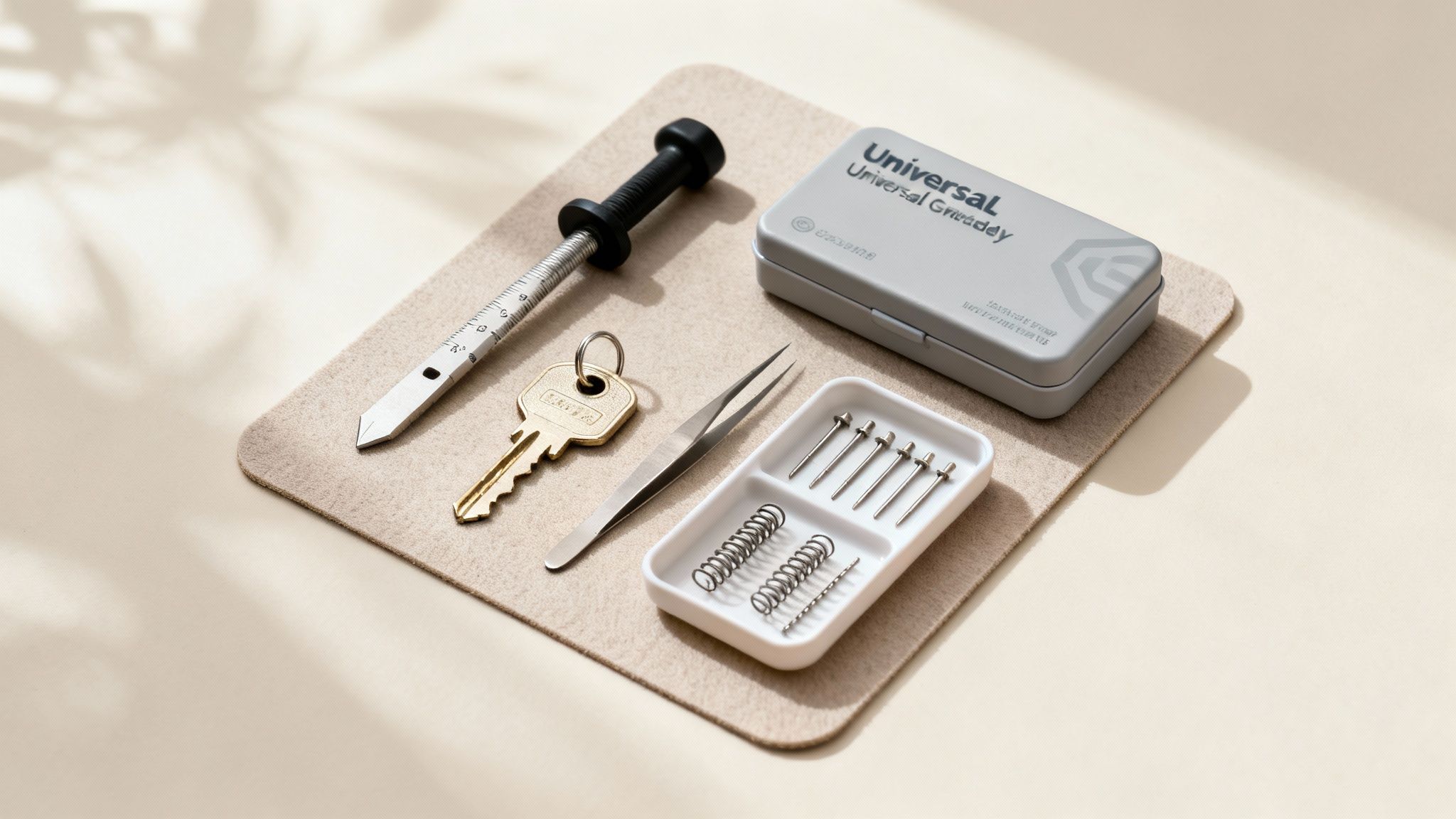
    Lock rekeying kit laid out with a rekeying tool, key, tweezers, pins, and springs.

    The heart of this operation is a standard rekeying kit. You can find these tailored for specific brands like Schlage or Kwikset, or you can get a more universal set. Inside, you'll find all the small pins, springs, and clips you'll need to match the lock to a new key.

    What's Actually in a Rekeying Kit?

    The most critical piece of equipment in that kit is the plug follower. It’s a simple cylinder of metal or plastic, but it’s essential for preventing a nightmare scenario. As you slide the lock's core (the plug) out of the cylinder, you slide the follower in right behind it. This single action keeps all the top pins and their tiny springs from launching into oblivion. If you skip this, you'll be on your hands and knees with a flashlight, and your lock will be out of commission.

    Your kit should also come with a few other essential items:

    • A Removal Tool: This is often a small, stiff piece of wire used to depress a retaining clip and release the lock cylinder.
    • Tweezers: You’ll be handling pins that are almost microscopic. Good tweezers are a must.
    • A Key Gauge: This tool is a lifesaver. It helps you measure the cuts on your new key so you know exactly which size pins to use. No guesswork required.
    • New Pins and Springs: These are the small, color-coded or numbered brass pins that will be arranged to match your new key.

    For anyone new to this, grabbing a kit made specifically for your lock's brand is the smartest move. It eliminates guesswork and ensures everything will fit. If you're tackling locks from a few different brands, a universal kit can work, but you’ll need to be extra careful matching the right parts.

    DIY vs. Calling a Pro: A Quick Cost Breakdown

    Doing it yourself can be rewarding, but it's worth weighing the true cost. For residents here in the Fort Pierce or Stuart area, it boils down to your time and confidence. If you accidentally damage the lock—and it happens more often than you'd think—you're looking at a full lock replacement, which costs far more than a simple rekey.

    A professional locksmith doesn't just bring the tools; they bring years of experience dealing with every quirky, stubborn, or unusual lock out there. If you find yourself in a jam—like a house lockout after a rekey attempt goes wrong—we're just a phone call away.

    Call Pro-B Locksmith at (772) 710-8169 for immediate help and don't let a small project become a major headache.

    To put it in perspective, here's a look at how the costs and benefits stack up for homeowners in and around Port St. Lucie.

    DIY Rekeying Kit vs Professional Locksmith Service Cost Breakdown

    This table gives a straightforward comparison between buying a kit and hiring an expert like Pro-B Locksmith.

    Item/ServiceDIY Rekeying KitProfessional Locksmith Service (e.g., Pro-B Locksmith)
    Upfront Cost$15 – $40 for a basic single-brand kit.Typically $50 – $150 per lock, often with discounts for multiple locks.
    Included ToolsBasic, single-use tools (plug follower, tweezers).Professional-grade, high-precision equipment for all lock types.
    Expertise & GuaranteeSuccess depends entirely on your skill; no guarantee.Guaranteed workmanship, ensuring your lock functions perfectly and is secure.
    Time Investment30-60 minutes per lock for a first-timer.Usually just 10-15 minutes per lock for an experienced locksmith.
    Risk FactorHigh risk of damaging the lock, losing parts, or incorrect pinning.Very low risk; professionals are insured against any accidental damage.

    While a $15 kit seems appealing, the potential for a much more expensive mistake is real. When you factor in the time, risk, and the peace of mind that comes with a professional guarantee, calling a local pro is often the most practical and cost-effective solution.

    Getting Your Hands Dirty: A Practical Guide to Rekeying a Cylindrical Lock

    Alright, this is where your preparation pays off. Rekeying a cylindrical lock—the kind on most front doors from Port St. Lucie to Jensen Beach—is a detailed job, but it’s completely manageable if you’re methodical. The absolute key is giving yourself a clean, well-lit space to work. Rushing this is the fastest way to lose a tiny spring and end up with a lock that’s just a paperweight.

    Cylindrical door locks are by far the most common type we see. They're a huge part of a global security market valued at USD 3.98 billion in 2023. At its core, the process involves realigning the 5-6 pin tumblers inside the lock, a fundamental skill that hasn't changed much since 1848. Here in North America, where this lock style holds a 47% market share, it’s the bread and butter of both DIY kits and our professional services.

    Getting the Lock Off the Door

    First things first, let's get that lock off the door. Start by undoing the two main screws on the interior side of your doorknob or deadbolt thumb-turn. Once they're out, you can gently pull both the inside and outside halves of the lock apart. The only thing left in the door should be the latch mechanism.

    Next, look at the edge of the door. You’ll see two more screws holding the latch plate in place. Remove those, and the whole latch assembly will slide right out. Do yourself a favor and keep all these parts together in a small tray or bowl so nothing goes missing.

    Taking Apart the Lock Cylinder

    With the lock free, it's time to get to the core. For most deadbolts, a small retaining ring or clip holds the cylinder in its housing. You might need your removal tool or a small flathead screwdriver to gently pry it off.

    Doorknobs are a little different. Look for a tiny hole on the shank (the "neck") of the interior knob. Use the pointy end of your removal tool to press the pin inside that hole while pulling the knob off. After that, the decorative plate, or "rose," usually twists or pops off, exposing the cylinder.

    Pro Tip: Be extremely careful when you're removing the cylinder. If you pull the core out of its housing without a plug follower ready, you’ll launch tiny springs and pins everywhere. It’s the number one mistake we see from DIY jobs in Stuart and can quickly turn a simple project into a call for an emergency lock change.

    Repinning the Cylinder for Your New Key

    Now for the main event. With the cylinder isolated, insert the old key and give it a slight turn—about a quarter of the way around. This lines up the internal pins just right, allowing the core (or "plug") to slide out.

    Here’s the crucial move: As you gently push the plug out of the cylinder with one hand, use your other hand to slide the plug follower in right behind it. It needs to be one smooth, continuous motion. The follower's job is to hold the top pins and springs in place so they don't pop out.

    With the follower secured, you can now tip the plug over and dump out the old bottom pins. Grab your new key and the key gauge from your kit. The gauge will tell you exactly which numbered pin to use for each cut on the key.

    Using your tweezers, carefully place the new bottom pins into the chambers of the plug, one by one, in the correct order. When you're done, the tops of all the pins should be perfectly flush with the top of the plug. This is what we call the "shear line."

    Putting It All Back Together and Testing

    Once all the new pins are sitting perfectly, it's time to reverse the process. Slide the plug back into the cylinder, pushing the follower out as you go. Just like before, this has to be a smooth, steady action to keep the top pins from getting jammed or twisted.

    Test the new key immediately, before you even think about putting the lock back on the door. It should turn smoothly in both directions. If you feel any catching or grinding, a pin is likely the wrong size or in the wrong spot. It's much easier to fix an issue on your workbench than on a half-assembled door.

    If you hit a snag or the lock won't cooperate, don't force anything. It’s always better to pause than to accidentally break a critical component. For those times when a project gets complicated, remember professional help is just a call away. Call (772) 710-8169 for immediate help in Fort Pierce or anywhere on the Treasure Coast. We can sort out everything from basic rekeys to full lock changes and get your door secured properly in minutes. You can also explore our full range of locksmith solutions to see how we can help with any security need.

    Common DIY Rekeying Mistakes and How to Fix Them

    Even when you follow instructions perfectly, a DIY lock rekeying project can go wrong quickly. You think you’ve got it all done, but then the new key grinds, gets stuck, or just won’t work. Don't worry, it happens. The good news is that most of these issues are common and have a straightforward fix once you know what to look for.

    One of the most classic—and frustrating—blunders we see from homeowners around Port St. Lucie is spilling the top pins. This happens when the plug follower slips or isn't inserted correctly, and suddenly the tiny top pins and their even tinier springs go flying. When that happens, your project is dead in the water. The only solution is to patiently find every single pin and spring, get them back into their chambers, and then try again. It’s a pain, but you can recover.

    Your Key Is Jamming After Reassembly

    This is another all-too-common scenario. You get the lock put back together, slide the new key in, and it only turns partway before jamming. This almost always means you’ve made a pinning error.

    A single pin that’s too long or too short for its spot will block the shear line from aligning perfectly, creating a physical obstruction that stops the plug from turning. The only solution is to take it apart again.

    • Slide the plug back out: Carefully use your follower tool to remove the plug from the cylinder once more.
    • Double-check the key: Grab your key gauge and meticulously re-measure every single cut on your new key.
    • Verify the pins: One by one, check the pins you placed in the plug against the measurements from the gauge. You’ll almost certainly find one that's the wrong size.
    • Swap and test: Replace the incorrect pin with the right one, reassemble it, and test the key before you mount the lock back on the door.

    Honestly, this one mistake is responsible for the vast majority of DIY rekeying failures. Precision is absolutely critical here—we're talking fractions of a millimeter.

    Losing a Master Pin or Wafer

    Some locks, particularly in rental properties in Stuart or Fort Pierce, contain master pins (or wafers). These are tiny, secondary pins that sit between the top and bottom pins, allowing a separate master key to operate the lock. If you accidentally lose one while you're working, your new key might still function, but you've just created a serious security vulnerability.

    If you think you've lost a master pin, or if the lock feels "mushy" after you've rekeyed it, that's a huge red flag. Even if it seems to work, the lock is now likely much easier to pick or bump open.

    When you run into complex situations like this, the potential savings from a DIY job just aren't worth the risk to your home's security. If you've hit a snag, whether it’s a tricky lock change or you need an urgent car ignition repair, calling a professional is always the smartest move.

    Give us a call at (772) 710-8169 for immediate help, and one of our technicians will get your lock rekeyed correctly and securely, guaranteed.

    Smart Locks and the Future of Rekeying

    The world of home security is moving far beyond the classic pin-and-tumbler lock. As smart lock technology becomes more common in homes across the Treasure Coast, the very idea of "rekeying" is being completely redefined. It's less about physical parts and more about digital control.
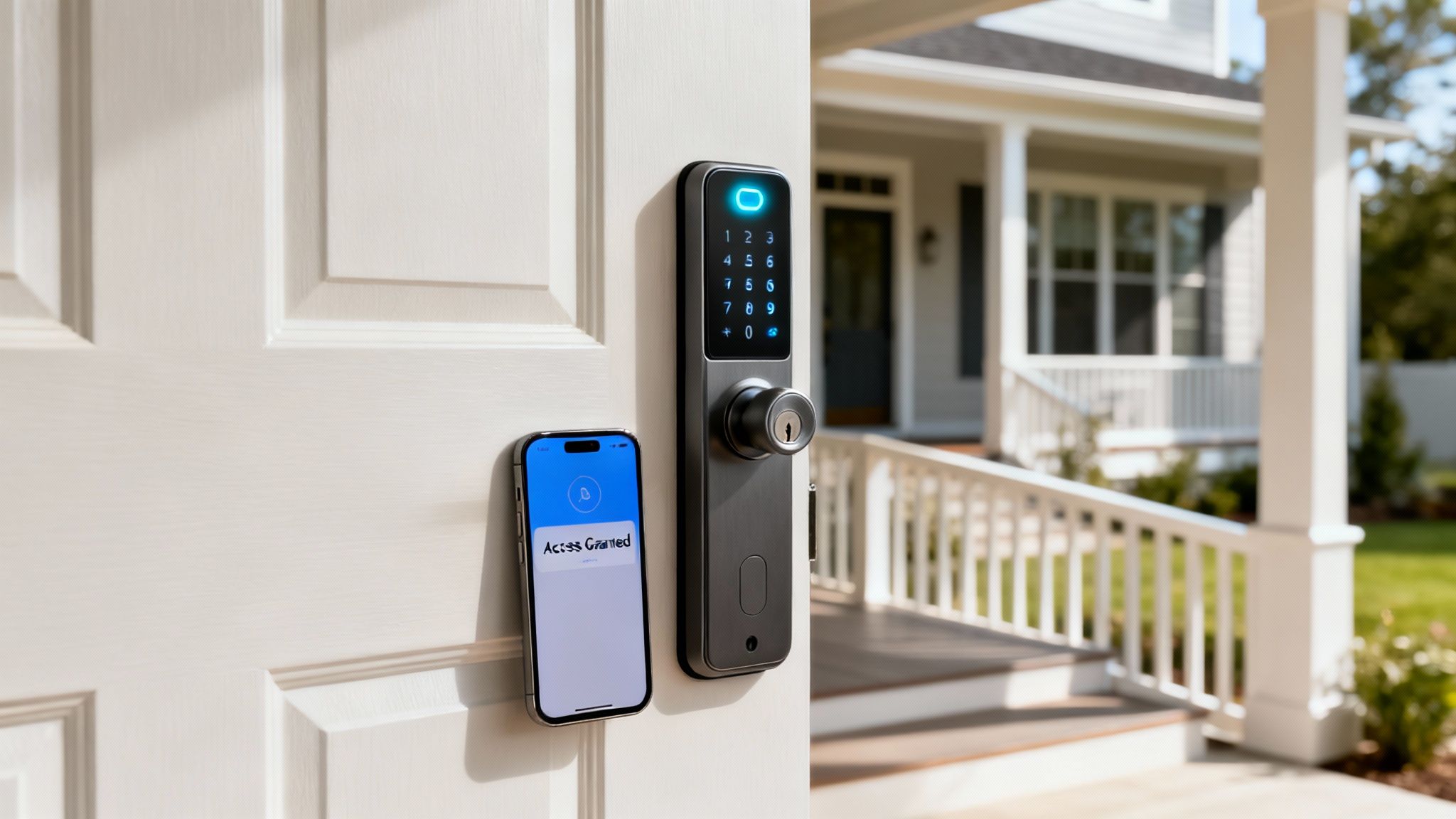
    A smart door lock with a blue illuminated keypad and a phone showing access granted on a white door.

    For many of these modern locks, there isn't a single pin to replace. Rekeying simply means revoking a digital credential from your smartphone. This is a huge leap in convenience, but it also introduces new considerations, like Wi-Fi dependency or potential digital vulnerabilities.

    Imagine managing a short-term rental in Jensen Beach. In the past, you'd have to physically rekey locks or meet every tenant. With a smart lock, you can grant them temporary access with a few taps on an app. Once they check out, you just as easily revoke their digital key, securing the property for the next guest without ever touching the lock.

    The New Meaning of a Rekey

    This shift to digital access is a game-changer for convenience and control. The security question is no longer about who has a physical key, but who has authorized digital access to your home.

    The numbers don't lie. The global smart door lock market is expected to explode from USD 3.50 billion in 2025 to an astounding USD 13.44 billion by 2032. As this market grows, "rekeying" is all about reprogramming digital access.

    In North America, which led the market with 39.5% of smart lock revenues, demand for locksmith services to reprogram these devices jumped 22% between 2021 and 2025. While about 30% of people are hesitant because of the higher cost, 40% of new home installations now include mobile controls. This feature alone can eliminate the need for traditional rekeying by as much as 70%. You can learn more about these smart lock market trends and see how they're reshaping home security.

    This technology is transforming how we manage access. Instead of rekeying after a tenant moves out, you simply delete their user code. It’s faster, cleaner, and offers a clear audit trail of who accessed the property and when.

    Is Digital Rekeying Right for You?

    While the upsides are obvious, it’s wise to weigh the pros and cons for your own home in Port St. Lucie or Stuart.

    • Pros: You get instant control over who comes and goes, there are no physical keys to lose, and you can create temporary codes for guests, cleaners, or contractors.
    • Cons: The initial cost is higher, the locks rely on batteries and often a Wi-Fi connection, and there's a risk of software bugs or hacking.

    Whether you're sticking with traditional hardware, thinking about upgrading to a smart lock, or just need a key fob replacement, our expertise covers it all. If you're considering a change or just have questions about your current setup, call (772) 710-8169 for immediate help.

    Answering Your Top Lock Rekeying Questions

    After helping countless homeowners across the Treasure Coast, we've heard just about every question there is when it comes to rekeying locks. To wrap things up, here are answers to the most common ones we get in the field.

    What’s the Real Cost to Rekey a Lock in Port St Lucie?

    The price comes down to one thing: are you doing it yourself or calling a professional?

    A DIY rekeying kit for a common brand like Kwikset or Schlage will probably run you $15 to $30. It’s cheap, but as we’ve discussed, it comes with risks if things go wrong.

    Having a professional locksmith from Pro-B Locksmith handle it for you in the Port St. Lucie area typically costs between $50 and $150 per lock. That price covers our expertise, specialized tools, and the peace of mind that comes from a job done right the first time. The final cost can vary depending on your lock type or if it's an emergency, like a late-night house lockout. For a solid, upfront quote, it's always best to just give us a call.

    Should I Rekey or Just Replace My Locks?

    This is a great question. If your current locks are in good shape and work smoothly, rekeying is almost always the best option. It's cheaper since you're not buying new hardware, it’s faster, and it’s more environmentally friendly.

    You should only consider a full lock change if your hardware is broken, heavily worn, or an older, less secure model. It’s also the right call if you want to upgrade to a high-security system or are just looking for a new style to match your home’s aesthetic. We can inspect your locks and give you an honest recommendation on what makes the most sense for your security and budget.

    Rekeying gives you the exact same security as a brand-new lock, but it must be done correctly. An improperly pinned lock is a serious vulnerability and can actually make your home less secure.

    Can I Rekey Any Type of Door Lock?

    Most standard residential locks from major brands are designed to be rekeyed. However, not all locks are the same.

    Some high-security locks, obscure brands, or very old hardware can be tricky. They often require specialized tools and knowledge, and some are not designed to be rekeyed at all. From a car lockout to a vintage deadbolt, each lock has its own requirements.

    If you’re unsure what you’re dealing with, the safest move is to consult a professional. At Pro-B Locksmith, we’ve worked with a massive range of lock types and can quickly tell you what your options are. For a fast answer, Call (772) 710-8169 for immediate help.

    How Long Does Rekeying Actually Take?

    For an experienced locksmith, rekeying a standard lock is quick work—usually about 10-15 minutes.

    If it's your first time doing it yourself, be realistic. You should probably set aside 30 minutes to an hour for each lock, and that's if you don't hit any snags. If you have a whole house to secure in Jensen Beach or Vero Beach, our mobile service can get it all done far more efficiently than spending your weekend hunched over a door.

    For more answers to common questions, you can also check out our comprehensive locksmith FAQ page.


    When you need it done right, done fast, and backed by a professional guarantee, trust your local experts. Pro-B Locksmith is ready to secure your property with expert rekeying, lock changes, and 24/7 emergency services across the Treasure Coast. https://problocksmith.com

  • How to Disable Anti Theft System: A Local Guide for Port St. Lucie

    How to Disable Anti Theft System: A Local Guide for Port St. Lucie

    When your car won't start in Port St. Lucie and you see that dreaded security light flashing, the first thing to try is incredibly simple: use your key fob to lock and then unlock the doors. This simple cycle can often reset the system and re-establish the connection between your key and the car's security module. It's a quick, practical tip that just might get you back on the road in Fort Pierce or Vero Beach.

    Diagnosing Your Anti Theft System Problem

    A red emergency light on a car dashboard, with a distressed person visible through the blurry windshield.

    When your car suddenly refuses to start or the alarm starts blaring for no apparent reason, it’s easy to assume the worst. But before you jump into trying to disable the anti-theft system, you have to be sure that’s actually the problem.

    Misdiagnosing the issue can send you down a frustrating rabbit hole of "fixes" that do nothing but waste your time and money. As local locksmiths, we get calls all the time from folks around Fort Pierce and Jensen Beach who are convinced their immobilizer is shot, only to find out it was a much simpler issue like a dead key fob. Let's walk through how to tell if the security system is truly the culprit.

    Telltale Signs of an Engaged Security System

    A triggered or faulty anti-theft system has a few classic symptoms. If your car is doing any of these, there’s a very high probability the security system is the source of your headache.

    • Flashing Security Light: This is your biggest clue. You'll see a little light on the dash, often an icon of a key or a padlock, flashing rapidly or staying lit when you try to start the car. A slow, steady blink when the car is off is normal; a frantic one when you turn the key is a red flag.
    • Engine Cranks But Won't Start: You turn the key and hear the starter going—that familiar "rur-rur-rur"—but the engine never actually catches and runs. This is a classic immobilizer move; it's cut off the fuel or spark to prevent theft.
    • Engine Starts and Immediately Dies: Some systems are designed to let the engine fire up for just a second or two before shutting it down. If the car starts and then instantly dies, every single time, you're almost certainly looking at a security system issue.
    • No Crank, No Start at All: In some cars, particularly newer ones, the anti-theft system won't even let the starter engage. You'll turn the key, the dashboard lights will come on, but you'll get complete silence from the engine.

    Pro Tip: Before you do anything else, grab your spare key. If the spare works perfectly, the problem isn't with your car's security system—it's an issue with the transponder chip or battery in your main key. This is a common call for a key fob replacement we see in the Stuart area.

    Differentiating From Other Common Car Problems

    It’s incredibly easy to mistake a security lockout for a different mechanical issue. A no-start situation can point to a lot of things. Here’s a quick rundown of how to distinguish a security fault from other common problems we see around Stuart and Vero Beach.

    To make it easier, here's a quick reference table.

    Symptom Checker Is It Your Anti Theft System

    SymptomLikely Anti-Theft System CauseOther Potential CausesYour First Action
    Engine cranks but won't catchImmobilizer has cut fuel/sparkFuel pump failure, clogged fuel filter, ignition system issueCheck for a flashing security light on the dash.
    Engine starts then immediately diesImmobilizer is shutting the engine downFaulty mass airflow sensor, vacuum leak, bad fuel pressure regulatorTry your spare key; if it works, the issue is your primary key.
    Nothing happens when you turn the key (no crank)Advanced immobilizer preventing starter engagementDead battery, bad starter, faulty ignition switch, neutral safety switch issueCheck if your headlights are bright. Dim lights point to a dead battery.
    Alarm goes off randomlyFaulty door/hood sensor, low car batteryShort in the electrical system, faulty key fobCheck that all doors, trunk, and hood are securely closed.

    This table should help you narrow down the possibilities before you start troubleshooting.

    For example, a dead battery is the number one reason cars don't start. The giveaway here is that you'll usually hear a rapid clicking sound when you turn the key, or the dash lights will be extremely dim or won't turn on at all. An anti-theft issue typically lets the dash lights shine at full brightness.

    If you have a faulty starter, you might just hear one loud "click" when you turn the key, but no cranking. In contrast, an immobilizer often lets the engine crank over and over without ever starting. A bad alternator is different, too—it won't stop the car from starting, but it will cause it to die while you're driving once the battery's charge is used up.

    Knowing these differences is key. If you’re stranded and can't figure it out, it's time to call in a professional. For fast, reliable help, you can learn more about our emergency lockout services across the Treasure Coast. Getting the right diagnosis from the start will save you from trying fixes that could potentially damage your vehicle.

    Call (772) 710-8169 for immediate help, and a certified technician will figure out the real problem the first time.

    Simple DIY Resets You Can Try First

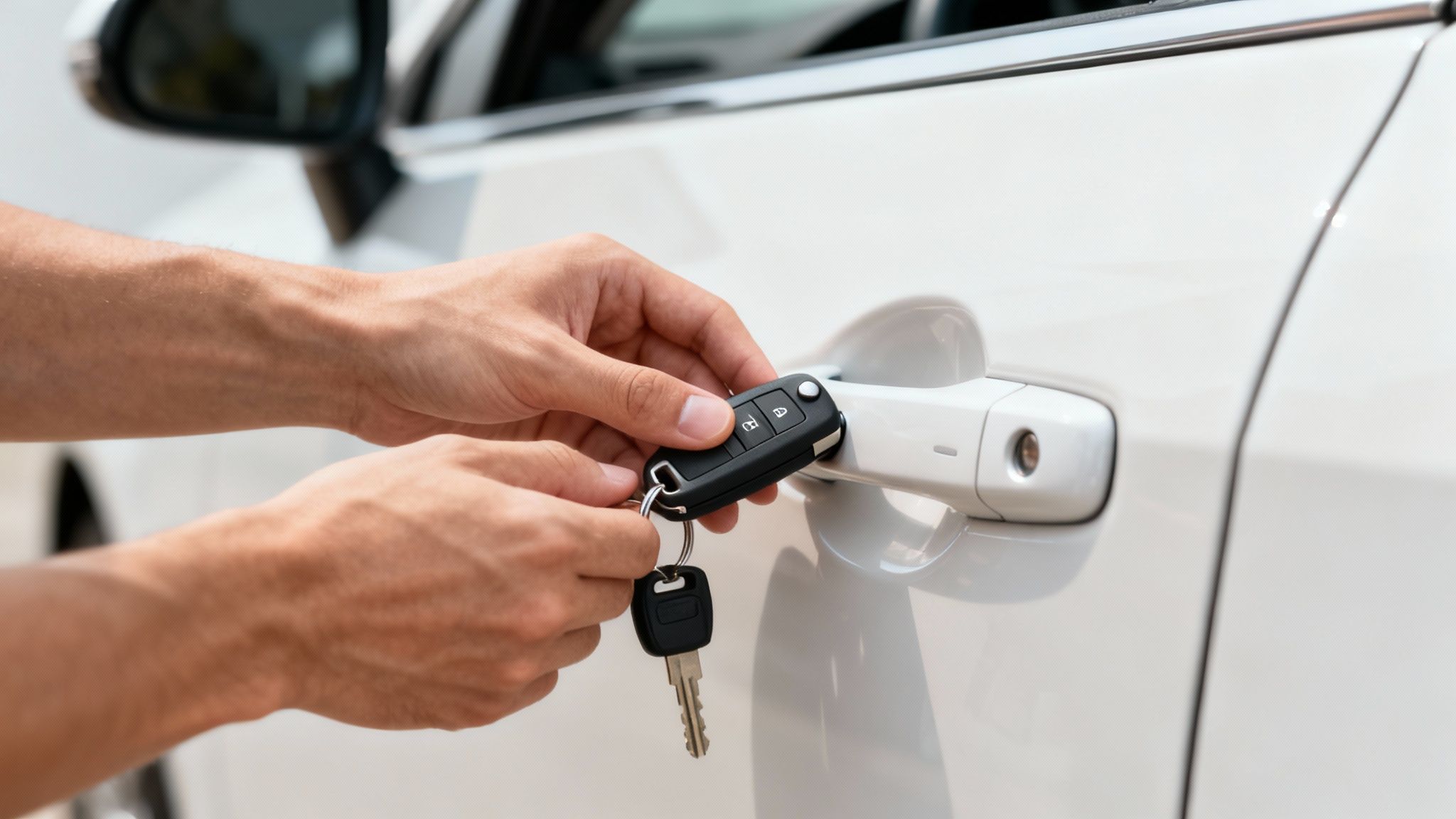
    Close-up of hands inserting car keys into a white car door handle.

    So, you've done a quick check and the evidence is pointing to a glitchy anti-theft system. Don't panic. Before you even think about calling a tow truck in Port St. Lucie, there are a few safe, manufacturer-intended resets you can try right where you are.

    These practical tips don't require any special tools. They're designed to re-establish the digital "handshake" between your key and your car's security module, which can sometimes get out of sync.

    The Key in the Door Trick

    This is your first, and often most successful, move, especially on slightly older cars. It’s a wonderfully low-tech and practical step. The car's computer is programmed to see a physical key turning the lock as a legitimate action from the owner, not a forced entry.

    • First, get out and make sure every door, the trunk, and the hood are shut tight.
    • Now, use your actual key—not the button on the fob—to lock the driver's side door.
    • Give it about 30 seconds.
    • Finally, use the physical key again to unlock the door.

    That simple, manual action is often all it takes to tell the security system, "Hey, the owner is here," and convince it to stand down. This simple turn of the key has gotten countless people in our community back on the road.

    The Key Fob Cycle

    If turning the key in the door didn't do it, your key fob is next up. This method works on the same principle, but uses the fob's radio signal to communicate with the car.

    Start by moving about 10 to 15 feet away from your vehicle. Press the lock button on your fob and wait for the familiar chirp or flash of the lights. Then, after a brief pause, press the unlock button. Get back in and try to start the car. This quick lock/unlock cycle can often resynchronize the fob with the vehicle's brain. Just keep in mind, if your fob’s battery is on its last legs, this probably won’t work.

    The Ignition Cycle Reset (The "10-Minute Relearn")

    Alright, this one is a bit more involved, but it's a standard procedure for many GM, Chrysler, and other domestic vehicles common in our area. It's a way to force the car's computer to re-recognize the transponder chip in your key. Follow these steps exactly for it to work.

    1. Put your key in the ignition and turn it to the "ON" position. This is the spot where the dashboard lights up, but you haven't actually started the engine.
    2. Look for the security light on your dash—it will probably be flashing or solid. Just leave it.
    3. Now, the hard part: wait. Leave the key in the "ON" position for about 10 to 15 minutes.
    4. After the time is up, that security light should turn off or stop flashing. That’s your signal that the key has been relearned.
    5. Turn the key to the "OFF" position and let it sit for about 10 seconds.
    6. Take a breath, and try to start the engine. It should now turn over.

    Why This Works: The ignition cycle reset gives the Body Control Module (BCM) or Engine Control Unit (ECU) enough time to properly validate your key's transponder chip. It’s a built-in security process to stop thieves from using bypass tools.

    Knowing When to Throw in the Towel and Call for Help

    These DIY methods are your first line of defense, but it's critical to know when you're beaten. If you’ve patiently tried all of these resets and the engine still won't crank, it’s time to stop. Continuing to cycle the ignition can drain your battery or cause bigger electronic headaches.

    This is the point where a professional touch is necessary. A mobile locksmith can come directly to you in Port St. Lucie, Fort Pierce, or Stuart with the proper diagnostic tools to pinpoint the real issue, whether it's a dead transponder chip, a bad ignition switch, or something else entirely. Don't risk making things worse—call us at (772) 710-8169 for immediate help. We can often perform a key fob replacement or ignition repair on the spot, saving you a frustrating and expensive trip to the dealership.

    For more answers to common vehicle security issues, take a look at our locksmith service frequently asked questions.

    How Modern Vehicle Immobilizers Work

    If your car was built in the last 25 years or so, it's protected by more than just a blaring alarm. Modern vehicles use a silent but powerful technology called an engine immobilizer. Understanding how this system works is the first step to figuring out why it's suddenly giving you a headache.

    Forget what you've seen in movies about hotwiring cars. For any modern vehicle you see driving around Port St. Lucie or Jensen Beach, that's pure fantasy. The immobilizer is designed to make sure the engine will only start when it recognizes one specific, authorized key.

    The Digital Handshake

    So, how does it work? Deep inside the plastic head of your car key or key fob, there's a tiny transponder chip. This chip is passive—it doesn't have its own battery. It waits to be powered up wirelessly when you put the key in the ignition.

    Wrapped around the ignition cylinder is an antenna ring. When you turn that key, the ring sends out a low-frequency radio signal, which zaps the transponder chip with just enough energy to wake it up. In response, the chip beams a unique alphanumeric code back to the car's Engine Control Unit (ECU) or Body Control Module (BCM).

    If the code from the key matches the one stored in the car's computer, you've got a successful digital handshake. The ECU then gives the green light to the fuel pump and ignition systems, and your car starts right up. But if the code is wrong, or if no code is received, the ECU locks everything down. No fuel, no spark. The engine will crank all day long, but it will never fire.

    This intricate back-and-forth is exactly why a simple metal copy of your key from a hardware store won't start your car. It might unlock the door, but without that correctly programmed transponder chip, the engine stays dead. This is a common reason we're called for key fob replacement services.

    This technology is a huge reason car theft has gotten so much harder. In fact, the global vehicle anti-theft system market was valued at USD 14.10 billion in 2024 and is expected to climb to USD 26.30 billion by 2032. This growth is all about these kinds of advanced security features. You can read more about these security advancements on databridgemarketresearch.com.

    Common Triggers for Immobilizer Faults

    So if these systems are so reliable, what makes them fail? From our experience as locksmiths serving Vero Beach and Fort Pierce, we see the same culprits over and over again. This digital handshake can be interrupted for a few key reasons, leaving you stranded.

    • Damaged Transponder Chip: All it takes is one hard drop onto a concrete floor or exposure to a strong magnet to wreck the delicate chip inside your key. The key itself might look perfectly fine, but the chip is toast.
    • Dead Key Fob Battery: While the transponder chip itself is passive, a weak or dead battery in your key fob can still cause interference, especially on push-to-start vehicles that rely on a stronger signal.
    • Signal Interference: Believe it or not, powerful radio frequency (RF) signals can jam the communication between your key and car. This can happen if you're parked near big radio towers or even have a stack of other transponder keys on the same keychain.
    • Faulty Antenna Ring: The ring around the ignition can wear out or get damaged, making it unable to power up or read your key's chip.
    • ECU Glitches: In rare cases, the car's main computer can develop a glitch and simply "forget" the codes for its authorized keys.

    When any of these things happen, your car thinks it's being stolen and goes into lockdown. Trying to bypass the system without fixing the root problem is a waste of time and can even create bigger electronic issues. If you're dealing with a stubborn immobilizer in the Stuart area, it’s a sure sign you need professional diagnostic tools.

    Call (772) 710-8169 for immediate help. A certified technician can handle an expert key fob replacement or ignition repair without any guesswork.

    When You Absolutely Need a Professional Locksmith

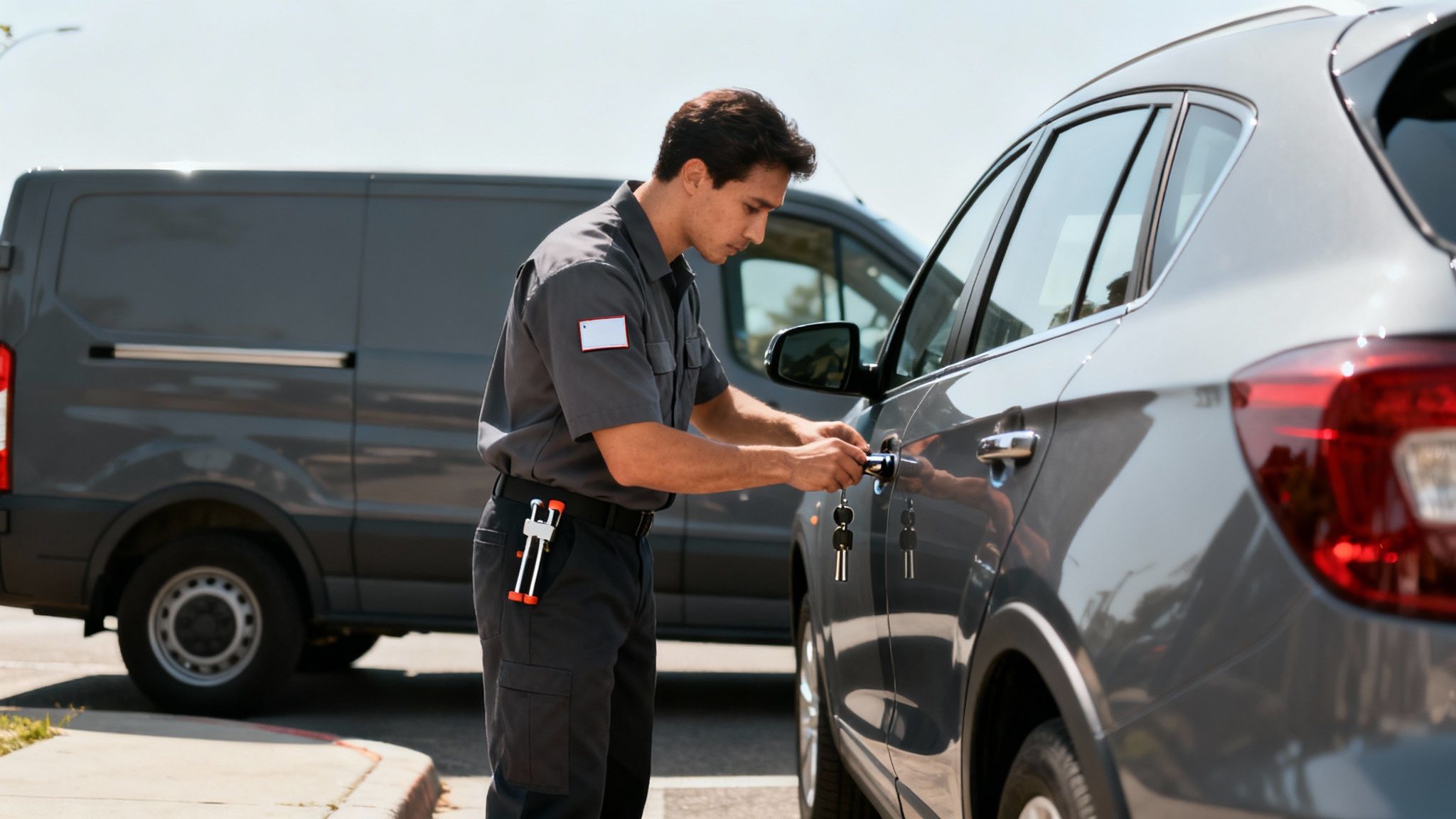
    A male technician wearing a uniform is using tools to unlock the driver's side door of a grey car.

    While trying a few simple resets is a smart first move, it's critical to know your limits when you're dealing with a vehicle's sensitive security electronics. I've seen it happen too many times: a minor glitch turns into a major, expensive repair because someone pushed a little too far.

    Knowing when to stop fiddling is just as important as knowing what to try in the first place. Once you've hit a wall, making a professional call is always the safer, faster, and often cheaper choice in the long run.

    Signs It's Time for Professional Help

    So, you've tried the simple tricks and your car is still giving you the silent treatment. You've probably reached the end of what can be fixed without specialized equipment. That stubbornly flashing security light that refuses to go away? That's your car's way of telling you the problem runs deeper.

    Here are the most common situations we run into around Port St. Lucie where a professional is the only real option:

    • You've Tried All the DIY Resets. You patiently went through the key-in-the-door method and the 10-minute ignition cycle, but the car remains dead. This isn't just a simple glitch; something has likely failed.
    • The Security Light is Blinking a Code. Some cars use that little light to communicate. A specific pattern—like flash-flash-pause-flash—isn't random. It's a diagnostic code pointing to a specific fault that only a tech with the right scanner can translate.
    • You've Lost Every Single Key. If you don't have a working key, there's nothing to reset. A mobile locksmith can come to you in Fort Pierce, cut a new key, and program it on the spot. No towing, no dealership hassle.
    • Your Key is Physically Damaged. A key snapped in the ignition or a fob that went through the wash might have a busted transponder chip inside. No amount of resetting will fix a key that can no longer talk to the car. This is a clear case for an ignition repair or key replacement.

    My Two Cents: Constantly trying to crank the engine when the anti-theft system is active can do more harm than good. You'll drain the battery for sure, and you could even send voltage spikes that damage the Engine Control Unit (ECU)—your car's very expensive brain.

    The Risks of Pushing Your Luck

    Going down the rabbit hole of aggressive "fixes" you found on some random forum is a huge gamble. These methods often suggest disconnecting wires or trying to bypass sensors, which can wreak havoc on modern, computer-driven vehicles. The global anti-theft system market is expected to hit USD 28.34 billion by 2034, which tells you just how complex and integrated these systems have become. They aren't designed for easy disassembly. You can read more on this market growth in research from Precedence Research.

    Trying to force the issue can lead straight to:

    • Frying the Body Control Module (BCM): This little computer runs everything from your power windows to your security system. Damaging it is a complicated and costly mess.
    • Destroying the Ignition Cylinder: Forcing a broken key or trying to rig the ignition can break delicate internal parts, meaning you'll need a full ignition repair.
    • Bricking the Car: In a worst-case scenario, you could corrupt the vehicle's main computer, rendering it completely useless until a specialist reprograms or replaces it.

    Why a Local Locksmith Is Your Best Bet

    Instead of taking that risk, a quick call saves you a world of time, stress, and money. A mobile automotive locksmith who serves the Fort Pierce, Stuart, and Jensen Beach areas comes right to you, so you don't even have to think about a tow truck.

    Our technicians show up with the same high-tech diagnostic tools and key-programming machines you'd find at a dealership. We can handle just about anything right in your driveway or office parking lot. Find out how our automotive locksmith services can get your problem sorted out quickly and without breaking the bank.

    Don't let a small security hiccup spiral into a financial nightmare. Call us at (772) 710-8169 for immediate help, and we’ll get a certified pro on the way to safely get you moving again.

    How to Prevent Future Anti-Theft Lockouts

    Dealing with a car that won't start because of a security system glitch is a massive headache. You’ve got places to be. While knowing the quick resets is useful, the best strategy is to avoid the problem in the first place.

    A few simple, preventative habits can keep your car's anti-theft system working for you, not against you. This will keep you reliably on the move, whether you're in Port St. Lucie or cruising around the Treasure Coast. A proactive approach starts with the very thing you use every day: your car key.

    Start With Your Key and Fob

    From my experience, the single most common point of failure we see on locksmith calls in our local service area is the key itself. A damaged key, a dead battery, or a weakened transponder chip is the number one trigger for an immobilizer lockout. Think of your key as a tiny, sophisticated computer that needs a little care.

    • Change the Fob Battery: Don't wait for it to die. As a rule of thumb, pop a new battery in your key fob every 18-24 months. A weak battery sends a faint signal that your car's receiver can easily miss, which can make the system think it's being hotwired.
    • Handle With Care: Avoid dropping your keys on concrete or getting them wet. The delicate transponder chip inside can be easily damaged, making the key useless even if it looks perfectly fine on the outside.
    • Separate Your Keys: Avoid keeping multiple transponder keys on the same keychain. It sounds strange, but their signals can actually interfere with each other, confusing your car’s antenna when you’re trying to start it.

    The Spare Key Isn't Just a Backup—It's a Lifesaver

    Having a properly programmed spare key is more than just a convenience; it's your single best defense against a lockout disaster. A spare is your ultimate diagnostic tool.

    If your primary key suddenly stops working, grab the spare. If the spare works, you know instantly the problem is the first key. If the spare also doesn't work, then you know the issue is likely with the car itself. That simple test can save you a ton of time and guesswork.

    Lost your spare? Never had one? Don't wait until you're stranded. A professional locksmith can create and program a new key fob replacement on-site for a fraction of what a dealership will charge. It's a small investment that provides huge peace of mind.

    A cheap, poorly cloned key from an unlicensed vendor is a major gamble. These keys often have weak signals or use faulty chips that can fail without warning. We’ve seen them corrupt a car's computer, turning a simple lockout into a much more expensive repair.

    Pay Attention to Your Surroundings

    Sometimes, the problem isn't your key but where you parked. Strong radio frequency (RF) interference can completely disrupt the signal between your key and your car. This is a temporary communication failure that can happen when you're parked near:

    • Large radio or cell phone towers
    • Power stations
    • Certain commercial buildings with powerful security systems

    If your car suddenly refuses to start in a location like this, try pushing it a few feet away. Often, just moving out of that "dead zone" is all it takes to re-establish the connection.

    These preventative measures are simple, but they're incredibly effective. The global market for vehicle anti-theft systems hit USD 14.60 billion in 2024 and is still growing fast. This reflects just how complex these systems are becoming, making professional maintenance and repair far more reliable than trying to disable them yourself. You can learn more about the growth of the anti-theft system market at imarcgroup.com.

    By taking care of your keys and being mindful of where you park, you can dramatically reduce the chances of an unexpected lockout. But if you do find yourself in a bind anywhere from Stuart to Jensen Beach, don't hesitate. Call (772) 710-8169 for immediate help, and we'll get you back on the road safely and swiftly.

    Your Top Questions About Car Anti-Theft Systems

    When it comes to vehicle security, there's a lot of confusing information and myths floating around. As locksmiths on the ground here in Port St. Lucie and the surrounding towns, we field the same questions day in and day out. Let's cut through the noise and give you some direct, no-nonsense answers based on our hands-on experience.

    Can a Factory Anti-Theft System Be Disabled Permanently?

    This is easily one of the most common questions we get. The short answer? No, not in any practical or safe way.

    Modern factory immobilizers aren't just an add-on; they're deeply woven into the car's Engine Control Unit (ECU). Think of it as part of your car's central nervous system. Trying to permanently disable or bypass it is a recipe for disaster. You're risking severe, unpredictable electrical problems that can be an absolute nightmare to diagnose later.

    A botched bypass could easily brick the ECU, leaving your car permanently inoperable. Beyond that, it might even void your car insurance policy since you've intentionally removed a critical safety feature.

    The only proper, professional solution for a faulty system is always repair, not removal. This usually involves services like:

    • Key Fob Replacement & Reprogramming: Getting your key and car back in sync.
    • Ignition Repair: Fixing a faulty antenna ring or ignition switch that isn't reading the key.
    • ECU Diagnostics: Finding and fixing the glitches within the car’s computer.

    Will Disconnecting the Car Battery Reset the System?

    The idea of a simple "hard reset" by pulling the battery cable is tempting, but it's rarely effective on modern anti-theft systems. Sure, that trick might fix a minor glitch with your radio, but immobilizers are designed with persistent memory that holds key data even without power. They're built specifically not to forget your programmed keys.

    In fact, disconnecting the battery can sometimes make the situation worse. Some higher-end vehicles interpret a sudden power loss as a tampering attempt, which can trigger a full security lockdown. Now, instead of a simple communication error, you have a system actively trying to prevent a perceived theft. It's a low-success tactic that we generally advise against.

    Why Is My Dashboard Security Light Blinking?

    That little flashing light on your dash is your car's way of communicating. A slow, steady blink when the car is off is completely normal—it’s just letting you know the security system is armed and on guard. It’s when that behavior changes that you need to pay attention.

    A rapid, frantic blink when you try to start the car, or a solid light that stays on, is a clear signal of a fault.

    This almost always means the car is failing to recognize the transponder chip in your key. The usual suspects are a dead battery in the key fob, physical damage to the key itself, or a problem with the car’s antenna ring around the ignition.

    The very first thing you should do is try your spare key. If the spare works perfectly, you know the problem is isolated to your main key. If neither key works, the issue lies within the vehicle, and it’s time to call a professional. For immediate help in the Stuart or Jensen Beach area, Call (772) 710-8169 for immediate help.

    What Does It Cost to Fix an Anti-Theft System Issue?

    The cost to sort out an anti-theft problem can vary dramatically depending on the root cause. A simple key fob battery is just a few dollars. But if the entire key fob needs to be replaced and programmed, calling a mobile locksmith is often the most cost-effective solution.

    • Key Fob Replacement: This typically runs between $150 and $400, which is almost always significantly less than dealership prices.
    • Ignition Switch Repair: This is a more involved job and the cost will depend heavily on your car's make and model.

    The key is getting an accurate diagnosis first. For a clear, upfront quote tailored to your specific car in the Fort Pierce or Vero Beach area, a professional assessment is your best bet. Don't guess—get an expert opinion.


    If you're facing a stubborn anti-theft issue or need any other locksmith service, from a car lockout to a house lockout or lock change, Pro-B Locksmith provides fast, reliable, and professional help across the Treasure Coast. From car lockouts to on-site key fob replacement, we have the tools and expertise to solve your problem correctly the first time. Visit us at https://problocksmith.com to learn more.

  • How to Fix a Patio Door Lock: A Treasure Coast Homeowner’s Guide

    How to Fix a Patio Door Lock: A Treasure Coast Homeowner’s Guide

    When your patio door lock starts acting up, it's more than just a hassle—it's a real security concern for your home here in Port St. Lucie. The good news is, before you start thinking about a costly replacement, the fix is often something you can handle. Most of the time, the problem boils down to one of three things: misalignment, debris in the mechanism, or worn-out parts.

    Diagnosing Your Stuck or Broken Patio Door Lock

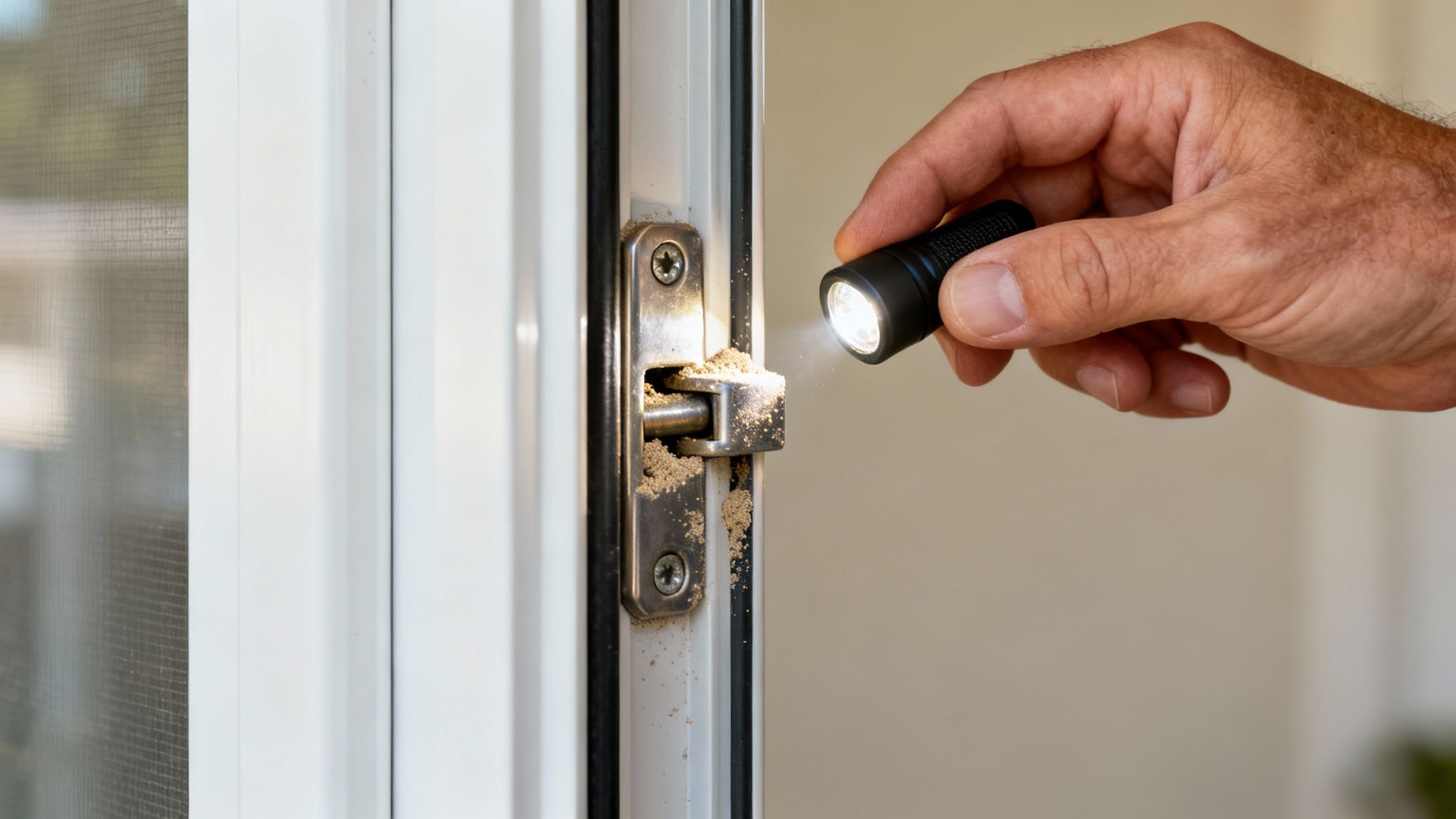
    A hand shines a flashlight on a patio door lock mechanism covered in termite frass.

    We get calls all the time from folks on the Treasure Coast whose patio door lock suddenly decided to quit. It’s easy to assume the lock itself is broken, but our coastal climate—with all its humidity, salt, and sand—is usually the real culprit. Figuring out why it’s failing is the first, and most important, step to getting it fixed right.

    A classic example we see in Stuart and Vero Beach homes is a door that gets tough to lock after a big storm or a sudden temperature drop. That almost always points to misalignment. Your house settles, the frame shifts just a hair, and suddenly the latch and the strike plate aren't lining up correctly. If you're locked out or locked in, Call (772) 710-8169 for immediate help; trying to force a stuck door can cause serious damage.

    Quick Diagnosis of Common Patio Door Lock Problems

    To help you get started, here's a quick reference table. Match your door's behavior to the likely cause.

    SymptomLikely CauseDifficulty Level
    Key is hard to turn or won't go inDebris in the keyway, worn-out cylinderEasy to Moderate
    Lock feels stiff when turning the knobNeeds lubrication, internal parts are corrodedEasy
    Handle is loose or wobblyMounting screws are looseEasy
    You have to lift or push the door to lock itDoor is misaligned, rollers are wornModerate
    The key turns but the latch doesn't moveBroken internal mechanism (cam or actuator)Difficult (Often requires replacement)

    This table should give you a solid starting point for troubleshooting.

    Common Signs of Failure

    Let's do a little detective work. Look and listen for these clues to pinpoint what's really going on with your lock.

    • Grinding or Scraping Noises: Hear that? It’s often the sound of the door dragging on the track because the rollers are shot. This throws the whole lock alignment out of whack.
    • A Loose or Wobbly Handle: Give the handle a jiggle. If it feels sloppy, the mounting screws have likely backed out, or worse, a component inside has snapped. This is a common issue in Jensen Beach homes from frequent use.
    • The Key Turns But Nothing Happens: This one is a dead giveaway. The internal link between the key cylinder and the latch is broken. The lock has failed internally and needs a professional lock change.
    • Visible Debris or Corrosion: Don't underestimate the power of sand, dirt, and rust, especially here. A quick look with a flashlight can tell you if the lock is just clogged up.

    Here's a little perspective: A 2022 industry analysis showed that most homeowners choose to repair or replace just the lock unit itself instead of the entire door frame. It really highlights how a timely, targeted repair is often the smartest and most effective solution.

    If you’re stuck on the wrong side of a door that won't budge, don't panic. Our emergency lockout services can get you back inside without damaging your door. For any other issue, taking a few minutes to diagnose the problem first will save you a ton of time and make sure you're actually fixing the right thing.

    Gearing Up for the Job

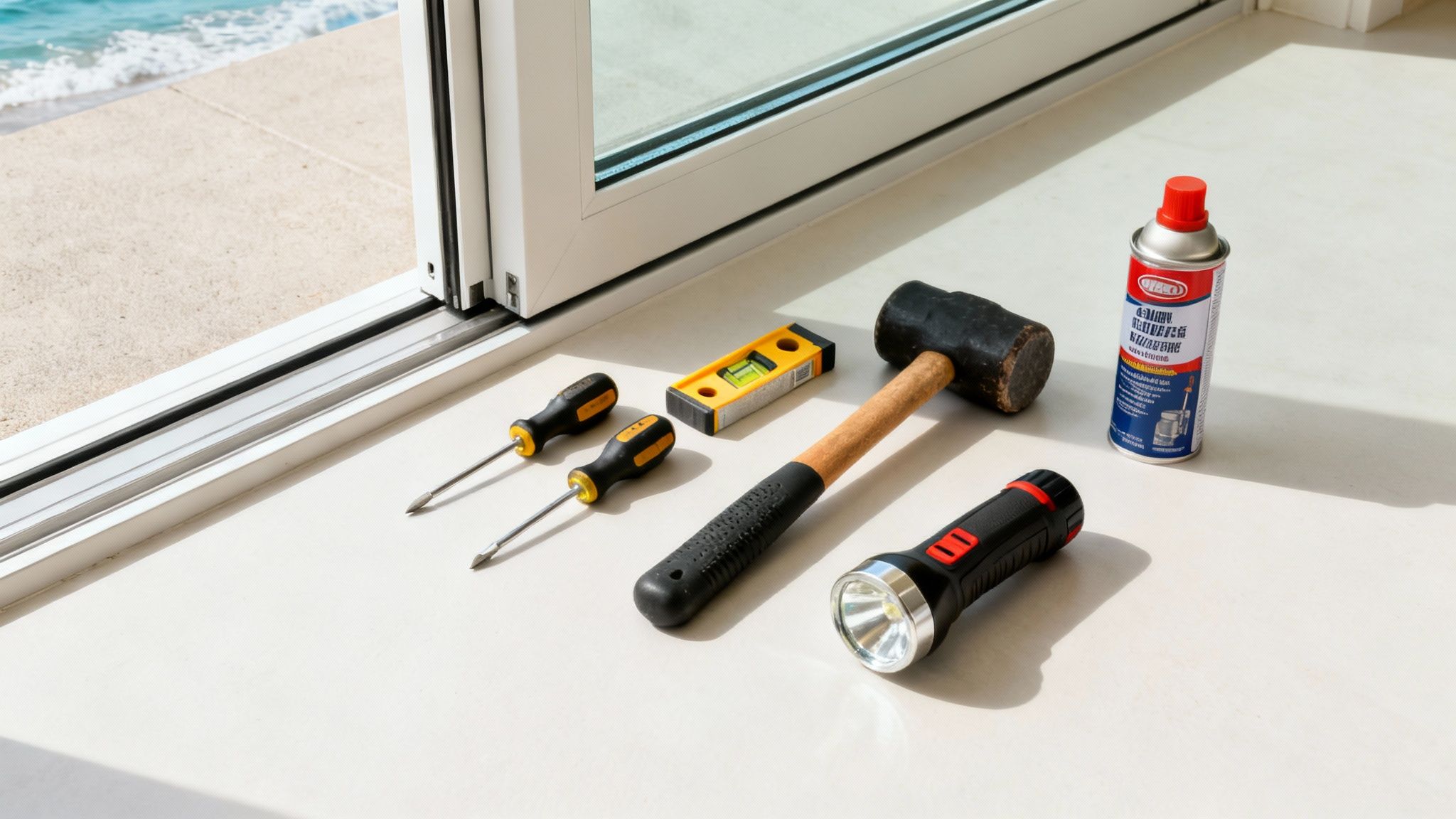
    Tools like screwdrivers, level, sledgehammer, flashlight, and spray can for home repair.

    Before you dive in and start taking things apart, let's talk about tools. Trying to fix a patio door lock without the right gear can turn a quick fix into a full-blown disaster, and you might even damage your door. The good news is, for most common lock problems, you probably already have what you need sitting in your garage.

    A successful repair starts before you even touch a screw. Just like a chef preps their ingredients, getting your tools ready first makes the whole process smoother and a lot less frustrating. This is a practical step that applies to any home repair, from a simple lock change to something more complex like an ignition repair on your car.

    Your Essential Repair Toolkit

    For the kind of patio door lock issues we see all the time here in Port St. Lucie, you don't need a professional-grade toolbox. A few basics will get you through most adjustments and maintenance tasks.

    Here's a quick list of what you should grab:

    • A Good Screwdriver Set: You'll need both Phillips and flathead screwdrivers for the handle, lock assembly, and strike plate. A multi-bit driver is a fantastic space-saver if you have one.
    • Silicone-Based Lubricant Spray: This is your secret weapon. You absolutely want a silicone-based spray because it lubricates without creating a sticky mess that attracts our Florida sand and grime.
    • Stiff Brush & Vacuum: An old toothbrush is perfect for scrubbing gunk out of the lock mechanism. Follow up with a vacuum and its crevice tool to get everything clean.
    • Flashlight or Headlamp: Let's be honest, you can't fix what you can't see. Most lock parts are hidden in shadow, so good light is a must.
    • Rubber Mallet: If the strike plate is just a little off, a few gentle taps with a rubber mallet can nudge it back into place without leaving dents.

    A Quick Tip from a Treasure Coast Pro: Stay away from oil-based lubricants like WD-40 for your locks. While it's a great product for other things, on locks, it leaves a tacky film. Here on the coast, from Fort Pierce to Jensen Beach, that sticky residue becomes a magnet for salt and sand, which will clog up your lock and make things worse down the road.

    A Quick Pre-Repair Checklist

    Got your tools? Great. Now, take just five minutes to prep your work area. This little bit of prep work can save you a world of hurt.

    First thing’s first: give the bottom track of your sliding door a thorough cleaning. You'd be surprised how often a lock issue is really just a door alignment problem caused by sand, dirt, and pet hair built up in the track.

    Next, make sure you have plenty of light. If you're working in a shady spot, grab a work light. Squinting at tiny screws in the dark is a surefire way to strip them or lose them. If you get started and realize the problem is bigger than you thought, or if you're missing a critical tool, don't try to force it. Sometimes it’s just smarter and faster to call in a pro.

    If you hit a snag or find yourself in a house lockout situation, just give us a call. You can reach us at (772) 710-8169 for immediate help.

    Getting Your Patio Door Aligned Just Right

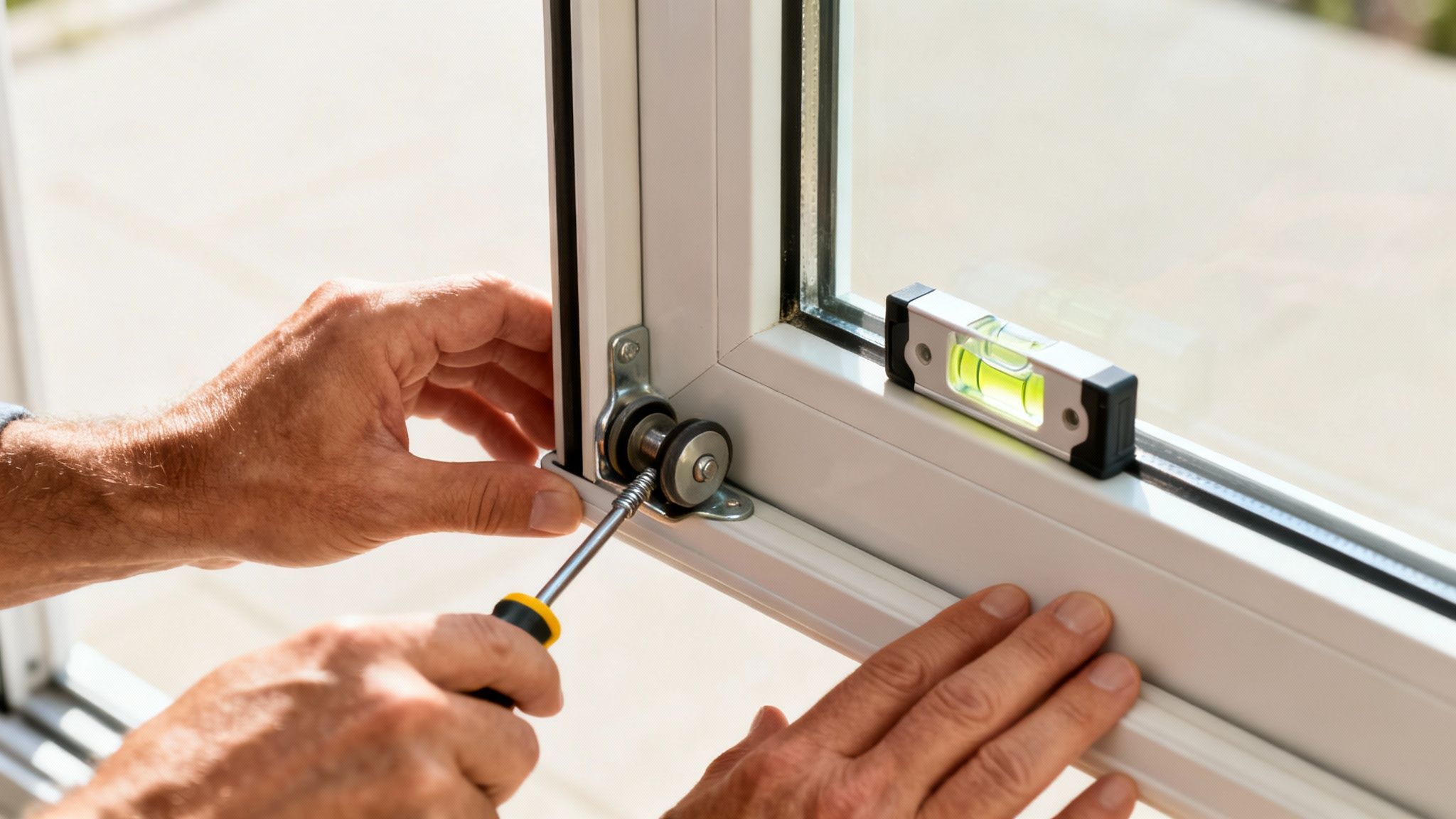
    Close-up of hands adjusting a patio door lock mechanism with a screwdriver, with a spirit level on the frame.

    When we get a call about a "broken" patio door lock in Fort Pierce or Vero Beach, we can tell you that 9 times out of 10, the lock mechanism is just fine. The real culprit? The door itself has fallen out of alignment. This is by far the most common problem we run into, and the good news is, it's often the most fixable.

    Over the years, the constant use and the simple settling of your house can cause a heavy sliding door to sag ever so slightly. That tiny shift is all it takes for the lock's latch to miss the strike plate on the jamb. If you have to jiggle, lift, or ram the door shut to get it to lock, you're dealing with a classic case of misalignment.

    Adjusting the Door Rollers

    The fix almost always starts with the rollers, which are the small wheels tucked away at the bottom of the door. They're what allow the door to glide, and they have adjustment screws that let you raise or lower each side of the panel.

    • How to find the screws: Look along the bottom edge of your door, typically near the corners. You'll see little holes, which are often covered with plastic plugs. Just pop those plugs out with a flathead screwdriver to access the adjustment screws inside.
    • Making the adjustment: You'll usually need a Phillips head screwdriver for this part. Turning the screw clockwise will raise that side of the door, and turning it counter-clockwise will lower it. It's a bit of a feel-it-out process.

    The trick is to make small, gradual adjustments—a quarter-turn at a time is plenty. After each turn, slide the door back and forth to check its movement and see how the lock lines up. A practical tip is to use a level on top of the door to get it perfectly straight. You're aiming for a smooth glide and a latch that slips into place without any force.

    My rule of thumb: if you’ve been turning screws for 20 minutes and the door still isn't sitting right, the rollers are probably shot. They might be cracked, corroded, or just plain worn out. No amount of adjusting will fix that, and it's time to think about replacing them.

    Fine-Tuning the Strike Plate

    Let's say you've got the door rolling perfectly level, but the latch is still just barely missing the mark. This is where a quick strike plate adjustment can save the day. The strike plate is that metal piece on the door frame where the lock's hook or latch goes.

    All you have to do is loosen the two screws holding it in place—don't take them all the way out. This gives you just enough play to slide the plate up or down. Nudge it into the perfect spot so the latch engages smoothly, then tighten the screws back down firmly. You’d be surprised how often this tiny tweak makes all the difference.

    If you’ve gone through these steps and are still wrestling with the lock, the problem is likely more than just alignment. Worn-out rollers can be a pain to replace, and if the issue is internal to the lock, a professional lock change is often the safest and most effective solution. When you feel like you're in over your head, don't hesitate to call (772) 710-8169 for immediate help.

    Deep Cleaning and Lubricating the Lock Mechanism

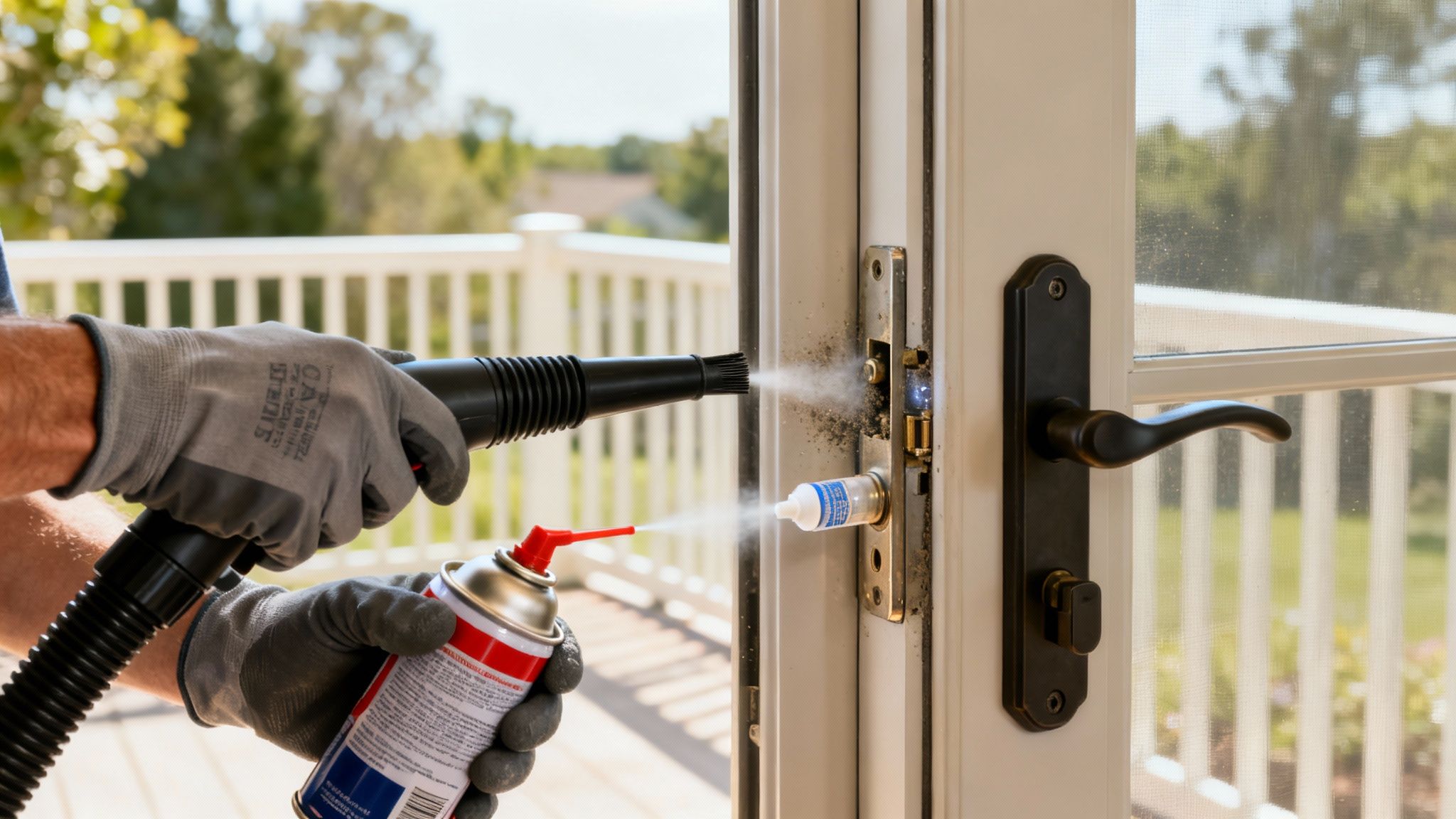
    Gloved hands cleaning a dirty patio door lock mechanism with lubricant spray and a vacuum tool.

    So, you've checked the door alignment and it’s spot on, but the lock still feels like it’s fighting you every time? If it’s stiff, gritty, or just plain stubborn, the problem is almost certainly inside the lock mechanism itself.

    Living here on the Treasure Coast, we see this all the time. Our wonderful combination of humidity, salty air, and fine sand is brutal on mechanical parts. That mix gets inside the lock, creating a corrosive gunk that causes friction and can eventually seize the whole thing up.

    This isn’t just a one-time fix; it’s about regular upkeep. A proper deep clean can bring back that smooth, like-new feel and stop a minor headache from becoming a major failure. And if you do get locked out because the mechanism jammed, don't force it. Just give us a quick call at (772) 710-8169, and we'll get it sorted.

    The Right Way to Clean and Lubricate

    Before you reach for that can of WD-40, hold on. It's critical to understand that the goal is to remove debris, not just soak it in oil. A sticky, wet lubricant will only act like a magnet for more sand and dust, creating a gritty paste that makes the problem even worse down the line.

    Here’s the professional, step-by-step approach we take on every job:

    • Blast Away the Grime: First, grab a vacuum cleaner with its narrow crevice tool. Get right in there and suck out any loose dirt, sand, and dust from the keyway, the latch opening, and any visible gaps. For the really stubborn stuff, a can of compressed air is fantastic for blowing it out.
    • Choose the Right Lubricant: Once the lock is clean, it's time to lubricate. You need a silicone or graphite-based spray lubricant. These are considered "dry" lubricants, meaning they don't leave a sticky residue that attracts new contaminants.
    • Apply with Precision: Use the little red straw that comes with the spray can and insert it directly into the keyway. A short, one-second burst is all you need. Then, work your key in and out a few times to spread the lubricant evenly. Give the latch mechanism itself a quick spray, too.

    Expert Tip: Don’t overdo it. A little goes a long way. The aim is a thin, protective coating, not a dripping mess. Over-lubricating is a common mistake that actually causes more buildup.

    This whole process is surprisingly fast. In fact, most industry data shows that routine servicing like this usually takes a homeowner between 20 and 45 minutes. It’s a small bit of time that can save you from a much longer and more expensive lock replacement. You can find more details on patio door maintenance trends on this market insights page.

    For anyone in Port St. Lucie, Fort Pierce, and especially our beachfront neighbors in places like Jensen Beach, this cleaning should be on your home maintenance calendar twice a year. A quick spring and fall cleaning will keep your patio door lock working perfectly and dramatically extend its life, keeping your home secure.

    Knowing When to Repair Versus Replace Your Lock

    Look, a simple adjustment can solve a lot of patio door lock headaches. But there comes a point when a lock is just… done. Forcing a failing lock to keep working isn't just a hassle; it’s a real security risk for your home and family here in Port St. Lucie.

    Learning to spot a lock that's on its last legs can save you from getting locked out at the worst possible time. A quick repair is fine for minor hiccups, but knowing when to pull the trigger on a full replacement is a crucial part of keeping your home secure.

    Clear Signs You Need a New Lock

    Some problems go way beyond what a little cleaning or a few turns of a screwdriver can fix. If you're seeing any of these issues, the lock’s internal mechanism has likely failed, and it's time to start shopping for a new one.

    • The Key Just Spins: You put the key in and turn it a full 360 degrees, but nothing happens. This is a classic sign that an internal piece, like the cam, has snapped. The lock is officially out of commission.
    • Cracks in the Lock Body: Get up close and inspect the metal casing around the lock. See any hairline cracks, especially near the screw holes? That's metal fatigue. The lock's integrity is shot, and it could easily fail if someone tries to force it.
    • Serious Rust or Corrosion: Our salty, humid air in Jensen Beach and Stuart is brutal on metal. If you can see significant rust flaking off the internal components, that mechanism is too far gone to ever work reliably again.

    A Critical Security Insight: A weak lock is practically an open door. Simply repairing or reinforcing a compromised patio door lock can slash the odds of a successful forced entry by an estimated 40–60%. That's a huge security boost you can't afford to ignore. You can discover more insights about patio door security on this market research page.

    Think Upgrade, Not Just Replacement

    When your lock finally gives up the ghost, don't just think of it as a repair. See it as an opportunity. This is your chance to seriously upgrade the security on one of your home's most common entry points for burglars.

    Today's patio door locks are leaps and bounds ahead of the old standard hardware. You have options now that offer real protection:

    • Multi-Point Locking Systems: These are fantastic. They bolt the door into the frame at the top, middle, and bottom, making it incredibly resistant to being pried open.
    • Reinforced Strike Plates: A simple but effective upgrade. A heavy-duty strike plate with long screws digs deep into the door frame, providing much more strength against kicks or shoulder slams.
    • High-Security Cylinders: Cylinders designed to resist picking and drilling add another tough layer of defense against more skilled intruders.

    When you've decided it's time for a new lock, a professional lock change is always the smartest move. It guarantees the new hardware is installed perfectly for both security and smooth, long-lasting operation. To see what your options are, take a look at our guide to professional residential locksmith services.

    If you’re ready to boost your home's security, call (772) 710-8169 for immediate help and a professional installation.

    Got Questions About Your Patio Door Lock? We've Got Answers.

    As a locksmith working up and down the Treasure Coast, I've seen it all when it comes to stubborn patio doors. From Port St. Lucie to Vero Beach, homeowners tend to run into the same handful of frustrating problems. Here are some of the questions I hear most often, with answers straight from years of hands-on experience.

    What's This Going to Cost Me? A Look at Patio Door Lock Repair Costs in Port St Lucie

    The price tag really hinges on what's actually broken.

    For a simple DIY fix, like cleaning out the track and using a good quality lubricant, you're only looking at about $20 in supplies. If the door just needs a professional alignment, you can typically expect that to run between $75 and $150.

    Now, if the mortise lock—the mechanism hidden inside the door frame—has given up the ghost, you're looking at a full replacement. For parts and labor, that can range from $150 to over $300, depending on the quality and security level of the new hardware. If a failed lock has you stuck on the wrong side of the door, give us a call at (772) 710-8169. We’ll give you a clear, honest quote right over the phone.

    Can I Just Grab Any Handle Set from the Hardware Store?

    I get this question a lot, and unfortunately, the answer is almost always no. Patio door hardware is frustratingly specific. The single most important factor is the "center-to-center" measurement—the exact distance between the mounting screw holes. Get this wrong, and nothing will line up.

    Your best bet is to take the old handle completely off the door and bring it with you. Even better? Snap a few clear pictures of it and show them to a professional. We can identify the brand and model in a second, saving you a couple of return trips and a lot of frustration.

    My Key Snapped Off in the Lock… Now What?

    First off, take a deep breath. Whatever you do, don't try to fish the broken piece out with another key or a paperclip. I’ve seen this countless times, and it almost always pushes the fragment deeper into the cylinder, making a simple extraction a much bigger, more expensive problem. A broken key can be as frustrating as a car lockout, but patience is key.

    If you can see a piece of the key sticking out, you might get lucky and be able to gently pull it straight out with a pair of needle-nose pliers. If it's broken off flush or is deep inside, it’s time to stop and call for help. We have special tools designed to hook and remove broken keys without damaging the tiny pins inside the lock. It’s delicate work.

    Expert Tip: A broken key is a huge red flag. It means either the key itself was old and fatigued, or the lock cylinder is gunked up and hard to turn. After we get the piece out, you should absolutely lubricate the lock or have the cylinder serviced to prevent it from happening all over again.

    Should I Repair This Old Lock or Just Replace It?

    This decision really comes down to a few key things: the lock's age, its overall condition, and the specific problem you're facing.

    If it's a simple fix—like debris in the keyway or a minor alignment issue—a repair is your most cost-effective option. It gets the door working securely again without a major investment.

    On the other hand, if your lock is over a decade old, shows visible rust (a huge problem here in Stuart and Jensen Beach with the salt air), or has failing internal parts, replacement is the smarter long-term move. A brand-new lock doesn't just solve the current problem; it’s a genuine security upgrade for your home. You can see the various locksmith services available in our Treasure Coast communities to figure out what's best for your home.


    When you need fast, reliable, and professional locksmith services on the Treasure Coast, trust Pro-B Locksmith. We handle everything from emergency lockouts to high-security upgrades, including services like key fob replacement and ignition repair, ensuring your peace of mind.

    Learn more and schedule your service at https://problocksmith.com.

  • Your Guide to House Key Replacement in Port St. Lucie

    Your Guide to House Key Replacement in Port St. Lucie

    That sinking feeling in your stomach when you realize your keys are gone… it's a uniquely stressful moment. Getting a house key replacement isn't just about cutting a new piece of metal; it’s about making your home secure again, fast. For residents of Port St. Lucie, Fort Pierce, and Vero Beach, this means deciding between a quick key copy, rekeying the locks, or a full lock replacement to get back that essential peace of mind.

    What to Do When You Lose Your House Keys in Port St. Lucie

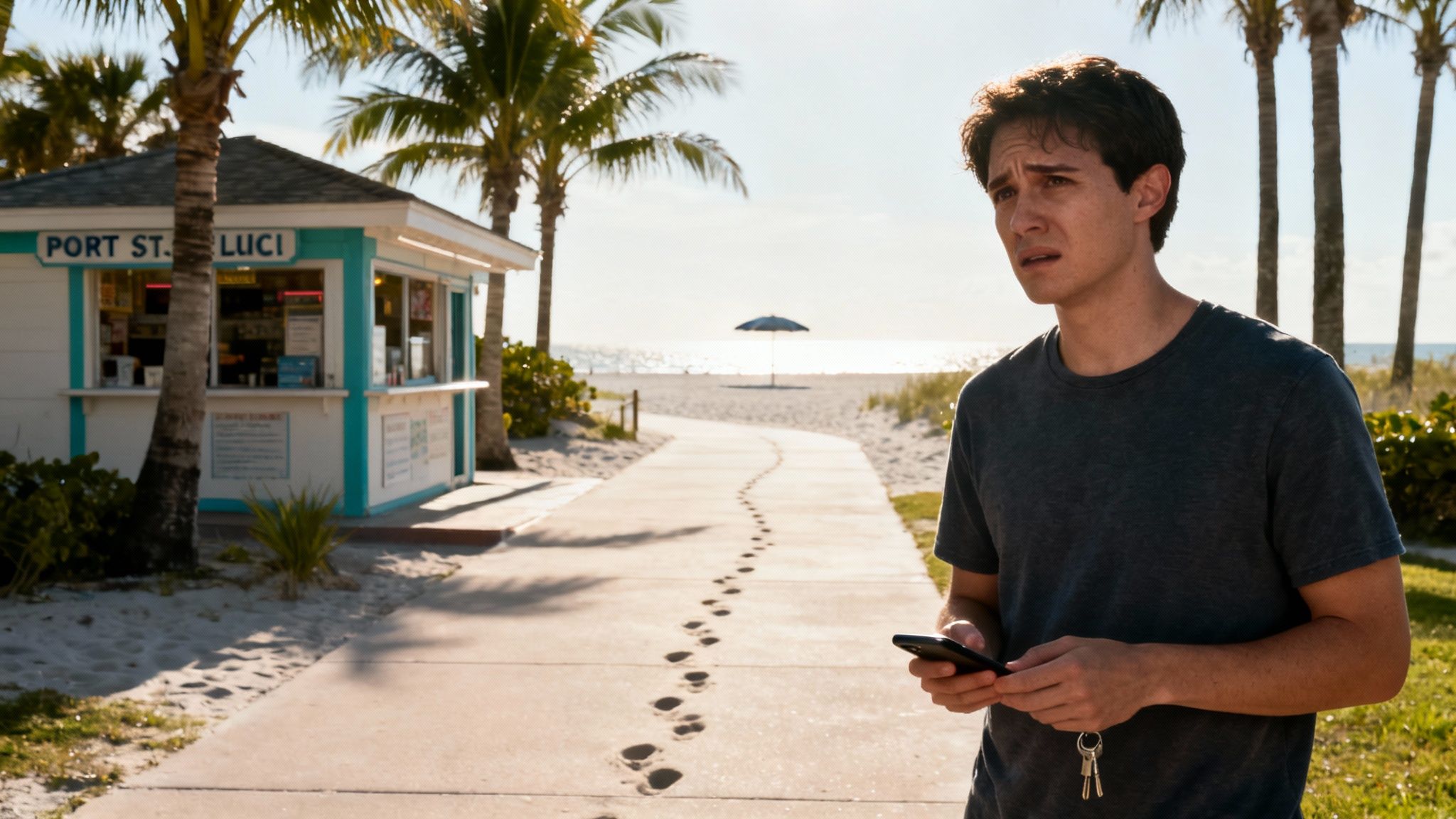
    You're standing at your front door, patting down empty pockets. It’s a terrible feeling. Maybe you were enjoying the day at Jensen Beach or running errands in Stuart—losing your house keys can derail your entire day. But before you panic, take a breath. The solution is often much simpler and faster than you think.

    A concerned young man holds a phone and keys on a sunny beach path by a snack shack.

    First, Calmly Retrace Your Steps

    The first practical step is to calmly retrace your path. Did you stop at a shop in Fort Pierce? Grab a coffee in downtown Stuart? Many lost keys are turned in by good samaritans.

    • Check your car thoroughly. Keys have a knack for disappearing under seats or falling into the gap between the seat and the center console.
    • Call the places you recently visited. Give any stores, restaurants, or parks you were at a quick ring.
    • Sweep your property. Look around the front porch, down the walkway, and near your driveway.

    If you’ve searched everywhere and still come up empty, it’s time to shift from searching to securing your home. This is where professional help is invaluable, especially if you suspect the keys were stolen rather than just misplaced.

    Understanding Your Security Options

    When you need a new house key, you have three primary options. Each offers a different level of security and cost, so it's important to choose the right solution for your specific situation.

    The critical question to ask is: could a stranger find my keys and connect them to my address? If your wallet with your ID was lost along with your keys, you need more than just a new key—you need to make the old one obsolete immediately.

    If you're simply dealing with a house lockout and need to get back inside, access is the immediate goal. However, if the key is gone for good, your focus must shift to long-term security. A quick phone call can provide clarity. Call (772) 710-8169 for immediate help and a professional security assessment right here on the Treasure Coast. We'll evaluate your situation and recommend the smartest solution, whether it's a simple duplication, a complex ignition repair for your vehicle, or a high-security lock change.

    Key Cutting vs. Rekeying: What’s the Right Call for Your Locks?

    After searching for your keys, you're left with a decision that directly impacts your family’s safety. Should you get a new key made, or is it time to rekey the locks? For homeowners here in Port St. Lucie, Fort Pierce, and across the Treasure Coast, understanding the difference is crucial.

    Let's break it down with a simple analogy.

    Think of key cutting like making a photocopy. You’re creating an identical copy of an existing key. It’s a quick and easy solution if you have a spare and just need another one, but it does nothing to enhance security if your original key is lost or stolen.

    Rekeying, on the other hand, is like changing the password for your front door. The lock hardware remains, but a skilled locksmith changes the internal pins so it works with a new key. This action instantly renders your old, lost key useless.

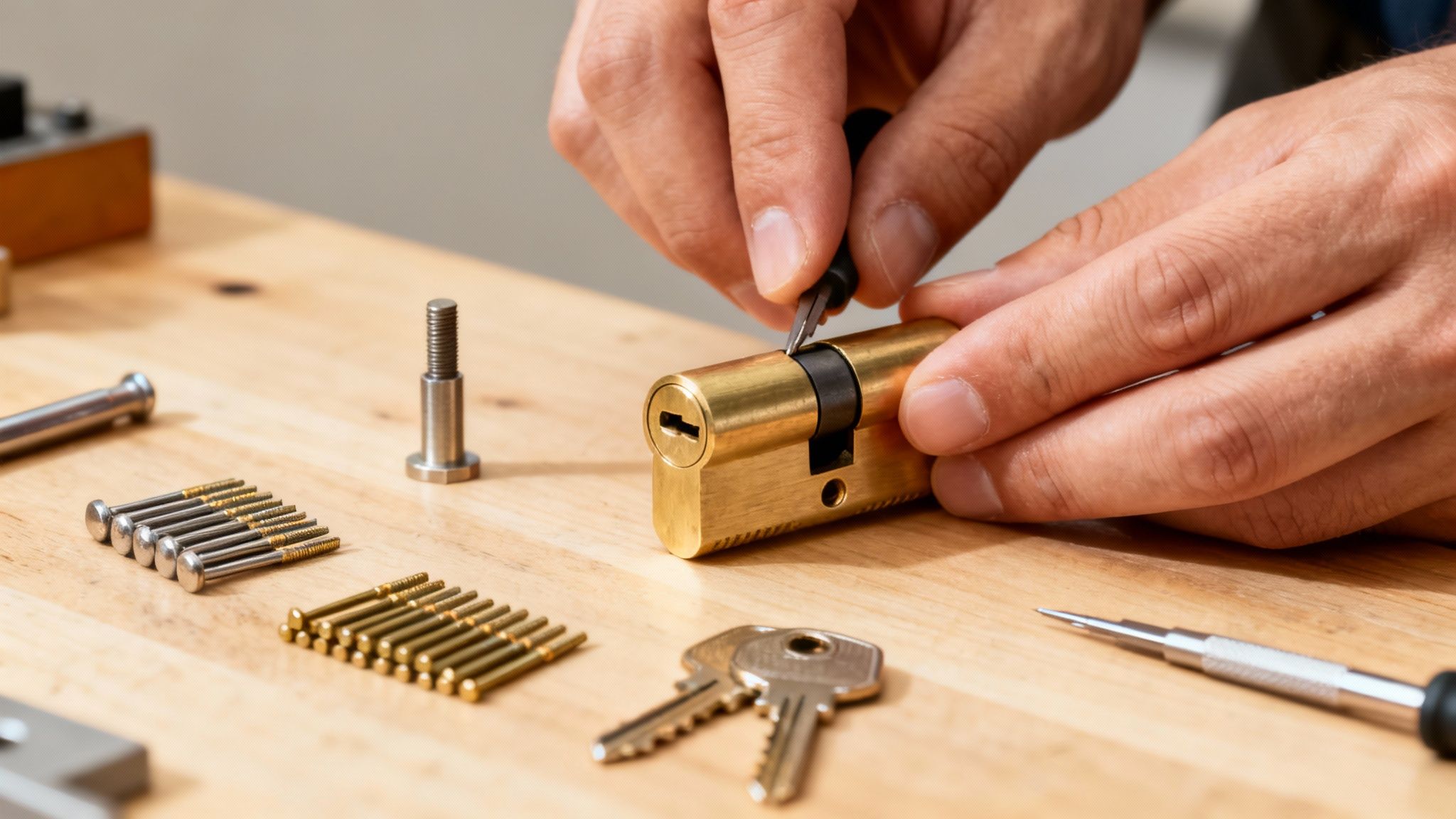
    Close-up of hands rekeying a brass lock cylinder on a wooden workbench with tools and pins.

    So, What Exactly Happens During a Rekey?

    Inside every lock cylinder is a set of tiny pins of different lengths, arranged like a complex puzzle. Your key is cut with grooves that align these pins perfectly, allowing the lock to turn.

    Here's a step-by-step explanation of the rekeying process:

    1. A locksmith carefully disassembles the lock cylinder.
    2. They remove the original set of key pins.
    3. A new set of pins, configured to match a new key, is inserted.
    4. The lock is reassembled, functioning just as before, but now it will only open with the new key.

    The result? Your lock is just as strong, but it's now completely secure against anyone who might have your old key. It’s a significant security upgrade without the cost of new hardware.

    When Rekeying is the Smartest Choice

    Getting a key copied is fine for a spare, but in many common local scenarios, rekeying is the only choice that truly protects your home.

    You should rekey your locks if:

    • You just moved into a new home in Stuart: You can never be sure who has a copy of the old key—previous owners, their relatives, or contractors. A rekey ensures you're the only one with access.
    • You lost a key somewhere in Jensen Beach: If you dropped your key and it could be traced to your address, rekeying is an absolute must for security.
    • A tenant is moving out of your Fort Pierce rental: This is standard procedure for any responsible landlord to protect new tenants and your investment.
    • Your keys were stolen: This is an emergency. While an old or damaged lock might need a full lock change, rekeying is the fastest way to secure your home right now.

    The power of rekeying is that it instantly invalidates all old keys. This single action puts you back in complete control of who can enter your home.

    The need for these services is more common than you'd think. The global market for locks is growing, fueled by people moving and renovating, which keeps the demand for rekeying and other house key replacement services steady. For more information, explore our comprehensive residential locksmith services.

    If you're unsure whether you need a simple copy or a full rekey, don't leave your security to chance. Call (772) 710-8169 for immediate help, and one of our licensed professionals can provide an expert opinion at your doorstep.

    When a Full Lock Replacement Is the Right Move

    Rekeying is a fantastic, budget-friendly security measure, but it has its limits. Think of it like this: rekeying is like changing an account password. It keeps out anyone with old credentials but doesn't upgrade the account's fundamental security features.

    Sometimes, the hardware itself—the physical lock—is the weak link. When a lock is old, damaged, or outdated, a full lock replacement is the only way to truly secure your home. It’s about strengthening the door's defenses, not just changing who has access.

    Recognizing the warning signs is crucial for keeping your Port St. Lucie home safe. A failing lock isn't just an inconvenience; it's a security vulnerability.

    Signs It’s Time for a Hardware Upgrade

    How do you know when to go beyond a simple rekey? There are several tell-tale signs that a lock's internal mechanism is failing. If you notice these issues at your home in Stuart or Jensen Beach, it’s time to take action.

    Look for these red flags:

    • Visible Rust or Corrosion: Here on the Treasure Coast, our humid, salty air is tough on metal. Rust doesn't just look bad; it weakens the lock's internal components, making it brittle and easier to force open.
    • Sticking or Difficulty Turning: Do you have to jiggle the key just right to get it to turn? That’s a clear signal that the internal pins are worn. Eventually, it will seize up completely, leading to an emergency house lockout.
    • Loose or Wobbly Hardware: If the handle, knob, or the entire cylinder moves when used, that’s a major sign of wear. A loose lock assembly is vulnerable to force and makes a break-in easier for criminals.

    Being proactive is the best security strategy. If your lock shows its age, don't wait for it to fail. For an expert assessment, Call (772) 710-8169 for immediate help. We can determine if a repair will suffice or if a full replacement is the smartest choice.

    Local Scenarios Demanding a Lock Change

    Let's consider some real-world examples from our area. A historic home in Vero Beach might have a charming original brass deadbolt that has become difficult to turn, especially on a humid day. This is a security risk. Swapping it for a modern, high-security deadbolt not only solves the functional problem but also provides a major security boost.

    Another example: a family in a quiet Fort Pierce neighborhood hears about a recent break-in nearby. Their own locks might seem fine, but their sense of security is shaken. This is a perfect time to upgrade to new, anti-pick and drill-resistant locks, providing a tangible improvement that helps everyone sleep better at night.

    A lock replacement is more than a repair—it's an investment in your home's security. It’s your chance to upgrade from basic protection to advanced hardware designed to stop modern break-in techniques.

    Choosing the Right Type of Lock

    When you opt for a full lock change, you're upgrading your home's first line of defense. Today’s locks offer features that older models simply can't match.

    Here are a few powerful options to consider:

    1. High-Security Deadbolts: These are the gold standard, built with hardened steel, reinforced strike plates, and complex pin systems to resist picking, drilling, and "bumping."
    2. Keypad and Smart Locks: For the ultimate convenience and control, keyless entry is the way to go. Use a code, fingerprint, or your phone to open the door, eliminating worries about lost or stolen keys.
    3. Heavy-Duty Handle Sets: Combining a secure latch and a deadbolt into a single, robust unit, these systems enhance both your home's security and its curb appeal.

    Choosing the right hardware is a critical step. Whether you’re replacing a worn-out lock or responding to a new security concern, a full replacement is often the most responsible decision for your family’s safety.

    Exploring Smart Locks and Modern Keyless Solutions

    Are you tired of juggling groceries while fumbling for a traditional key? Home security has evolved far beyond the simple brass key. Today, modern keyless solutions like smart locks and keypads offer new levels of convenience and control, turning a basic house key replacement into a major home upgrade.

    Modern smart lock on a white door with a smartphone app displaying a keypad, overlooking a beach.

    Imagine returning from a day at Jensen Beach with your hands full. Instead of the usual struggle, you unlock your door with a quick tap on your phone or by entering a simple code. This is a practical reality for homeowners across the Treasure Coast.

    What Are My Keyless Entry Options?

    Keyless solutions come in several forms, each offering unique benefits for your lifestyle. None involve a metal key that can be lost, stolen, or copied without your knowledge.

    • Keypad Locks: These are the most straightforward entry into keyless living. Simply enter a pre-set code to unlock your door. They are reliable and eliminate the need for physical keys.
    • Smart Locks: These advanced locks connect to your home’s Wi-Fi or Bluetooth, allowing you to control everything from a smartphone app. You can lock or unlock your door remotely, grant temporary access to guests, and view an activity log.
    • Key Fobs: Similar to your car's remote, these small devices unlock your door with the press of a button, offering a modern alternative to a key without the complexity of a full smart lock system.

    This technology is familiar to us. It’s the same principle behind the key fob replacement we perform for vehicles. At Pro-B Locksmith, we understand this technology inside and out, whether for your car or your home.

    Practical Benefits for Treasure Coast Living

    The convenience of a keyless system is a perfect fit for life in Port St. Lucie, Fort Pierce, and Stuart. Consider a practical scenario: you can grant a temporary access code to a contractor or house sitter while you're away. Once their job is done, you simply delete the code, instantly revoking their access without needing to exchange a physical key.

    This level of control is a game-changer for your security and peace of mind. You can also set unique codes for each family member and get a notification on your phone when they arrive home safely. No more worrying if your teenager remembered to lock the door—you can check and lock it yourself from your phone.

    Cost Versus Convenience

    Upgrading to a smart lock has a higher initial cost than traditional lock services. The global smart-lock market was valued at about USD 2.77 billion in 2024 and is expected to soar to roughly USD 8.14 billion by 2030. While a new key or rekeying might cost $10–$75, a smart lock with professional installation typically ranges from $150–$500+, showing a clear trend toward investing in electronic security. You can discover more insights about the growing smart lock market and its trends.

    However, this should be viewed as an investment in convenience, security, and control. You're buying features like activity logs, remote access, and freedom from ever needing an emergency house lockout service again due to a lost key. Most smart locks provide ample warning before the battery dies and usually include a backup keyway for emergencies.

    Ready to explore a keyless solution for your home? Call (772) 710-8169 for immediate help, and we can walk you through the best options for your needs and budget.

    Handling an Emergency House Lockout Situation

    It’s a sinking feeling—the moment you hear the door click shut and realize your keys are still inside. Whether you're on your porch in Port St. Lucie or just returned from the beach in Fort Pierce, being stranded is universally stressful.

    Before considering risky DIY solutions, take a deep breath. A calm, step-by-step approach will get you back inside safely and without causing more problems.

    A service technician uses a smartphone on a porch as a van approaches at dusk.

    Your Immediate Action Plan

    Panic leads to poor decisions. Instead of trying to force a window, follow this practical checklist first. It could save you time, money, and stress.

    1. Check Every Possible Entry Point: Do a full lap around your house. Is a back door unlocked? What about a sliding glass door or a first-floor window?
    2. Call for a Spare Key: Who has a spare? Think about a trusted neighbor in your Stuart community, a family member in Vero Beach, or your landlord. One phone call could solve the problem.
    3. Stay Safe and Visible: If it’s dark, wait in a well-lit area. Your safety is the top priority.

    If these options don't work, it's time to call a professional. Resisting the urge to force your way in is crucial.

    Why DIY Break-Ins Are a Bad Idea

    We've all seen heroes pop locks in movies, but reality is different. Trying to force a lock or break a window will almost certainly create a more expensive problem.

    A broken lock, a splintered doorframe, or a shattered window will cost far more to fix than a professional locksmith's service call. You can easily turn a simple lockout into a major home repair bill.

    Don't let frustration cost you hundreds in damages. The smartest, fastest, and most cost-effective solution is always to call a licensed professional with the right tools to get you inside without damaging your property. You can learn more about our emergency lockout services and how we get you back in quickly.

    The Professional and Reliable Solution

    When you’re stuck outside, you need someone fast, trustworthy, and local. Our 24/7 mobile locksmith service is designed for these moments. We dispatch licensed technicians to your location in Port St. Lucie, Fort Pierce, and surrounding areas, so help arrives when you need it most.

    Emergency locksmith services constitute a massive USD 5.0 billion global market, representing millions of calls each year from people needing immediate house key replacement and lockout help.

    Our team has the expertise to handle any house lockout—or even a car lockout—without leaving a scratch. Locked out? Don't risk it. Call (772) 710-8169 for immediate help, and we'll get you back inside safely.

    Why You Should Always Choose a Local Licensed Locksmith

    When you're locked out, your home's security is paramount. The instinct is to search for a locksmith and call the first number you see. Be cautious—many top results are national call centers, not local businesses.

    These call centers act as middlemen, dispatching unknown, often unqualified subcontractors to your home. This leads to surprise fees, long waits, and no local accountability if the job isn't done right.

    The Dangers of Unlicensed and National Services

    Choosing an unlicensed individual or a national call center for your house key replacement is a gamble. The technicians they send often lack proper training, insurance, or the background checks required in Florida. This can result in a damaged lock, a shoddy installation, or a home that's less secure than before.

    Imagine you're locked out of your house in Stuart. You call a number from an ad, get a low quote, and agree. An hour later, a subcontractor arrives, and the final bill is three times what you were told. Now you have a scratched doorframe and no local shop to hold responsible.

    The Pro-B Locksmith Difference: Local Expertise and Trust

    This is why finding a licensed, local locksmith is so critical. A local business like ours has a reputation to protect right here in the community. We're your neighbors in Port St. Lucie, Fort Pierce, and Vero Beach, and our business is built on providing honest, dependable service.

    As a licensed locksmith, we adhere to Florida's highest professional standards. This means you get:

    • Accountability: We stand behind every job, whether it's a simple lock change or a complex car key replacement.
    • Verified Expertise: Our team is trained, background-checked, and fully insured. Your peace of mind is our priority.
    • Transparent Pricing: We provide a clear, honest quote before starting any work. No hidden fees or surprises.

    When you call Pro-B Locksmith, you’re not just hiring a service. You’re gaining a local security partner who is genuinely invested in your safety. Our reputation on the Treasure Coast means everything to us.

    Being local also means we're fast. Since our technicians are already in St. Lucie County, we can typically reach you in just 15–20 minutes for emergencies like a house lockout. You can learn more about what sets us apart by reading about our locksmith services in Port St. Lucie.

    Don't trust your family's safety to a random person from a 1-800 number. For professional, reliable service from a team you can count on, Call (772) 710-8169 for immediate help.

    Your House Key Replacement Questions, Answered

    Have questions about replacing your house keys? Here are straightforward answers to common queries from homeowners around Port St. Lucie and the Treasure Coast.

    How Much Does House Key Replacement Cost in Port St Lucie?

    The cost varies. A simple key copy is the most budget-friendly option. If security is a concern after losing a key, rekeying your locks is a great middle-ground choice. A full lock change with new hardware is the most involved and costs more.

    Factors affecting the final price include:

    • The type of lock (standard vs. high-security)
    • The time of day (emergency calls outside business hours may have different rates)
    • The number of locks needing service

    The best way to get an accurate price is to call us. We provide clear, upfront quotes for your specific situation, whether you're in Fort Pierce, Vero Beach, or Port St. Lucie.

    Can a Locksmith Make a Key Without the Original?

    Yes, absolutely. Losing the only key to a lock is a common problem we solve. Our locksmiths are trained to create a new key from scratch by working directly with the lock itself.

    Using specialized tools, we can "read" the lock's internal pinning and cut a key that works perfectly, all without the original.

    Is It Cheaper to Rekey or Replace My Locks?

    In most cases, rekeying is more economical. Rekeying provides the same security benefit as a new lock by rendering old or lost keys useless.

    As long as your current lock hardware is in good condition (not broken, rusted, or worn out), rekeying is the smartest choice. You get the security of a "new" key system without the expense of buying new hardware.


    For quick, professional answers and immediate help with your house key replacement, you can count on the local team at Pro-B Locksmith. Call (772) 710-8169 for immediate help anywhere on the Treasure Coast.

  • Laser Car Key Cutting: Mobile Service for Port St. Lucie & the Treasure Coast

    Laser Car Key Cutting: Mobile Service for Port St. Lucie & the Treasure Coast

    It's a feeling we all dread: that sudden, stomach-dropping moment you realize your car key is gone. If you're in Port St. Lucie and driving a modern vehicle, your first thought might be an expensive, time-consuming trip to the dealership. But before you even think about calling a tow truck, there's a much better, faster, and more wallet-friendly option right here on the Treasure Coast. The answer is laser car key cutting, and a skilled mobile locksmith can bring this high-tech service straight to your car's location, whether you're in Fort Pierce, Stuart, or Jensen Beach.

    Your Guide to Laser Car Key Cutting on the Treasure Coast

    Losing a high-security car key, the kind with a built-in transponder chip, can instantly feel like a catastrophe. The old way of thinking involves a tow, a long wait at the dealership service department, and a bill that stings. Thankfully, that's not the reality anymore for drivers in Fort Pierce, Stuart, and our neighboring communities.

    The locksmith trade has come a long way from just helping with house lockouts. Today, we're essentially mobile workshops on wheels. We've invested in the same sophisticated technology the dealerships use, including laser key cutting machines, and we bring it all directly to you. That means you skip the tow, the appointment hassle, and the dealership overhead. For example, if you're stranded after a day at the beach in Jensen Beach, we come to your parking lot and solve the problem right there.

    What This Guide Covers for Treasure Coast Drivers

    We put this guide together to demystify the process of replacing a modern car key. We'll break down what makes these keys so different, walk you through how we cut and program them on-site, and show you exactly why calling a mobile locksmith is nearly always the smarter move.

    Here’s what you’ll learn:

    • Why laser-cut keys offer such a high level of security.
    • How our on-the-spot mobile cutting and programming service works.
    • A head-to-head comparison of our service versus the dealership.
    • The huge variety of vehicle brands we can handle, from Ford and Chevy to luxury makes like BMW and Mercedes.

    Our mission is simple: to take a high-stress situation, like being locked out of your car or losing your keys in Vero Beach, and turn it into a quick, painless fix. We handle the entire job, from the precision laser car key cutting to programming the transponder chip so it talks to your car.

    If you ever find yourself in a bind, it pays to know what your options are. You can read our expert advice on handling emergency lockout situations to be ready for anything. Whether you’re stuck at your home in Port St. Lucie or stranded in a parking lot, the right help is just around the corner.

    For any lock-related emergency, from key fob replacements to ignition repairs, Call (772) 710-8169 for immediate help.

    How Laser-Cut Keys Provide Superior Security

    So, what really separates a modern laser-cut key from the old-school metal key that used to jingle on your parents' keychain? It helps to think of it this way: a traditional key is like a simple jagged fence—it has its purpose, but it’s not too hard to climb or copy. A laser-cut key, on the other hand, is like an intricate maze carved with incredible precision right into the blade.

    These keys, which we in the industry often call "sidewinder" or "internal cut" keys, don't have those familiar teeth along the edge. Instead, they have a unique, winding groove milled down the center or sides of the blade. This design isn't just for looks; it's a huge leap forward in security, making the lock incredibly difficult for thieves to pick or duplicate with standard tools.

    The Anatomy of a High-Security Key

    The security magic of laser car key cutting really comes down to the key's physical design. Unlike older keys that wear down, bend, or can be copied at any hardware store for a few bucks, laser-cut keys are in a different league entirely.

    Their rock-solid protection stems from a few core features:

    • Unique Internal Groove: The pattern is milled into the flat face of the key blade, not stamped along the edges. This internal cut requires specialized, computer-guided equipment to replicate, making unauthorized duplication a non-starter.
    • Symmetrical Design: Most laser-cut keys are symmetrical, which is a fancy way of saying they work no matter which way you insert them into the lock. It’s a small convenience that comes from the precision milling on both sides of the blade.
    • Enhanced Durability: These keys are made from a thicker, more resilient metal alloy. Since they don't have deep cuts on the edges creating weak points, they are far less likely to bend, snap, or wear out over the years.

    To really see the difference, it helps to put them side-by-side.

    Traditional Keys vs Laser-Cut Keys: A Quick Comparison

    FeatureTraditional Car KeyLaser-Cut Car Key
    Cut StyleJagged cuts along a single edgeWinding groove milled into the blade's surface
    Security LevelLow; vulnerable to picking and easy duplicationHigh; extremely difficult to pick or duplicate
    DurabilityProne to bending, breaking, and wearThicker and stronger; highly resistant to wear
    DuplicationCan be copied at most hardware storesRequires specialized laser cutting equipment
    ConvenienceMust be inserted in one specific orientationOften symmetrical; works whichever way it's inserted

    This table makes it pretty clear why automakers made the switch. The newer technology offers a robust solution to common security vulnerabilities.

    Why This Matters for Your Vehicle

    The complex design of a laser-cut key means that having a blank key and a standard cutting machine just won't work. To create a new key, a locksmith needs the vehicle's specific key code from the manufacturer and a high-precision laser cutter to replicate the pattern perfectly.

    This is why, if you lose your high-security key or need a spare, a trip to the local hardware store is out of the question. You need a professional locksmith who has invested in the right technology.

    If you find yourself in a bind in Fort Pierce or Jensen Beach needing a key fob replacement or a new laser-cut key, we've got you covered. Call (772) 710-8169 for immediate help, and we'll bring the technology to you to create a perfect replacement on the spot.

    How We Make a New Laser-Cut Key Right at Your Car

    It might seem like a bit of magic—how can a perfect, fully functional car key be made right there in a parking lot, without ever towing your car to a shop? The secret is our mobile workshop. We’ve outfitted our service vans with the exact same high-tech equipment you'd find at a dealership. This setup allows us to bring the entire laser car key cutting and programming service directly to you, whether you’re stuck at home in Vero Beach or stranded at work in Stuart.

    The whole process is built around being secure, efficient, and completely transparent. We don't just show up and start cutting; we have a professional procedure to get you back behind the wheel safely and without a long wait. It’s a smooth workflow that turns what feels like a major headache into a simple, on-the-spot fix.

    Your On-Site Key Replacement Experience: A Step-by-Step Example

    From the moment our technician arrives, we follow a clear, professional set of steps. Let's say you're stranded after work in a Port St. Lucie office park; here’s a play-by-play of what you can expect:

    1. Verifying Ownership: This is always our first step, and it's for your protection. We'll ask to see your driver's license and the vehicle's registration or title. This ensures we're only making a key for the rightful owner.
    2. Getting the Key Code: Next, we need the blueprint for your key. We use your car's Vehicle Identification Number (VIN) to access its specific key code from a secure database. This code dictates the exact pattern of that internal groove, guaranteeing a factory-perfect match.
    3. Precision Laser Cutting: With the code in hand, we fire up our onboard laser cutting machine. You can actually watch as the high-precision tool mills the sidewinder pattern into the side of the new key blade. The result is a key that is physically identical to your original one.
    4. Programming the Transponder Chip: The final, and arguably most critical, step is the programming. We connect our diagnostic tool to your car's OBD-II port (usually under the dashboard) to sync the new key's transponder chip with your vehicle's immobilizer. This electronic "handshake" is what tells your car it's okay to start.

    The Technology That Makes It All Happen

    This on-the-spot service is possible because the key-cutting industry has made huge leaps in creating powerful, yet portable, laser-based systems. This shift has been driven by massive demand from the automotive world and has been widely adopted by professional locksmiths. In fact, the market for these machines is expected to grow at a compound annual growth rate of around 5.7% between 2025 and 2033, ballooning to an estimated value of about USD 2.18 billion. You can discover more about these industry trends in key-cutting technology.

    This one-two punch of precise mechanical cutting and sophisticated electronic programming is what really sets a professional locksmith service apart. It’s a complete solution that tackles every part of a modern key replacement, all without a tow truck or a trip to the dealer.

    And this process isn't just for lost keys. We handle everything from making a spare key fob to performing a complex ignition repair when a key breaks off in the lock. For a closer look at what we can do, feel free to explore our full range of automotive locksmith solutions.

    If you’re staring at a broken key in Fort Pierce or dealing with a car lockout anywhere on the Treasure Coast, Call (772) 710-8169 for on-the-spot service.

    Why a Mobile Locksmith Is Your Best Choice

    So, you've lost your high-security car key, or maybe you just need a spare. You’ve got two main choices: head back to the car dealership or call a mobile locksmith. While your first instinct might be to go to the dealer, a mobile locksmith almost always offers a better, more practical solution that saves you a ton of time, money, and stress.

    For anyone in Port St. Lucie, Fort Pierce, or the nearby communities, think about what a trip to the dealership really involves. You'll likely need to book an appointment days out, get your car towed if you have no keys at all, and then pay inflated prices for the key and the labor. It’s a slow, expensive process for what is often an urgent problem.

    Now, picture this instead: a fully equipped workshop on wheels pulls up right where you are. That’s what a mobile locksmith does. We bring the same dealership-grade technology for laser car key cutting and programming directly to you. It doesn’t matter if you're stuck in your driveway in Vero Beach or stranded in a grocery store parking lot in Jensen Beach—we come to you.

    Speed and Convenience on Your Terms

    The most obvious advantage we have is our ability to provide immediate, on-the-spot service. Forget about calling a tow truck or killing hours in a sterile dealership waiting room. For a real-world example, a customer in Stuart recently locked themselves out of their car at the mall and we had them back inside with a new key in under an hour. This is the level of fast, practical help we provide.

    This level of convenience is a lifesaver, especially during a stressful car lockout. Instead of derailing your entire schedule, we get the job done right there so you can get on with your day. If you need help now, Call (772) 710-8169 for immediate help.

    Cost-Effective Solutions Without Compromise

    Let's talk about the price tag. Dealerships have massive overhead costs, and guess who pays for that? You do. A mobile locksmith runs a much leaner operation, which means we can provide the exact same high-quality service—and often better—for significantly less.

    Modern key replacement isn't just about cutting a piece of metal; it involves precise cutting and complex electronic programming. Regional data shows that replacing a laser-cut key can run into the hundreds, largely due to the specialized equipment required for cutting the blade and syncing the transponder. You can find more details on the factors influencing laser cutting machine statistics on customcy.com. By coming to you, we instantly eliminate towing fees and those steep dealership labor rates, making the final bill much easier to swallow.

    Choosing a local, mobile locksmith isn't just about saving money; it's about getting a faster, more personal, and equally professional service. We handle everything from key fob replacement to ignition repair with the same expertise as a dealer, but with a focus on your convenience.

    Mobile Locksmith vs Dealership For Laser-Cut Keys

    When you're stuck, the last thing you want is a complicated solution. The table below breaks down exactly why a local mobile locksmith is the smarter choice for residents of Port St. Lucie, Fort Pierce, and surrounding areas.

    FactorMobile Locksmith (Port St. Lucie & Surrounding)Car Dealership
    ConvenienceWe come directly to you—home, work, or roadside.You must get your vehicle to their service center.
    SpeedImmediate response for emergencies.Requires scheduling an appointment, often days away.
    CostSignificantly lower prices due to less overhead.Higher costs for parts, labor, and potential towing fees.
    TowingNot required. We solve the problem on-site.Often necessary if all keys are lost, adding cost and time.
    Service HoursFlexible, with emergency services available 24/7.Restricted to standard business hours (Mon-Fri, 9-5).
    ExpertiseSpecialized in all makes and models, focused solely on locks & keys.General auto repair; key specialists may not always be on staff.

    Ultimately, the choice is clear. A mobile locksmith offers a modern, customer-focused solution designed to get you back on the road with minimal fuss.

    Car Brands We Service Across the Treasure Coast

    "Can you even make a key for my car?" That’s usually the first question we hear from drivers around Port St. Lucie. Our answer is almost always a confident, "You bet." Our mobile service vans are basically workshops on wheels, loaded with advanced laser car key cutting machines and the specific software needed to handle the huge variety of cars you see on the roads here on the Treasure Coast.

    We get it. Modern cars, whether they're your trusty daily driver or a high-end luxury vehicle, have incredibly complex key systems. Our team is constantly training to keep up with the unique security protocols for just about every domestic, Asian, and European manufacturer out there. So, whether you've lost your keys in Fort Pierce or just need a spare in Jensen Beach, we’ve got the right tools and the know-how to get it done right.

    Domestic and American Brands

    American cars are everywhere in our local communities, and we’re fully equipped to handle them. We cut and program keys for the most common models on the road every single day.

    • Ford: From the workhorse F-150 to the family-hauling Explorer, we manage their transponder keys and fobs.
    • Chevrolet: Got a Silverado or a Malibu? Our equipment has you covered.
    • Dodge, Chrysler, and Jeep: We’ll get you back into your Ram truck, Grand Cherokee, or minivan in no time.

    Popular Asian and European Manufacturers

    The performance and sheer reliability of Asian and European cars make them a favorite for a lot of Florida drivers. Our technology is built to create perfectly precise keys for these brands, guaranteeing they fit and "talk" to your car’s computer without a hitch. If you’re locked out of your Toyota in Stuart or need a key fob replacement for your BMW over in Vero Beach, we’re the ones to call.

    Need help now? Call us at (772) 710-8169.

    It's worth noting that the same technical precision we use to create a new laser-cut key for a Mercedes-Benz is the same standard we apply to all our work, including a secure lock change for your home or business in Port St. Lucie.

    Our service list is long, but here’s a quick look at some of the brands we handle all the time:

    • Honda: Civic, Accord, CR-V, you name it.
    • Toyota: Camry, Corolla, RAV4, and Tacoma.
    • Nissan: Altima, Rogue, Sentra, and Titan.
    • Hyundai & Kia: We service their full range of models.
    • BMW & Mercedes-Benz: Including those with sophisticated keyless entry systems.
    • Volkswagen & Audi: From their popular sedans to their SUVs.

    No matter what you drive, our mission is to offer a faster, more reliable, and wallet-friendly alternative to the dealership. We have everything needed to solve your specific key problem, right on the spot.

    Need a Laser-Cut Car Key Made Right Now?

    When you’re stuck without your car key, every minute feels like an hour. The last thing you want is to deal with the hassle of towing your car to a dealership and then waiting—and paying—for their service. That’s where we come in.

    We bring the solution directly to you, providing on-site laser car key cutting across Port St. Lucie, Fort Pierce, and Vero Beach. Forget the towing fees and the long delays. We show up, cut and program your key, and get you back on the road.

    This isn't your old-school key cutting. The technology has evolved incredibly, allowing us to fit what used to be a massive workshop machine into our mobile service vans. The same high-precision laser cutters that dealerships use are now portable, letting us deliver that same level of quality right at your curb. In fact, the whole laser cutting market is booming, and we're bringing that innovation straight to you.

    More Than Just Car Keys

    While we specialize in high-security laser-cut keys, we’re a full-service locksmith team ready for whatever you throw at us. Think of us as your go-to problem-solvers for any lock and key issue on the Treasure Coast.

    • Emergency Car Lockouts: Locked out in Fort Pierce? We'll get you back in your car quickly, with zero damage.
    • House Lockouts: It happens to the best of us in Stuart. We’ll get you back inside your home, safe and sound.
    • Key Fob Replacement: We can program and replace most modern key fobs and smart keys in Jensen Beach.
    • Ignition Repair: If your key won't turn in Vero Beach, we can often fix or replace the ignition without a costly trip to the mechanic.
    • Lock Change Services: Need to re-secure your home or business in Port St. Lucie? We can install new, high-quality locks.

    A lost key doesn't have to derail your entire day. Whether you're dealing with a simple lockout in Stuart or a tricky ignition problem in Jensen Beach, our team is ready to help. We believe in upfront pricing and service you can actually trust.

    For fast, professional laser car key cutting and any other locksmith needs, keep our number handy. If you have questions or need a quote, don't hesitate to reach out to us with any questions.

    When you need help, call (772) 710-8169 right away.

    Answering Your Laser-Cut Key Questions

    When you're dealing with something as specific as laser car key cutting, you're bound to have a few questions. We get it. Here are the answers to the questions we hear most often from drivers around Port St. Lucie and the Treasure Coast.

    How Long Does It Take to Cut a Key On-Site?

    One of the best parts of calling a mobile locksmith is the speed. You don't have to book an appointment days in advance or wait around at a dealership. Once we pull up to your location, whether you're in Fort Pierce or Stuart, the whole job is usually done in under an hour. That includes cutting the physical key and programming its internal transponder chip.

    Are These Keys More Expensive Than Regular Ones?

    It's true that the technology involved makes a laser-cut key more complex, so it costs more than a simple, old-school metal key. But that’s not the whole story.

    When you compare our mobile service to the dealership, you'll find we are significantly more affordable. You skip the towing fees, inflated labor rates, and dealership markups, which saves you a serious amount of cash and a lot of hassle.

    What if I've Lost Every Single Key I Have?

    Losing all your keys is a nightmare scenario, but don't panic—we can solve it. Even with no original key to copy, we can create a brand-new one for you right on the spot using your vehicle's VIN.

    So, while having a key helps, it's not required. This makes us the go-to solution for total key loss emergencies in places like Vero Beach and Jensen Beach. If you're in this boat, call us immediately at (772) 710-8169.

    Can You Program a Key Fob I Bought Online?

    We get this question a lot. We can certainly try to program a key you bought from an online seller, but it's a bit of a gamble. These third-party fobs often have quality control or compatibility problems that can stop them from properly communicating with your car.

    We always recommend using an OEM key fob or one we provide ourselves. This guarantees the electronic "handshake" between the key and your vehicle's security system is perfect, saving you from frustrating problems down the road.


    A lost or broken key doesn't have to ruin your day. Pro-B Locksmith brings the workshop right to your curb with fast, reliable, and affordable mobile service across Port St. Lucie, Fort Pierce, Vero Beach, Stuart, and Jensen Beach. From emergency lockouts to sophisticated key fob replacements, we're the local pros you can trust.

    Find out more about what we do at https://problocksmith.com.

  • Mastering Key Fob Duplication With Pro-B Locksmith

    Mastering Key Fob Duplication With Pro-B Locksmith

    Key fob duplication combines precision and technology to deliver a fully functional spare, keeping you moving and preventing lockout headaches. Whether you need key fob replacement or a cloned smart key, our mobile teams across Port St. Lucie, Fort Pierce, Vero Beach, Stuart, and Jensen Beach have you covered.

    Key Fob Duplication Essentials

    Key Fob Duplication Process

    1. Identify your device: remote key, proximity fob, or smart key.
    2. Match it to the right blank shell.
    3. Cut the mechanical blade on our CNC cutter.
    4. Program transponder chips or rolling codes to sync with your ECU.
    5. For highly encrypted smart keys, perform factory-level cloning on the spot.

    Key Benefits Of Duplication

    • Provides a ready spare to avoid car lockouts in Port St. Lucie and Fort Pierce
    • Replaces broken or lost fobs fast during house or vehicle lockout calls
    • Covers most makes and models with mobile, on-the-spot service
    • Offers key fob replacement and programming to restore access immediately

    Types Of Key Fobs

    Remote Key
    Sends a radio signal with each button press to lock and unlock doors instantly.

    Proximity Fob
    Opens doors as you approach—no buttons required, just have it in your pocket.

    Smart Key
    Handles push-button starts and encrypted rolling codes for next-level security.

    “Pro-B Locksmith’s mobile teams resolve 90% of key fob duplication jobs in under an hour around Stuart and Jensen Beach.”

    Picture a Jensen Beach parent stranded on a school run. Kids waiting by the car, our van rolls up in 15 minutes, and we cut and program a fresh fob before the school bell rings. Call (772) 710-8169 for immediate help—our services run 24/7, so you’re never left out in the cold.

    Before you decide, here’s a quick look at common fob types, their features, duplication complexity, and average costs.

    Comparison Of Common Key Fob Types

    Fob TypeKey FeaturesDuplication ComplexityAverage Cost
    Remote KeyBasic lock/unlockLow$50–$100
    Proximity FobPassive entryMedium$120–$200
    Smart KeyPush-button start with encryptionHigh$200–$350

    Common Duplication Scenarios

    • A Vero Beach driver losing a remote key in a supermarket parking lot
    • A Stuart homeowner stuck when a proximity fob battery dies mid-entry
    • A Port St. Lucie professional needing a cloned smart key for a leased BMW

    In Vero Beach, one customer had just 10 minutes before an appointment. Our tech cut the blade and synced the fob in under 20 minutes. Another Stuart call involved a dead proximity fob on a rental property—shell swapped, chip flashed live, no second trip needed.

    How Duplication Works

    Once the blade is cut, we read chip data via NFC or directly through the vehicle’s OBD port. For encrypted smart keys, factory-level cloning imports codes using OEM protocols and controlled blanks. That’s why you need specialized software and authenticated hardware.

    Pro-B Locksmith’s mobile fleet in Jensen Beach and Stuart carries every blank and programming module. We’re ready 24/7 for urgent lockout, key fob replacement, ignition repair, or lock change on the Treasure Coast.

    On a broader note, the automotive smart key fob market is set to grow by USD 4.59 billion between 2024 and 2028 at a 5.36% CAGR, driven by demand for push-button start and passive entry features. For more details, see our market analysis at Technavio’s report.

    For a full range of solutions beyond fob duplication, check out our guide on comprehensive locksmith services, covering car lockout, house lockout, ignition repair, and lock change.

    Required Tools And Vehicle Information

    Mobile Locksmith Equipment

    Before our Pro-B Locksmith van rolls up, we collect your vehicle’s specifics—make, model, year, and VIN. That lets us pick the right blank and programming routine on the spot.

    When you ring us at (772) 710-8169, having those details ready means we tackle your key fob duplication in one go. No extra stops across Port St. Lucie, Fort Pierce, or Jensen Beach.

    • Vehicle Make and Model (Plus Trim)
    • Production Year & VIN
    • Fob Type (remote, proximity, or smart key)
    • Proof of Ownership (registration or title)

    Tools Carried

    Our mobile vans, patrolling from Vero Beach to Stuart, are packed with dealership-grade instruments chosen to handle everything from basic remotes to advanced encrypted keys.

    • Precision key blanks for major manufacturers
    • CNC cutting machines tuned to OEM tolerances
    • Programmers for transponder chips and rolling codes
    • Signal analyzers to capture remote frequencies
    • Licensed software suites matching factory toolsets

    Equipment Comparison

    ToolPurposeTypical Scenario
    Precision Key BlanksMechanical blade cuttingReplacing a lost fob blade
    CNC Cutting MachineAccurate blank shapingComplex key profiles in high demand
    Diagnostic ProgrammerTransponder and code synchronizationSmart key encryption and cloning
    Signal AnalyzerRolling-code signal captureEmergency roadside duplication

    Integrating these tools has slashed our average response time to under 20 minutes for car lockouts and fob replacements.

    Global aftermarket trends back up the demand. The automotive key blank market is projected at USD 6.5 billion in 2025 and climbing to USD 10.2 billion by 2035. For a deeper dive, check the outlook from Future Market Insights.

    Restricted Blanks And Permits

    Certain high-security blanks need special approval. Fortunately, we carry permits for Port St. Lucie and Fort Pierce, so you won’t face legal hurdles or delays.

    • Monitored restricted-keyway legal codes
    • Permit details stored in our mobile management system
    • Full compliance with federal and local rules

    “Carrying the right permits for restricted blanks means no fines, no holdups—just fast, legal duplication.”

    Prepare For Arrival

    Grab your original fob and ownership docs before we pull in. Having these on hand speeds up verification and syncs the new device seamlessly with your ECU.

    • Original key or fob for comparison
    • Vehicle title or registration
    • Photo of the VIN plate (if title isn’t handy)
    • Photo ID matching the registered owner

    Showing up with these items helps us finish in one visit and protects your security. For a 24/7 mobile appointment across Port St. Lucie, Fort Pierce, Vero Beach, Stuart, or Jensen Beach, call (772) 710-8169 now.

    You may also want to explore our full suite of automotive locksmith services—everything from ignition repair to emergency lockouts—on our automotive locksmith page. Our fully stocked vans are always nearby, ready to deliver OEM-precision key fob duplication whenever you need it.

    Onsite Duplication And Programming Steps

    Mobile Key Fob Programming Van

    Imagine you’re stuck in Jensen Beach and your key fob dies—our Pro-B Locksmith van pulls right up next to your ride. We start by running a full vehicle diagnostic, pinpointing whether you’re dealing with rolling-code tech or an older transponder style. This scan tells us exactly which blank shell we need.

    On one recent call, a Stuart customer was back behind the wheel in just 18 minutes, beating our usual 15–20 minute response time. That speed keeps your day on track.

    Running Vehicle Diagnostics

    First, we plug into the OBD port and pull ECU data to flag any stored fault codes that might block programming.

    For instance, some Toyota models require factory-level cloning rather than a simple code copy. During diagnostics we:

    • Record fob IDs with our certified programmer
    • Test the original remote’s signal strength
    • Log any ECU errors before moving forward

    Our mobile teams wrap up 90% of jobs within an hour once diagnostics finish.

    In Vero Beach, we even used a signal amplifier to capture a BMW’s push-button fob from the driveway—cutting sync retries and speeding up the whole process.

    Selecting Blanks And Cutting

    Each Pro-B van carries dozens of precise blank shells for brands like Mazda, BMW, and more. We match your vehicle’s make, model, and year to the right housing, then inspect alignment under magnification to avoid miscuts.

    • Match the blank to your vehicle’s specs
    • Secure it in the CNC cutter
    • Trim the blade to factory dimensions

    Capturing Codes And Programming

    With the blank ready, we capture rolling codes or clone the chip based on your encryption type. Proximity remotes use NFC reads, while high-security smart keys connect over BLE via OBD.

    • NFC capture for proximity fobs
    • OBD cloning for encrypted smart keys
    • Final sync test to confirm success

    Avoiding Common Sync Errors

    A weak fob battery often stalls the process. Radio interference can also throw off the ECU match.

    Checking the fob’s battery power first clears up about 70% of sync faults.

    Swapping in a fresh cell on the spot and moving the fob closer to the antenna usually fixes it. Our final battery and function check cuts return visits by roughly 35%.

    Integrating Additional Services

    Sometimes diagnostics reveal worn ignition cylinders or door locks ready to fail. We can handle:

    • Ignition cylinder repairs when your key sticks
    • Door lock replacements after attempted break-ins
    • House lockout assistance if you need a spare set

    Bundling these services with fob duplication saves you a travel fee. Whether in Jensen Beach or Fort Pierce, one call keeps costs down and reduces hassle.

    Additional Services Comparison

    ServiceBenefit
    Ignition Cylinder RepairPrevents future key jams and wear
    Door Lock ReplacementRestores security after break-ins or misalignment
    House Lockout AssistanceQuick entry with a spare set and lock change

    Call (772) 710-8169 any time—day or night—for on-site key fob duplication or lockout assistance across the Treasure Coast.

    Final Checks And Handoff

    Before we pack up, every button—lock, unlock, and push-to-start—gets tested. Those last checks mean you drive off confident, without surprise callbacks. Local reviews applaud our fast, professional mobile locksmith service. Count on Pro-B Locksmith around the clock, wherever you are.

    Cost Estimates And Compatibility Pitfalls

    Pinning down a budget for key fob duplication can feel like wandering through a maze. Aftermarket shells often look identical to OEM fobs but struggle to establish a solid handshake with your ECU. On top of that, travel fees apply when we cross neighborhoods.

    We work on a flat-rate model and send real-time ETA updates straight to your phone. That way, you know exactly what you’ll pay for travel and labor—no surprises.

    • Coverage across Port St. Lucie, Fort Pierce, Stuart, and Vero Beach
    • 24/7 mobile service with an average 15–20 minute response
    • Transparent pricing: no hidden fees or surprise surcharges
    • Live SMS alerts to track your technician’s arrival

    Understanding Hidden Fees

    Being by the coast has its perks—until it comes to unexpected travel costs. Here’s how our travel fees break down:

    • Jensen Beach and Stuart: $15 travel fee
    • Vero Beach and Fort Pierce (outside core zones): $30
    • Rural Treasure Coast locations: custom quote on request

    We’ll text you any extra charges before dispatch. That way, your budget stays on point.

    Typical Duplication Costs And Times By Vehicle

    Typical Duplication Costs And Times By Vehicle

    Vehicle ModelAverage CostTime To Duplicate
    Honda Civic$80–$15030–45 minutes
    Toyota Camry$100–$18035–50 minutes
    BMW 3 Series$200–$35045–60 minutes
    Ford F-150$90–$16030–45 minutes
    Mercedes C-Class$220–$38050–65 minutes

    Spotting Compatibility Pitfalls

    Not all blanks are created equal. Relying on cheap, third-party fobs often leads to headaches when they fail to sync with your car’s encryption.

    • Generic fobs with mismatched frequency bands
    • Firmware-locked chips demanding dealer-only protocols
    • Missing PIN or key-code data that drags out the job

    “Using unauthorized blanks led to a return trip for 25% of our past jobs,” says one Pro-B Locksmith technician.

    Verifying blank authenticity on the spot drops our recall rate by 35%, saving you time and hassle.

    When To Bundle Services

    Pairing fob duplication with other lock-related work can translate into real savings:

    • Ignition cylinder wear: fixing the cylinder today prevents future failures.
    • Door lock damage: scratches or misalignment mean it’s wise to swap the lock along with the fob.
    • Post-accident security: even a minor collision can compromise lock integrity.
    • High-traffic usage: fleet vehicles and rentals benefit from a periodic overhaul.

    Bundle for a 20% labor discount and one travel fee.

    Additional Money Saving Tips

    • Weekday off-peak discount (10 AM–2 PM weekdays): 10% off
    • Treasure Coast referral club: $20 service credit per successful referral
    • Multi-service bundles: up to 15% savings

    Check if your carmaker’s key plan offers free PIN retrieval to avoid dealership fees.

    Final Price Transparency

    Every estimate includes labor, programming, and travel for one vehicle. The only extra charge comes if we find a damaged cylinder or door lock that needs replacing. You’ll receive a detailed invoice via email, breaking down each fee. Keep it for tax purposes or warranty claims.

    Call (772) 710-8169 now to lock in clear, upfront pricing on your key fob duplication.

    Security Measures And Duplication Limits

    Automakers build high-security fobs with anti-clone features and encryption to keep thieves at bay across Treasure Coast communities. Knowing these layers explains why some fobs refuse DIY duplication—and when calling in a pro is your best move.

    • Restricted Keyway Systems prevent generic blanks from fitting in Port St. Lucie and Fort Pierce.
    • Patent-Protected Blanks need serial authorization before cutting.
    • Digital Authentication Services rely on encrypted tokens and special programmers.

    Key Takeaway: Pro-B Locksmith meets anti-duplication standards using certified tools and the right permits.

    Restricted Keyway Systems

    Automakers limit who can buy blanks so cut-and-paste keys don’t float around. In Port St. Lucie, our vans stock systems like ABS and Mul-T-Lock under strict state and federal permits.

    • Digital permit storage pulls up legal codes in seconds.
    • Each serial number is verified before we touch a restricted blank.
    • Automated logs protect your security and satisfy insurance requirements.

    When master keys vanish or tokens expire, sometimes only the dealer holds the golden ticket.

    Dealer Vs Locksmith Duplication Limits

    FactorDescription
    Restricted BlanksRequire serial authorization and permits
    Digital AuthenticationEncrypted token and OEM protocols needed

    If an on-site workaround hits a wall, we fast-track coordination with dealerships to get you back on the road. Learn more about market trends on Dataintelo.

    Pro Tip: Schedule proactive fob checkups every 12 months to swap out weak batteries before they fail.

    Upgrading Security Blanks

    Stepping up to OEM blanks means stronger encryption and exclusive profiles linked to your VIN.

    • Each blank carries a manufacturer certification stamp.
    • Controlled blank programs tie each key to your car’s unique ID.
    • Factory-approved chips only sync with your ECU firmware.

    Insurance Support And Coverage

    Many auto and home policies will cover a stolen or damaged fob. Call your insurer first to confirm coverage before ordering a premium blank. Pro-B Locksmith supplies detailed invoices—parts, labor, everything—so you can breeze through reimbursement.

    Proactive Maintenance Advice

    A monthly fob test can save you from a lockout. Our technicians in Port St. Lucie and Jensen Beach can set up annual visits for battery swaps, firmware updates, and lock lubrication. Bundling fob duplication with ignition repair or full lock changes often cuts down on travel fees. For same-day service across Port St. Lucie, Fort Pierce, Stuart, Vero Beach, and Jensen Beach, call Pro-B Locksmith at (772) 710-8169. We’re mobile, 24/7, and ready to respond in a flash.

    Real Job Stories And Practical Tips

    Onsite Key Fob Duplication

    When our mobile crew rolls up, theory meets reality. Treasure Coast calls have taught us how to tackle every key fob crisis:

    • A Jensen Beach homeowner’s Honda fob died—fresh CR2032 battery and an IoT dongle to boost signal capture. Programming time cut in half.
    • A Stuart road trip stalled until we cloned a BMW smart key on the spot—fob responding in under 40 minutes.
    • A Fort Pierce commuter’s high-security fob wouldn’t pair, so we brought factory-level cloning tools.
    • A Vero Beach parent misplaced a proximity fob during school pickup—tight timing was everything.
    • One Jensen Beach rental manager needed multiple universal shells in a single visit.

    Each of these jobs—from Port St. Lucie to Vero Beach—helped us develop shortcuts you can use next time you’re locked out.

    Jensen Beach Honda Lockout

    A homeowner’s Honda remained locked when the fob battery was dead. We replaced the battery, used an IoT dongle for rolling codes, and had the fob synced in half the usual time.

    Key Takeaway: Use an IoT dongle to boost signal capture when the fob battery dies.

    Stuart BMW Clone Before Trip

    Loading for a getaway, the spare key was at home. We cut a blank shell, plugged in our OBD programmer, and had the BMW responding in under 40 minutes—with a transponder ID check before closing out.

    Pro Tips for Every Call-Out

    • Pack universal key shells for at least 10 major brands.
    • Ask for the VIN and transponder ID on first contact.
    • Keep extra CR2032 batteries on hand for instant swaps.
    • Bring a mobile signal amplifier for encrypted smart keys.
    ScenarioLocationTip
    Honda LockoutJensen BeachUse an IoT dongle for rolling codes
    BMW Key CloneStuartVerify transponder ID before finishing

    Managing multi-brand jobs gets messy if you show up unprepared. Jot down vehicle specs and a gear list before dispatch. That prep ensures we fix your lockout or duplicate your key fob in one smooth visit.

    Call (772) 710-8169 for immediate service anywhere on the Treasure Coast. Our mobile teams provide on-site key fob duplication, car lockout, house lockout, ignition repair, and lock change 24/7. Learn more about customer experiences on Pro-B Locksmith reviews.

    Fast responses guaranteed. Always.

    FAQ

    Onsite Duplication Timeframes

    Standard sedans like Honda Civic or Toyota Camry: 30–45 minutes. SUVs or trucks: 35–50 minutes. Luxury models like BMW 3 Series: 45–60 minutes.

    Need assistance right now? Give us a ring at (772) 710-8169 for car or home lockouts and any key fob work around Port St. Lucie.

    Cloning Compatibility

    Not every remote qualifies for same-day copying. Many high-security fobs—certain Mercedes, BMW variants, Tesla—carry encrypted chips that only dealerships or factory-level equipment can handle.

    Key Insight: Some encrypted fobs require OEM protocols only dealerships can access.

    For instant help with a lockout or fob replacement, call (772) 710-8169—day or night.

    Prep Checklist

    Having the right details at hand saves time. Before our technicians arrive, gather:

    • Vehicle make, model, and year
    • VIN or a clear photo of the VIN plate
    • Proof of ownership (title or registration)
    • Your original fob, if available

    Questions? Dial (772) 710-8169 for fast support in Port St. Lucie and nearby areas.

    Aftermarket Versus OEM

    Choosing between aftermarket blanks and dealer parts comes down to cost versus reliability. Aftermarket options run 20–40% less, but you risk sync failures. OEM blanks, though pricier, slot right into your vehicle’s encryption.

    OptionProsCons
    OEM BlanksReliable sync, full warrantyHigher cost
    AftermarketLower cost, wide availabilityPossible compatibility issues

    Pro Tip: Stick with OEM for daily drivers; save tested aftermarket fobs as budget spares.


    Pro-B Locksmith https://problocksmith.com

  • A Guide to Car Key Reprogramming in Port St. Lucie

    A Guide to Car Key Reprogramming in Port St. Lucie

    At its core, car key reprogramming is the process of electronically pairing a new or existing key fob with your car's internal computer. It’s like teaching your car a new secret handshake. If the key and the car don't recognize each other's unique signal, your engine simply won't start. This is a vital security measure that stops just any cut key from operating your vehicle. For residents in Port St. Lucie and across the Treasure Coast, understanding this process is key to solving frustrating car key issues quickly and efficiently.

    What Car Key Reprogramming Really Means

    So, how does that little plastic fob actually "talk" to a massive machine like your car? It's all thanks to a tiny microchip tucked inside your key, known as a transponder chip. This chip holds a one-of-a-kind serial number that it broadcasts to a receiver coiled around your car's ignition.

    The moment you turn the key or push the start button, your car’s main computer—the Engine Control Unit (ECU)—sends out a request for that code. If the code from your key's transponder chip matches what's stored in the ECU's memory, the car's immobilizer system gets the green light, and the engine roars to life. This entire "digital handshake" happens in the blink of an eye.

    Car key reprogramming is simply the technical process of accessing your car's computer with specialized tools to either introduce a new key or re-establish the connection with an old one. It’s a common service we provide for drivers in Port St. Lucie, Fort Pierce, Vero Beach, Stuart, and Jensen Beach.

    When Reprogramming Becomes Necessary

    Whether you're cruising through Port St. Lucie, Fort Pierce, or Vero Beach, you'd be surprised how often keys can lose their sync. Knowing the signs can save you a lot of guesswork and frustration.

    You'll almost certainly need reprogramming if:

    • You've Lost a Key: If a key goes missing or is stolen, the first step is to get a new one programmed. Just as importantly, the old key needs to be erased from your car's memory to render it useless.
    • You've Replaced the Key Fob Battery: Sometimes, especially if the battery was completely drained for a while, changing it can cause the fob to lose its memory and forget its connection to your car.
    • The Key Mysteriously Stops Working: Electronics aren't foolproof. The delicate circuitry inside a key can fail from a hard drop or a random glitch, and a key that worked perfectly yesterday might be a paperweight today.
    • You Need a Spare Key: Back in the day, getting a spare was as easy as a quick trip to the hardware store. Not anymore. Any new key needs its transponder chip properly programmed to be recognized by your vehicle.

    Essentially, reprogramming rebuilds that secure digital bridge between your key and your car. Without that connection, the key is just a piece of metal that might unlock your door manually, but it will never start the engine.

    For folks in Stuart and Jensen Beach, this is a more frequent issue than you might imagine. A simple drop onto the asphalt or an accidental dip in the ocean can be enough to damage the key's internal electronics, requiring a mobile locksmith to come out and fix the problem.

    Whether it’s a lost key, a glitchy fob, or another frustrating situation like a car lockout or needing an ignition repair, getting a professional involved is the quickest solution. Pro-B Locksmith brings a full range of mobile services right to your location. You can explore our comprehensive locksmith services on our website to see everything we offer. Don't get stuck—expert help is ready and waiting. Call (772) 710-8169 for immediate help anywhere on the Treasure Coast.

    Signs Your Car Key Needs Reprogramming

    A confused man holds car keys next to his car, which has hazard lights blinking.

    It’s a moment we see all the time across Stuart and Jensen Beach—a key that worked perfectly yesterday suddenly decides to quit today. Before you assume the worst, it helps to know the subtle clues your car is giving you. Knowing the difference between a simple dead battery and a desynchronized key can save you time, money, and a whole lot of frustration.

    Often, the first sign of trouble is when your remote starts acting flaky. Maybe the unlock button only works on the third try, or the panic button goes off for no reason. This isn't just an annoyance; it’s a clear signal that the communication between your key fob and your car's brain is getting weak. This is a classic case where car key reprogramming is needed to get them talking again.

    The Engine Won't Start, But The Lights Come On

    Here’s one of the most definitive signs you have a reprogramming problem: you turn the key, the dashboard lights up like a Christmas tree, the radio comes on, but the engine won't even try to turn over. What’s going on?

    While the metal part of your key can still turn the ignition, the car's immobilizer doesn't recognize the code from the transponder chip. In your car’s mind, it’s being hot-wired. As a security measure, it shuts down the starter and fuel pump, leaving you stranded. If this happens—especially after dropping your keys or swapping the fob battery—that digital "handshake" has failed.

    Don't panic. If your car won’t start in Stuart because of a key issue, just call (772) 710-8169 for immediate help. Our mobile team can be there quickly to solve the problem.

    Spotting The Telltale Symptoms

    Beyond the engine refusing to start, there are several other red flags that point to a programming issue. From our experience working in Port St. Lucie and Fort Pierce, here are the most common things to watch for:

    • Intermittent Remote Functions: Does your key work from 20 feet away one day, but the next you have to be right at the door? That kind of unreliable performance usually points to a syncing problem, not a weak battery.
    • "Key Not Detected" Warning: Many modern cars with push-to-start ignitions will flash a "Key Not Detected" message on the dash, even when the key is sitting right there in the cup holder.
    • Unresponsive After a Battery Change: If you just popped in a new key fob battery and now nothing works, the fob probably lost its programming when the power was cut.
    • One Key Works, The Other Doesn't: If your spare key starts the car just fine but your main key is dead in the water, the problem is definitely isolated to that specific key's programming.

    The technology inside your car key is more advanced than ever, and it's a rapidly growing field. The global car key programmer market was valued at about USD 1.2 billion in 2024 and is expected to more than double by 2033. This boom shows just how critical professional tools and expertise have become. You can discover more insights about this evolving market to see the tech behind the scenes.

    When To Suspect Reprogramming Over A Dead Battery

    It's really easy to mistake a programming glitch for a dead battery. Here’s a simple way to tell them apart.

    A dead battery usually means a total, sudden failure of all remote functions at once. The little red light on your fob that blinks when you press a button? That won't light up either. It's all or nothing.

    A reprogramming issue, on the other hand, often shows up as inconsistent or partial failure. For instance, the lock button might work perfectly, but the unlock button is completely unresponsive. This kind of selective problem is a classic sign that the key's code has been scrambled or has fallen out of sync with your car's computer—something a new battery just can't fix.

    The Professional Reprogramming Process Unpacked

    Hands connecting an automotive diagnostic tool to a car engine, with a laptop displaying a key icon.

    So, your key has given up the ghost and you’ve called a professional. What actually happens when a locksmith shows up at your location in Port St. Lucie? Car key reprogramming isn't some kind of technical voodoo; it’s a precise, step-by-step procedure that requires specialized gear and a lot of know-how. Let's pull back the curtain on how our technicians get drivers in Vero Beach, Fort Pierce, and beyond back on the road.

    Think of us as the IT department for your vehicle. We're not just cutting a new piece of metal—we're securely managing who gets access to your car's central computer. The whole point is to get the car to recognize a new key’s unique digital signature while, for security's sake, wiping the old one from its memory. Best of all, we do it right where you are, whether that's your driveway in Port St. Lucie or a parking lot in Stuart.

    The Step-by-Step Syncing Process

    While every car brand has its own little quirks, the core process for reprogramming a key is pretty consistent. Our mobile vans are essentially workshops on wheels, equipped with the same powerful diagnostic tools you’d find at a dealership, which lets us get the job done quickly and correctly.

    Here’s a look at what our technicians do once they arrive:

    1. Vehicle Identification and System Analysis: First things first, we plug our diagnostic programmer directly into your car's On-Board Diagnostics port (the OBD-II port), which is usually tucked away under the dashboard. This gives us a direct line of communication with the car's brain—the Engine Control Unit (ECU) and its immobilizer system. We then pinpoint your car's exact make, model, year, and the specific security system it uses.

    2. Accessing the Vehicle's Computer: Using our specialized software, we securely log into your car's computer. This part is absolutely critical and where professional tools are a must. It's like having a temporary admin password that lets us manage which keys the car will trust.

    3. Erasing Old Key Data: If you lost a key, this step is your peace of mind. We tell the ECU to completely forget the digital signature of the missing key. This means that even if someone finds it later, it's just a useless piece of plastic and metal—it won't start your car.

    4. Programming the New Key: Now it’s time to introduce the new key or fob to the car. Our programmer puts the car into a special "learning mode," making it ready to accept a new transponder code. We then sync the new key's unique signal with the car's immobilizer, creating that secure digital handshake.

    5. Functionality Testing and Verification: A successful sync is great, but we're not done yet. We meticulously test every single function: starting the engine, locking and unlocking the doors, popping the trunk, and hitting the panic button. The job isn't finished until it all works just like it did from the factory. Whether you just need a reprogram or a full key fob replacement, we guarantee it’ll work flawlessly.

    Why Professional Equipment Is Non-Negotiable

    You’ll find plenty of cheap "DIY" programmers for sale online, but trying to use one is a huge gamble. Modern cars are packed with incredibly complex and sensitive electronics. One wrong command from a sketchy, unverified tool can corrupt the entire ECU, a mistake that can easily cost thousands of dollars to fix. Our professional-grade tools are constantly updated with the latest manufacturer software, which is exactly what prevents these kinds of disasters.

    The complexity of this job is only increasing. The automotive industry's shift towards digital and virtual keys means the demand for sophisticated reprogramming is skyrocketing. The virtual car key market was valued at around $3.45 billion in 2024 and is projected to explode to $16.7 billion by 2033, showing how rapidly this technology is evolving. You can learn more about the rise of digital key technology and what it means for drivers.

    This trend really drives home why professional expertise is more important than ever. What used to be a simple mechanical task now involves secure cloud connections and manufacturer-level diagnostic interfaces. For a secure, reliable fix, you need a technician with the right training and the right tools. If you're in Jensen Beach or Vero Beach and need an expert to sort out your car key, call (772) 710-8169 for immediate assistance.

    Thinking about reprogramming your car key yourself after watching a YouTube video? I get it. The idea of a quick, cheap fix is tempting. Before you go down that rabbit hole with a generic programmer from Amazon, let's have a frank chat about the risks.

    For some really old cars, sure, there were simple tricks to sync a key. But your modern car is basically a computer on wheels, and a tiny mistake in this digital world can snowball into a massive, wallet-draining headache. We see it happen all the time across the Treasure Coast. Folks trying to save a few bucks on a DIY job end up with a much bigger bill than they ever expected.

    The Real Risk of "Bricking" Your Car's Computer

    The absolute worst-case scenario with a DIY reprogramming attempt? You could "brick" your car's main computer, either the Engine Control Unit (ECU) or the Body Control Module (BCM). These are the brains of the operation. Trying to program them with a cheap, knock-off tool is like trying to perform brain surgery with a butter knife. It’s not going to end well.

    Those generic programmers are often loaded with pirated or outdated software that sends garbled commands to your car's electronics. One wrong signal can corrupt the firmware, and just like that, the module is a useless brick. A bricked ECU doesn't just mean your key won't work—it means your car won't start at all. You're looking at a tow truck ride to the dealer and a replacement bill that can easily top a thousand dollars.

    A professional locksmith doesn't take chances. We invest thousands in certified, constantly updated equipment that speaks the same language as your car's manufacturer, guaranteeing a safe and successful connection every time.

    You Might Erase Every Key You Own

    Here’s another disaster we see a lot in places like Port St. Lucie and Fort Pierce. As a security feature, many cars will wipe their memory of all existing keys when you put them into "programming mode." It’s designed to lock out old, lost keys.

    So, what happens if your DIY process fails halfway through? Or the cheap tool glitches out? You're suddenly left with zero working keys. The original key that got you home is now as dead as the new one. Your small problem has just become an emergency, leaving you stranded and needing a far more involved service call.

    A professional car key reprogramming service isn't just about adding a new key. It's about properly managing your car's entire security system. We make sure the keys you want are synced correctly while also deactivating any lost or stolen ones from the vehicle's memory, keeping your car secure.

    That "Great Deal" on an Online Key Fob

    Buying a key fob from a massive online marketplace seems like a smart way to save money, but it’s a total crapshoot. More often than not, it's a waste of time and money. Here’s why:

    • Wrong Frequency: Your car is listening for a very specific radio frequency. A key that looks identical can be broadcasting on the wrong channel, making it completely invisible to your vehicle.
    • Locked Transponders: This is a big one. Many used key fobs have a transponder chip that is permanently "locked" to the first car it was paired with. It's physically impossible to reprogram it for your vehicle, no matter how skilled the technician is.
    • Junk Quality: Let's be honest, many aftermarket fobs are built poorly. The buttons wear out, the plastic cracks, and the internal electronics fail. You’ll be right back where you started in a few months.

    If you're in Stuart or Jensen Beach with a key that's giving you grief, don't double down on a risky DIY fix. Instead of potentially making things worse, make one phone call for a solution that’s guaranteed to work. Whether you need a simple car lockout service, a tricky ignition repair, or a new key fob replacement, our mobile team is on standby. Call (772) 710-8169 for immediate help, and let a pro handle it right the first time.

    What Does Car Key Reprogramming Actually Cost?

    When your car key suddenly decides to quit, the last thing you need is a surprise bill that feels like salt in the wound. Getting a handle on what car key reprogramming costs before you call can save you a lot of stress and help you choose the right person for the job. The final price isn't some random number; it’s a mix of a few key factors that change with every car and situation.

    Here on the Treasure Coast, you shouldn't have to guess what you'll pay. We believe in being straight with our customers, so let's pull back the curtain on what really goes into a quote. This way, you can make a smart decision with no hidden fees waiting for you.

    Key Factors That Drive the Price

    The cost to get a key reprogrammed can swing pretty widely, usually landing somewhere between $100 and over $400. So, what causes that big of a gap? It all comes down to the specifics of your car and the type of key you have.

    Here are the main things that will influence the final cost:

    • Your Car's Make and Model: This is easily the biggest piece of the puzzle. European brands like BMW, Mercedes-Benz, Audi, and Volkswagen are known for their sophisticated security systems. Programming keys for these vehicles takes highly specialized gear and knowledge, which bumps up the price compared to many American or Japanese cars.
    • The Type of Key: A basic transponder key—the kind without any buttons—is the most straightforward and affordable to program. A remote-head key costs a bit more, and a modern smart key or proximity fob for a push-to-start car will be at the top end of the price range because of all the tech packed inside.
    • Do You Need a New Key? If you've lost your only key, the job isn't just about programming. It also involves cutting a new physical key. This two-for-one service of a key fob replacement and programming will naturally cost more than just re-syncing a key you already have.
    • Is It an Emergency? Getting stuck in a Fort Pierce parking lot late at night is a different scenario than a scheduled appointment. An emergency, after-hours call will usually include a higher service fee to reflect the urgency.

    If you're not sure where your situation falls, the best thing to do is just ask for a clear, upfront quote. Call us at (772) 710-8169 for immediate help, and we can give you a solid price based on your vehicle's details.

    Dealership vs. Mobile Locksmith: A Cost Showdown

    For many drivers in Port St. Lucie and Vero Beach, the dealership is the first place they think of for a key problem. But honestly, that's often the most expensive and inconvenient route you can take. A professional mobile locksmith is almost always the smarter, more affordable choice.

    Let's put them head-to-head:

    Cost FactorThe DealershipMobile Locksmith (Pro-B Locksmith)
    Towing FeesYep. If your car won't start, you're on the hook for a tow to their shop. That can easily add $100 or more right off the bat.Nope. We come straight to you, whether you're at home in Stuart, at work in Jensen Beach, or stranded on the side of the road.
    Labor RatesHigh. Dealerships have huge buildings, sales teams, and other major overhead costs. Guess who pays for that? You do, in the form of higher labor rates.Much more affordable. Our mobile setup keeps our overhead low, which means we can offer better pricing for the exact same quality of work.
    ConvenienceLow. Get ready to make an appointment, arrange a tow, and then spend hours in a waiting room. It can eat up your whole day.High. We're all about speed. We offer fast, often same-day service, solving the problem right where you are so you can get back to your life.

    When you choose a mobile locksmith, you’re not just saving money on the bill. You’re also saving yourself from the extra costs and massive hassle of a dealership visit.

    What About Other Related Services?

    Sometimes, a faulty key is just a symptom of a bigger problem. A good, full-service locksmith can spot these related issues and handle them in the same visit, saving you the time and money of a second call-out.

    An honest locksmith will always talk you through potential related costs before starting work. For instance, if your key snapped off in the ignition, the job might grow from just making a new key to needing an ignition repair as well.

    Here are a few common services that often go hand-in-hand with key programming:

    • Car Lockout Service: If your keys are mocking you from inside your locked car, you'll need a lockout service first. We use special tools to get your car open without a scratch.
    • Ignition Repair or Replacement: A worn-out or damaged ignition switch can stop even a perfectly programmed key from turning the car on. We can often repair these problems right on the spot.
    • Lock Change or Rekey: This is less common for cars, but if your keys were stolen and you're worried about security, rekeying the locks can give you crucial peace of mind.

    At the end of the day, the best way to understand your total cost is to get a clear quote from an expert. We take pride in giving our customers straightforward, honest pricing for every job, whether it's a simple reprogram or a more complex ignition fix.

    Why a Mobile Locksmith Is Your Best Solution

    Male technician reprogramming a car key with a diagnostic tool in a parking lot.

    When your car key suddenly quits on you, the last thing you want is another problem to solve. Trying to get your car towed, booking an appointment at the dealership, and then waiting around for hours—it's a massive, expensive headache. This is exactly where a mobile locksmith completely changes the game. We turn a day-ruining ordeal into a quick, simple fix right where you are.

    Picture it: you're ready to head home from work in Port St. Lucie or packing up after a relaxing day at Jensen Beach, but your key is completely unresponsive. Instead of arranging a tow, you just make one phone call. A fully equipped mobile workshop pulls up, and a certified technician gets your car key reprogramming done on the spot.

    Ultimate Convenience and Speed

    The single biggest reason people call us is simple: we come directly to you. Our entire service is built around solving your problem in the real world, cutting out the two worst parts of dealing with a dealership—towing fees and agonizing waits.

    • No Towing Required: If your key won't start the car, you don't have to fork over $100+ for a tow truck. We bring everything needed to your driveway or parking spot, saving you money right off the bat.
    • Rapid, Same-Day Service: Good luck getting a dealership appointment on short notice. We specialize in getting to you fast, usually providing same-day service that has you back on the road in a couple of hours, not days.

    This kind of on-the-spot service is a lifesaver for anyone in Fort Pierce, Vero Beach, or Stuart who can't afford to lose a whole day to a key problem. If you need fast, professional help that respects your time, call (772) 710-8169 for immediate assistance.

    More Than Just Reprogramming

    While we're experts at reprogramming keys, our skills go much deeper. Our mobile units are essentially workshops on wheels, stocked with the tools and inventory to fix almost any lock and key issue in a single trip. This means we don't just put a band-aid on the problem; we find the root cause and solve it for good.

    Choosing a mobile locksmith isn’t just about convenience; it’s about getting a complete solution. A single call can resolve a car lockout, provide a key fob replacement, and even perform a complex ignition repair, all without you ever leaving your car.

    Our technicians are trained and equipped to handle it all:

    • Car Lockouts: We'll get you back into your vehicle safely and without a scratch.
    • Key Fob Replacements: We can cut and program new keys for the vast majority of makes and models.
    • Ignition Repair: If the problem is a faulty ignition, we can fix or replace that, too.
    • House Lockouts & Lock Changes: Our expertise isn't just for cars; we handle residential security as well.

    When you go with a local, mobile service, you're choosing the faster, more affordable, and frankly, far more convenient option. You can learn more about our full range of automotive locksmith services and see how we can get you out of a jam today.

    Frequently Asked Questions About Car Key Reprogramming

    It's completely normal to have a few questions about how all this works. We get calls every day from folks around Port St. Lucie and Fort Pierce trying to make sense of modern car keys. Here are the answers to a few of the most common ones we hear.

    How Long Does This Actually Take?

    Believe it or not, we can usually get you sorted out pretty fast. Once our mobile locksmith arrives at your location, whether you're in Stuart or Vero Beach, the entire car key reprogramming process typically takes just 20 to 45 minutes.

    The exact time can vary a bit depending on your car's make and model, but our goal is always the same: get you back behind the wheel as quickly as possible.

    Can You Work With a Key I Bought Online?

    We get this question a lot. Yes, we can often program keys you've purchased yourself, but it comes with a word of caution. The internet is flooded with low-quality fobs and keys that are either locked to another vehicle, use the wrong internal frequency, or are just cheap knock-offs that won't communicate with your car's computer.

    While we'll absolutely give it our best shot, we can't guarantee a third-party key will work. The safest bet is to let us provide a high-quality key fob that we know is compatible and stand behind. It saves you the headache and the risk of wasting money on a dud.

    What’s the Difference Between Key Cutting and Programming?

    Think of it this way: cutting is the old-school part, and programming is the modern, high-tech part.

    • Cutting is the physical act of shaping the metal blade to fit your car’s lock cylinders. This lets you manually unlock the door or turn the ignition.
    • Programming is the digital "handshake" between the tiny transponder chip in your key and your car's computer. Without this digital connection, the car’s anti-theft system won't recognize the key, and the engine won't start.

    Key Takeaway: For any car made in the last 20-25 years, you need both. The key must be physically cut to turn the lock and digitally programmed to start the engine.

    Have more questions? We've got more answers. Check out our detailed locksmith FAQ page for more information.


    When you need fast, reliable, and professional locksmith services on the Treasure Coast, trust Pro-B Locksmith. Whether it's a car lockout, ignition repair, or key fob replacement, we bring the solution to you. https://problocksmith.com
  • How to Secure Sliding Glass Doors in Your Florida Home

    How to Secure Sliding Glass Doors in Your Florida Home

    A solid plan for securing a sliding glass door means looking at it from multiple angles. For homeowners in Port St. Lucie and across the Treasure Coast, this is a critical part of home safety. It starts with ditching that flimsy factory latch for something much tougher, like a double-bolt or keyed lock. From there, adding a physical barrier—think a sturdy security bar in the track—and reinforcing the glass itself with security film are smart moves that make a world of difference.

    Why Your Sliding Glass Door Is a Security Risk

    Close-up of a partially open sliding glass door with a security latch, leading to a balcony and palm tree.

    That gorgeous view from your sliding glass door is one of the best things about living in Port St. Lucie. It brings the outdoors in, filling your home with natural light. The problem is, that beautiful entryway is often the biggest security loophole in your entire house, a fact that burglars know all too well.

    What many homeowners from Fort Pierce to Jensen Beach don't realize is just how weak the standard latch on most sliding doors really is. These basic locks can often be jiggled open or forced with very simple tools, offering almost no real resistance to someone who wants in. Whether it's an older home in Vero Beach or a newer build in Stuart, this is a common vulnerability.

    Common Vulnerabilities Burglars Exploit

    Burglars are all about finding the easiest way in. And frankly, a standard sliding glass door gives them a few great options to choose from. Knowing what they're looking for is the first step to shutting them down for good.

    Here are the key weaknesses they love to exploit:

    • Flimsy Factory Locks: That simple latch is an intruder's first stop. It can often be pried open with a screwdriver or forced with a bit of muscle.
    • Lifting the Door: It sounds crazy, but older or poorly installed doors can sometimes be lifted right off their tracks from the outside, making the lock completely useless.
    • Exposed Location: Sliding doors are usually on the back of the house, out of sight from the street. This gives a burglar plenty of privacy to work on getting in without being noticed.

    A layered security strategy is always the best defense. Relying on a single lock is like putting a "Welcome" mat out for trouble. When you combine physical barriers, stronger locks, and reinforced glass, you turn your weakest link into a powerful deterrent.

    The numbers don't lie. Research shows that sliding glass doors are a major weak point, with some studies suggesting up to 22% of all break-ins happen through these patio doors. This is almost always because people are still relying on the inadequate locks that came with the door. You can learn more about these home security findings to see just how critical an upgrade is.

    If you have a bad feeling about your door, don't wait for a break-in or a frustrating house lockout to do something about it. A professional lock change is a fast and effective solution. Call (772) 710-8169 for immediate help to secure your home.

    Simple Security Upgrades You Can Do Today

    A wooden dowel, tape measure, and ruler lie on a sliding glass door track for security.

    You don’t have to break the bank to make a huge difference in your home’s security. In fact, some of the most effective ways to secure a sliding glass door are surprisingly simple, cheap, and can be done in just a few minutes. For anyone living in Fort Pierce or anywhere on the Treasure Coast, these quick fixes are the fastest way to get some immediate peace of mind.

    The goal with these upgrades is straightforward: add a physical barrier that stops the door from sliding open, even if the main lock is compromised. It’s all about creating a secondary line of defense that makes forcing the door open a whole lot harder.

    The Power of a Simple Security Bar

    The old-school wooden dowel or security bar is a classic for a reason—it just works. When you lay one in the bottom track, it physically blocks the door from moving. It’s a beautifully simple concept, but the devil is in the details. Just dropping a random stick in the track isn't enough.

    For this to be truly effective, the bar needs to be cut to the perfect length. Here's a step-by-step guide:

    1. Close and Lock: Ensure your sliding door is fully closed and locked.
    2. Measure the Track: Use a tape measure to find the exact distance in the track between the inside edge of the sliding door's frame and the door jamb.
    3. Cut Precisely: Get a sturdy wooden dowel (at least 1" thick) or a metal rod and cut it to that exact measurement. A snug fit is crucial; you don't want any wiggle room for an intruder to exploit.

    While a dowel is great, a Charley bar is a more permanent and convenient option. These are hinged bars that mount right onto the door frame and swing down to lock, so you never have to bend over or worry about misplacing the bar.

    This simple physical block is often the most powerful deterrent. It’s a clear visual cue to any potential intruder that your door is reinforced, and it’s a method that brute force can’t easily overcome.

    If you're not sure which bar is right for you, or if the door seems misaligned and the bar doesn't sit properly, it might be a sign of a bigger issue with the track or rollers. If you’re running into trouble, Call (772) 710-8169 for immediate help so we can check out your door’s condition.

    Adding Auxiliary Locks for Layered Security

    A security bar is a fantastic start, but adding a secondary lock can really elevate your defense. You can find plenty of great options at hardware stores in Stuart or Vero Beach, and most are designed for an easy DIY installation.

    A loop lock is a great example. It’s a two-piece device: a "loop" mounts on the door frame and a "pin" goes on the sliding door itself. When you engage it, the pin slides into the loop, locking the two panels together. This does more than just stop the door from sliding—it also helps prevent it from being lifted off its tracks, a surprisingly common entry method for burglars.

    Another solid choice is a double-bolt lock. Unlike the flimsy thumb-turn latch that comes standard on most doors, this lock drives two bolts into the frame and requires a key to open. It's a serious upgrade and adds a formidable layer of protection, often being a great intermediate step before you consider a full lock change.

    These DIY solutions are the bedrock of good sliding door security. They're cost-effective, easy to install, and will immediately make your home a much tougher target.

    Reinforcing the Glass Against Break-Ins

    A squeegee stuck in the center of a shattered sliding glass door with plastic wrap on the floor.

    Beefing up your door's lock and track is a fantastic start, but you're only solving half the problem. A determined intruder might not even bother with the lock. They'll just go for the most direct path—straight through that huge pane of glass.

    And here in Florida, a smash-and-grab isn't our only concern. When tropical storms start brewing, that same sheet of glass becomes a major weak point against high winds and flying debris.

    That’s why strengthening the glass itself is a non-negotiable layer in your home security. It makes your home a much tougher target for burglars and adds a crucial defense against storm damage, which is a constant worry for anyone living along the Treasure Coast.

    Applying Security Film for Immediate Protection

    One of the quickest and most cost-effective ways to reinforce your glass is by applying a high-quality security film. Essentially, it's a super-strong, transparent layer that adheres directly to the glass surface.

    When it's installed correctly, this film works wonders by holding shattered glass together. Instead of the pane exploding into a thousand dangerous pieces, it will just spiderweb and stay in the frame. This gives you two massive advantages:

    • It’s a huge deterrent. Smashing through filmed glass is loud, messy, and takes a lot of effort. Most burglars want a quiet, easy job, and this extra barrier is often enough to make them move on.
    • It adds storm protection. During a hurricane in Port St. Lucie, the film can be the one thing that stops wind and rain from blasting into your home through a broken window.

    Security films are sold in different thicknesses, measured in mils. For home use, a film that is 4 to 8 mils thick really hits the sweet spot between solid protection and visual clarity. You can go thicker, but they can be trickier to install without bubbles or flaws.

    Pro Tip: A common mistake I see is people opting for a very thin film just to save a few dollars. While anything is better than nothing, investing in a proper security-grade product ensures you're buying real protection, not just a false sense of security.

    Upgrading to Laminated or Tempered Glass

    If you're looking for the absolute best defense, replacing the standard glass with modern safety glass is the way to go. It’s a bigger investment, sure, but it’s an incredibly smart move if you're already planning a renovation or need to replace an old, drafty door in your Jensen Beach home.

    The shift to stronger glass has completely changed home safety. Today's safety glass, whether it's tempered or laminated, is four to five times more resistant to impact than the old-school glass in many existing doors. Considering how many burglars specifically target sliding doors because of the breakable glass, this upgrade alone can dramatically cut your risk.

    • Tempered Glass: This glass is treated with heat to make it incredibly tough. If it ever does break, it shatters into small, dull, pebble-like chunks instead of long, dangerous shards.
    • Laminated Glass: This is the gold standard for security. It's basically a sandwich—a tough plastic interlayer (PVB) fused between two layers of glass. Even if the glass cracks under extreme force, that interlayer holds everything together, creating a barrier that's incredibly difficult to get through.

    Choosing between security film and a full glass replacement usually boils down to your budget and current needs. If you want professional advice on the best route for your home or need a lock change to go with your newly reinforced glass, our team is here to help. Call (772) 710-8169 for immediate help to discuss your options.

    When DIY Isn't Enough: Advanced Locks a Professional Should Install

    Close-up of hands installing a lock mechanism on a modern sliding glass door, with tools nearby.

    Sometimes, a security bar or a simple add-on lock just won't cut it. For homeowners in Stuart and Vero Beach who want true, fortress-like security, it’s time to bring in the pros. Advanced locking systems offer a level of protection that off-the-shelf hardware simply can't compete with.

    These aren't your average hardware store locks. We’re talking about precision-engineered mechanisms that demand expert installation. Trying to install one yourself can easily lead to a misaligned lock, a damaged door frame, or—worst of all—a system that gives you a false sense of security. Whether you're in a house lockout situation or proactively upgrading, professional service is key.

    The Power of a Multi-Point Locking System

    Imagine a lock that secures your door in multiple places at once. That's the idea behind a multi-point locking system. When you turn the key, it doesn't just engage one latch; it drives several heavy-duty bolts into the door frame at the top, middle, and bottom.

    This design makes prying the door open nearly impossible. The force from an attempted break-in gets distributed across the entire frame instead of being focused on one weak point. It essentially anchors your sliding door, turning it into a solid barrier.

    • Pry-Resistant: With locking points up and down the frame, there's no single spot for a burglar to exploit.
    • Enhanced Stability: These systems are great for preventing the door from being lifted off its track, a common weak spot on older sliding doors.
    • Superior Seal: As a nice bonus, especially for us here on the Treasure Coast, they pull the door tightly into the frame, which can improve weather sealing and energy efficiency.

    A professional installation is absolutely non-negotiable for these systems. Our technicians have the specialized tools and training to ensure every single locking point aligns perfectly. An improperly installed multi-point lock is little better than the standard latch it replaced.

    High-Security Keyed Locks

    Another fantastic professional-grade upgrade is a high-security keyed lock built specifically for sliding doors. These are a world away from basic locks and are engineered to defeat the common tricks burglars use.

    They are built with complex internal mechanisms and hardened steel, making them highly resistant to:

    • Picking: Intricate keyways make it extremely difficult for even a skilled person to manipulate the lock.
    • Drilling: Hardened steel components are designed to chew up drill bits, stopping a common forced-entry method in its tracks.
    • Bumping: Special pins and unique designs prevent the use of "bump keys" to jar the lock open.

    Industry security standards like PAS 24 have become critical for certifying that doors can withstand common burglary tools. In fact, models that meet these standards have been shown to reduce successful break-ins by over 80% compared to non-certified ones. You can find more details on these security accreditations and their impact on home safety.


    Choosing Between DIY and Professional Security

    Deciding whether to stick with a DIY solution or call a professional can be tough. This table breaks down the key differences to help you choose the right path for your home, budget, and peace of mind.

    FeatureDIY Solutions (Bars, Simple Locks)Professional Installation (Multi-Point Locks)
    Security LevelGoodExcellent
    InstallationSimple, user-installedRequires specialized tools & expertise
    Cost$20 – $100$300 – $800+ (including hardware & labor)
    Pry ResistanceModerateVery High
    Lift-Out ProtectionVaries, often minimalHigh
    Best ForRenters, budget-conscious homeowners, adding a secondary layerMaximum security, primary residences, high-risk areas

    Ultimately, while DIY options offer a solid boost in security, nothing compares to a professionally installed system for complete protection and confidence.


    When you're ready to explore these advanced options for your Port St. Lucie home, the first step is a professional assessment. For a full breakdown of how we can fortify your home, take a look at our residential locksmith services.

    If you need help right away, whether it's for an upgrade or an emergency like a car lockout, just Call (772) 710-8169. We'll help you find the perfect security solution for your sliding doors.

    Essential Maintenance for Lasting Security

    It doesn't matter how fancy your lock is or how tough the glass is—if the door itself isn't in good shape, your security is compromised. Especially in a humid climate like we have here in Port St. Lucie, the daily grind can really wear down your sliding door's components, creating weak points an intruder can exploit. A little routine maintenance is one of the most effective, yet most overlooked, ways to keep your home secure.

    Think about it: a door that sticks, grinds, or sits crooked in its frame is more than just a daily hassle. It's a security flaw. When a door doesn't align properly, even the best locks might not engage correctly, basically leaving your home unlocked. Spending just a few minutes every couple of months on upkeep makes sure all your security upgrades can actually do their job.

    Your Practical Maintenance Checklist

    Here's a quick and easy check-up you can do yourself. Running through these steps can catch small issues before they become major security vulnerabilities that might lead to needing a full lock change.

    • Clean Out the Tracks: The bottom track is a magnet for dirt, sand, and pet hair. All that gunk can jam up the rollers, push the door out of alignment, and make it a real pain to lock. Grab a vacuum with the crevice tool to get the worst of it, then use a stiff brush for anything left behind.
    • Lubricate the Rollers: Once the tracks are clean, hit the rollers with a silicone-based lubricant. This is key. A door that glides smoothly is one that locks securely, and this simple step prevents the grinding that wears down parts over time.
    • Check and Tighten Hardware: All the opening and closing can cause the screws on the handle and lock assembly to work themselves loose. Take a screwdriver and just snug them up. A wobbly handle is one of the first things a potential burglar will jiggle to test for weakness.

    If your door doesn't sit perfectly flush in the frame, that's a red flag. It might seem minor, but it can be just enough to prevent a deadbolt from fully seating, creating a critical failure point.

    Neglected maintenance is a silent security threat. A door that won't close flush or lock smoothly is a sign that its core function is compromised, making it an easy target for intruders.

    If you've gone through this checklist and the door still feels wobbly or the lock is fighting you, you might be looking at a bigger issue. It could be worn-out rollers or a lock mechanism that's on its last legs. Don't wait until you're dealing with a complete house lockout or a busted lock. For a professional repair or security assessment in Fort Pierce or Stuart, Call (772) 710-8169 for immediate help.

    Common Questions About Sliding Door Security

    Over the years, our locksmiths have heard just about every question you can imagine when it comes to securing sliding glass doors. Whether you're in Port St. Lucie or Vero Beach, the concerns are often the same. Let's tackle some of the most common questions our technicians get asked out in the field.

    Are New Sliding Glass Doors Safer Than Old Ones?

    There's really no comparison. Modern sliding doors are engineered with security as a core feature, not an afterthought. They often come straight from the factory with multi-point locking systems and tough, tempered or laminated glass.

    Older doors, particularly those that are 15+ years old, usually just have a flimsy latch and a single pane of glass. It’s a design that practically invites trouble. If your home in Fort Pierce or Stuart still has one of these originals, the upgrades we've discussed aren't just good ideas—they're essential. This is a common reason for a lock change in older local homes.

    Will Security Film Really Stop an Intruder?

    It won’t turn your glass into a bank vault, but it's a fantastic deterrent. Security film is designed to hold shattered glass together. So, instead of the glass collapsing quietly to the ground after a hard impact, it stays in the frame, creating a messy, noisy, and time-consuming obstacle.

    An intruder wants to be fast and quiet. Security film denies them both. The racket and the extra time it takes to get through the glass is often enough to make them give up and find an easier target. It's also a great bonus for hurricane prep in our Florida climate.

    Can I Install a Smart Lock on My Sliding Door?

    You bet. Smart home tech has finally caught up with sliding doors. You can get anything from a simple sensor that pings your phone when the door opens, all the way to fully automated locks you can control from an app. A good locksmith can help you find a model that works with your specific door and integrates smoothly with your other smart devices. We also handle automotive needs like key fob replacement and ignition repair.

    Not sure where to start? Call (772) 710-8169 for immediate help. We can take a look at your door and point you toward the best options. You can also find more answers on our local locksmith FAQ page.

    What Does a Professional Locksmith Installation Cost?

    The cost really depends on what you need. Something straightforward like installing a high-quality secondary lock is a very affordable upgrade that adds a ton of value. On the other end, retrofitting a full multi-point locking system is more of an investment, but it provides a massive boost to your home's long-term security.

    The best approach is to get a direct quote. We can come out, assess your door and your specific needs, and give you a clear, honest price with no surprises. You'll probably find that serious peace of mind is more affordable than you think.

  • Unlock Guidance: Can a Locksmith Open a Safe in Port St. Lucie?

    Unlock Guidance: Can a Locksmith Open a Safe in Port St. Lucie?

    It’s a scenario that can cause instant panic: you're standing in front of your safe in your Port St. Lucie home, but the key is gone, the combination has vanished from your memory, or the keypad battery is dead. The first question that pops into your head is probably, can a locksmith open a safe?

    The short answer is a resounding yes. For anyone in Port St. Lucie, Stuart, or across the Treasure Coast, calling a skilled, local locksmith is the smartest and fastest way to regain access to your valuables.

    Yes, a Locksmith Can Definitely Open Your Safe

    A male locksmith in uniform kneels, carefully using a key to open a dark grey safe in a home.

    Being locked out of your safe doesn’t mean your valuables are lost for good. Professional locksmiths have a specific set of tools and, more importantly, the hands-on experience needed for these tricky situations. This isn't about brute force; it’s a delicate craft that requires a deep understanding of both old-school mechanical locks and modern electronic systems.

    The process always starts with a careful assessment, whether you’re in Fort Pierce or Jensen Beach. A locksmith will first identify your safe's type—is it a digital keypad, a classic dial combination, or a keyed lock? This initial diagnosis determines the best way forward, with the primary goal of opening it without damaging the safe itself.

    A true professional always tries non-destructive methods first. The aim is to get your safe open and make sure it’s fully usable afterward, saving you the expense of a replacement. If you're in a bind, call (772) 710-8169 for immediate help from a technician who prioritizes your property.

    This precise, thoughtful approach is what defines professional locksmithing. It’s the same level of care that goes into a stressful house lockout or creating a new key fob replacement. A great locksmith is more than a handyman; they're a security expert.

    The techniques for opening a safe are learned over years of training, ensuring you get a reliable solution. This specialized expertise is just one part of the wide range of security solutions we offer, which you can explore by looking at the full list of our local locksmith services.

    The Art of Non-Destructive Safe Opening

    A person in white gloves carefully turning the dial of a dark grey combination safe with a tool.

    Whenever possible, a true professional’s goal is to open your safe without a scratch. This is where the real skill and artistry of the trade come into play. It might sound like something out of a heist movie, but the reality is a mix of patience, a delicate touch, and a deep understanding of how locks work.

    We always try these damage-free methods first. Why? Because it preserves your safe, saving you the headache and expense of a costly repair or, even worse, a full replacement.

    Precision Methods for Different Lock Types

    Here’s a practical, step-by-step look at how we approach it:

    1. For Combination Dials (Manipulation): This classic technique is like a doctor using a stethoscope. We apply light pressure to the handle and slowly rotate the dial. We carefully listen and feel for the faintest clicks as the lock's internal tumblers fall into their gates, slowly revealing the combination.
    2. For Electronic Keypads: A dead battery is a common problem. Our first step is often to use specialized tools to give the keypad an external power boost, allowing you to enter your code. If the electronics have failed, we can sometimes use diagnostic equipment to bypass the circuit and retract the bolts without damage.

    A skilled locksmith can get into a surprising number of safes this way. In fact, industry estimates suggest that 30–60% of routine safe lockouts can be solved with manipulation or electronic bypasses, no drilling required. You can learn more about these professional safe-opening methods and their effectiveness.

    These non-destructive solutions aren't just about saving the safe; they're about providing a smarter, better service. It's the same philosophy we apply to every job, whether it's a home lock change or a complex ignition repair: use expertise and the right tools to fix the problem cleanly and efficiently.

    Understanding When Drilling Is Necessary

    While we always aim to open a safe without leaving a scratch, some situations just don't leave us another choice. It’s important to know that professional safe drilling isn't about brute force; it's a surgical procedure, and we treat it as an absolute last resort.

    For our clients in Vero Beach, Fort Pierce, and surrounding areas, we'll only recommend drilling after exhausting all non-destructive methods. This might happen if the internal locking mechanism has rusted solid, a part has broken internally, or if a safe's high-security features, like a glass relocker, have been activated—often during a failed burglary attempt—which permanently seizes the bolts.

    A Precise and Controlled Process

    When drilling becomes the only option, it's performed with incredible precision. This is a world away from grabbing a power drill out of a toolbox and just going for it. Here’s the step-by-step process:

    1. Consult Schematics: We use manufacturer's blueprints for your exact safe model to identify the single best point to drill. This avoids critical components and internal damage.
    2. Use Specialized Tools: We use high-powered, pinpoint drill bits made to cut through hardened steel plates without creating excessive heat that could damage your valuables.
    3. Create a Minimal Opening: The goal is to create a tiny hole, often no bigger than a pen tip. This allows us to insert a borescope (a small camera) to see inside, diagnose the problem, and manually bypass the lock mechanism.

    This precise technique is the difference between a professional opening and irreparable damage. An amateur attempt can shatter internal components, making the safe permanently inaccessible and destroying its value.

    After drilling, your safe is far from ruined. We professionally repair the small access point, service the lock (or perform a lock change if needed), and restore its security, putting it right back into service. If you're dealing with a tough safe lockout, call (772) 710-8169 for immediate help from technicians who know how to handle it the right way.

    What to Expect During Your Service Call

    A locksmith talks to a homeowner about a safe, with tools nearby in a home entryway.

    When you call us to open a safe in Stuart or Jensen Beach, you’re not just hiring a technician; you’re inviting a trusted security professional onto your property. We get it. That's why we aim to make the entire process, from the initial phone call to the final handshake, completely transparent and stress-free. Knowing what happens next can give you some serious peace of mind.

    First, we will always verify that you are the rightful owner of the safe. This is a crucial step for both your protection and our professional integrity. It’s a simple check that ensures we're helping the right person while upholding strict legal and ethical standards.

    Our Professional Safe Opening Process

    Here’s what you can expect, step-by-step:

    1. Assessment: Our technician will examine your safe to identify its make, model, security features, and the cause of the lockout.
    2. Explanation & Quote: Based on the assessment, we’ll explain your options clearly—whether it's manipulation or drilling. You’ll receive a clear, upfront quote before any work begins. No surprises, no hidden fees.
    3. Execution: We use specialized tools and years of experience to work efficiently and with minimal disruption, treating your property with the utmost respect.

    This dedication to quality isn't just for safe opening. It’s the same standard of care we apply to every single service call, whether we're getting someone back into their car during an emergency car lockout in Stuart, handling an ignition repair in Fort Pierce, or performing a lock change for a family in Vero Beach.

    It’s this consistent, professional approach that has made us a go-to security partner across the Treasure Coast. If you’re locked out of your safe and need a professional you can count on, call (772) 710-8169 for immediate help.

    How to Choose the Right Safe Locksmith

    When your valuables are on the line, you can’t just call the first number you find. Opening a high-security safe is a world away from handling a simple car lockout—it’s a specialized skill that not every locksmith has mastered. Finding the right pro in the Fort Pierce or Stuart area is absolutely critical.

    Start with the basics: make sure the technician is licensed and insured. From there, dive into local reviews. Seeing what your neighbors in Port St. Lucie are saying about their experiences is one of the most reliable ways to gauge a company's skill and professionalism. Feel free to check out our own customer reviews to see how we’ve helped others in the community.

    Questions to Ask a Safe Locksmith

    Once you have someone on the phone, don't be shy about asking direct questions. A true professional will be happy to answer. Here are a few practical tips:

    • Ask about their experience: "Have you worked on a [Your Safe Brand] safe before?"
    • Discuss their methods: "What's your process? Do you always try non-destructive methods first?"
    • Request upfront pricing: "Can you provide a clear quote before you start work?"

    Be cautious of anyone who gives a suspiciously low quote without knowing anything about your safe, or whose immediate suggestion is drilling. A locksmith with a wide range of expertise, from commercial lock changes to advanced key fob replacement, usually has the deep technical knowledge needed for delicate safe work.

    Safe opening is a highly specialized niche. With around 18,000–19,000 locksmiths working across the U.S., only a fraction have dedicated themselves to mastering the art of both mechanical and electronic safes. You can learn more about locksmith industry trends to see how that specialization really makes a difference.

    Ultimately, choosing a reputable, local expert like Pro-B Locksmith means the job gets done right the first time, protecting both your valuables and the safe itself from unnecessary damage.

    Got Questions About Opening Your Safe? We've Got Answers.

    Even after understanding the basics, it's natural to have a few more questions buzzing around. We hear them all the time from folks here on the Treasure Coast, so let's tackle the most common ones head-on. Our aim here is to give you clear, helpful information so you know exactly what to expect.

    How Much Does It Cost to Open a Safe?

    This is usually the first question, and the honest answer is: it depends. The price is tied directly to the safe's security rating, the type of lock, and the method required to open it. For example, opening a simple home safe with a lost key is on the lower end. Tackling a high-security commercial vault in Fort Pierce that needs precision drilling and repair will cost more.

    At Pro-B Locksmith, we don't do guesswork. Call (772) 710-8169 for immediate help, and we'll provide a firm, upfront quote once we understand your specific situation.

    How Long Will This Actually Take?

    Time is another big variable. If we can manipulate a combination dial, we could be done in under an hour. If we're up against a high-security safe that demands precision drilling, it could take a few hours of careful, focused work. Our technicians always put precision first to protect what's inside. We'll give you a realistic timeframe once we're on-site in Port St. Lucie or the surrounding area.

    The name of the game is patience and precision. Rushing a safe opening is a recipe for disaster. A true professional takes the time to do it right, protecting both the safe and its contents.

    Will I Be Able to Use My Safe Afterwards?

    Absolutely. Our number one goal is to get your safe open while keeping it fully functional. Whenever we use non-destructive methods, your safe will be completely unharmed. You'll be able to set a new combination or get a new key and use it right away.

    If drilling is the only way in, don't worry—we're experts at repair. We professionally patch the tiny drill point and then service or replace the lock mechanism (a service similar to a standard lock change). This restores your safe’s security and function completely.

    Do I Need to Prove I Own the Safe?

    Yes, and this is non-negotiable. It’s a crucial step that protects both you and us. As licensed professionals, we have a legal and ethical duty to verify ownership before we start any work on a safe in Stuart, Vero Beach, or anywhere else.

    Usually, a photo ID with an address matching the location is all it takes. This simple check ensures we're helping the right person and upholding the security standards our clients count on. For more on our company policies, feel free to check out our complete locksmith FAQ page.

  • Your Guide to a Spare Car Key Maker in Port St. Lucie and Stuart

    Your Guide to a Spare Car Key Maker in Port St. Lucie and Stuart

    Losing your only car key can completely derail your day, whether you're in Port St. Lucie or Jensen Beach. But what if you could turn that potential crisis into a minor hiccup? Using a local spare car key maker to create a duplicate before you're in a jam is the smartest move you can make. It’s a simple ounce of prevention that saves you from the stress and inflated costs of an emergency call.

    A man stands next to a car, looking down at the car key he holds, with a bridge and water in the golden background.

    Why Waiting for an Emergency is a Bad Idea

    Picture this: you’ve just had a great evening at the Sunrise Theatre in Fort Pierce, but when you reach for your keys, your pocket is empty. That gut-wrenching moment is all too common here on the Treasure Coast. Waiting until you're locked out means you're stressed, stranded, and often paying a premium for urgency. A simple car lockout can quickly become a major expense.

    Being proactive just makes sense. A scheduled visit from a mobile locksmith in Port St. Lucie is always more affordable and far less stressful than a frantic, late-night call. While an emergency lockout service is a lifesaver when you need it, avoiding that scenario in the first place is the real win. If you're down to one key, Call (772) 710-8169 for immediate help to get a spare made at your convenience.

    Choosing Your Key Maker: Dealership vs. Local Locksmith

    So, where do you go for a spare car key? Most people automatically think of their dealership. But that path usually involves the hassle of getting your car to them (sometimes requiring a tow truck if you've lost all keys), waiting around for an appointment, and paying top dollar for the service. It’s a whole ordeal.

    There's a much better way. A local mobile locksmith serving areas like Port St. Lucie, Vero Beach, and Jensen Beach brings the entire workshop to you. We can cut and program a brand-new key right in your driveway, often for significantly less than the dealership would charge. That on-the-spot convenience saves you time, money, and a massive headache.

    This isn’t a niche problem, either. With over 800 cars per 1,000 people in the U.S., the need for key services is constant. In fact, some data suggests that 20-30% of cars over 10 years old need a new key each year, feeding a global market worth over $5.36 billion. It’s a big industry, and finding a trustworthy local pro makes all the difference.

    Dealership vs. Local Locksmith: A Quick Comparison

    Here’s a practical, step-by-step comparison of getting a spare key from a dealership versus a local mobile locksmith, focusing on factors that matter to Treasure Coast residents.

    FactorDealershipLocal Mobile Locksmith (e.g., in Port St. Lucie)
    ConvenienceRequires you to bring the car to their location, often needing a tow if all keys are lost.Comes directly to you—at home in Vero Beach, work in Stuart, or wherever you are.
    CostTypically charges a premium for parts, labor, and overhead. Often the most expensive option.More affordable rates due to lower overhead. Competitive, transparent pricing.
    Turnaround TimeMay require you to book an appointment days in advance and wait for hours at the service center.On-the-spot service. Can often cut and program a key within an hour of arrival.
    Service AreaFixed location. You must travel to them.Mobile service covering the entire Treasure Coast, from Jensen Beach to Fort Pierce.
    PersonalizationStandardized, corporate process. You're just another work order.Personalized service from a local business that values your time and safety.

    The takeaway is clear: for speed, affordability, and sheer convenience, a mobile locksmith is almost always the superior choice in our local area.

    Stuck or just planning ahead? Give us a call at (772) 710-8169 for fast, professional help that comes right to your doorstep.

    What Kind of Car Key Do You Have?

    Three car keys, one traditional and two modern remote fobs, lying on a light-colored surface.

    Before calling a locksmith, it helps to know what you're holding in your hand. Car keys aren't just simple pieces of metal anymore. Figuring out what type you have is the first and most important step in finding the right spare car key maker.

    From Fort Pierce to Stuart, the keys we see every day generally fall into four main categories. Each one has its own technology tucked inside, which means making a copy isn't always straightforward. A little know-how here goes a long way in understanding what to ask for.

    The Keys We See Most on the Treasure Coast

    Here's a practical guide to what's likely on your keychain:

    • Traditional Mechanical Keys: The classic, all-metal key. No plastic head, no buttons, no fuss. If you’re driving a car from the early 90s or older around Vero Beach, this is probably what you have. They’re the simplest to copy—it’s all about a precise cut.
    • Transponder Keys: See that thick, plastic head on your key? It houses a tiny transponder chip that communicates with your car. When you turn the key, it sends a unique code to the ignition. If the car doesn't recognize the code, the engine won't start, preventing theft.
    • Remote Head Keys: This is a two-in-one. It's a transponder key with the lock, unlock, and panic buttons built right into the head. You still insert it into the ignition to start the car, but you get the convenience of a remote.
    • Smart Keys & Proximity Fobs: This is the standard for most modern cars with a push-to-start button. You just need to have the fob in your pocket or purse. The car senses it nearby, letting you unlock the doors and start the engine without ever taking the key out.

    The transponder chip was a genuine game-changer for car security. When they became common in the 1990s, they helped slash car theft rates by 60% in the US. Today, those little chips are part of a global market worth nearly $369 million, and they stop countless thefts by making sure only your key can start your car.

    Why It Matters Which Key You Have

    Knowing your key type is crucial because it determines how a spare is made. A simple mechanical key just needs to be cut. But anything with a chip—a transponder, a remote head key, or a smart fob—needs to be professionally programmed. The new key must be digitally introduced to your car's computer so they can communicate.

    Getting locked out with a modern smart key in Port St. Lucie is a totally different ballgame than with an old metal one. You can’t just run to the hardware store for a copy. It takes a pro with the right tools to sync a new key to your vehicle. If that’s you, call (772) 710-8169 for help right now.

    This is where a mobile locksmith proves their worth. Our vans are equipped with the same diagnostic tools the dealerships use, allowing us to program a new key fob replacement for you in your own driveway, whether you're in Jensen Beach or Fort Pierce. From basic transponders to the latest push-to-start fobs, we handle it all on the spot. You can see more about our full range of automotive locksmith services and how we solve any key problem.

    How We Make Your New Car Key On-Site

    Mobile technician making a spare car key using a specialized machine and laptop on a driveway.

    So, what actually happens when you call a mobile locksmith? It’s like having a dealership-level workshop pull up right in your driveway. We bring all the necessary technology to get you a new key fast, whether you're at home in Vero Beach or stranded in a parking lot in Stuart.

    The whole process kicks off with a quick phone call. A little bit of preparation on your end makes things go much smoother and faster.

    What We'll Need From You: A Step-by-Step Guide

    When you call, our technician will ask for a few key details. This practical step helps us grab the right key blank and programming tools for your exact car before we even head out.

    1. Your Car's Make, Model, and Year: This is the big one. A 2015 Ford F-150 has a completely different key system than a 2021 Honda Civic.
    2. Vehicle Identification Number (VIN): Think of this as your car's fingerprint. The 17-digit VIN tells us everything we need to know to cut the key correctly. You can usually find it on your insurance card, registration, or on a small plate on the driver's side dashboard, visible through the windshield.
    3. Your Location: Since we cover the Treasure Coast, a precise address in Port St. Lucie, Fort Pierce, or wherever you are helps us get to you without any delays.

    Having this information ready before you call is a huge time-saver for everyone.

    The Key-Making Process, Step by Step

    Once our mobile van arrives, we get right to work. It’s a fascinating mix of precision cutting and modern digital programming.

    Step 1: Key Blade Cutting
    We tackle the physical key blade first. Using a specialized key-cutting machine right in our van, we'll either duplicate your existing key or, if all keys are lost, cut a brand-new one based on your car's VIN. This machine is incredibly precise, ensuring a perfect fit that won't damage your ignition or door locks.

    Step 2: Digital Programming
    Next up is the programming. We connect a diagnostic tool to your car's OBD-II port—it’s the same port your mechanic uses to run engine diagnostics. This gives us secure access to your vehicle’s onboard computer.

    Expert Insight: The technology we use is part of a rapidly expanding field. The car key programmer market, which includes the tools every spare car key maker relies on, is currently valued at $1.2 billion and is expected to more than double by 2033. This shows how complex modern keys have become. You can discover more insights about car key programmer trends to see where the industry is headed.

    Through this connection, we program the new transponder chip or key fob to "talk" to your car's immobilizer system. Your vehicle will officially recognize the new key, allowing it to start the engine and use all the remote functions just like the original. Before we leave, we test everything—the buttons, the ignition, the door locks—to make sure it's all working flawlessly.

    If you’re stuck without a key or just want the peace of mind of having a spare, don't wait. Call (772) 710-8169 for immediate help from a professional who comes right to you.

    Why a Mobile Locksmith Is Your Best Bet on the Treasure Coast

    A smiling technician in uniform hands a car key fob to a customer outdoors by the beach.

    When you need a spare car key, your first thought might be the dealership. It seems like the official, go-to source. But here on the Treasure Coast, from Stuart all the way up to Vero Beach, there's a much smarter, more efficient option: a local mobile locksmith. The difference isn't just about small perks; it completely changes the entire experience for the better.

    It all boils down to three key factors: convenience, speed, and cost. A mobile spare car key maker cuts out the biggest headaches of a dealership visit. The most obvious one? You don't have to figure out how to get your car to them, which is a massive problem if you've lost every single key.

    The Power of On-Site Service: A Real-World Example

    Let’s paint a picture. You've just wrapped up a perfect day at Jensen Beach, but as you're packing up, you realize your only key fob is gone. The old way meant calling for an expensive tow truck, getting your car to the dealer, and then waiting for an appointment—which could be days away.

    Now, imagine this instead: you make one phone call. A fully equipped mobile workshop arrives right where you are, and a professional technician cuts and programs a brand new key for you right on the spot.

    That's the mobile locksmith difference. We bring the entire shop to you.

    "A mobile locksmith brings the solution directly to you, saving you time, money, and the headache of a dealership visit."

    This on-demand approach is designed for how life actually happens. Whether you're stuck in your driveway in Port St. Lucie or stranded in your office parking lot in Fort Pierce, we can get the job done without derailing your day. We serve communities all along the coast—you can see a complete list on our service areas page.

    More Than Just a Spare Key Maker

    A great automotive locksmith is more than just a key cutter; they're a vehicle security expert who can tackle a whole range of problems. This broad expertise is invaluable when your issue is more complicated than a simple lost fob.

    Our mobile units come prepared for anything. We can handle:

    • Car Lockout Assistance: We'll get you back into your vehicle using specialized tools that won't damage your locks, windows, or door frame.
    • Key Fob Replacement: We can program new fobs for almost any make and model on the road today, making sure all the remote functions work perfectly.
    • Ignition Repair: Is your key stuck, broken off in the ignition, or the cylinder just won't turn? We can often repair or replace it on-site, saving you a trip to the mechanic.
    • Lock Change and Rekeying: A critical security step if your keys were stolen, ensuring the old key will no longer work.

    Choosing a local mobile locksmith means you're getting a dedicated security professional who understands what drivers on the Treasure Coast need. It’s about getting back behind the wheel with peace of mind and as little hassle as possible.

    For fast, on-the-spot help with any car key or lock issue, call (772) 710-8169 for immediate help.

    Beyond Spare Keys: Proactive Tips and Other Essential Locksmith Services

    Having a spare car key is your best defense against a lockout, but true peace of mind comes from preventing problems before they start. A little bit of care for your keys and locks can save you a lot of grief. It’s not just about having a copy; it's about keeping your entire security system in good working order.

    Think of a full-service locksmith as more than just a spare car key maker. We're your go-to security partners for your home, business, and vehicle. Whether it’s a car issue in Stuart or your front door in Jensen Beach, we're the problem-solvers for anything that locks.

    Practical Tips for Your Keys and Ignition

    Today's key fobs are tough, but they're not invincible. A few simple habits can extend their lifespan and help you avoid a sudden failure.

    • Mind the Heat: Don't leave your fob baking on the dashboard in the Florida sun. Extreme heat is brutal on the internal electronics and can kill the battery life.
    • Change the Battery Proactively: Is the range on your remote getting shorter? That's the first sign the battery is weakening. Don't wait for it to die completely—most are simple to replace and can prevent you from getting stranded at the worst possible time.
    • Don't Force the Ignition: If your key feels sticky or gets tough to turn, that's a warning sign. Forcing it is the fastest way to break the key or damage the cylinder. An ignition repair is a quick on-site job for us and is much cheaper than replacing the whole thing later.

    Your All-in-One Security Pro for the Treasure Coast

    Your security doesn't stop when you park your car. We bring the same fast, professional approach to homes and businesses all over the Treasure Coast.

    For example, if you find yourself in a house lockout situation in Port St. Lucie, our technicians can get you back inside without drilling or damaging your property. We have the right tools to get the job done cleanly.

    A locksmith's real value goes beyond answering emergency calls. We build long-term security solutions, whether that's upgrading the deadbolts on your home or installing a full master key system for a local business.

    For business owners in Fort Pierce, a quick lock change is a must when an employee leaves or a set of keys goes missing. We can either rekey your current locks—a fast and affordable option—or install new high-security hardware to give you total control over who has access.

    From getting a spare key made to a complete security upgrade for your home or business, having a reliable local expert you can trust is key. For any lock or key trouble, Call (772) 710-8169 for reliable help across the Treasure Coast.

    Answering Your Car Key Questions

    Working with drivers across the Treasure Coast, we hear a lot of the same questions day in and day out. It makes sense—most people don't think about their car keys until there's a problem. So, let's clear up some of the most common concerns.

    How Much Does a Spare Car Key Cost?

    This is always the first question, and the honest answer is: it depends entirely on your key. A basic, old-school mechanical key without a chip is inexpensive. But a modern smart key fob with proximity sensors requires complex programming, which affects the cost.

    Here's the good news: choosing a local mobile locksmith over the dealership is a surefire way to save money. We consistently see customers in Port St. Lucie save 50% or more compared to dealer prices for the exact same key. We believe in upfront pricing, so you'll know the full cost before we begin any work. No hidden fees, no surprises.

    For a precise quote for your make and model, just call us at (772) 710-8169 for immediate help.

    I've Lost Every Single Key. Now What?

    First, don't panic. This feels like a catastrophe, but it's a situation we solve every single day in places like Fort Pierce and Vero Beach. Even with zero keys, we can absolutely make you a brand new one from scratch.

    Here's the step-by-step of how we solve it:

    1. We use your car’s Vehicle Identification Number (VIN) to access the specific key codes from the manufacturer's database.
    2. This gives us the blueprint to cut a new key blade that fits your locks perfectly.
    3. After that, we use our diagnostic tools to program the new key or fob directly to your car’s immobilizer system.

    This "all keys lost" scenario is where a mobile locksmith is a true lifesaver. You completely avoid the massive headache and expense of getting your car towed to a dealership.

    How Long Am I Going to Be Stuck Waiting?

    This is where we really outshine the dealership. They might make you book an appointment, leave your car for half the day, or wait in a stuffy lobby.

    Once we arrive at your location—whether you're at home in Stuart or stuck at work in Jensen Beach—the whole process is usually wrapped up in under an hour. That includes cutting the physical key and programming all the electronics. Our job is to solve your problem fast and get you back on schedule, whether you need a simple key fob replacement or a more involved ignition repair.


    For any car key emergency or just for the peace of mind of having a spare, trust the local experts who come directly to you. Pro-B Locksmith delivers professional, affordable mobile service all across the Treasure Coast.

    Get a free quote and see how quickly we can help by visiting us at https://problocksmith.com today.