Losing a modern car key rarely happens at a convenient time. It happens in a grocery store parking lot, outside work, in your driveway before school drop-off, or when you are already late and the key that worked yesterday will not turn today.
Around Port St. Lucie and the rest of the Treasure Coast, a lot of those “regular car keys” people mention are not regular. They are laser cut keys, and replacing them is a different job than copying an old edge-cut key at a hardware store. If your vehicle uses one, the process involves precision cutting, the right key profile, and often chip programming before the car will even start.
That is why drivers in Stuart, Fort Pierce, Vero Beach, and Jensen Beach often look for a mobile locksmith instead of starting with a dealership. The practical question is simple. Can someone come to you, cut the right key on-site, program it correctly, and get you moving again without the extra hassle? Yes. Call (772) 710-8169 for immediate help if you are dealing with a lost, broken, or stuck laser cut key.
Stuck in Stuart with a Lost Car Key?
A common call goes like this. Someone finishes shopping, reaches into a pocket or purse, and the key is gone. Or the fob is there, but the emergency blade is damaged and the car will not respond. In Stuart, that can leave you stuck in a parking lot, outside a marina, or at home with a vehicle you cannot move.
The stressful part is usually not just the lost key. It is everything that follows. You start thinking about towing, dealership schedules, parts departments, programming fees, and how many days the whole thing might take.
What local drivers usually need
In that moment, customers rarely need a long explanation. They need three things:
- A real answer fast: Can someone make a working key for this make and model today?
- Service at the vehicle: If the car cannot move, towing it somewhere adds another problem.
- Clear pricing: People want to know what the job involves before work starts.
That is where a mobile locksmith makes more sense for many Treasure Coast drivers. If you are in Stuart and need help now, this local service page is the right starting point: Stuart locksmith service.
A laser cut key problem can look different depending on the vehicle. Sometimes the blade is worn. Sometimes the key is snapped. Sometimes the transponder is the issue and the cut is only half the job. Sometimes you locked the only working key in the trunk and need entry first, replacement second.
Tip: If you still have one key that works sometimes, do not wait for it to fail completely. A worn high-security key can damage the ignition or leave you stranded without warning.
In Port St. Lucie, Fort Pierce, and nearby towns, sending a technician to the car, confirming the exact key type, cutting it properly, and programming it there is often the fastest fix. That avoids the dealership loop and gets the problem solved where it started.
What Makes a Laser Cut Key Different
A laser cut key looks and works differently from the older keys many people grew up with. Traditional keys have visible teeth along the edge. A laser cut key has a thicker blade and a milled groove that runs through the center. Many are also symmetrical, so they can be inserted either way.
To illustrate, a traditional key is a simple path with a few turns. A laser cut key is closer to a narrow channel carved with much tighter detail. The lock expects that exact pattern. If the cut is even slightly off, the key may bind, feel rough, or fail to turn.
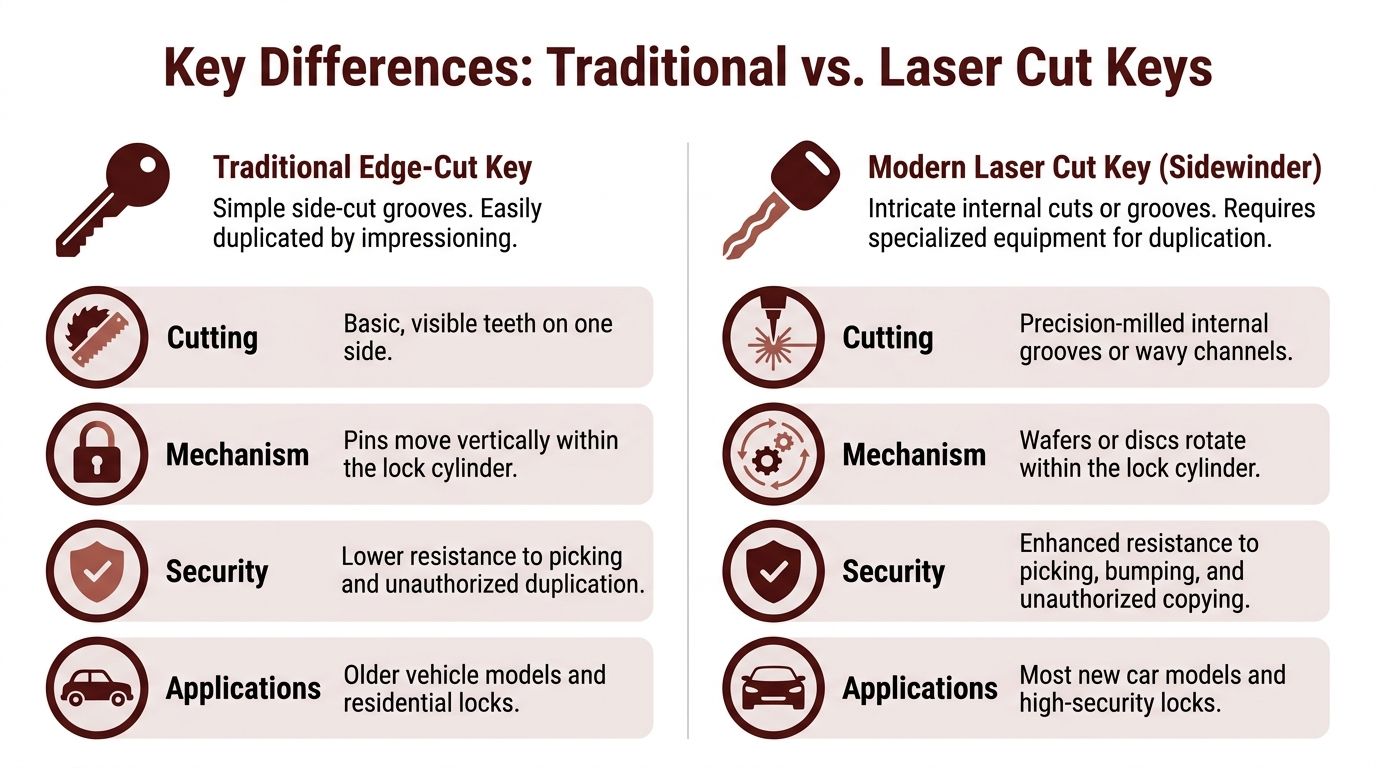
Traditional and laser cut side by side
| Feature | Traditional Key | Laser Cut Key |
|---|---|---|
| Blade shape | Thinner, edge-cut | Thicker, center-cut groove |
| Insertion | Usually one orientation | Often works in either orientation |
| Duplication | Simpler equipment | Specialized high-security machine |
| Security design | Visible teeth | Internal or sidewinder-style pattern |
| Common use | Older locks and vehicles | Most modern vehicles |
The security difference is not just marketing language. According to Honda, a standard cut key has a 1 in 3,500 chance of an identical match, while laser-cut keys improve that to 1 in 30,000, making them nearly 10 times more secure. The same source says their adoption contributed to more than a 27% decrease in national car thefts (Honda figures discussed here).
Why hardware store copying usually does not work
A standard duplicator is built for simpler edge cuts. It is not designed for the center groove and tighter tolerances of a sidewinder key. That matters because a key can look “close enough” to the eye and still fail in the ignition.
Laser cut keys are commonly paired with transponder technology. So even if someone copied the blade shape, the vehicle may still not start unless the chip is recognized by the immobilizer.
Practical differences drivers notice include:
- A sturdier feel: The blade is thicker and more rigid.
- Smoother insertion: Many models insert either way, which feels more natural in daily use.
- Harder unauthorized copying: The machine and profile requirements create a real barrier.
Key takeaway: A laser cut key is not a fancier-looking key. It is a high-security key system that combines a more complex mechanical cut with modern anti-theft design.
For drivers in Port St. Lucie, Stuart, and Vero Beach, that means replacement is more specialized, but it also means your vehicle is using a stronger lock-and-key setup than older cars did.
The High-Tech Process of Cutting and Programming
Making a replacement laser cut key is a precision job. It is not guesswork, and it is not the same process used for an older metal key. The work has two parts: cutting the blade correctly and, when required, programming the electronic portion so the car recognizes it.
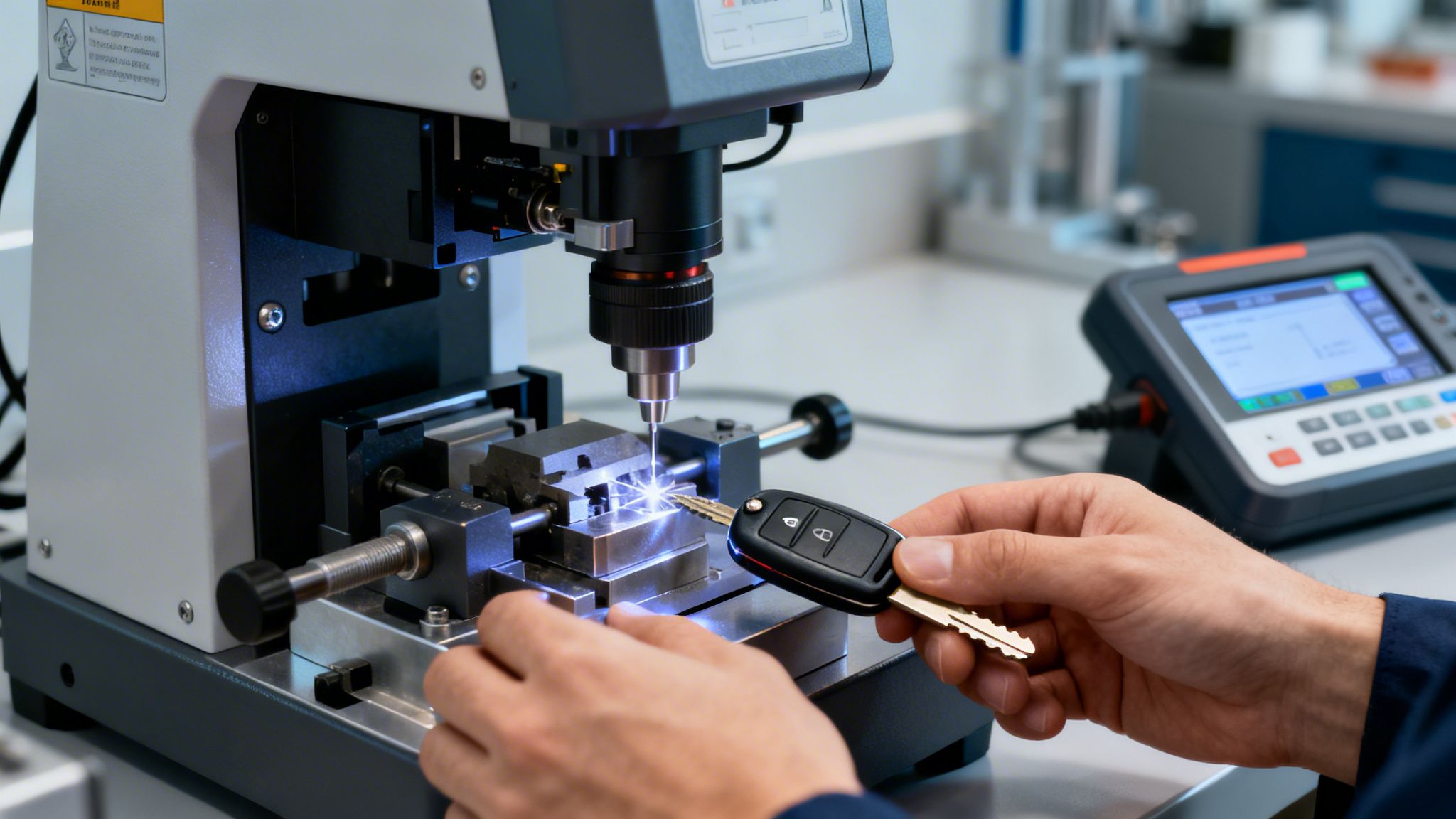
How the blade is cut
The machine must follow the exact manufacturer-specific profile for that vehicle. According to KeyMe’s explanation of professional high-security key cutting, the process requires computer-controlled milling machines that achieve depth and spacing accuracies within 0.01-0.05 mm. The same source notes there are 7 common blade styles, and poor calibration can make a key fail or wear out the lock cylinder 20-30% faster (professional cutting details).
That sounds technical, but its practical meaning is simple. Tiny errors matter.
A proper job typically involves:
- Identifying the correct keyway and blade style
- Reading existing key data or decoding the lock information
- Milling the blank on a calibrated high-security machine
- Testing fit before forcing anything into the ignition
Why programming matters too
Many modern vehicles will not start because the blade turns alone. The chip inside the key has to communicate with the car’s immobilizer system. If it is not programmed correctly, the key may unlock the door but still fail to start the engine.
That is one reason on-site automotive locksmith service has become so valuable in places like Jensen Beach and Vero Beach. The right van can carry both the cutter and the programming equipment, so the entire job happens where the vehicle sits.
Some mobile services, including Pro-B Locksmith, outfit vans with high-precision cutting and diagnostic tools for on-site automotive key work. That setup is useful when a vehicle cannot be moved and the customer needs the key cut and programmed at the same stop.
Tip: A fresh key should insert smoothly, turn cleanly, and start the vehicle consistently. If it feels rough or only works intermittently, stop using it until the cut and programming are checked.
DIY videos can make the process look easy. In practice, the cutting, calibration, and programming steps are where expensive mistakes happen.
Why Modern Cars Use High-Security Keys
Modern vehicles use high-security keys because older systems were easier to copy, easier to wear out, and easier to defeat. Automakers moved toward tighter key profiles and immobilizer-based systems because theft prevention became a bigger engineering priority.
The roots of the technology go back further than the car key in your hand. The industrial side of laser cutting began in 1965, when Western Electric introduced production-oriented laser cutters. By the 1980s, there were about 20,000 industrial laser cutters in use worldwide, which helped make the precision behind high-security key manufacturing possible. Automotive use followed in the late 1980s as manufacturers adapted that precision to combat rising theft (history of laser cutter development).
What that means for the vehicle owner
Car makers did not add this complexity for no reason. They wanted a key system that was harder to duplicate casually and more exact inside the lock.
That is why many drivers with Honda, Toyota, Ford, BMW, Volkswagen, Lexus, Hyundai, and similar vehicles discover that a “simple spare key” is not simple. Their vehicle may use:
- A sidewinder blade
- A transponder chip
- An immobilizer handshake
- A remote or proximity function tied to the same device
Why the extra precision is worth it
A high-security key system brings trade-offs. Replacement takes more specialized work. The upside is better protection and a more refined lock design for day-to-day use.
Owners notice the benefit when they compare it to older keys that got sloppy over time. A modern laser cut key system feels more deliberate. The ignition and door cylinders are less forgiving of bad copies, and that is exactly the point.
For Treasure Coast drivers, the important takeaway is compatibility. If your car is from the modern era and the key blade is thick with a center groove, you are probably dealing with a high-security key, not a basic duplicate job.
The Pro-B Locksmith Advantage Over a Dealership
When people compare a mobile locksmith with a dealership, they often focus on price first. That makes sense, but it is only part of the decision. The bigger issue is often how quickly you can get the right key made without adding towing, scheduling delays, or another day off work.
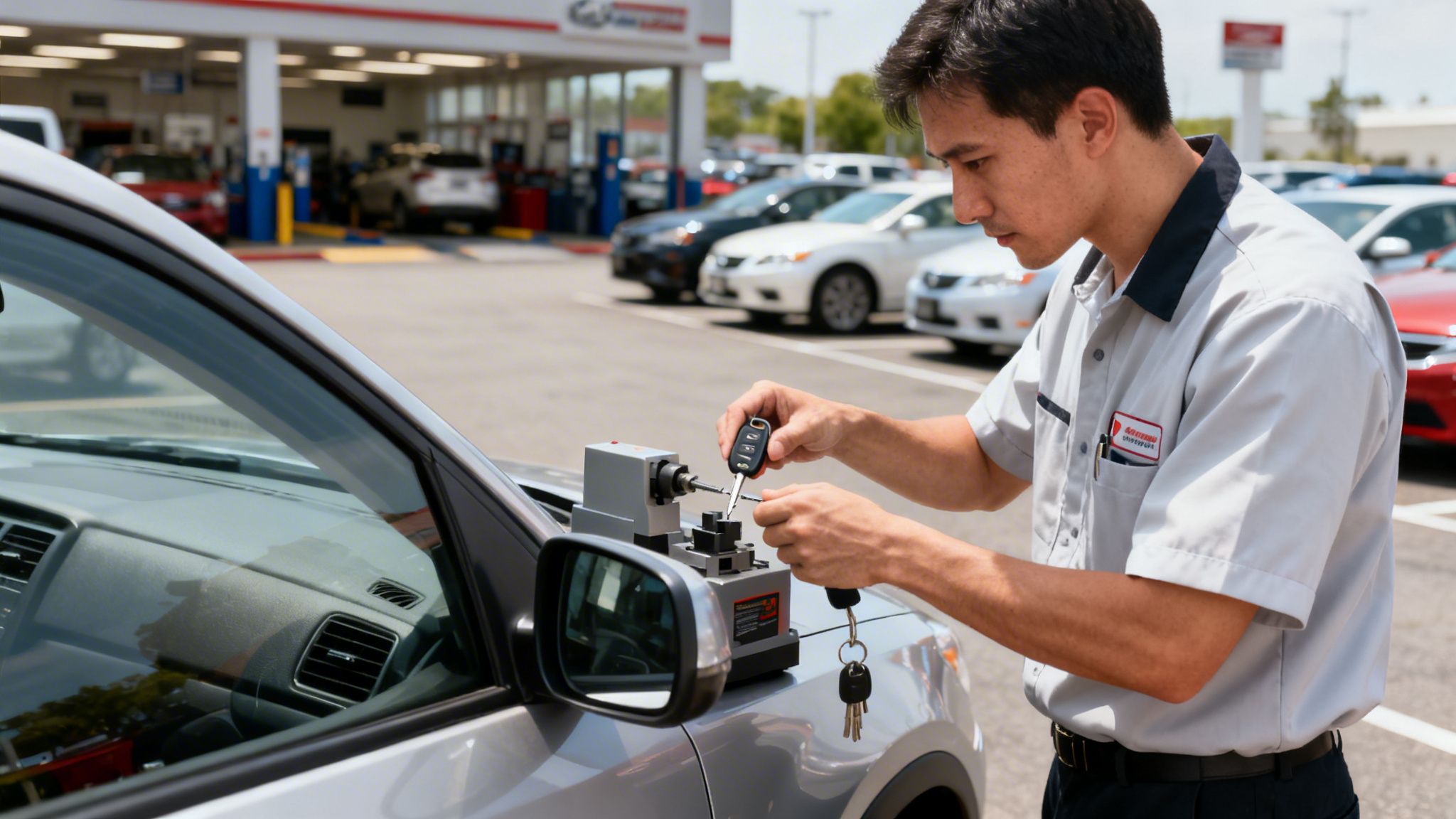
For many Treasure Coast drivers, mobile service is more practical because the work happens where the car already is. If you are in Fort Pierce at work, in Jensen Beach at home, or parked in Port St. Lucie with a non-starting key, the technician comes to you. The dealership model often pushes the problem back onto the customer first.
The trade-offs that matter
A dealership can be the right route in some situations, for rare models or unusual manufacturer restrictions. But for a large share of laser cut key replacements, a qualified automotive locksmith handles the job faster and with less disruption.
The usual differences look like this:
- Convenience: The vehicle stays in place while the key is cut and programmed on-site.
- Less downtime: You do not have to build your day around parts counters and service lane schedules.
- More direct communication: You can test the key with the technician standing there.
Why workmanship matters more than the logo on the building
Laser cut keys demand accuracy. That is where the primary risk lies. A cheap or rushed job can create a key that technically fits but does not work correctly.
Substandard cutting can lead to binding or shimming errors, and poorly aligned equipment can leave a customer with a frustrating key that fails because of operator error rather than the key design itself (consumer-facing warning on laser key precision issues). That is why any professional handling this kind of key should be willing to explain how to test it before the job is finished.
A good handoff should include checking that the key:
- unlocks the door smoothly
- turns in the ignition without force
- starts the car consistently
- does not feel rough or catch midway
Tip: Do not accept “it should loosen up.” A newly cut high-security key should work cleanly from the start.
The value of mobile service is not just speed. It is seeing the full job completed at the car, testing it immediately, and resolving any issue before the technician leaves. If you want the faster route instead of waiting on a dealer process, call (772) 710-8169 for immediate help.
What to Expect When You Call Us for a New Key
Customers often feel better once they know exactly how the service call works. Replacing a laser cut key is straightforward when the vehicle details are confirmed first and the technician arrives with the right equipment.
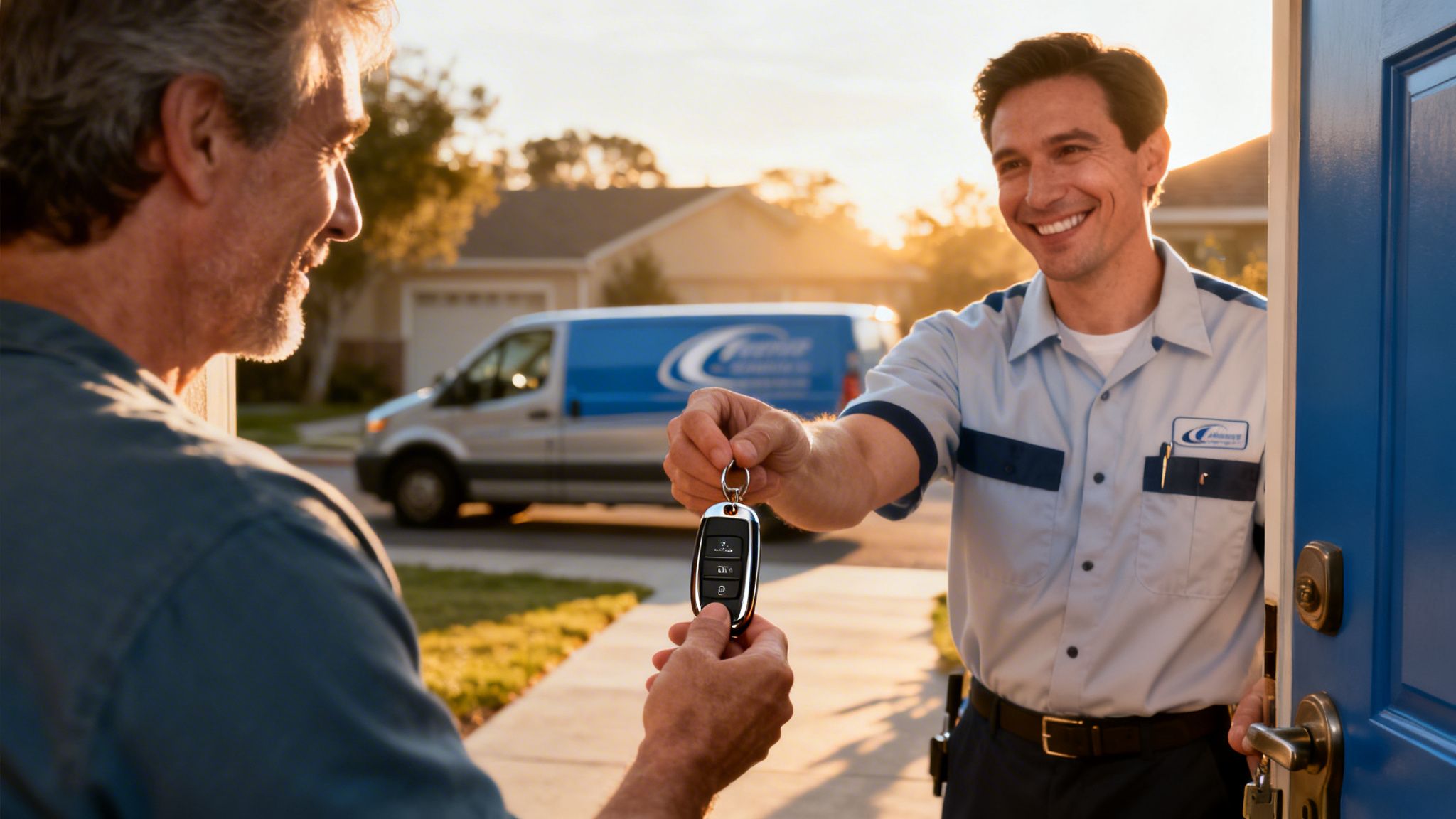
The service call, step by step
You call and describe the problem
Lost key, broken blade, locked keys in the car, key turns but will not start, or fob stopped working. The more specific you are, the faster the setup.You provide the vehicle details
Make, model, and year help identify the likely key type and whether programming is part of the job.We quote the work up front
That gives you a clear picture before the technician begins.A mobile technician comes to the vehicle
This matters if the car is stuck at home, at work, or in a parking lot.The new key is cut and programmed on-site
The final step is testing everything before the job is done.
Why professional machines matter
Some online videos show fiber lasers being used to cut keys, but the process is complex and does not offer the same reliability as purpose-built high-security key cutting machines. Those specialized machines can cost upwards of $15,000, and they are used to match manufacturer specifications without risking damage (video-based discussion of fiber laser key cutting limits).
That is the difference between experimentation and service work. A professional setup is designed to produce a dependable key, not just a key-shaped object.
If you need a replacement in Port St. Lucie, Fort Pierce, Stuart, or Vero Beach, call (772) 710-8169 and have your vehicle information ready. That makes the process faster from the first minute.
Complete Locksmith Services on the Treasure Coast
A laser cut key issue often introduces people to a locksmith for the first time. Then a few weeks later they call again for a completely different problem. That is normal. The same mobile setup that handles automotive key work often helps with home, business, and lockout issues across the Treasure Coast.
For drivers, that can mean emergency car lockout help, key fob replacement, ignition repair, broken key extraction, or on-site spare key creation. For homeowners, the need is often different. House lockout service, rekeying after a move, deadbolt replacement, mailbox lock changes, and smart lock installation are common calls in Port St. Lucie, Fort Pierce, and Jensen Beach.
Commercial customers tend to need practical access solutions. That might be lock changes after staff turnover, master key systems, panic bar service, or help securing a storefront before opening the next day.
If you need automotive help beyond laser cut keys, this page covers the full scope of automotive locksmith services.
Common reasons locals call
- After a move: Rekey the house instead of wondering who still has old copies.
- After a lockout: Get back in without damaging the door or vehicle.
- After key failure: Replace the fob, repair the ignition, or cut a working spare before the next emergency.
A local mobile locksmith should be useful for more than one problem. That matters when you want one phone number for the next lockout, lock change, or car key issue instead of starting over every time.
Your Laser Cut Key Questions Answered
Can a laser cut key be copied at a hardware store?
Usually no. These keys require specialized high-security cutting equipment, and many also need chip programming before the vehicle will start.
Is a laser cut key the same as a key fob?
Not always. A laser cut key refers to the blade style. It may be part of a remote head key, a flip key, or a proximity setup with an emergency insert.
Why does my new key unlock the door but not start the car?
That usually points to a programming issue, not just a cutting issue. The blade may be correct while the transponder chip is not yet matched to the immobilizer.
What if the key turns roughly in the ignition?
Stop using it until someone checks the cut. A rough-turning high-security key can indicate a poor duplicate, wear on the original key pattern, or a problem in the ignition cylinder.
Can you help if I am locked out and also need a replacement key?
Yes. That is a common service call. Entry comes first, then the technician can confirm the key type and make the replacement on-site if the vehicle requires it.
Do you handle car keys exclusively?
No. Automotive work is only part of the job. House lockouts, lock changes, rekeying, and related locksmith services are available across the Treasure Coast.
For more general questions about service, coverage areas, and common locksmith issues, see the locksmith FAQ page.
If your laser cut key is lost, broken, worn out, or locked in the car, Pro-B Locksmith provides mobile locksmith service across Port St. Lucie, Fort Pierce, Stuart, Jensen Beach, and nearby Treasure Coast communities. Call (772) 710-8169 for immediate help with car lockout service, key fob replacement, ignition repair, house lockout assistance, or lock change service at your location.