
You walk out of a store in Port St. Lucie, reach for your keys, and realize they’re gone. Or the fob is in your hand, but the car won’t recognize it. Or the key turns halfway in the ignition and sticks.
That’s usually when people start searching for key cutting and programming, but those two jobs aren’t the same. One shapes the metal so the lock can turn. The other tells the vehicle’s security system that this key is authorized to start the engine.
For a house, cutting is often the whole job. For a modern vehicle in Fort Pierce, Vero Beach, Stuart, or Jensen Beach, cutting alone often won’t solve the problem. The car may grant access, but it still won’t start unless the chip or fob is correctly paired to the vehicle.
A mobile locksmith matters most when the problem can’t wait. If you’re stranded at work, locked out at home, or holding the only broken key for your SUV, you need someone who can come to you, identify the exact key type, cut it correctly, and handle the electronics on site. That’s the difference between getting back on the road today and spending days chasing dealer appointments or mail-in options.
Lost Your Keys in Port St Lucie? Start Here
If you’ve lost your keys somewhere between Tradition, St. Lucie West, Fort Pierce, or down toward Jensen Beach, start with the basic question: do you need a key cut, a key programmed, or both?
Think of it this way. The cutting is the physical shape, like a house key made to fit a lock. The programming is the security approval, more like the unique code that tells the car’s computer, “yes, this key belongs here.”
What to do first
Stop retrying a failing key
If the blade is bent, worn, or cracking, forcing it into the ignition can turn a key problem into an ignition repair.Check whether you still have any working spare
A working spare can change the job from building a key from scratch to duplicating and verifying an existing one.Gather your vehicle details
The make, model, year, and VIN help identify the correct blank, chip type, and programming method.Have proof of ownership ready
A licensed locksmith should ask for it. That protects you and the vehicle.
If you need immediate local help, the fastest next step is contacting a mobile locksmith serving the area directly, such as a Port St. Lucie locksmith that can come to your driveway, office parking lot, or roadside location.
Practical rule: If the car was built with a chip key, remote head key, or push-to-start fob, assume cutting alone won’t finish the job.
People often call after trying the cheap route first. They buy a blank online, get a rough copy made, and then find out the vehicle still won’t start. That delay is avoidable when the key is identified correctly from the start.
Key Cutting vs Programming What Is the Difference
A driver in Port St. Lucie can have a key copied at a kiosk, hold a brand-new fob from an online seller, and still be stuck in the same parking lot. That usually comes down to one missed detail. Cutting and programming are two separate jobs.
Key cutting deals with the physical key. Programming deals with the vehicle’s anti-theft system. On many newer cars, you need both before the job is finished.
Cutting is the mechanical part
Cutting shapes the blade so it matches the locks on the car. That includes the door lock, trunk lock, and on some vehicles, the ignition cylinder.
If the cut is off even slightly, the key may stick, turn hard, or wear the lock faster. I see that after hardware-store copies and low-quality online blanks more often than people expect. A key that binds in the ignition is not a small issue. It can turn a simple replacement into an ignition repair.
Programming is the electronic part
Programming pairs the key or fob to the car’s computer. The chip inside the key, or the proximity fob itself, has to be recognized by the immobilizer system before the engine will start.
That is why a key can open the door and still fail the ultimate test.
- Cutting lets the key physically operate the lock
- Programming authorizes the vehicle to accept that key
- Both services are often required on modern cars
For many Treasure Coast drivers, that distinction only becomes clear after they spend money in the wrong order. They buy a blank online, pay someone to cut it, then learn the vehicle still needs onboard or diagnostic programming. A local automotive locksmith service can usually confirm the key type first and handle the full job on site, which avoids the dealer trip and the wait that comes with mail-in programming.
Real examples people run into
A basic house key needs accurate cutting. No programming.
An older car with a plain metal key may only need the blade duplicated, though wear in the lock still matters.
A late-model SUV often needs three things checked before the job is done: the emergency blade cut correctly, the transponder or fob programmed correctly, and the remote buttons tested with the vehicle.
That is the part many drivers do not hear from big-box cutters or online sellers.
A key that turns but will not start the car is unfinished work.
When cutting is enough, and when it is not
| Situation | Cutting needed | Programming needed |
|---|---|---|
| House key duplicate | Yes | No |
| Simple mailbox or padlock key | Yes | No |
| Older mechanical car key | Yes | Sometimes no |
| Transponder key replacement | Yes | Yes |
| Remote head key replacement | Yes | Yes |
| Push-to-start fob replacement | Often yes for emergency blade | Yes |
The practical difference is time. A dealer may charge more and keep the vehicle tied up. A mail-order service may save a little on paper but leave you waiting days while the car sits useless. A mobile locksmith can cut and program many keys where the vehicle is parked, which is usually the fastest route when you need to get back on the road.
A Guide to Modern Car Keys on the Treasure Coast
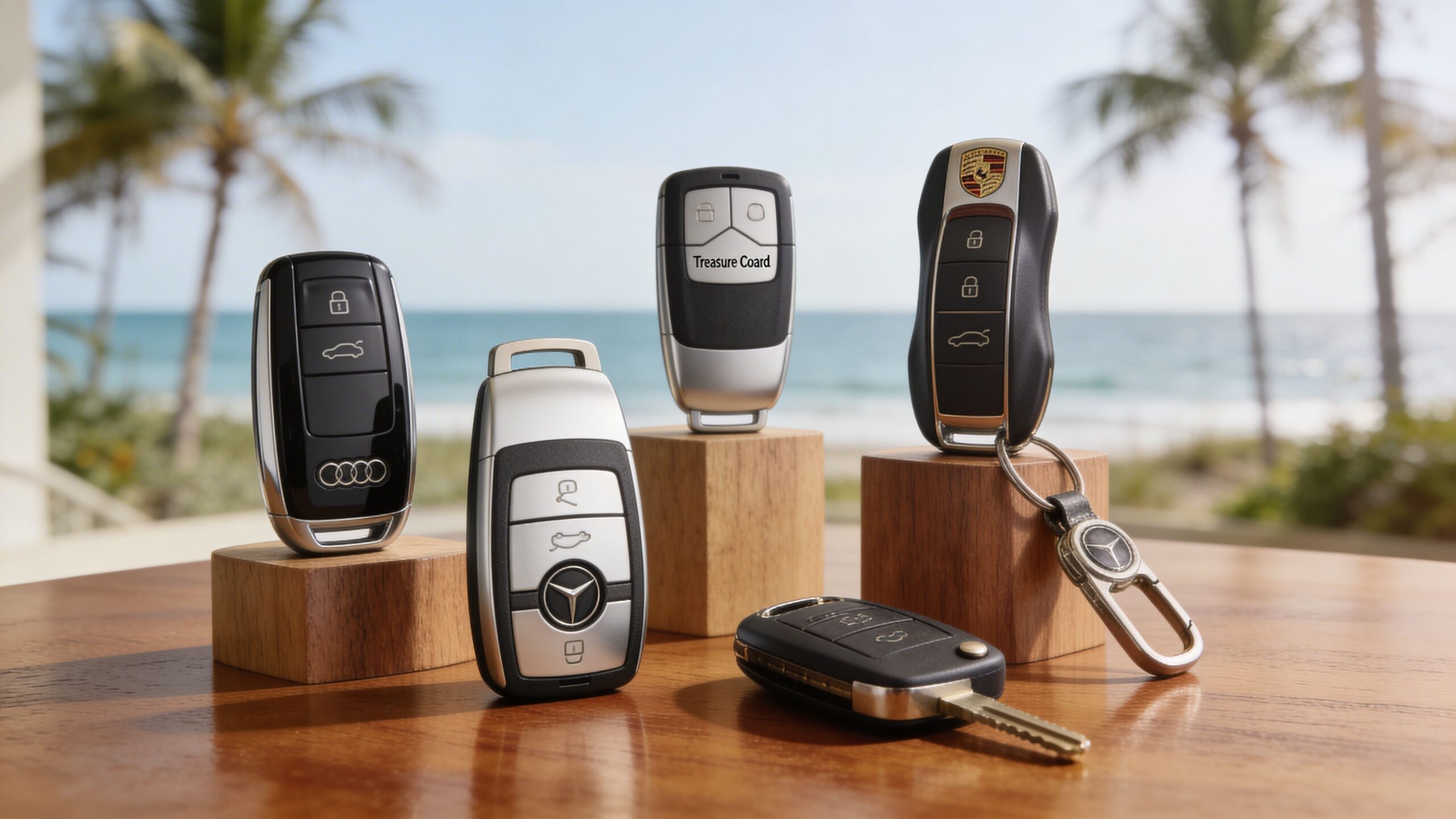
You’re standing in a Publix parking lot in Port St. Lucie with a key in your hand, and the car still will not start. That usually means the problem is not the blade alone. Modern car keys often combine metal cutting, chip recognition, remote functions, and anti-theft programming in one device.
That is why identifying the key type early saves time, especially when you need help at home, at work, or on the roadside anywhere from Jensen Beach to Vero Beach.
Traditional metal keys
These are the simplest keys on the vehicle side. They have no chip, no remote board, and no proximity function.
Older cars, work trucks, and some fleet vehicles still use them. In many cases, the job is straightforward. Cut the blade accurately, check operation in the door and ignition, and you are done.
Transponder keys
Transponder keys catch drivers off guard because they often look plain. The chip is hidden inside the head, but the vehicle checks for that chip before it allows the engine to start.
If the blade is cut right but the chip is wrong or unprogrammed, the key may turn and still leave you stranded. That is a common problem with bargain online replacements and generic duplicates that were never matched to the car.
Laser-cut sidewinder keys
These keys are milled with tighter patterns than basic edge-cut keys. The blade is usually thicker, and the grooves are cut differently.
I see these often on higher-security models, including many European vehicles and some GM applications. They require the right machine and the right blank. A simple hardware-store duplicator will not handle them properly.
Remote head keys
A remote head key combines the metal blade and lock buttons in one unit. It is common on a lot of daily drivers across the Treasure Coast.
Failures are not always obvious. Sometimes the blade still works, but the buttons fail. Sometimes the remote works, but the transponder does not. Good service starts by identifying which part failed before ordering parts or programming anything.
Smart and proximity fobs
Push-to-start systems rely more on encrypted communication than on the visible key blade. Many still include a hidden emergency key, but the primary function is electronic.
These systems leave less room for guesswork. Some vehicles accept on-site programming smoothly. Others have tighter security steps, limited key-slot availability, or model-specific procedures that must be followed in sequence.
Why local mobile service matters here
On the Treasure Coast, speed matters as much as the key type. A dealership often means towing, appointment delays, and higher parts pricing. Mail-in programming can leave the car parked for days while you wait for a programmed key to come back.
A properly equipped mobile locksmith can identify the key, cut what is needed, and program many replacements where the vehicle sits. For drivers who need help now, that is usually the practical option. If you need that kind of on-site help, a local automotive locksmith service should have code-cutting equipment, sidewinder capability, and vehicle programming tools in the van.
The Locksmiths Craft How On-Site Key Cutting Works
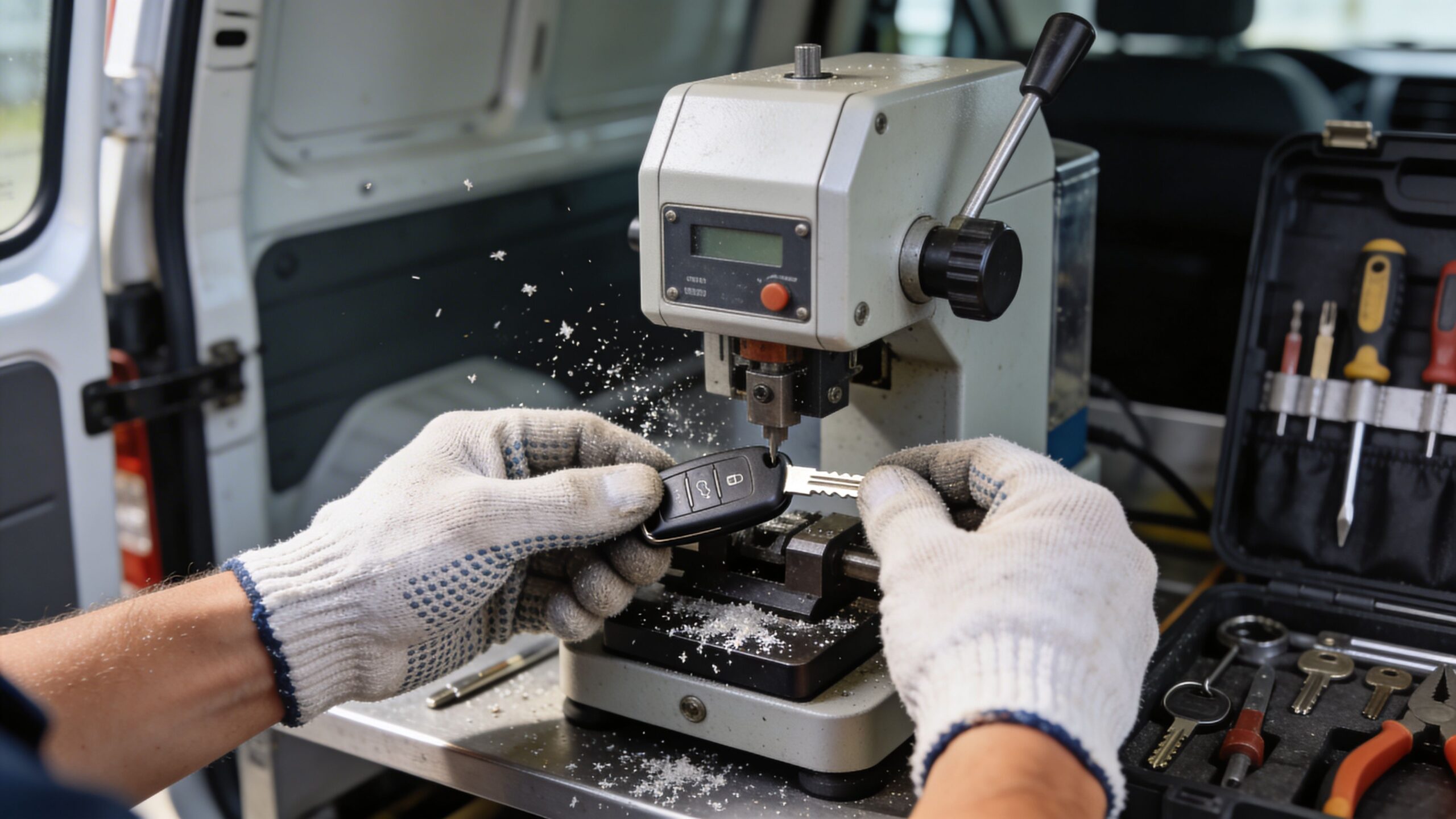
Key cutting looks simple until you watch it done correctly. The difference between a clean factory-style key and a rough duplicate is often invisible until the key sticks, drags, or fails in the ignition.
Method one uses an existing key
If you still have a working key, a locksmith can often duplicate it. But duplication isn’t just tracing metal.
A professional checks for wear first. If the only surviving key is already worn down, copying that wear can pass the defect into the new key. That’s one reason some hardware-store copies work poorly. The machine may copy the old key exactly, including its mistakes.
Method two cuts from code
When all keys are lost, the better route is often cutting from code.
That process uses the vehicle’s VIN to retrieve manufacturer specifications from a database. A computerized code cutter mills the new key to the proper pattern instead of guessing from lock wear or copying a damaged key.
Code cutters can mill with tolerances under 0.01mm, and code-cut keys achieve a 99.5% first-time start success rate compared with 70% for some visual duplicates, according to Blade Auto Keys’ explanation of car key cutting and programming.
Why that precision matters
When the cut is off, several things happen:
- The key binds in the lock
- The ignition doesn’t rotate cleanly
- The blade wears faster
- The cylinder can suffer damage
- Broken keys become more likely
That last problem often leads people to call for ignition repair. In practice, I see a lot of ignition issues that started as bad key issues. A weak copy forces the wafers incorrectly, and the driver keeps twisting harder because it “almost works.”
Shop-floor reality: A key that has to be jiggled every time is already warning you.
Sidewinder and high-security cutting
Laser-cut or sidewinder keys require a different machine and a steadier process. These aren’t the keys you want cut on generic equipment.
The machine has to hold the blank firmly, align it correctly, and mill the internal pattern cleanly. On-site vans that handle this work properly carry dedicated sidewinder or laser-cutting equipment, along with the right jaws and calibration tools.
What the cutting appointment usually looks like
A proper mobile visit is methodical, not rushed. The sequence usually goes like this:
Verify ownership
The locksmith confirms the vehicle belongs to the person requesting service.Identify the key system
Blank type, chip family, blade style, and any remote or smart functions are checked.Retrieve key specs
This may come from the existing key, lock decoding, or VIN-based code information.Cut the blade
The cutter mills the blank to match the required pattern.Deburr and test
The technician smooths the edge and checks operation in the door, trunk, or ignition as applicable.
One mobile option in Port St. Lucie with vans equipped for that type of on-site work is Pro-B Locksmith. The relevant point isn’t the name. It’s the equipment and process. A true automotive setup should be able to cut accurately in your driveway without sending you elsewhere for the next step.
The Digital Handshake How Key Programming Secures Your Car
A lot of drivers find out about programming the hard way. The new key turns, the dash lights up, and the car still refuses to start.
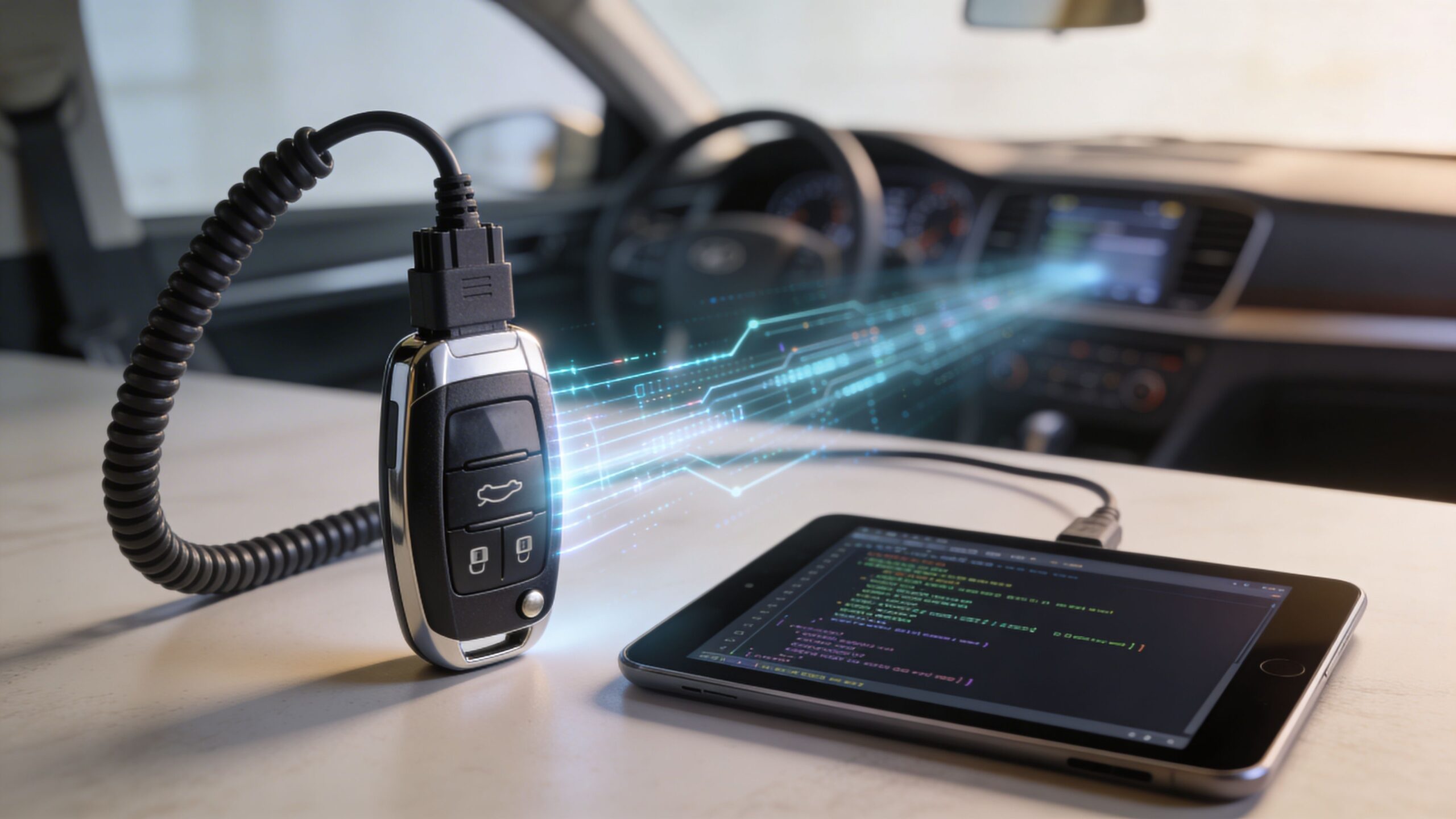
That happens because modern vehicles do two jobs before they let you drive. The mechanical key has to match the lock, and the chip or fob has to match the car’s immobilizer system. If that coded exchange fails, the vehicle blocks ignition or fuel delivery, even when the blade itself is cut correctly.
What the car is verifying
The vehicle is checking for authorization. On older systems, that usually means reading a transponder chip in the head of the key. On newer systems, it may involve a proximity fob, encrypted data, rolling codes, or a push-to-start credential stored in the car’s security module.
The practical takeaway is simple. A correctly cut key can still be useless until the vehicle accepts it.
That is why key replacement changed so much over the last few decades. For many cars, programming is no longer an extra feature. It is part of making a working key.
How on-site programming is done correctly
A trained mobile locksmith does not plug in a generic tool and hope for the best. The process starts with identifying the exact system on the vehicle, then using professional programming equipment and the correct procedure for that make, model, and year.
In the field, that often means connecting through the OBD-II port, accessing the immobilizer or body control system, and adding or syncing the new key or fob. Some vehicles allow straightforward key addition. Others require PIN retrieval, security wait times, EEPROM work, or a sequence that can lock out the system if handled incorrectly.
The job may include:
- Adding a new key for a spare or replacement
- Programming an all-keys-lost key when nothing working remains
- Deleting missing keys from memory for security
- Syncing remote buttons for lock, trunk, or panic functions
- Pairing a proximity fob for push-to-start vehicles
- Testing start, lock, disarm, and backup functions before the technician leaves
That last step matters. I have seen aftermarket fobs start the car but fail to lock the doors consistently, or work at the push button but not in the emergency key slot. Good programming work includes function testing, not just getting one successful start.
Why this matters more in urgent situations
Programming is where local mobile service has a real advantage for Treasure Coast drivers. If the car is sitting in a Stuart parking lot, outside a home in Port St. Lucie, or disabled at work in Fort Pierce, the problem is tied to the vehicle itself. The programming has to happen with the car present.
A dealership can often do the job, but the process usually adds towing, scheduling, and counter time. Mail-in services create a different problem. They are built around shipping delays, limited support if the key arrives uncut or unsynced, and no technician standing next to the vehicle to fix an issue on the spot.
A mobile locksmith brings the cutter, programmer, and diagnostic process to the car. That removes extra steps at a time when they are least affordable.
Programming is also part of securing the vehicle
Lost-key service is not only about getting you running again. It is also a chance to remove risk.
If a key or fob is missing, the safer approach may be to erase it from the vehicle’s memory so it no longer starts the car. That matters after a theft concern, a break-in, a used car purchase with an unknown key count, or a fleet change where an old key should not keep working.
Done right, programming solves two problems at once. It restores access, and it closes the door on keys that should no longer be trusted.
Mobile Locksmith vs The Dealer Saving Time and Money
People often assume the dealership is the safest choice because it’s the manufacturer path. In reality, the better question is simpler: who can solve the problem fastest, correctly, and without creating extra steps?
For a lot of Treasure Coast drivers, the answer is a true mobile locksmith.
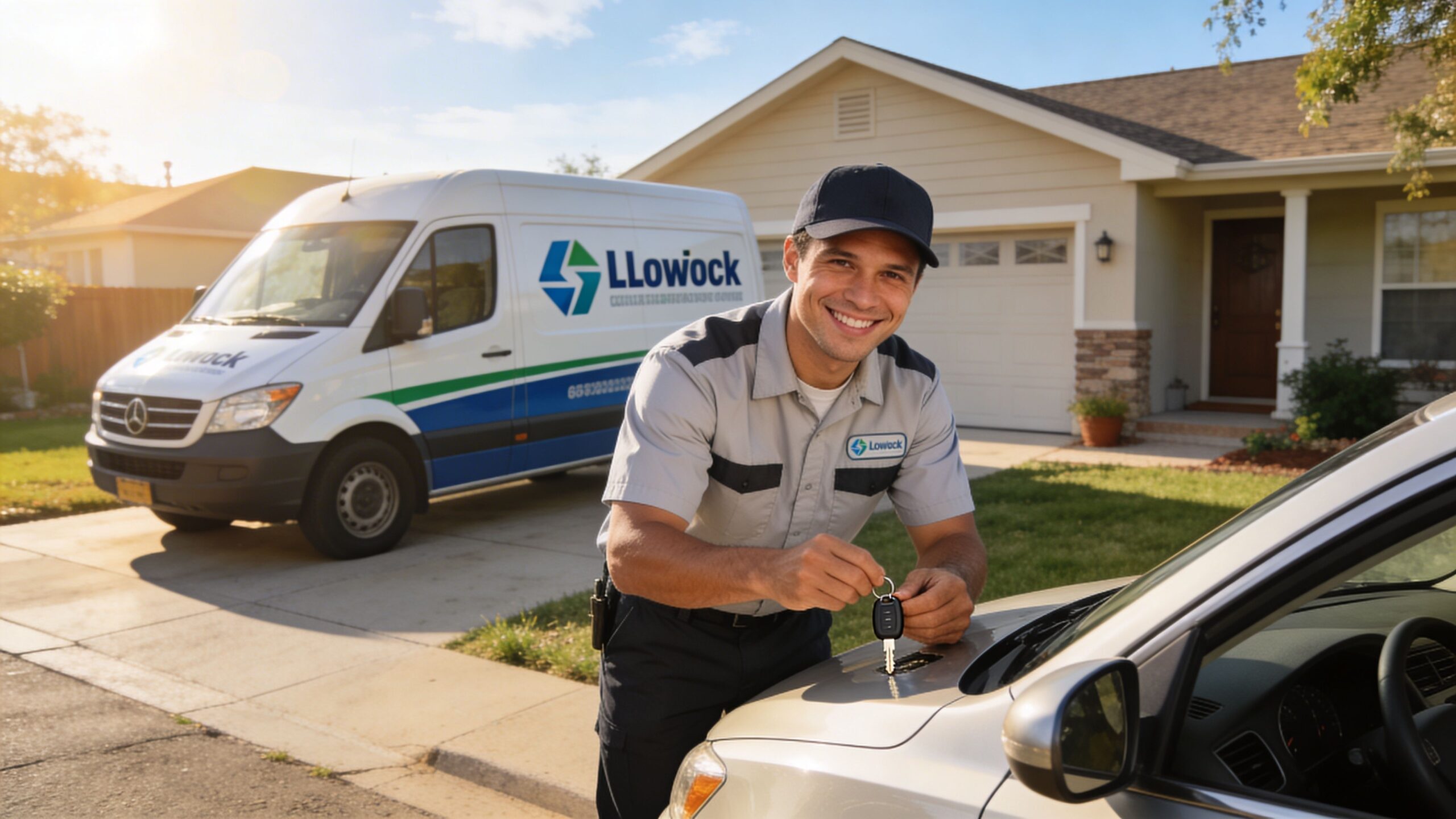
The dealer route often adds friction
If the vehicle won’t start, the dealer usually expects the car to come to them. That can mean arranging a tow, waiting for an open slot, and making another trip to pick the vehicle up.
That process makes even less sense when the issue can be solved where the car is already parked.
Mobile service is built for the specific problem
Often, the pressing problem is immediate. You’re locked out in Port St. Lucie. Your only fob stopped working in Jensen Beach. The key broke in the ignition in Fort Pierce. You don’t need a counter visit. You need a technician, a cutter, and a programmer at the location.
Mail-order key programming can take days or weeks, while mobile locksmiths can provide on-site help in 15 to 20 minutes and often at half the dealer price, according to this discussion of mobile versus mail-order key programming.
That’s the trade-off in plain terms:
| Issue | Dealer or mail-in route | Mobile locksmith route |
|---|---|---|
| Vehicle won’t move | Usually requires towing or shipping parts | Service happens where the car is |
| Lockout urgency | Limited practical help if the car is inaccessible | Immediate roadside response |
| Lost all keys | Often multiple steps and delays | Cut and program on site |
| Schedule | Business-hour dependent | Better suited to emergency timing |
DIY sits in the middle and often fails both tests
A lot of people try to split the difference. They buy a blank online, order a programmer, and assume they’ll save money.
Sometimes they end up with:
- The wrong fob
- A blade that was cut poorly
- A vehicle that still won’t recognize the key
- A call for emergency help after losing more time
That’s why local service matters. A technician who works Treasure Coast calls all week understands the practical patterns. Condo lockouts in Stuart. Broken Honda keys in Port St. Lucie parking lots. Push-to-start failures outside big-box stores in Fort Pierce. The problem isn’t theoretical.
If you need urgent help and want to skip towing, waiting rooms, and shipping delays, Call (772) 710-8169 for immediate help.
The Dangers of DIY Key Replacement and Programming
DIY key replacement looks cheap at first because the hidden risks don’t show up until the last step. The blank arrives. The fob looks right. The app or programmer claims compatibility. Then the car rejects it, or worse, the system gets locked into a deeper fault.
That risk has increased with newer smart systems. Searches for “proximity fob programming failed” have spiked 40% since early 2025, and failed attempts on newer vehicles can brick the BCM and lead to repairs costing thousands of dollars, as described in this report on smart fob programming failures.
Common DIY failure points
Some mistakes happen before programming even starts.
Wrong part ordered
Two fobs can look nearly identical and still be wrong for frequency, chipset, or vehicle-specific compatibility.Bad cut on the emergency blade
The fob may be correct, but the hidden key won’t work in the door.Used or locked electronics
Some online fobs can’t be reused the way buyers expect.Outdated programming tool
The tool may connect, but not support the current security procedure.
The expensive part of DIY usually isn’t the kit. It’s what happens after the kit fails.
DIY vs. Pro-B Locksmith A Risk Comparison
| Factor | DIY Approach | Professional Service (Pro-B Locksmith) |
|---|---|---|
| Key identification | Buyer guesses based on photos or listings | Key type is identified from vehicle data and hardware |
| Blade cutting | May rely on a kiosk or basic duplicator | Cut with professional automotive equipment |
| Programming support | Depends on app, generic instructions, and tool compatibility | Performed with dedicated diagnostic tools on site |
| Security issues | Missing keys often stay active in the system | Missing or stolen keys can be addressed during service |
| Failure consequences | More delays, possible module issues, repeated purchases | Single service visit with testing before completion |
A simple checklist before you buy anything online
If you’re still considering the DIY route, slow down and verify these first:
Exact vehicle details
Year, make, model, and trim all matter.Current key type
Plain transponder, remote head key, sidewinder, or proximity fob.Whether all keys are lost
All-keys-lost situations are usually more complex than spare-key additions.Whether the issue is really the key
A weak fob battery, damaged ignition, or failed receiver can mimic programming failure.
The safer move is usually to diagnose first, then cut and program once with the correct tools. That avoids turning a key problem into an electronics problem.
Your Checklist for Fast Roadside and Home Locksmith Service
When you call for lockout help, key fob replacement, ignition repair, lock change, or a new house key, a little preparation speeds up everything.
Have these ready before the call
Photo ID and proof of ownership
For vehicles, registration or title helps confirm authorization. For homes, a lease, ID, or property documentation may be needed depending on the situation.Vehicle details
Have the make, model, year, and VIN ready if it’s an automotive call. The VIN helps identify the correct key path when a new key must be made from scratch.A clear problem description
Say whether you’re locked out, lost all keys, broke a key in the ignition, need a fob programmed, or need a lock changed at home.Your exact location
Apartment gate codes, business names, parking lot sections, and cross streets help more than a general neighborhood name.
A small step that helps the technician reach you faster
If you’re in a large neighborhood, condo complex, or a busy shopping area, drop a precise pin and confirm the route details. Tools like mapping software show why accurate routing matters when a service vehicle is trying to reach the right building, gate, or parking row without wasting time.
When the problem isn’t your car
The same idea applies to home and business calls. If you’re locked out of a house in Port St. Lucie, need rekeying after a move in Fort Pierce, or need emergency entry at a storefront, gather the same essentials: who you are, where you are, and what’s happening.
For urgent lockout situations, this emergency lockout service is the kind of local response page worth keeping bookmarked.
If you need fast, local help with key cutting and programming, car lockout service, house lockout assistance, key fob replacement, ignition repair, or a lock change anywhere around Port St. Lucie and the Treasure Coast, contact Pro-B Locksmith. Call (772) 710-8169 for immediate help.

