Tag: ignition repair

  • Key Issues: What to Do When Your Key Won’t Go In The Ignition

    Key Issues: What to Do When Your Key Won’t Go In The Ignition

    It’s a moment of pure frustration that can happen to anyone. You’re ready to head out, but your car key just won’t slide into the ignition. It’s a common headache for drivers all over the Treasure Coast, from Port St. Lucie to Jensen Beach, but don’t panic. Most of the time, the fix is surprisingly simple.

    The most frequent culprits are a locked steering wheel, some gunk or debris in the keyway, or a key that’s simply worn or damaged. The absolute worst thing you can do right now is try to force it. That’s how a minor jam turns into a major, expensive repair, especially if it requires a full ignition repair.

    Your Immediate Action Plan When a Key Won't Go In

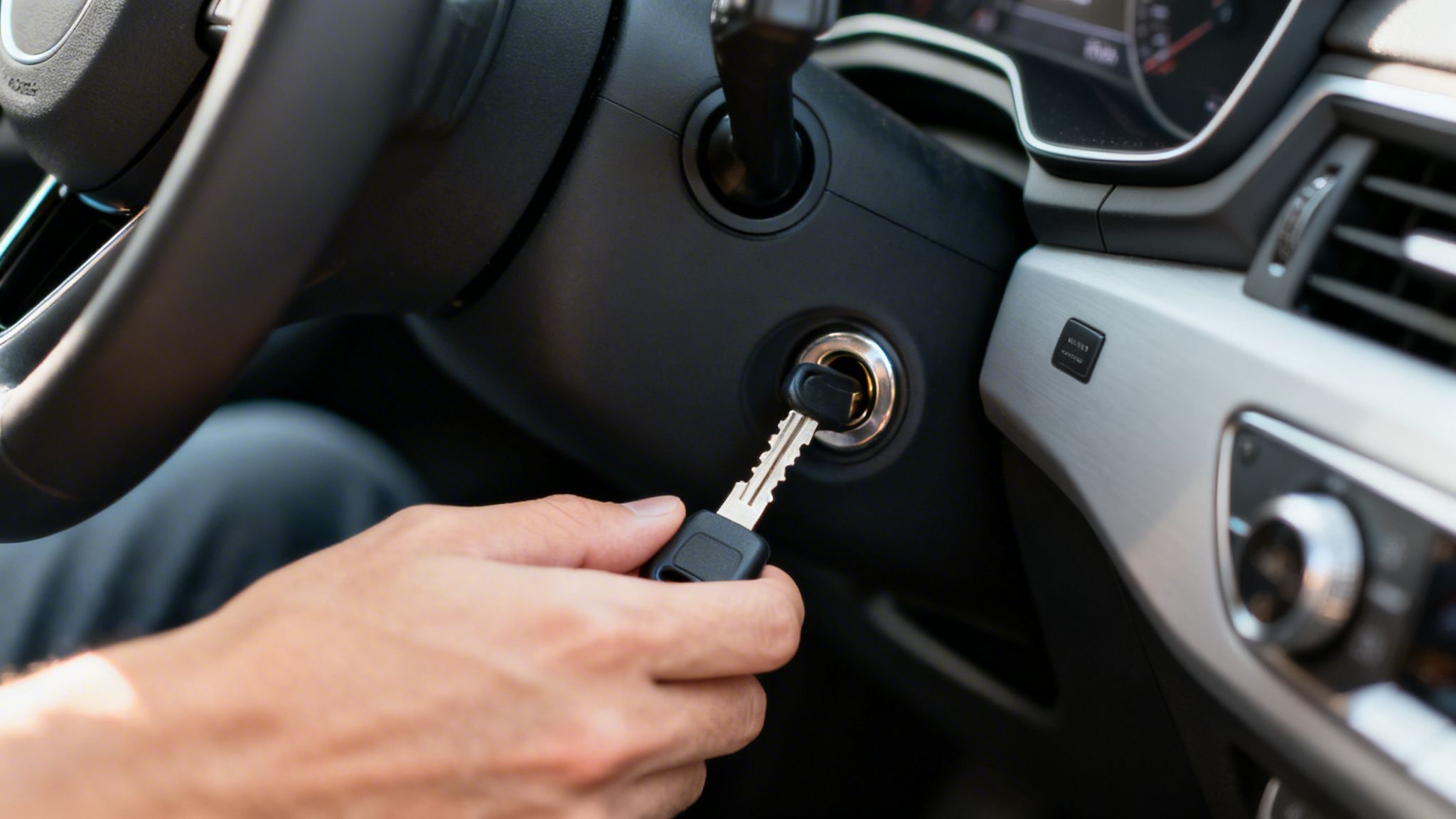
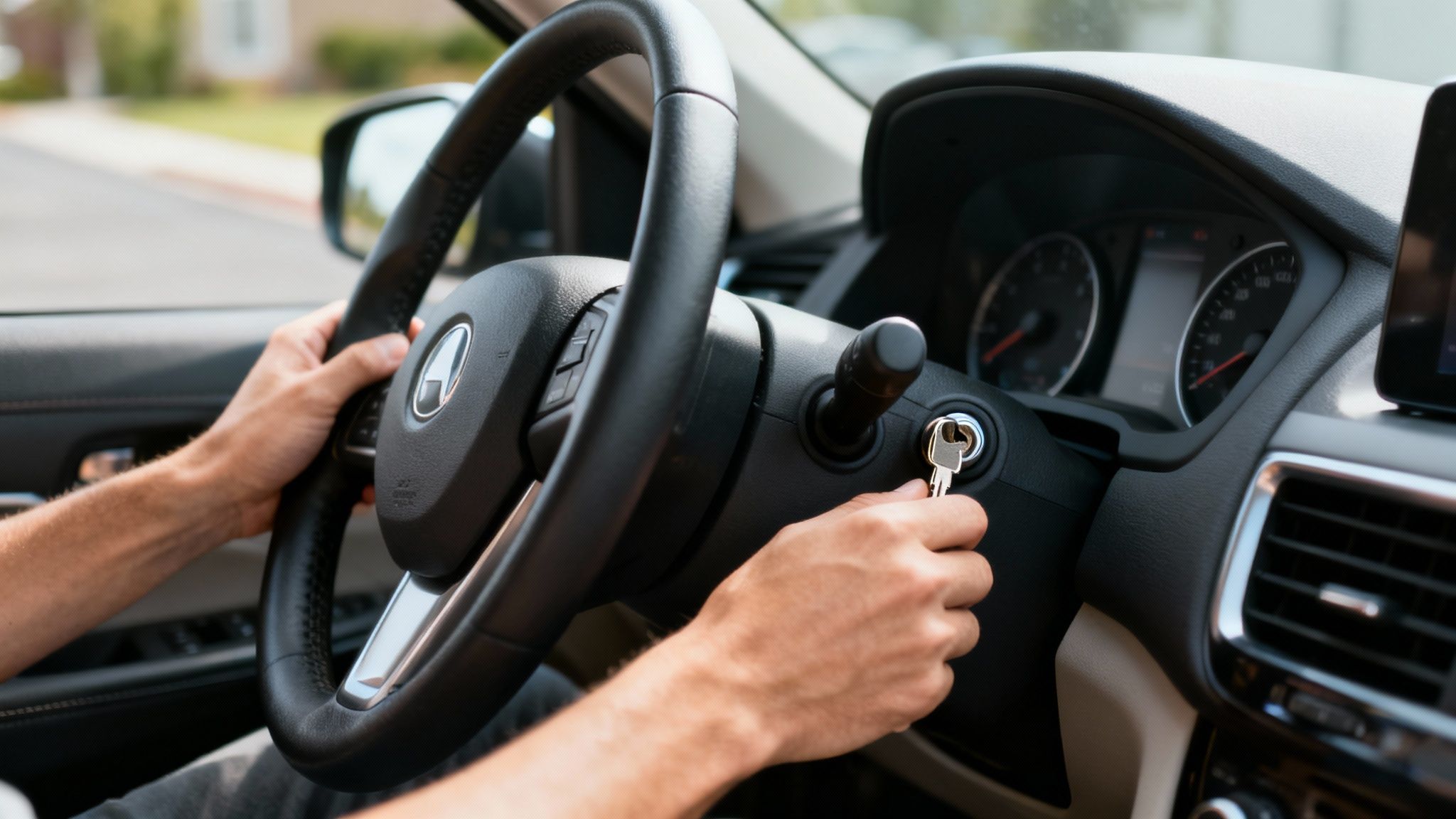
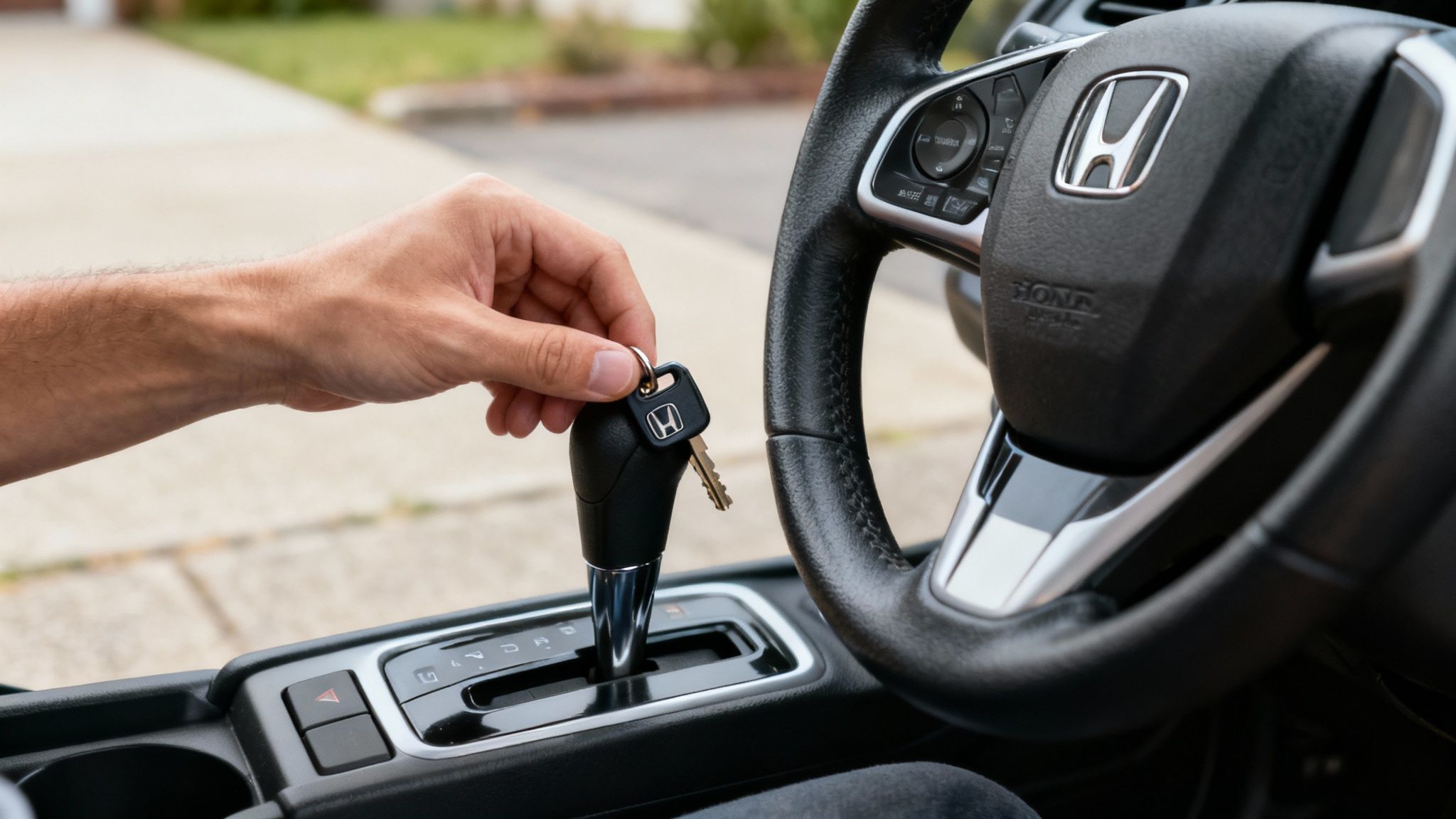
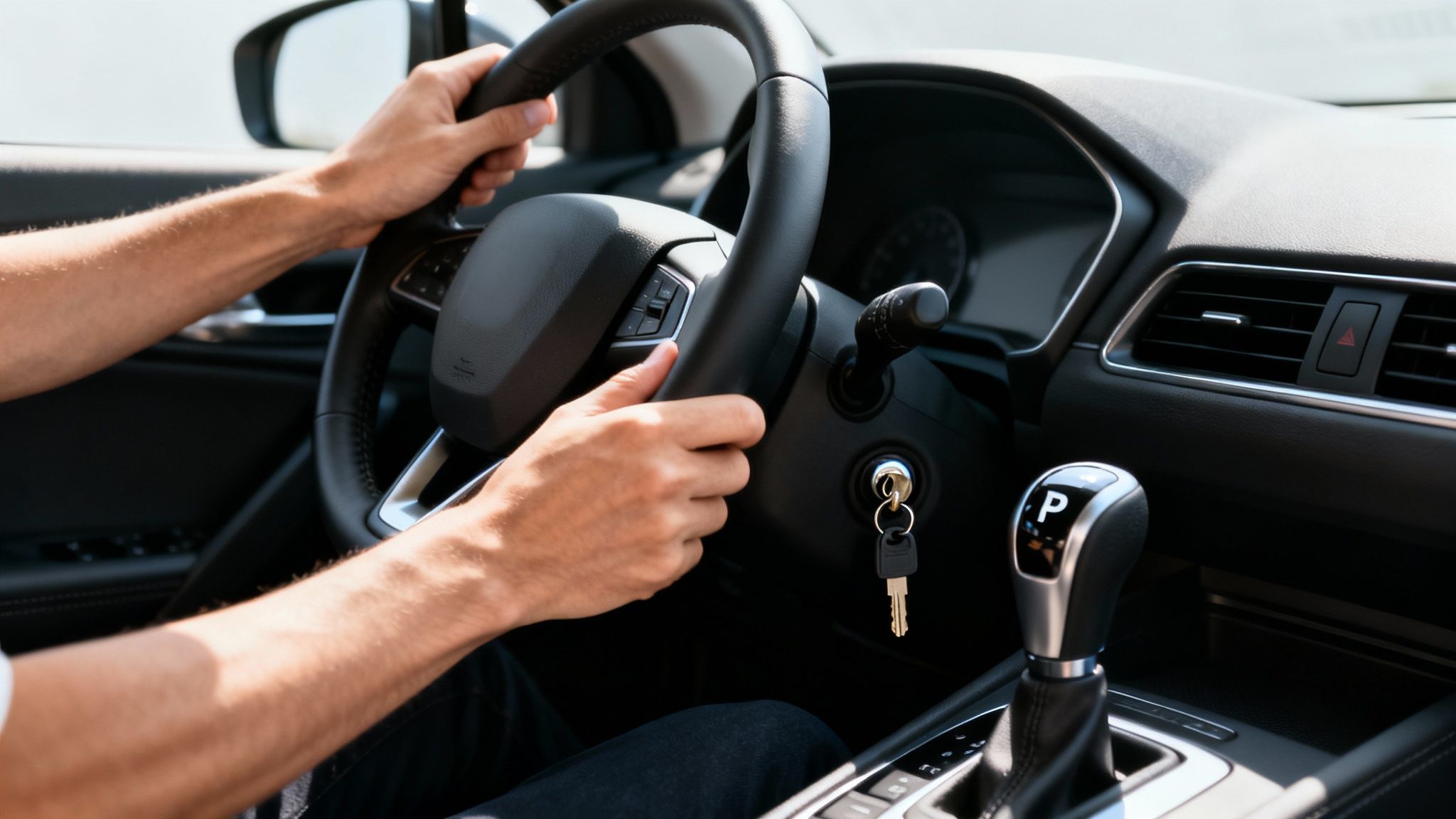
    Close-up of a person's hand inserting a car key into the ignition, inside a modern vehicle.

    We get calls for this exact scenario all the time, from busy parking lots in Port St. Lucie to quiet driveways in Vero Beach. Before you even think about calling a tow truck, let’s run through a quick diagnostic to figure out what’s really going on.

    These first few checks are practical tips that can often solve the problem in minutes and get you back on your way.

    Quick Ignition Key Problem Diagnosis

    To help you quickly pinpoint the problem, here’s a step-by-step table that matches what you’re seeing and feeling with the most likely cause.

    SymptomLikely CauseFirst Action to Take
    Key goes in slightly, then stops hard. Steering wheel is stiff.Locked Steering WheelGently jiggle the steering wheel from side to side while trying to insert the key.
    Key won't go in at all. You feel a "mushy" or soft blockage.Debris in IgnitionUse a can of compressed air to blow out the keyway. Check key for dirt.
    Key feels loose or wobbly when you try to insert it.Worn or Damaged KeyInspect the key for visible bends, cracks, or significant wear on the grooves. Try your spare key.
    Key goes in, but won't turn.Ignition Cylinder FailureThis is more serious. Avoid force. If you're in the Fort Pierce area, Call (772) 710-8169 for immediate help.

    This table covers the most common issues we see in the field. If your situation matches one of these, you’ve got a clear, solution-focused starting point.

    First-Response Troubleshooting

    Your goal is to figure this out without making things worse. A key that won’t go in the ignition is almost always a mechanical issue, so let's start with a hands-on inspection.

    • Take a Good Look at Your Key: Is it clean? A day at Jensen Beach could easily leave sand particles packed into the key’s grooves. Check for any obvious grime, gunk, or even subtle bends.
    • Check That Steering Wheel: Try to turn the steering wheel. Is it locked tight? This is a standard anti-theft feature that engages when the wheel is turned after the car is off, and it also locks the ignition.
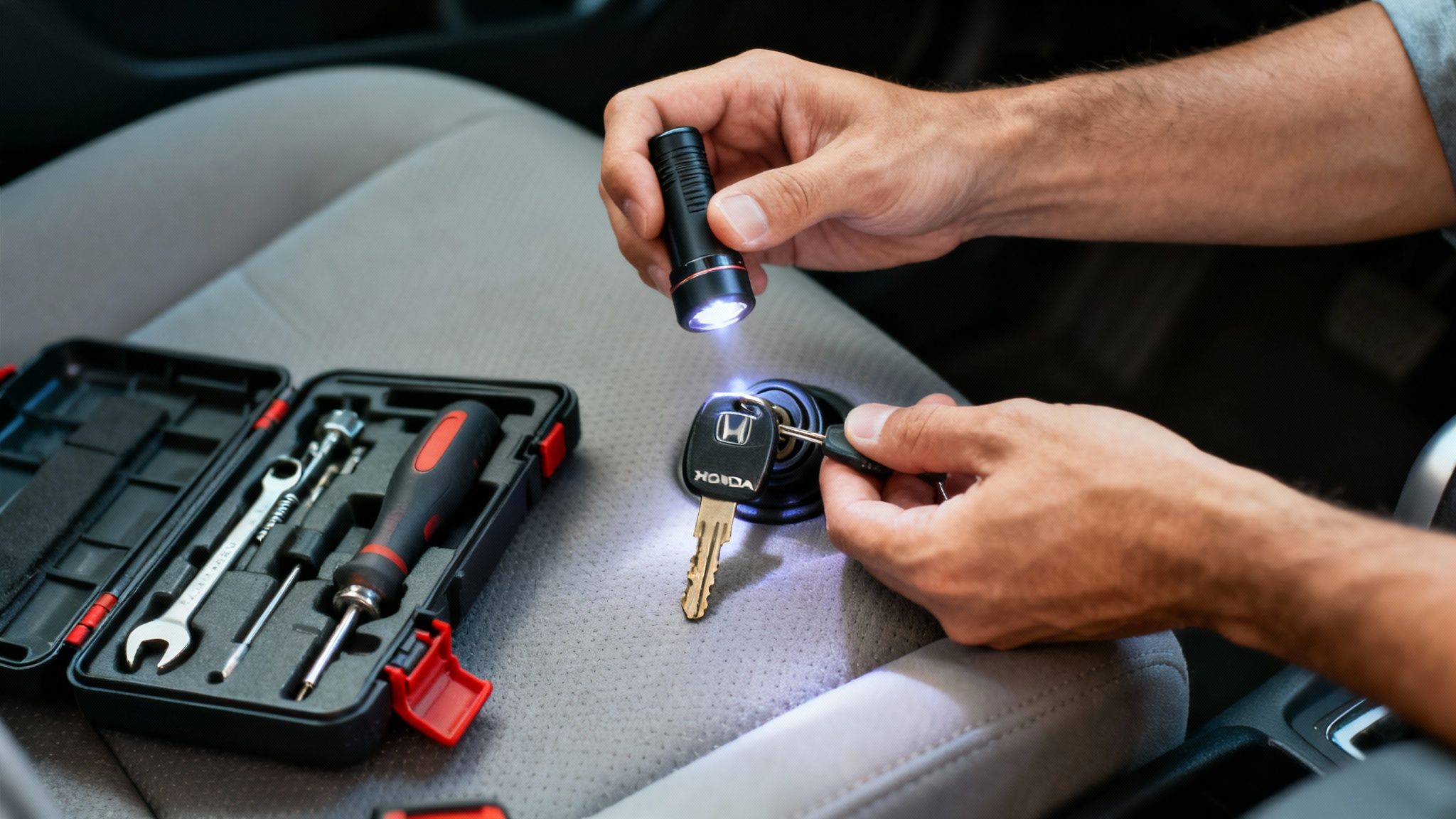
    • Peer Inside the Ignition: Grab your phone and turn on the flashlight. Shine it directly into the ignition lock cylinder. Do you see anything that doesn't belong? Lint, a crumb, or even a piece from a previously broken key can block the way.

    Often, one of these simple checks does the trick. As a real example, we recently had a customer in Stuart who was amazed that all it took was a gentle wiggle of the steering wheel to free the lock and get their key in.

    My Biggest Piece of Advice: Never, ever force the key. The inside of an ignition lock is a series of delicate wafers and pins. Ramming the key home can bend those wafers or even snap the key right off in the lock. If it doesn’t slide in with just a little bit of gentle pressure, stop.

    If you’ve tried these steps and are still stuck, or if you feel any sort of grinding or crunching, that’s your cue to stop and call a professional. Forcing it from here is a gamble that rarely pays off. If you’re dealing with a stubborn ignition, a car lockout, or just need fast help, give our mobile team a call. Call (772) 710-8169 for immediate help in Fort Pierce and the surrounding areas.

    Uncovering the Common Causes of Ignition Jams

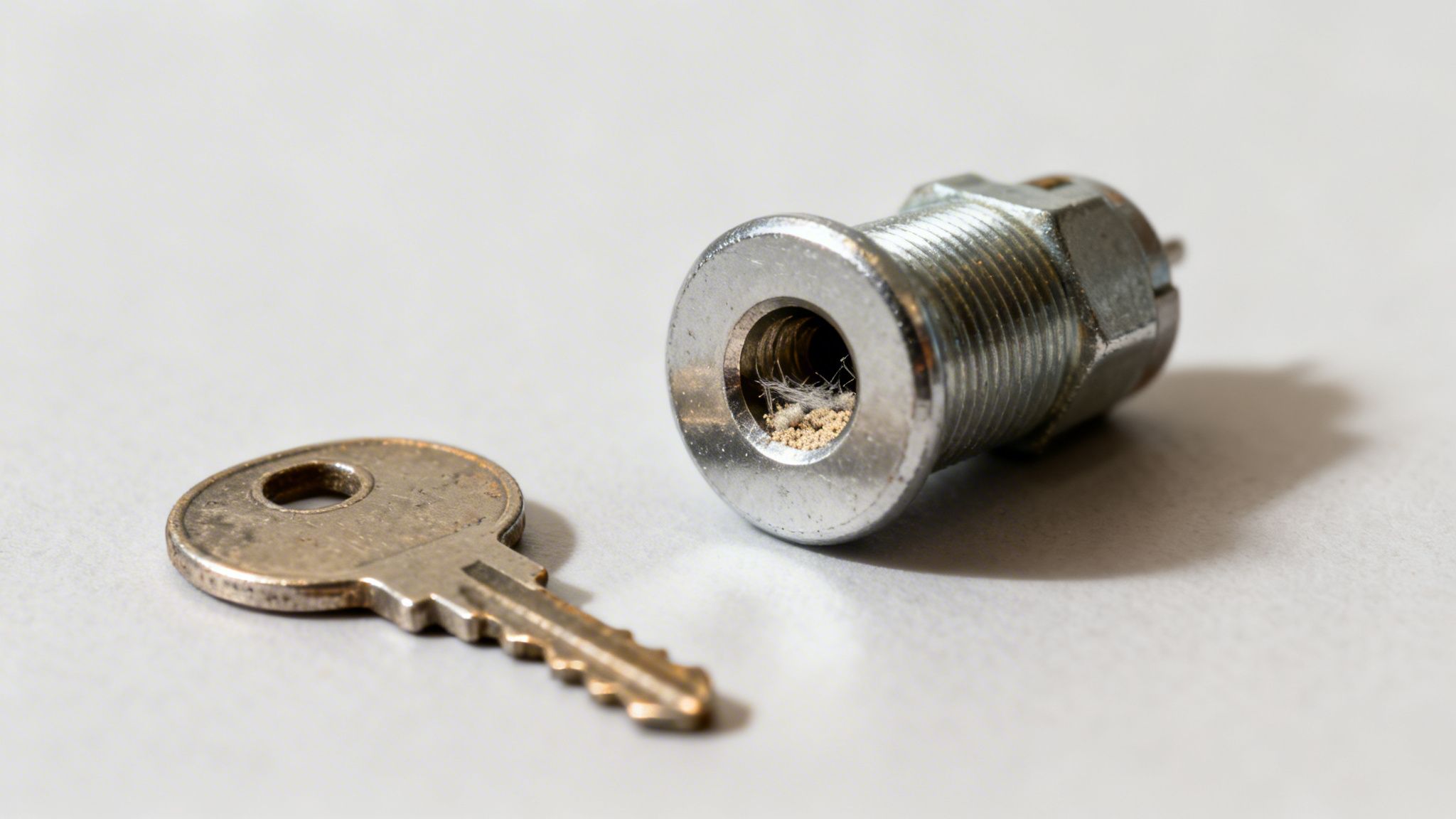
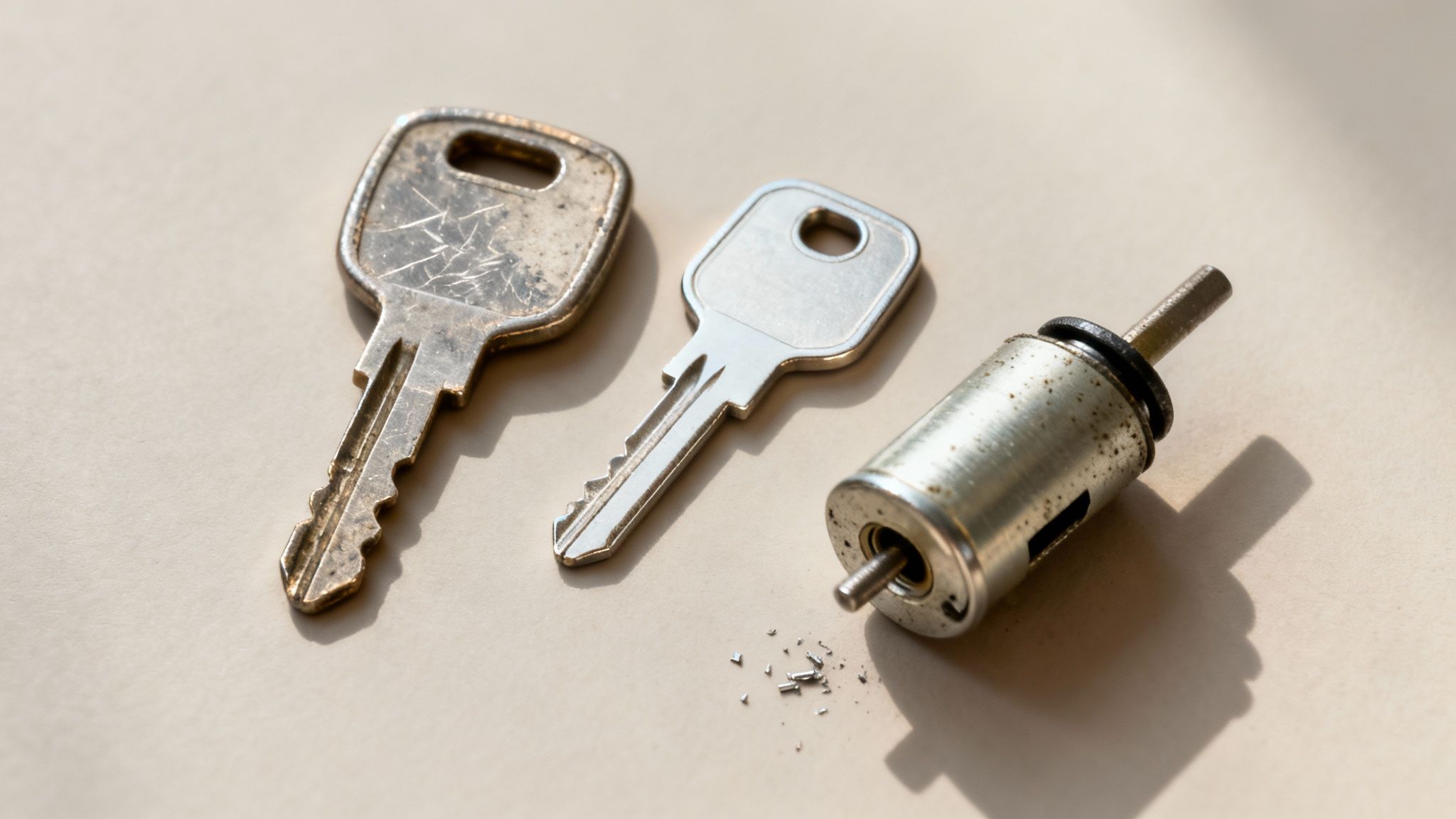
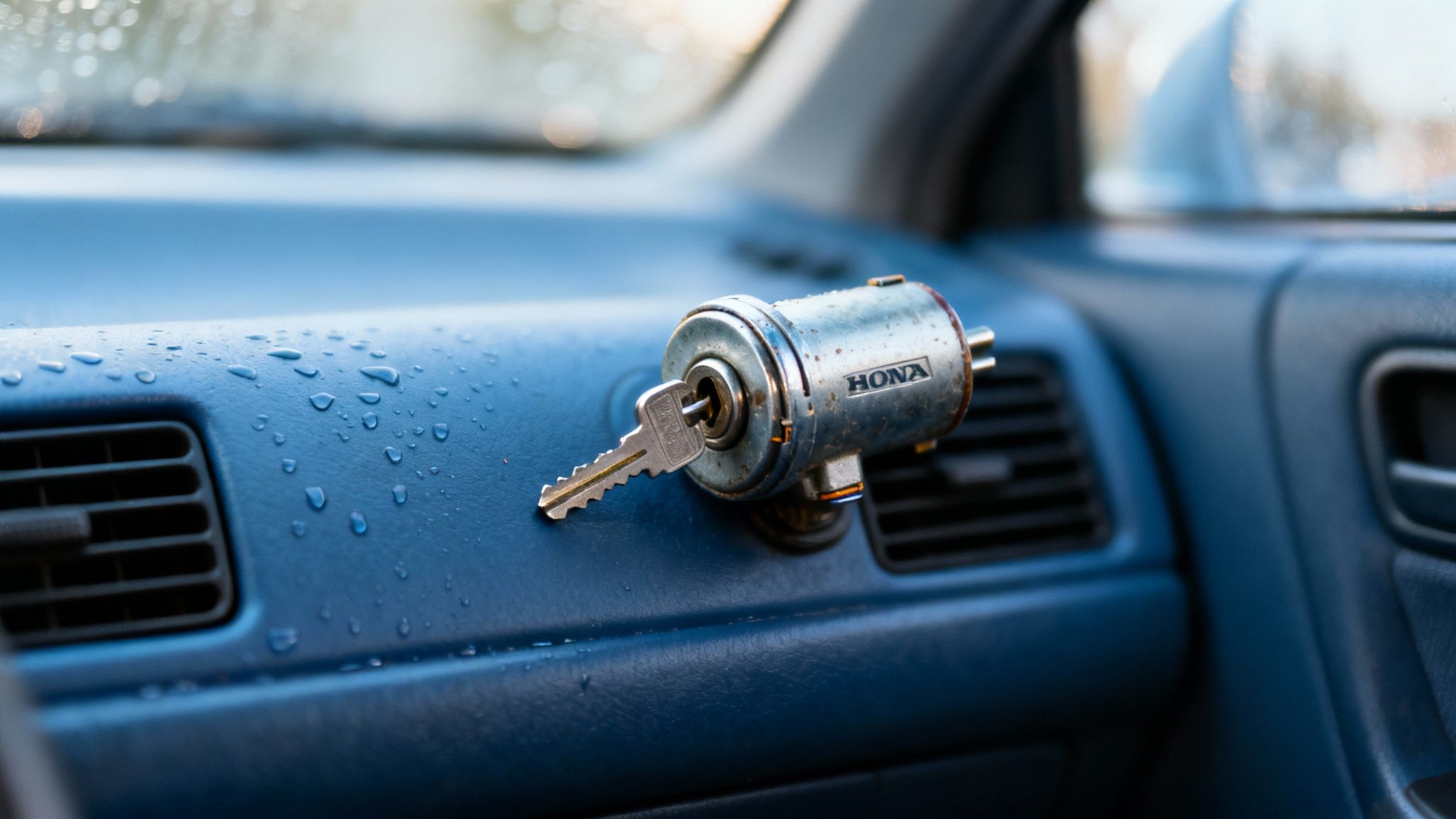
    A small, worn key lies next to a silver lock cylinder blocked with dirt and lint.

    It’s one of the most frustrating things that can happen: you go to start your car, and the key just won't go into the ignition. It feels like a major failure, but the root cause is usually something surprisingly simple. Figuring out what’s physically stopping your key is the first step to getting back on the road, whether you're here on the Treasure Coast or anywhere else.

    Let's walk through the most common culprits I see in the field. Each one has its own tell-tale signs.

    A Worn or Damaged Key

    Think about how many times you’ve used your car key. Over years of daily use, those sharp, precise edges wear down. The metal gets rounded, and the grooves that are supposed to perfectly match the wafers inside the ignition cylinder just don't line up anymore.

    This kind of wear happens so gradually you might not even notice it until the key stops working completely. Here's a practical tip: try your spare key. If the spare—which is probably much less worn—slides in without a fight, you’ve found your problem. A new key or key fob replacement is a straightforward fix for our local locksmiths.

    Debris Blocking the Keyway

    Your ignition’s keyway is basically an open invitation for gunk and debris. For those of us living near the coast, it’s a constant battle. A few grains of sand from a trip to the beach in Jensen Beach or Stuart are all it takes to create a solid blockage.

    Of course, it's not just sand. We’ve pulled out all sorts of things:

    • Lint and dust from a pocket or purse.
    • Tiny food crumbs from a snack on the go.
    • Sticky residue from a spilled drink that dried inside the lock.

    When this stuff builds up, it can stop the key from going in far enough to engage the pins. If your key wont go in ignition and feels like it’s hitting something soft or mushy, debris is almost always the suspect.

    “An ignition jam is often a symptom of something simple. Before assuming the worst, check for the basics: a locked steering wheel, a dirty key, or a blocked keyway. These account for the majority of service calls we get in the Fort Pierce area.”

    The Steering Wheel Lock

    This one is probably the most common reason for a key jam, and it's actually a standard anti-theft feature. If you turn the steering wheel after you’ve shut off the car, you might hear a click. That's a hardened steel pin engaging, locking both the steering column and the ignition cylinder. It physically blocks the key from being inserted or turned.

    I get calls for this all the time, from packed parking lots in Port St. Lucie to quiet streets in Vero Beach. The fix is usually easy: just gently wiggle the steering wheel back and forth. This releases the tension on the locking pin, allowing you to slide the key in smoothly.

    Damage from a Theft Attempt

    On a more serious note, the problem could be damage from an attempted theft. When a thief tries to force a screwdriver or a badly copied key into the ignition, they can easily bend or break the delicate internal wafers. This creates a permanent obstruction that your real key can’t get past.

    If you see signs of forced entry like scratch marks around the ignition, or suspect this is the issue, do not try to force your key in—you’ll only make it worse. This is a job for an ignition repair specialist. Call (772) 710-8169 for immediate help, and one of our technicians will head your way.

    What to Do When Your Key Won't Go In the Ignition

    It’s one of those moments that can send a jolt of panic through you: your key just won't go into the ignition. Before you start imagining worst-case scenarios and expensive tow truck bills, take a breath. As a professional locksmith serving the Treasure Coast, I can tell you that this is a super common problem, and more often than not, the solution is surprisingly simple.

    The absolute number one rule is do not force it. Jamming the key in harder can easily damage the delicate wafers inside the ignition cylinder. That turns a simple fix into a much more complicated and costly repair. Let's run through a few practical tips you can safely try yourself.

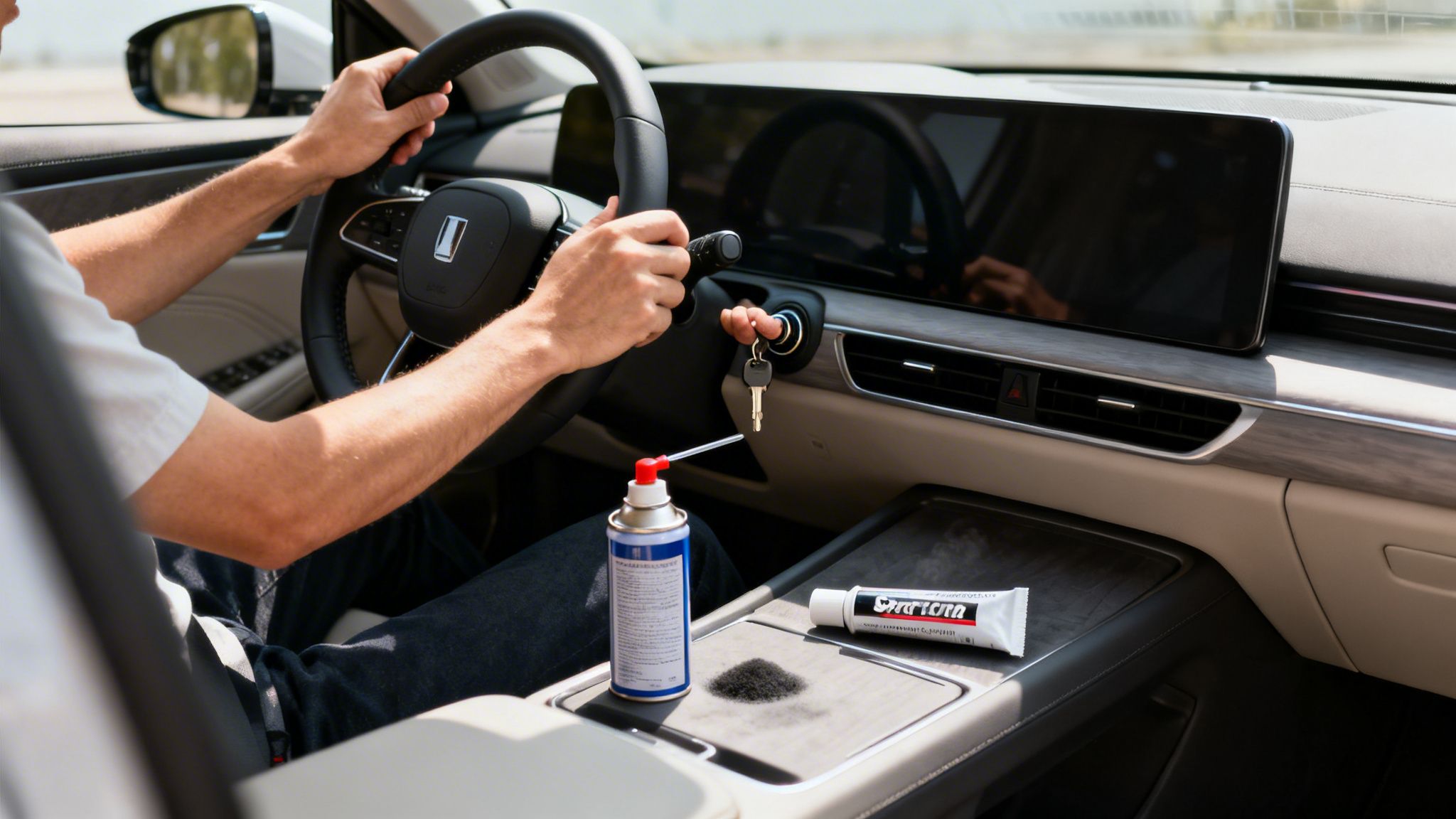
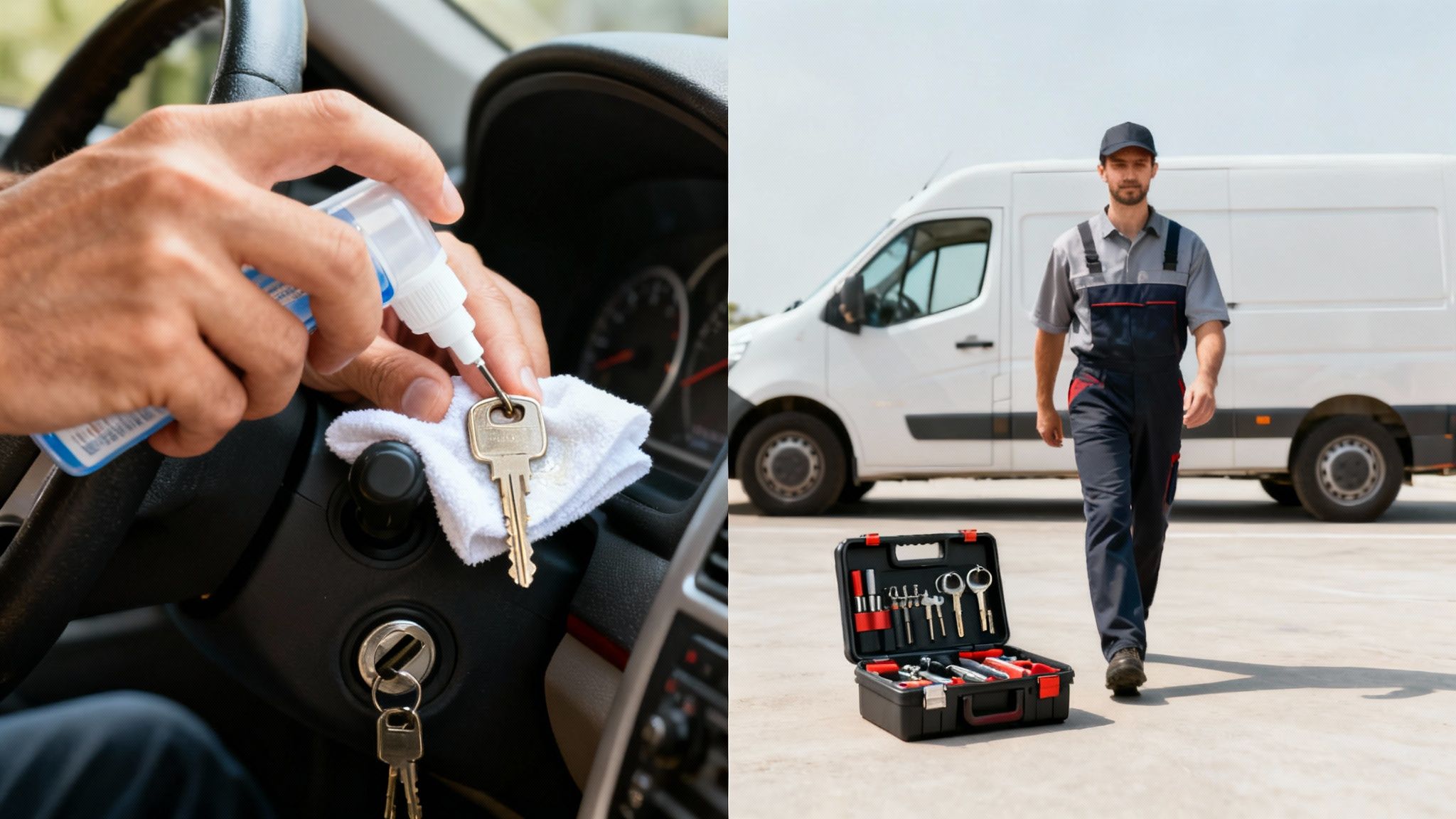
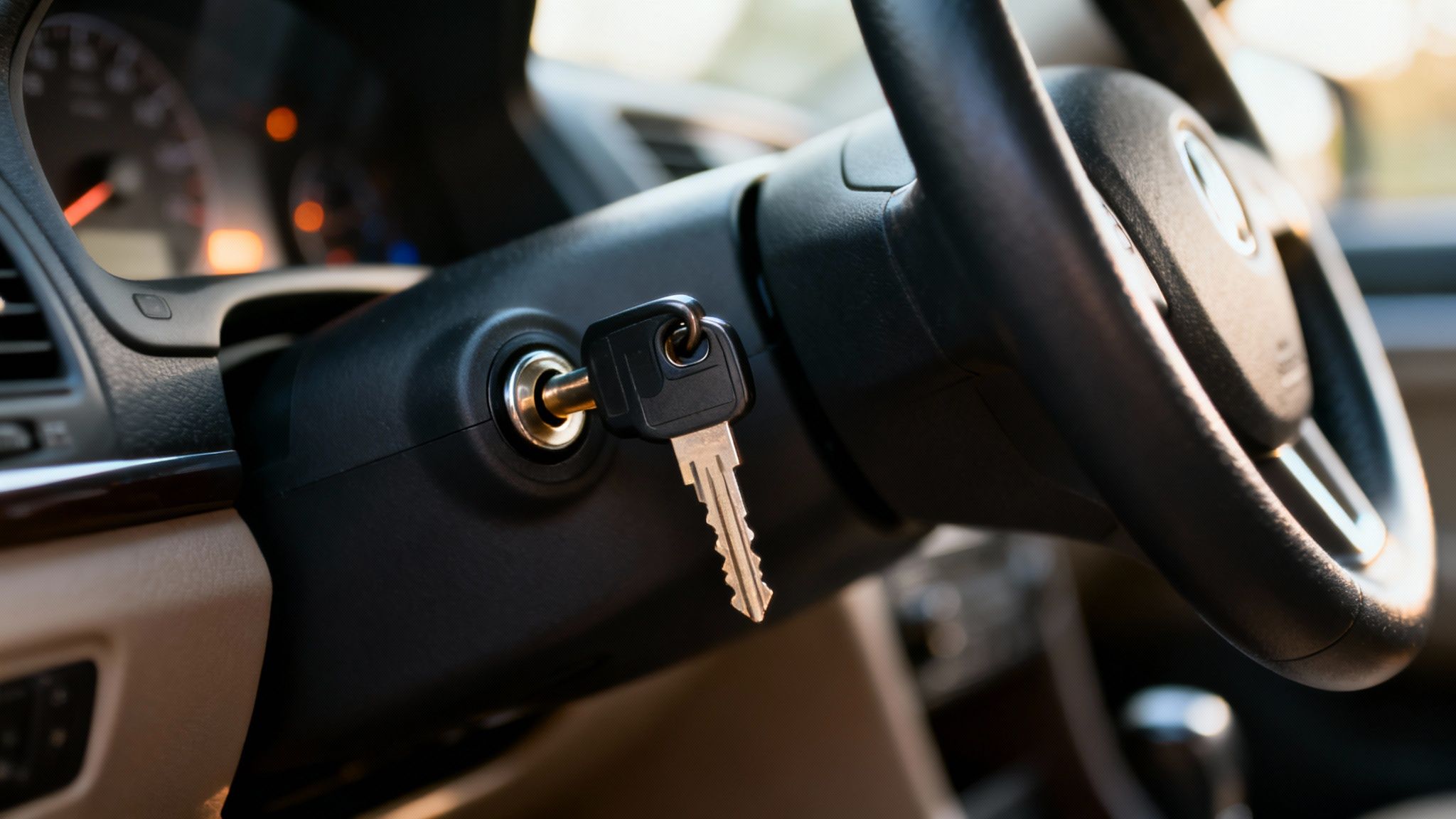
    Man's hands in a car with keys in the ignition, next to lubricating spray and tube.

    Step 1: Grab Your Spare Key

    First things first, find your spare key. After thousands of twists and turns, your main key's metal edges get worn down. The grooves become less defined and might not line up with the ignition's internal pins anymore.

    If your spare key—which is probably a lot less worn—slides in smoothly, you've just found your culprit. The old key is simply worn out. This means you’ll need a key fob replacement or a new metal key cut, which is a quick and easy job for any professional locksmith.

    Step 2: Jiggle the Steering Wheel

    This is probably the most frequent reason a key gets stuck, and luckily, it's the easiest fix. It’s a built-in anti-theft feature: if you turn the steering wheel after the car is off, a pin will lock both the steering column and the ignition.

    All you have to do is gently rock the steering wheel back and forth. You don't need to muscle it. While wiggling the wheel, try inserting the key at the same time. You’ll usually feel a little click as the lock releases, and the key should slide right in. We get calls about this constantly from drivers in Stuart and Jensen Beach, and they're always relieved it's nothing serious.

    A Critical Warning on Lubricants: Please, whatever you do, never spray WD-40 or any other oil-based lubricant into your ignition. It might seem like a good idea, but these wet oils are magnets for dust and grit. They create a sticky gunk that clogs the internal pins and will absolutely make the problem worse in the long run.

    Step 3: Clean the Ignition Keyway

    Over time, your ignition slot can collect a surprising amount of gunk. Lint from your pocket, sand from a day at Vero Beach, or even tiny crumbs can build up and create a blockage.

    A can of compressed air is your best friend here. Here's a step-by-step explanation:

    • Pop the thin straw onto the nozzle.
    • Stick the straw just inside the keyway.
    • Give it a few short, strong bursts to dislodge any loose debris.

    This is often all it takes to clear the path.

    If things are a bit more stuck, the only safe lubricant to use is a dry one. We recommend a graphite powder lubricant designed specifically for locks. Just a tiny puff into the keyway is all you need. Then, gently work your key in and out a few times to spread the powder around. This helps the pins move freely without leaving behind any sticky residue.

    If you’ve tried these steps and your key wont go in ignition still, it's time to stop. Forcing it further will only cause more damage. The issue is likely something more serious, like a bent key or an internal failure in the ignition cylinder.

    At this point, it's best to call in a pro. For fast, non-destructive ignition help in Port St. Lucie, Fort Pierce, and the surrounding areas, Call (772) 710-8169 for immediate help. Our mobile locksmiths will come right to you, figure out what's wrong, and get it fixed on the spot.

    Knowing When to Call a Professional Locksmith

    Look, I get it. You want to try and fix the problem yourself and save a few bucks. But with car ignitions, there’s a definite point where you need to know when to stop. Pushing your luck can turn a simple fix into a seriously expensive ignition repair.

    Knowing when to put down the tools and pick up the phone is the smartest move you can make.

    A locksmith kneels, using a tool to open a gray car's door lock, with keys. A service van is in the background.

    If you've spent more than a couple of minutes trying the simple fixes we've talked about, it’s time to stop. Seriously. Force is your worst enemy here. The inside of an ignition is full of delicate, precisely aligned wafers and springs. Trying to jam the key in can bend those parts, break them, or worse—snap your key right off in the cylinder. Trust me, that’s a much bigger headache than a house lockout.

    Clear Signs It's Time for a Pro

    From my experience, there are a few tell-tale signs that the problem is beyond a quick DIY fix. If you see any of these, your next move should be calling for help.

    • Visible Damage in the Lock: Grab your phone's flashlight and take a close look inside the keyway. See any bent metal, broken bits, or signs of tampering? Don't even think about putting your key in there again.
    • Your Key is Bent or Broken: Even a slightly bent key is a red flag. Trying to straighten it yourself is a recipe for a snapped key. If it's not perfectly straight, it’s safer to have a pro cut a new one from the code.
    • The Easy Fixes Aren't Working: You’ve tried compressed air, you’ve wiggled the steering wheel, and your spare key won't go in either. At this point, you can be pretty sure the issue is deeper than a bit of dirt or a stuck steering lock.

    A faulty ignition can be a massive safety risk. It's a sobering reminder of why you can't mess around with a failing ignition.

    Here's a Pro Tip: Modern ignitions are tied into the car’s computer, anti-theft immobilizer, and transponder key system. An aggressive DIY attempt can fry these electronics, turning a small mechanical problem into a massive electrical one with a much higher repair bill.

    Your Go-To Ignition Experts on the Treasure Coast

    When you're stranded in Port St. Lucie, Fort Pierce, or anywhere along the Treasure Coast, you need an expert who comes to you. That's exactly what we do at Pro-B Locksmith. Forget paying for a tow truck just to end up with dealership repair prices. Our mobile locksmiths handle ignition repair and replacement right where you are. When DIY fails, it's crucial to know when to call an expert, like a professional locksmith.

    Car trouble doesn’t keep business hours, which is why we’re on call 24/7. Our technicians have the right tools to diagnose the issue correctly without causing more damage. Often, we can repair the existing ignition cylinder instead of doing a full replacement, which saves you a good chunk of money.

    For fast, honest service when your key wont go in ignition, Call (772) 710-8169 for immediate help. To learn more about our other vehicle services, check out our guide on automotive locksmith solutions.

    How to Prevent Future Ignition and Key Problems

    Nobody wants to be that person stuck in a parking lot, jiggling a key that refuses to go into the ignition. The good news is that you can usually avoid this headache altogether. A few simple, proactive habits go a long way in protecting your car's ignition system, especially for us here on the Treasure Coast where sand and heat can be tough on vehicles.

    Think about your keychain for a second. Is it loaded down with other keys, fobs, and decorations? I've seen countless ignition cylinders fail prematurely because of a heavy keychain. All that weight constantly pulls down on the delicate wafers inside the ignition while you drive, leading to wear, misalignment, and eventually, a key that just won't fit. Lighten that load—your ignition will thank you.

    Taking Care of Your Keys

    Your car key is a precision-cut tool, not a pocketknife. Using it to pry things open or scrape a sticker off a window might seem harmless, but even a tiny bend or a new burr on the metal can stop it from sliding into the ignition properly.

    And don't forget about debris. A practical tip is to use a quick blast from a can of compressed air into the keyway every month or so. It clears out the dust, lint, and sand that inevitably builds up, which is a common culprit I see from Jensen Beach to Stuart.

    Here's a pro tip: Get your spare key cut by a real locksmith. Keys from a big box hardware store are often just a copy of your already worn-out key, which means you're just duplicating the problem. A locksmith can create a fresh key from the manufacturer's code, guaranteeing a perfect fit.

    What About Keyless Ignitions?

    Modern cars are changing the nature of this problem. With an estimated 70% of new cars now sold with keyless push-to-start systems, the issue is less about a physical key and more about a dead fob battery. You can read more about the rise of keyless systems and why it's a good idea to stay prepared.

    The easiest fix? Swap out your fob battery every year or two. It’s a simple, cheap way to avoid getting stranded in a Fort Pierce parking lot. It’s also a great idea to learn your car’s manual override—most vehicles have a hidden key slot or a specific spot on the dash where you can place a dead fob to start the engine. Check your owner's manual for the details.

    Whether you need a key fob replacement or a high-quality spare key made in the Port St. Lucie area, don't wait for an emergency. Call us at (772) 710-8169, and one of our mobile technicians can come to you anywhere from Vero Beach to Stuart. Take a look at our complete Pro-B Locksmith services and let us help you stay one step ahead of any lock and key trouble.

    Your Top Ignition Questions Answered

    Even after you've tried the basics, it's normal to have a few more questions. We get calls all day from folks across the Treasure Coast—from Port St. Lucie to Fort Pierce—who are stuck and just want straight, solution-focused answers. So, let's tackle the most common ones we hear.

    How Much Does Ignition Repair Cost in Port St Lucie?

    Honestly, it really depends on what’s actually wrong. Sometimes, the fix is as simple as cleaning gunk out of the lock cylinder, which might just cost you a can of compressed air.

    But when you need a professional locksmith, the costs for services in Port St. Lucie typically break down like this:

    • Key Extraction: If a key has snapped off in the ignition, we can typically get the broken piece out for $100 to $150.
    • Ignition Repair or Re-keying: For a damaged cylinder we can fix on the spot, you're looking at a cost between $150 and $350.
    • Full Ignition Replacement: This is the big one. Swapping out the entire ignition switch can run anywhere from $250 to over $600, depending heavily on your car's make and model.

    A Quick Tip from Our Experience: We save people in Fort Pierce and Vero Beach a lot of money by repairing ignition cylinders whenever possible. Dealerships often jump straight to a full, expensive replacement, but a repair is often all that's needed.

    The best way to know for sure is to get a direct quote. Give us a ring at (772) 710-8169 for immediate help and we'll give you a clear price right over the phone.

    Is It Safe to Use WD-40 in My Car Ignition?

    Let me be blunt: absolutely not. Please, whatever you do, never spray WD-40 or any oily, wet lubricant into your car’s ignition.

    We see the aftermath of this all the time, especially with our coastal sand and humidity here in Florida. While it might seem like a quick fix, that wet oil is a magnet for dust and dirt. It quickly turns into a thick, sticky sludge that gums up the delicate pins and wafers inside, causing a much bigger and costlier failure down the road.

    If you must use something, only use a "dry" lubricant. Products like graphite powder or a PTFE/silicone spray designed specifically for locks are the only safe options. They lubricate without leaving a sticky mess. When your key wont go in ignition, using the wrong product can make a bad situation much worse.

    What if My Key Goes in but Won't Turn?

    This is another classic problem we get calls about constantly. If the key slides in just fine but locks up when you try to turn it, a few things could be happening.

    Nine times out of ten, the steering wheel lock is engaged. It's a security feature that can accidentally bind the ignition. Before you panic, try this step-by-step fix: gently jiggle the steering wheel back and forth a bit while you gently try to turn the key. That little bit of movement is usually all it takes to release the pin.

    If that doesn't do the trick, here are the next most likely causes:

    • The gear selector isn't fully seated in "Park" or "Neutral."
    • Your key is so worn that the ridges no longer line up with the pins inside the lock.
    • The ignition cylinder itself is worn out, and the internal parts are stuck or broken.

    Our mobile team can figure this out fast, whether you're stranded in Stuart or Jensen Beach. We'll diagnose if it’s a simple fix, a worn-out key that needs replacing, or an ignition that needs repair.


    Whether you're dealing with a house lockout, need a lock change, or require a new key fob replacement, having a local expert you can count on makes all the difference. Pro-B Locksmith is on call 24/7 with fast mobile service across the Treasure Coast. You can find out more about all our professional services at https://problocksmith.com.

  • How to Start a Car Without a Key Fob: 2026 Treasure Coast Guide

    How to Start a Car Without a Key Fob: 2026 Treasure Coast Guide

    You’re standing in a parking lot somewhere on the Treasure Coast, arms full, and you press the button on your key fob. Nothing. You press it again, maybe a little harder this time. Still nothing. That sudden, sinking feeling is something we see all the time as locksmiths serving Port St. Lucie—a modern convenience that has just left you completely stranded.

    A man holds a car key fob and shopping bags, standing by a grey car with palm trees.

    Whether you're trying to leave work in Port St. Lucie or packing up after a day at the beach in Fort Pierce, a dead key fob brings your day to a screeching halt. But don't panic. In most cases, you can still get into your car and start it using the hidden mechanical key and a special emergency start procedure.

    Car manufacturers know this happens, so they’ve built in some clever backups. The trick is simply knowing they exist and how to use them.

    What Causes a Key Fob to Suddenly Fail?

    Before you assume the worst, it helps to know what you're up against. Nine times out of ten, the fix is surprisingly simple.

    Here are the usual suspects when your key fob goes silent:

    • Dead Fob Battery: This is the most common reason by a long shot. These little coin batteries usually last 1-2 years, and they often die without any warning.
    • Signal Interference: Sometimes, strong radio signals from nearby cell towers in Stuart or other electronic devices can temporarily block your fob's signal.
    • Dead Car Battery: The problem might not be your fob at all. If your car’s battery is dead, nothing will work. Learning how to repair car battery problems can help you figure out if this is the real issue.
    • Physical Damage: A fob that's been dropped one too many times or took a dive into the water at Jensen Beach might have internal damage to the transponder chip.

    To help you figure out what to do, we've put together a quick reference table.

    Immediate Actions for a Non-Responsive Key Fob

    Here's a quick reference table to help you diagnose the issue and find the fastest solution when you're stranded.

    SymptomMost Likely CauseFirst Action to Try
    Car won't unlock, no lights flashDead fob battery or signal interferenceUse the physical key hidden inside the fob to unlock the door.
    "Key Not Detected" on dashFob battery is weak, but not deadHold the fob directly against the push-to-start button and try again.
    Nothing works, interior lights are dim/offDead car batteryTry to jump-start the car or test the vehicle's battery.
    Fob looks damaged, pieces are loosePhysical damage to the fobAttempt emergency start procedures; a replacement fob is likely needed.

    This table should give you a solid starting point for getting back on the road.

    Expert Tip: Seeing a "Key Not Detected" message on your dashboard is your car's way of saying it can't hear the fob. This doesn't mean the fob is broken—it just means the signal is too weak. Pushing the fob directly against the start button often provides just enough signal for the car to recognize it.

    If these workarounds don't solve the problem, or if you're dealing with a lost key or a damaged ignition, it’s time to call in a professional. Don't waste your day trying to troubleshoot a complex electrical issue.

    For any car access emergency, a professional locksmith is your fastest solution. If you're stuck anywhere from Vero Beach to Stuart, Call (772) 710-8169 for immediate help. For more details on what to expect, check out our guide on professional emergency lockout services.

    Your First Line of Defense: The Hidden Mechanical Key

    It’s happened to all of us. You’re standing by your car in a Fort Pierce parking lot, clicking the unlock button on your fob, and… nothing. Before the frustration sets in, take a breath. Almost every single key fob has a secret weapon tucked inside: a real, physical key. This is your first and most reliable way to get back inside your car, and it's easier to access than you might think.

    Close-up of hands inserting a metal key into a black and silver car key fob.

    Take a close look at your fob. Whether you drive a Toyota, Ford, Honda, or Chevy, you’ll find a small release latch or button somewhere on the casing. Just slide or press it, and the metal key blade will pop right out.

    How to Find and Use That Hidden Key

    Okay, you’ve got the key. Now, where’s the lock? To achieve that modern, seamless look, car designers have gotten clever about hiding the keyhole on the driver's side door. It can be a real pain to find, especially if you're in a dark parking garage in Stuart or trying to get home to Jensen Beach after sunset.

    Examine the driver's side door handle. You’re looking for a small plastic cap, usually with a tiny slot on the underside. This little piece covers the actual key cylinder.

    Pro Tip for Treasure Coast Drivers: To get that cap off without scratching your paint, just use the tip of the mechanical key you just freed. Gently insert it into the slot on the bottom of the cap and pry outward. It should pop right off, revealing the keyhole you need.

    Once you use the key to unlock the door, be prepared for your car alarm to start blaring. Don't worry—this is completely normal. The alarm is designed to go off, but it will almost always stop the moment you start the engine. Getting inside is the first victory. If the car still won't start, though, you're not out of the woods. Call (772) 710-8169 for immediate help. A Pro-B Locksmith technician can be on-site in minutes to get you moving again.

    Scenarios Where the Mechanical Key Is Your Lifesaver

    Imagine spending a perfect day at the beach in Vero Beach, only to find your key fob—after being exposed to a little sand and salt air—is completely dead. That hidden key is your ticket into the car to grab your phone and get out of the Florida sun while you sort things out.

    This simple piece of metal is indispensable in a few common situations:

    • Completely Dead Fob Battery: When the battery is totally drained, your fob isn't sending any signal. The mechanical key is the only way in without damaging your vehicle.
    • Signal Interference: Parking near high-powered radio towers in Port St. Lucie or in a crowded shopping center can sometimes block your fob's signal. The physical key bypasses all that electronic noise.
    • Damaged Fob: If you've dropped your key fob and it’s cracked or broken, the delicate electronics inside are likely toast. The metal key provides immediate, guaranteed access.

    Knowing how to use this built-in backup can turn what feels like a major crisis into a minor speed bump. It's a skill every car owner on the Treasure Coast should have. If you've lost the key entirely or are facing a more complicated ignition problem, our specialized automotive locksmith services are here to get you back on the road, fast.

    Using the Fob Itself to Start Your Car

    A person's hand inserts a car key into the ignition of a modern car dashboard.

    So you've managed to get inside your car using the hidden mechanical key, only to be met with that frustrating "Key Not Detected" message on the dash. It’s a moment of panic we see all the time with drivers from Port St. Lucie to Vero Beach. This message simply means your car's push-to-start ignition isn't picking up the radio signal it expects from your fob.

    But here’s a piece of good news: even with a completely dead battery, your fob isn't useless. Tucked away inside that plastic case is a passive RFID (Radio-Frequency Identification) chip. This little chip is the unsung hero of key fobs. It doesn’t need any battery power to communicate; it just needs to be right up against a specific reader in your car to give the "all clear" for the engine to start.

    The only catch is figuring out where that reader is.

    Finding Your Car’s Emergency Start Location

    Car manufacturers, in their infinite wisdom, don't have a universal spot for this emergency key reader. It’s usually unmarked, leaving many drivers in Stuart and Jensen Beach searching in the dark. From our experience as local locksmiths, however, most of them are in one of a few common-sense locations.

    Your mission is to physically touch the key fob to the correct spot while you press the brake and hit the start button. Here are the most likely places to check:

    • The Start/Stop Button Itself: This is the most popular design by far. Use the nose of your fob to physically push the ignition button.
    • The Steering Column: Have a look around the plastic housing behind the steering wheel. You might see a small key-shaped icon or a subtle indentation where a traditional key would go.
    • Inside the Center Console: Pop open your armrest and check the bottom of the storage bin or in a cupholder. Some cars have a dedicated slot just for this purpose.
    • Within the Glove Box: It's less common, but some vehicles have a special slot or designated area inside the glove compartment.

    If you’re still stumped, your owner’s manual is the ultimate guide—a quick search for "keyless start" or "emergency start" should give you a diagram. But let's be honest, when you’re stranded, you don’t have time for that. Trying the start button first is always your best bet.

    A "Key Not Detected" message doesn't mean your fob is broken—it just means the signal is too weak. The RFID chip is a passive, powerless backup. By pressing the fob directly against the car’s reader (often the start button), you allow the immobilizer to read the chip and give the green light for ignition.

    The Emergency Start Process Step-by-Step

    Let's put this into practice. Picture this: you're leaving a restaurant in downtown Fort Pierce, your fob is dead, and as soon as you use the metal key to get in, the car alarm starts blaring. It's a stressful scene.

    First thing's first: get in and shut the door. This usually quiets the alarm. Now, press your foot firmly on the brake pedal, just like you always do.

    Next, take the entire key fob—not the little metal key blade—and hold it flat against the engine's start/stop button. While keeping it pressed there, push the button with the fob. You'll feel it click. That's when your car's internal antenna reads the passive RFID chip, recognizes your key, and the engine should spring to life.

    This little trick works on the vast majority of push-to-start cars out there. It’s a simple, elegant solution that can turn a frustrating roadside problem into a minor inconvenience. If it doesn't work after a couple of tries, though, you might be looking at a different issue. The problem could be a dead car battery, a faulty ignition system, or even a damaged transponder chip inside the fob itself.

    If you're in that spot and the car still refuses to start, don't keep jamming the button and risk damaging your ignition. For fast, expert help anywhere on the Treasure Coast, Call (772) 710-8169 for immediate help. A Pro-B Locksmith technician can come to you, diagnose the real problem on-site, and handle anything from a quick key fob replacement to a more involved ignition repair.

    Preventing Future Lockouts and Avoiding Risks

    Once you’ve dealt with an emergency lockout, the next logical step is to make sure it never happens again. Moving from reactive fixes to a few proactive habits is the best way for any Treasure Coast driver to avoid getting stranded. The goal is simple: never find yourself frantically searching "how to start my car without a key fob" in a parking lot ever again.

    Honestly, the most effective prevention is also the simplest. You have to stay on top of your key fob’s battery. Those little coin batteries—usually a CR2032 or something similar—are the heart of your remote. As a general rule, you should plan to replace your key fob battery every one to two years, even if it’s still working.

    Waiting for the "Key Not Detected" warning to flash on your dash is like waiting for the fuel light to come on before you start looking for a gas station. It’s a recipe for getting stuck at the worst possible moment, whether you're in a busy Port St. Lucie shopping center or on a quiet street in Jensen Beach.

    The Critical Importance of a Spare Key

    Beyond battery changes, having a spare key is the ultimate safety net. It happens to the best of us—a key gets lost, damaged, or just disappears. The stress and cost of handling that as an emergency are always higher than planning ahead. A duplicate gives you an immediate, stress-free backup plan.

    Think of it like insurance. You hope you never have to use it, but you'll be incredibly thankful it's there if you do.

    A spare key isn't just a convenience; it's a crucial security tool. If your primary fob is lost or stolen, you have an immediate way to access and secure your vehicle while you get the lost fob deactivated.

    Getting a spare key made before you're in a jam is always more affordable and far less hassle. Instead of paying steep dealership prices and waiting days for an appointment, a mobile locksmith can come right to your home or office in Vero Beach or Stuart. At Pro-B Locksmith, we can cut and program a new key fob replacement on-site, often for much less than you'd think. Don't wait until you're stranded. Call (772) 710-8169 to schedule a visit and get your spare key made today.

    The "Ghost Ride": A Keyless Car Security Risk

    There’s a strange and risky scenario that’s unique to push-to-start vehicles. Imagine this: you start your car in your Fort Pierce driveway, run back inside to grab something, then drive off, completely forgetting your key fob is still sitting on the kitchen counter.

    Here’s the scary part: your car will keep running perfectly without the fob inside. You could drive all the way from Palm City to Sebastian without a single warning. The problem hits the second you turn the engine off. Without the key fob present to handshake with the car's computer, the immobilizer engages, and it absolutely will not restart.

    Now you're completely stranded. This isn't just an inconvenience; it's a major security threat. Car thieves know all about this vulnerability. An unattended, running car is a prime target, and this risk is only amplified by the recent surge in vehicle thefts. In 2022, over 1 million vehicles were stolen nationwide—the highest number since 2008. That breaks down to about two cars stolen every single minute.

    Proactive Vehicle Maintenance

    Finally, it’s important to remember that sometimes a car that won't start has nothing to do with the key. A dead or dying main car battery can easily mimic the symptoms of a fob failure, leaving you just as stranded.

    Learning the tell-tale signs of a weak car battery—like a slow, sluggish engine crank or dimming lights—is another layer of prevention. To dig deeper, it's helpful to understand Why Your Car Battery Keeps Dying and what you can do to stop it.

    By taking care of your whole vehicle, from the small battery in your pocket to the big one under the hood, you’re doing everything you can to make sure you never get left on the side of the road.

    When to Call a Professional Locksmith

    So, you’ve tried the hidden key, held the fob right up to the start button, and… still nothing. Your car is just an expensive, stubborn paperweight. While the tricks we've covered work wonders for a dead fob battery, some problems are deeper than that. There are moments when you have to know when to stop tinkering and call in a professional. It can save you time, a massive headache, and even prevent further damage to your car's sensitive electronics.

    A mechanic in uniform walks towards a grey Volkswagen car, carrying a toolbox and keys, ready for service.

    If the basic workarounds aren't getting you back on the road, it’s a pretty clear signal that the issue is out of your hands. Continuing to try different things might just make the real problem harder for a technician to diagnose.

    Clear Signs You Need an Expert

    Knowing the difference between a simple hiccup and a system failure is key. Whether you're stranded on Hutchinson Island or in a Hobe Sound parking lot, keep an eye out for these tell-tale signs that it’s time to call for backup.

    A professional locksmith is your best bet in these situations:

    • You've Lost All Your Keys. This one's a no-brainer. If the fob is truly gone, no amount of troubleshooting will help. A mobile locksmith can come to you, verify you own the car, and then cut and program a brand new key on the spot.
    • The Ignition or Start Button Is Completely Dead. You slide the mechanical key in, but it won't turn. Or you press the start button (even with the fob right next to it), and absolutely nothing happens. This could be a failed ignition cylinder or a faulty button, and trying to force it is a recipe for a much more expensive repair.
    • The Dash Still Screams "Key Not Detected." You’ve done everything right, placing the fob in every conceivable emergency slot, and the car just won't recognize it. This usually points to a fried transponder chip inside the fob or a communication error with the car's immobilizer system.
    • Your Fob Is Physically Damaged. If the fob took a swim, got run over, or was chewed on by the dog, the delicate electronics inside are almost certainly toast. It’s time for a replacement.

    When you hit one of these roadblocks, the next step is simple. Call (772) 710-8169 for immediate help, and we'll have a certified technician on the way.

    The Pro-B Locksmith Advantage: Local and Fast

    When you’re stuck, who you call makes all the difference. A lot of people just google "locksmith" and end up calling a national dispatcher. These companies are just middlemen who farm out the job to a subcontractor, leading to long waits, surprise fees, and technicians who might not have the right tools for modern cars.

    Choosing a local, mobile locksmith means you’re calling a neighbor who is already in your community. With Pro-B Locksmith, you’re not a number in a national queue; you’re a priority. We dispatch our own licensed and insured technicians directly from St. Lucie County.

    Because we're truly local, we can promise an average response time of just 15-20 minutes across Port St. Lucie, Fort Pierce, and Stuart. We also believe in transparent, upfront pricing. The quote you get on the phone is the price you'll actually pay—no games, no hidden charges.

    Our service vans are basically workshops on wheels. We bring the advanced equipment needed for complex jobs right to your location.

    • On-Site Key Fob Programming: We can create and program new fobs for almost any make and model, usually for a fraction of what a dealership charges.
    • Ignition Repair and Replacement: If the ignition itself is the culprit, we can diagnose and fix it right there, saving you a tow truck bill.
    • Transponder Key Services: We have the tools to troubleshoot and resolve immobilizer system issues that prevent your car from starting.

    From a simple car lockout to a complex ignition repair, our only goal is to get you moving again quickly and affordably. You can see all the communities we cover by checking out our Treasure Coast service areas. If the quick fixes didn't work, don't stress—just let an expert take it from here.

    Your Key Fob Questions, Answered by the Pros

    When your key fob suddenly quits on you, a million questions probably pop into your head. We get it. As locksmiths working across the Treasure Coast every day, we've heard them all. Here are the straight-up answers to the most common questions we get from drivers, designed to give you some clarity and confidence.

    How Much Does It Cost to Replace a Key Fob in the Port St. Lucie Area?

    This is usually the first question on everyone's mind, and the answer can be a real shocker depending on where you go. If you head to the dealership, be prepared for a bill ranging from $400 to $800, sometimes even more. You’re not just paying for the key; you’re covering their massive overhead, and you’ll likely have to pay for a tow to get your car there.

    As a mobile locksmith, Pro-B Locksmith delivers the exact same result—a brand new, fully programmed key fob or smart key—for a fraction of that price. We give you a clear quote over the phone, so you know exactly what to expect. And since we come directly to you in Port St. Lucie, Fort Pierce, or Stuart, you completely avoid the added cost and hassle of a tow truck. Give us a call at (772) 710-8169 for an exact quote for your car.

    Can a Locksmith Make a Key for a Car Without the Original?

    Absolutely. Losing all your keys feels like a disaster, but for us, it's a routine job. We get calls for "all keys lost" situations all the time, from a house lockout to a complete car key replacement, and the answer is always yes, we can get you back on the road.

    We start by using your car's Vehicle Identification Number (VIN) to access the key code. Our mobile service vans are basically workshops on wheels, equipped with advanced laser key cutters and the same programming tools the dealers use. This setup allows us to cut a new transponder key or program a new smart fob right there on the spot, whether you’re stuck in your driveway in Jensen Beach or stranded at the mall in Vero Beach.

    Will Using the Hidden Mechanical Key Trigger My Car Alarm?

    More often than not, yes, it will. Don't panic—this is perfectly normal. The car's security system is designed to see the physical key as a potential break-in attempt if it doesn't get the "all clear" signal from the fob.

    When the alarm starts blaring, just stay calm and proceed. It’s an expected part of the emergency process. The alarm will shut off the moment you successfully start the car by holding the fob against the start button, as the car will then recognize its passive RFID chip.

    Using the mechanical key is a safe and intended way to access your vehicle. The alarm is simply a temporary side effect that resolves once the car's immobilizer recognizes the fob's passive RFID chip during the emergency start sequence.

    What if My Ignition Is Broken and Won't Start the Car?

    If your physical key won't turn, the start button is completely dead even with a good fob, or the car won't recognize the key in the emergency slot, you're likely dealing with a faulty ignition. This is definitely a job for a professional.

    Whatever you do, don't keep forcing the key or mashing the start button. You could easily turn a small repair into a much bigger and more expensive problem. Pro-B Locksmith specializes in ignition repair and replacement. Our technicians will come to you, diagnose the real issue—whether it's the cylinder, a bad switch, or a wiring problem—and fix it right there, saving you another tow bill. We also offer other essential services like a residential lock change if you ever need it.


    If you’re staring down any of these key fob or ignition headaches, don’t let it derail your day. For fast, honest, and skilled service anywhere on the Treasure Coast, you can count on the local experts at Pro-B Locksmith. We have the right tools and deep experience to solve the problem on-site.

    Call (772) 710-8169 for immediate help or learn more at our website, https://problocksmith.com.

  • Your Guide to Fixing a Broken Car Key in Port St. Lucie

    Your Guide to Fixing a Broken Car Key in Port St. Lucie

    It’s a sound every driver dreads: the sharp snap of a car key. One moment you're trying to get on your way, the next you're holding half a key, with the other piece stuck in your car. It’s a frustrating situation that can instantly throw a wrench in your day, but don't panic.

    This is actually one of the most common calls we get as mobile locksmiths across the Treasure Coast. Most of the time, it's a straightforward fix—we extract the broken fragment and cut you a brand new key right there on the spot. For example, a customer in a busy Port St. Lucie shopping center recently had their key snap off in the ignition. We were on-site in under 30 minutes to resolve it. But what you do in these first few minutes is critical. A moment of panic can turn a simple extraction into a much more expensive repair.

    Your Immediate Action Plan for a Broken Car Key

    That sinking feeling you get when you see half a key in your hand is universal. Whether you're in a busy Fort Pierce parking lot or just in your driveway in Jensen Beach, the single most important thing is to take a breath and assess the situation before you act. We’ve seen it all, and the costliest mistakes almost always come from trying a forceful, quick fix.

    First, figure out exactly where the key broke. This tells you everything you need to know about what to do next.

    • Broken in Your Hand: If the key snapped but isn't stuck inside a lock, you've got the best-case scenario. You just need a replacement key made.
    • Broken in a Door Lock: A bit more complicated, but manageable. The main thing is to avoid using that lock until the piece is safely removed.
    • Broken in the Ignition: This is the most delicate situation. A fragment in the ignition not only stops you from starting the car, but it also carries the highest risk of damage if you try to remove it yourself.

    A person's hand holds a modern car key remote, while another key is in the vehicle's ignition.

    So, where do you start? To make it simple, here’s a quick step-by-step reference guide.

    Broken Key First Response Guide

    Use this quick guide to determine the best course of action based on where your key broke and what type of key you have.

    Key Broke In…Immediate ActionWhat to Avoid at All Costs
    Your HandGather both pieces of the key. Call a locksmith to have a new key cut from the two halves.Taping or gluing the key. It will just snap again in the lock, making the problem worse.
    Door LockLeave it alone. Use another door to access the vehicle if possible. Call a professional.Poking at it with wires, tweezers, or knives. You can easily damage the lock or push the piece in deeper.
    IgnitionDo not turn the ignition or insert the remaining key piece. Disconnect the battery if you're comfortable doing so. Call (772) 710-8169 for immediate help.Using pliers to try and turn the fragment, or trying to start the car. This can damage the ignition cylinder or trigger the anti-theft system.

    This table should help you stabilize the situation and prevent any accidental damage while you wait for help.

    What to Avoid at All Costs

    Before you even think about grabbing super glue or a pair of pliers, just stop. We've seen well-intentioned DIY attempts turn a simple extraction into a costly ignition replacement. For instance, repeatedly trying to turn the ignition with the broken piece can sometimes trigger the car's immobilizer system. At that point, not only do you need the key extracted, but you might need the whole system reset by a professional.

    Forcing the broken fragment further into the ignition is another common—and costly—mistake. You risk damaging the delicate internal wafers, which are the tiny components that read your key's unique cut. Once those are bent or broken, a simple extraction is off the table.

    Your goal isn't to be a hero and solve it yourself in five minutes. It's to stabilize the situation and prevent further damage. A professional locksmith arrives with specialized extraction tools designed specifically to grip and remove key fragments without harming your vehicle.

    Just last week, we had a call in Stuart where a driver tried using tweezers to pull out a key that broke off flush with the ignition. All it did was push the piece further in, lodging it behind a wafer. What would have been a 15-minute job turned into a much more complex extraction.

    If you find yourself in a bind like a car lockout, don't risk making it worse. A quick phone call can save you time, money, and a massive headache. You can learn more about how our emergency lockout services can help you get back in without any damage.

    If you’re stuck anywhere from Vero Beach to Port St. Lucie, call us at (772) 710-8169 for immediate help. We'll get you back on the road safely and quickly.

    Can You Get a Broken Key Out Yourself?

    It's a sinking feeling—you turn the key, hear a snap, and you're left holding half a key. The other half is stuck in your car door or ignition. The first impulse is often to run for the toolbox and grab a pair of pliers.

    Please don't. While it feels like the logical next step, trying to yank a key fragment out with the wrong tool is one of the fastest ways to turn a small problem into a big, expensive one. Before you try anything, let's walk through the steps of a DIY attempt, and when it’s time to call a pro.

    White-gloved hands holding a broken car key fragment with pliers next to a car key fob.

    There’s really only one situation where you should even consider it: a good chunk of the key blade is sticking out of the lock. If you have enough metal showing to get a solid, straight grip without having to dig around, you might be able to pull it out cleanly.

    The Right Way to Try (If You Must)

    If you’ve got a visible piece to grab, follow these steps carefully:

    1. Get the Right Tool: Skip the bulky standard pliers; they'll just slip and chew up the face of your lock cylinder. You need a pair of fine-tipped needle-nose pliers for a precise, secure grip.
    2. Add Lubricant: A quick spritz of something like WD-40 or a graphite-based lock lubricant directly into the keyway can help free things up. Just be careful not to overdo it.
    3. Pull Straight Out: Once you've applied lubricant, grip the broken piece firmly with the needle-nose pliers. Pull straight out without any wiggling or twisting.

    The secret to a successful DIY extraction is a straight, clean pull. Any side-to-side motion can bend or break the delicate wafers inside the lock—the tiny, spring-loaded pins that read your key's cuts. Damaged wafers almost always mean you're looking at a much more involved and costly professional repair.

    When to Put the Tools Down and Call a Pro

    Knowing when to stop is far more important than knowing how to start. If you see any of these red flags, your DIY attempt is over. Forcing it will only make the situation worse.

    • The key broke flush with the lock. If nothing is sticking out, you have nothing to grab. Trying to fish it out with a paperclip or knife will only push the fragment deeper into the cylinder.
    • The fragment won't budge. If you apply gentle, straight-out pressure and it feels completely solid, stop. It's probably snagged on an internal part of the lock.
    • You have a modern transponder or laser-cut key. These systems are incredibly complex and sensitive. The risk of damaging the ignition's internal antenna or the delicate lock mechanism is just too high.

    We've seen countless simple extraction jobs in Jensen Beach and Stuart turn into full ignition replacements because of a well-intentioned but forceful DIY attempt. If your key snapped in the ignition, this guide on broken ignition key removal offers more detail you can review before making a decision.

    Ultimately, if you're facing any of those warning signs, don't risk it. A professional locksmith arrives with specialized tools designed specifically for this job, allowing them to remove the fragment without damaging your vehicle. If you’re in Port St. Lucie, Vero Beach, or anywhere along the Treasure Coast, call (772) 710-8169 for immediate help. A quick call now can save you from a much bigger headache and a larger bill later.

    How We Get You Back on the Road: The Mobile Locksmith Process

    When you're stranded with a key snapped off in the lock or ignition, the last thing you want is a tow truck and a long wait at the dealership. So, what actually happens when you call a mobile locksmith instead? Let me walk you through our step-by-step process for bringing the entire solution right to your car's window.

    A mobile locksmith cuts a new car key on-site using a specialized machine in a service van.

    The moment your call comes in, we dispatch a fully equipped service van to your exact location. It doesn’t matter if you’re at home in Vero Beach, stuck in a parking lot in Fort Pierce, or pulled over in Stuart—our job is to get to you fast.

    Step 1: Safely Extracting the Broken Piece

    Our first priority on arrival is to get that broken key shard out without damaging your car. We've seen too many ignitions ruined by well-intentioned DIY attempts with pliers or paper clips. We use professional tools made specifically for this job.

    • Specialized Key Extractors: These are incredibly thin, hooked tools. We slide them into the keyway right alongside the broken fragment, get a firm grip, and gently pull it straight out.
    • Professional Lubricants: A quick spray of a high-quality lock lubricant helps everything slide smoothly, so we don't have to use force.
    • Thorough Inspection: Once the piece is out, we take a close look at the lock or ignition cylinder to make sure no delicate internal pins or wafers were bent or damaged in the process.

    This careful approach is what prevents a simple extraction from turning into a costly ignition repair.

    Step 2: Cutting and Programming a New Key On-the-Spot

    With the fragment safely removed, we don’t just hand it to you and wish you luck. Our service vans are basically workshops on wheels, complete with the same advanced equipment you'd find at a dealership.

    Dealership-level service doesn't have to come with a dealership's price tag or wait time. Our mobile units bring advanced laser cutters and programmers to your location, creating and synchronizing your new key on-site, often for a fraction of the cost and without any towing involved.

    We’re equipped to create any type of car key right then and there:

    • Traditional all-metal keys
    • Transponder keys that have security chips
    • Modern laser-cut or "sidewinder" keys
    • Keyless entry remotes and smart key fobs

    The ability to provide this service on the go is more important than ever. The complexity and variety of vehicle keys have exploded in recent years, a trend you can see reflected in the growth of the automotive key market.

    The Pro-B Locksmith Advantage

    Our goal is simple: provide fast, honest, and reliable help across the Treasure Coast. Whether we're handling a straightforward car lockout or a more complex key fob replacement, our technicians arrive ready to solve the problem. We also handle house lockout and lock change services with the same speed and professionalism.

    For anyone looking for a dependable locksmith in Port St. Lucie, we offer a complete, on-site service that gets you back on the road without the dealership hassle.

    If you have a broken car key and need a fast, professional resolution in Jensen Beach, Stuart, or the surrounding areas, call (772) 710-8169 for immediate help.

    Breaking Down the Cost of Car Key Replacement

    When your car key snaps, two questions probably pop into your head right away: "How much is this going to cost me?" and "How long am I going to be stuck?" You need a clear answer, not vague estimates. So let's break down exactly what to expect in Port St. Lucie and the surrounding areas.

    The truth is, there’s no single price for a broken key service. The cost is tied directly to the technology packed inside your key.

    Why Prices Vary So Much

    The biggest factors are always your car's make, model, and year. A simple metal key for a ‘98 sedan is a world away from a modern smart key that’s in constant communication with your car’s computer.

    Here’s what really drives the final price:

    • The Type of Key: A basic, non-chip key is the cheapest and easiest fix. A transponder key, however, has a security chip that has to be programmed to talk to your car. Laser-cut keys need special equipment, and a smart key fob is the most complex of all, requiring both a new blade and sophisticated programming.
    • Your Vehicle: European cars like BMW or Mercedes are notorious for their complex security systems. This often means the programming process takes more time and specialized tools compared to many American or Japanese vehicles.
    • The Extraction Itself: If a piece of the key is sticking out of the lock, getting it out is usually quick. But if it's broken off deep inside the ignition cylinder, it becomes a much more delicate operation.

    Mobile Locksmith vs. The Dealership

    Let's talk about your two main options: us or the dealership. Going to the dealer is almost always the more expensive and slower path. First, you have to get your car there, which usually means paying for a tow. Then, you’ll face dealership-level prices for both the key and the labor to program it.

    A new smart key from a dealership can easily top $500 once you add up the programming fees and the cost of a tow truck. In contrast, our mobile service comes right to you in Port St. Lucie, Fort Pierce, or Jensen Beach, and we handle the entire job on-site for a fraction of that.

    We cut out the tow truck, the service advisor, and the dealership overhead. You just get faster service without the extra hassle and expense.

    How Long Will This Take?

    We know you have places to be, and our goal is to get you moving again without wasting your day. Once one of our technicians arrives at your location in Port St. Lucie, Stuart, or nearby, we can typically handle the entire process—extracting the broken piece, cutting a new key, and programming it—in under an hour.

    If you're dealing with a broken car key and need a fast, honest quote, just give us a call.

    Call (772) 710-8169 for immediate help. We’ll give you straightforward pricing for all our services, from key fob replacement to full ignition repair.

    Why Modern Keys Break and How to Prevent It

    A car key almost never snaps out of the blue. It’s usually the final straw after a long period of stress. I’ve seen it countless times—people using their keys as makeshift pry bars, box openers, or ice scrapers. That’s the fastest way to find yourself stranded in Port St. Lucie with two halves of a key.

    But even with normal use, wear and tear is inevitable. Over the years, the precise grooves on a metal key blade get worn down and rounded. You might notice you have to jiggle it a bit to get it to turn. That extra wiggling and forcing puts stress on the metal, and eventually, it just gives up.

    A broken car remote key with a cracked circuit board, next to a small metal key on a light surface.

    And it's not just traditional keys. With today's key fobs and smart keys, the weak point is often the fragile electronics tucked inside. Drop your fob on the pavement in a Fort Pierce parking lot one too many times, and you can easily crack the circuit board or knock the tiny transponder chip loose. When that happens, your key is useless.

    Common Causes of Key Failure

    So, what are the usual suspects when a key fails? Knowing what to look out for can be the difference between a normal day and being stranded.

    • A Heavy Keychain: That huge bundle of keys, charms, and gadgets you carry around puts constant, leveraged strain on the key blade. More importantly, the weight pulls on the internal components of your car's ignition switch, which is a much more expensive fix.
    • Stiff or Worn Locks: If you have to fight your key to get it to turn, that’s a major red flag. You're putting immense stress on the key blade. The real problem is likely the lock mechanism itself, which probably needs to be serviced or lubricated.
    • Moisture and Heat: Florida's humidity is no friend to electronics. Over time, it can work its way inside a key fob and corrode the circuitry. Leaving your key on the dashboard in the blistering Vero Beach sun can be just as bad, potentially damaging the battery and sensitive components.

    Your Key, Your Security, and Immobilizers

    A working key isn't just about convenience; it's your first line of defense against theft. The importance of modern key technology becomes crystal clear when you look at recent vehicle theft trends. In 2026, for example, certain Hyundai and Kia models like the Elantra and Sonata were among the most stolen cars in the U.S.

    The reason? Many were built without engine immobilizers. This oversight allowed thieves to start them with simple tools, underscoring the critical role a properly programmed transponder key plays. For a deeper dive into these trends, you can review the latest data on car theft statistics.

    A proactive approach is always cheaper than a reactive one. A small investment in key maintenance or getting a sticky lock serviced can save you from a much bigger, more stressful emergency down the road—like a full ignition replacement.

    Proactive Tips to Protect Your Key

    Honestly, the best way to handle a broken key is to make sure it never happens in the first place. These practical tips can help extend the life of your keys.

    1. Lighten Your Keychain: Seriously. Take off all the non-essentials. Your ignition will thank you.
    2. Never Force a Key: If the key doesn't turn smoothly, stop. The problem isn't the key; it's the lock. Forcing it is asking for a snap.
    3. Get a Spare Made Now: Don't wait until you lose your only key or it breaks. Having a backup ready to go offers incredible peace of mind.
    4. Protect Your Fob: A simple silicone cover can do wonders. It cushions the fob from drops and adds a layer of protection against moisture.

    If you’re already noticing your key is getting hard to use or you want to get a spare key fob replacement before disaster strikes, that's a smart move. For expert advice and services in Stuart, Vero Beach, or anywhere on the Treasure Coast, call (772) 710-8169 for immediate help.

    Your Broken Car Key Questions Answered

    When your car key snaps, a flood of questions usually follows. Over the years, we've heard just about all of them from folks across the Treasure Coast. Here are clear, professional answers to some of the most common ones we get in the Port St. Lucie area.

    What If I Don't Have the Original Key?

    This is a frequent worry, but you can relax. The short answer is yes, we can absolutely make a brand new key for your car, even if the original is lost or in pieces. We don't need to have the old key to cut a new one.

    Our process uses your car's Vehicle Identification Number (VIN). Using the VIN, we can look up the specific key code assigned to your vehicle by the manufacturer. From there, our mobile van has all the equipment needed to cut a fresh key right on the spot and program it to sync perfectly with your car's computer. It’s a service we perform daily in Port St. Lucie, Fort Pierce, and beyond.

    Is a Locksmith Cheaper Than the Dealership?

    Almost always, yes. Calling a mobile locksmith is not only more affordable but also a whole lot easier than dealing with a dealership for a broken car key. Dealerships have massive overhead costs, and that gets passed directly to you in the form of higher prices for both the key and the labor.

    Don't forget about the towing bill. You'll have to get your car towed to the dealership, which adds time and money to an already stressful situation. A mobile locksmith drives straight to you—whether you're stuck in Stuart, Vero Beach, or Jensen Beach—which means no towing fees and a much faster solution. Call (772) 710-8169 for immediate help and skip the dealership headache.

    Could Removing the Broken Piece Damage My Ignition?

    As long as a trained professional is doing the work, removing a broken key fragment will not damage your ignition or door lock. We have specialized extraction tools that are designed to slide past the delicate wafers inside the lock and grip the broken piece without causing any harm.

    The real danger comes from trying to fix it yourself. We've seen people try everything from pliers and screwdrivers to super glue, and these attempts often do more harm than good. You can easily bend the internal lock components or damage the ignition cylinder, turning a simple extraction into a much more involved and expensive ignition repair.

    Think of it this way: your car's lock and key system is a vital part of its security. With modern cars using advanced immobilizers, keeping that system intact is more important than ever. These security improvements are a big reason why U.S. car thefts saw a 23% decline in early 2026. This just goes to show why professional service for something like a broken car key is so critical for maintaining your vehicle’s security. You can read more about these recent anti-theft improvements and statistics.

    If your question wasn't answered here, head over to our frequently asked questions page for even more information.


    For any lock and key emergency, from a house lockout to a key fob replacement, Pro-B Locksmith delivers fast, reliable, and professional service right where you are. Don't let a broken key derail your day—visit us at https://problocksmith.com or call us for immediate assistance.

  • Back on the road: car ignition key won t turn? Quick fixes for Port St. Lucie drivers

    Back on the road: car ignition key won t turn? Quick fixes for Port St. Lucie drivers

    That moment of panic is all too familiar: you slip the key into the ignition, give it a turn, and… nothing. It’s completely stuck. Before your mind jumps to an expensive repair, take a deep breath. More often than not, this is a simple issue with an equally simple fix.

    As a local locksmith serving drivers all over Port St. Lucie, Fort Pierce, and Stuart, I’ve seen this countless times. Let’s walk through what’s likely happening and how you can get yourself back on the road.

    Your Guide to Common Ignition Problems

    A driver's hand is shown pressing a small circular object into the center of a car's steering wheel.

    From Jensen Beach to Vero Beach, a stuck ignition is a universal frustration. The good news is that it’s rarely a sign of a catastrophic failure. Usually, it's just your car’s way of telling you something is slightly out of place.

    Why Is My Ignition Stuck?

    Understanding the why is the first step to finding the solution. Here are the most common culprits I see in the field across the Treasure Coast:

    • Your Steering Wheel is Locked: This is, by far, the number one reason. It's a built-in anti-theft feature, but it’s incredibly easy to accidentally trigger when you get out of the car.
    • The Car Isn't Fully in Park (or Neutral): For safety, your vehicle won't allow the key to turn unless the gear selector is securely in "Park" or "Neutral." A slight misalignment is all it takes to lock you out.
    • The Key Itself is the Problem: Keys don't last forever. Years of use can wear down the grooves, or a slight bend can prevent it from properly engaging the pins inside the ignition cylinder. A damaged key is a common cause for needing a key fob replacement.
    • Something is Jamming the Keyway: It’s amazing what can find its way into an ignition lock. Pocket lint, sand from a day at Jensen Beach, and other tiny bits of debris can build up and block the key.

    Believe it or not, the locked steering wheel is the call we get most often. Automotive service data actually shows that 15-20% of all car key emergencies aren't about a broken ignition but are simply due to this security feature. It's been standard in cars since the 1980s, so it’s a problem we’ve been solving on the Treasure Coast for decades.

    For a professional, it's usually a quick, tool-free fix that takes just a few moments. You can learn the trick yourself by checking out this handy steering wheel lock guide. But if you’re stuck somewhere in Stuart or Port St. Lucie and just can’t get it to budge, Call (772) 710-8169 for immediate help.

    Expert Tip: When you try to free a locked steering wheel, don't force it! The key is gentle, consistent pressure. Wiggle the wheel back and forth while lightly trying to turn the key. Too much force on the key can bend or break it, turning a simple problem into a more serious one requiring professional ignition repair.

    Quick Troubleshooting For A Stuck Ignition Key

    Use this step-by-step table to quickly identify the likely cause of your ignition problem and the first action you should take to resolve it.

    SymptomPotential CauseFirst Step to Try
    Steering wheel is hard to move, key won't turnSteering Wheel Lock EngagedGently wiggle the steering wheel left and right while turning the key.
    Key goes in but won't turn at allGear Selector MisalignmentFirmly press the brake and jiggle the gear shifter. Ensure it's fully in Park.
    Key feels loose or difficult to insert/removeWorn or Damaged KeyInspect the key for visible bends or damage. Try your spare key if you have one.
    Key only goes in part of the way or feels grittyDebris in Ignition LockUse a can of compressed air to blow out the keyway. Do not use lubricants like WD-40.

    This quick-check table should help you diagnose the most common issues on your own. Remember to be patient and avoid forcing anything, as that can lead to more significant damage to the key or the ignition cylinder itself. If these steps don’t work, it’s a good sign that it's time to call for professional help. If you’re in our service area, Call (772) 710-8169 for immediate help.

    Practical DIY Fixes You Can Try Right Now

    A person's hands inside a car, holding a car key in the ignition while sitting behind the steering wheel.

    Before you panic and assume the worst, let's walk through a few simple, safe things you can try yourself. More often than not, the reason your car ignition key won't turn is a minor issue you can solve in less than a minute, right where you're parked here in Port St. Lucie.

    Wiggle the Steering Wheel

    This is hands-down the most common fix because a locked steering wheel is the number one culprit. When the wheel is locked, it puts tension on the ignition's lock pin, physically stopping the key from turning.

    • Step 1: Insert the Key: Place your key in the ignition as you normally would.
    • Step 2: Gentle Pressure on Key: Apply light, steady pressure to the key as if you were going to turn it. Don't force it.
    • Step 3: Wiggle the Wheel: While maintaining light pressure on the key, use your other hand to wiggle the steering wheel back and forth. You should feel a distinct "click" as the pressure releases and the lock disengages. The key should then turn freely.

    Just last week, a customer in Stuart had this exact problem after parking on a slight incline. The angle of the car put just enough extra tension on the wheels to bind the steering lock. A quick wiggle was all it took to get them back on the road.

    Check Your Gear Shifter

    Every automatic car has a built-in safety feature that prevents it from starting unless it's securely in Park (P) or Neutral (N). Sometimes, the gear shifter can look like it's in the right spot but is actually a hair out of alignment.

    With your foot firmly on the brake, give the gear shifter a little jiggle. Make sure it's pushed all the way into the Park position, then try the key again.

    Inspect the Key and Ignition Lock

    Pull the key out and give it a good look. Do you see any obvious bends, cracks, or badly worn-down teeth? Over years of use, even a tiny bit of damage can throw off how the key lines up with the tumblers inside the ignition cylinder.

    At the same time, check the ignition's keyway for debris. Pocket lint, sand, and tiny crumbs can get jammed in there and block the key. A quick blast from a can of compressed air (the kind for cleaning computer keyboards) is perfect for clearing it out. Just remember, never spray a lubricant like WD-40 into the ignition. It attracts dust and will gum up the delicate internal parts, creating a much bigger headache down the line.

    A bent or worn-out key isn't just a nuisance; it's a leading cause of ignition failure. In my experience, wear and tear accounts for an estimated 25-30% of all ignition key issues. Think about it—your key goes through thousands of cycles. After 7-10 years, that repetitive stress can warp its precise shape. This is especially true for Treasure Coast drivers who might be looking at dealership replacement costs of $200-$400 for a modern key. A local locksmith can often provide a new key fob replacement for a fraction of that cost.

    If these simple tricks don't get you going, it's time to stop. Trying to force a stubborn key is the fastest way to break it off inside the ignition, turning a manageable problem into a much more complicated and expensive extraction.

    For fast, non-destructive help anywhere around Jensen Beach or Fort Pierce, call (772) 710-8169 and you'll be connected with a certified locksmith. Our team handles all sorts of vehicle emergencies, from ignition repair to car lockout situations. You can learn more about our car lockout services and how we get you back into your car without a scratch.

    Is It a Worn-Out Key or a Bad Ignition?

    Close-up of a metallic key next to a key cylinder with its internal pins visible.

    If you've tried the simple fixes and your key is still stuck, the problem is almost certainly physical. We're talking about the key itself or the ignition cylinder it goes into. After thousands of turns over the years, these metal parts simply wear out, and eventually, you'll find your car ignition key won't turn.

    Often, the problem doesn't just appear out of nowhere. We hear it all the time from folks in Vero Beach and Stuart—the key felt a bit "sticky" for a while, or they had to jiggle it just right for weeks before it finally gave up the ghost.

    This slow, gradual failure is the tell-tale sign of internal components wearing down. It’s a mechanical breakdown, not a sudden glitch.

    Key Trouble or Ignition Trouble? A Simple Test

    Figuring out whether the problem is your key or your ignition is the most important diagnostic step you can take on your own. Thankfully, the test is incredibly simple: grab your spare key.

    • Spare Key Works? Perfect! You’ve isolated the problem. Your everyday key has likely become too worn down, bent, or even slightly twisted to line up with the ignition's internal pins anymore. The fix is a simple key fob replacement or getting a new standard key cut.
    • Spare Key Also Stuck? This is a dead giveaway that the issue is inside the ignition cylinder itself. The delicate internal pins have probably shifted, worn out, or gotten damaged, so no key—not even a brand-new one—is going to work.

    We recently helped a customer in Fort Pierce who had been fighting with his key for a month. When it finally got stuck for good, he tried his spare, which had been sitting in a drawer for years. That key wouldn't turn either, confirming the ignition cylinder was shot and letting us get straight to the ignition repair without any guesswork.

    Crucial Warning: Whatever you do, do not try to force a stuck key. I've seen it happen dozens of times—you apply too much pressure, and the key blade snaps right off in the ignition. This instantly turns a straightforward repair into a much more complicated and costly extraction job.

    When the Problem is Deeper: The Ignition Switch

    A worn-out ignition lock is a mechanical problem, but a bad ignition switch is an electrical one. The switch is the part behind the lock that actually tells your car to start and powers up your accessories.

    If the issue seems bigger than just a jammed lock, it helps to know the common bad ignition switch symptoms. Look out for things like your car stalling while you're driving, the dashboard lights flickering for no reason, or accessories cutting out randomly.

    If you notice any of these electrical gremlins, it’s time to stop the DIY work and bring in a professional. For expert ignition repair in Port St. Lucie and across the Treasure Coast, Call (772) 710-8169 for immediate help. We’ll pinpoint the exact cause and get you back on the road.

    Why a Mobile Locksmith Beats a Tow to the Dealership

    A smiling mechanic kneels on a street, fixing a grey car's door handle, with a silver van parked nearby.

    When your car ignition key won't turn, your mind probably jumps straight to the dealership. It’s a common reaction, but for drivers here on the Treasure Coast, it's almost always the slowest and most expensive path you can take. Dealerships are set up for scheduled oil changes and major repairs, not for getting you out of a jam right now.

    Before you even dial a tow truck, just think about what that choice involves. First, you're hit with the tow fee itself, which can easily be over a hundred bucks just to get your car across town. Then you’re stuck playing by the dealership's rules—and their schedule. That could mean your car sits for days before a mechanic even glances at it.

    A mobile locksmith, on the other hand, is built for exactly this kind of problem. We operate on a completely different model: one designed for speed, convenience, and your peace of mind.

    The On-Site Advantage

    The biggest difference is simple: we come to you. It doesn't matter if you're stranded in your driveway in Port St. Lucie, stuck in a shopping center parking lot in Fort Pierce, or running late in Vero Beach. Our van is a fully equipped workshop on wheels. We roll up with the right tools, the latest diagnostic tech, and the experience to fix your ignition on the spot.

    There’s no tow truck. No stale coffee in a waiting room. No wondering when you’ll get your car back. An ordeal that could stretch over several days becomes a problem we can often solve in under an hour. We handle everything from a straightforward ignition repair to programming a new key fob replacement, all without your car ever leaving its parking spot.

    Local Insight: Dealerships frequently have to order specific ignition parts or key blanks, which adds days to the repair. As local specialists serving the Treasure Coast, we keep our vans stocked with a huge inventory of parts for the most common vehicles in our area. This means we can usually finish the job in one visit, getting you back on the road—and back to your life—that much faster.

    Transparency and Real Cost Savings

    Let’s be honest: dealerships are notorious for high labor rates and bloated service charges. You often won't have a clue what the final bill will be until the work is already done. A professional mobile locksmith gives you clear, upfront pricing before we touch your car, so there are no surprises.

    Our direct-to-you service cuts out the massive overhead costs of a dealership's facility, and we pass those savings directly to you. For a typical ignition repair or key replacement, our services can be 40-50% less expensive than what you'd pay at the dealer. And that's before you even add in the towing fee. We believe in doing honest work for a fair price.

    If you need an expert you can trust for ignition repair, car lockout, or even a house lockout, Call (772) 710-8169 for immediate help.

    Mobile Locksmith vs Car Dealership for Ignition Issues

    When you're stuck, the choice becomes pretty clear. Here’s a quick breakdown for drivers in the Port St. Lucie area trying to decide what to do about a stuck ignition.

    Service FactorPro-B Locksmith (Mobile)Car Dealership
    LocationWe come to you anywhere on the Treasure Coast.You must tow your vehicle to their location.
    Response TimeUsually under an hour; immediate service.Often requires an appointment days away.
    CostUpfront pricing, no tow fees, lower labor rates.Higher labor rates plus expensive towing costs.
    ConvenienceRepair completed on-site while you wait.Involves waiting rooms, rental cars, and delays.

    At the end of the day, when your key is stuck, you just want the fastest and most affordable fix. A mobile locksmith offers specialized expertise right where you are, saving you from the headache and high costs of a dealership ordeal. You can learn more about our full range of automotive locksmith services and see how we help drivers get back on the road every single day.

    A Little Prevention Goes a Long Way

    The absolute best way to handle a key that won't turn is to make sure it never happens in the first place. Think of it like changing your oil—a few simple habits can save you from that sinking feeling of being stranded in a Stuart parking lot or your own Jensen Beach driveway.

    It's all about shifting your mindset from emergency reaction to smart, proactive maintenance.

    Lighten Up That Keychain

    I see this all the time. A customer hands me a keychain that looks like it weighs five pounds. While it might feel organized to have every key you own in one place, that weight is a slow-motion killer for your car's ignition.

    Every time you drive, the bouncing and swinging of that heavy bundle pulls down on the ignition cylinder. It might not seem like much, but over thousands of miles, that constant strain grinds down the delicate pins and wafers inside.

    My Two-Finger Rule: If your keychain is too heavy to comfortably hold between your thumb and index finger, it's putting too much stress on your ignition. Do yourself a favor and separate your car key from everything else. That one simple change can add years to the life of your ignition assembly.

    Keep Your Keys and Ignition in Good Shape

    A little bit of basic care can make a huge difference. You don't need to be a mechanic; these are easy tasks that pay off big time.

    • Blow Out the Debris: A couple of times a year, grab a can of compressed air and give the keyway a good blast. You'd be surprised how much dust, lint, and gunk can get in there. Follow it up with a very short spray of a dry graphite lubricant to keep everything moving freely.
    • Don't Copy a Worn-Out Key: If you need a spare, never take a worn, rounded key to get duplicated. You're just making a brand-new copy of a bad key. A professional locksmith can cut a new key from your car's factory code, ensuring it's a perfect match, just like the day it left the dealership.
    • Give Your Spare a Job: Don't just toss your spare key in a drawer and forget about it. Use it to start the car once every few months. This not only confirms it still works but also helps you feel any stickiness in the ignition before it becomes a real problem.

    Following these simple tips can help you avoid the headache and expense of a failed ignition. But if you do find yourself stuck with a key that won't budge, don't force it and don't panic. Professional help is just a phone call away.

    For expert ignition repair or a new key fob replacement anywhere on the Treasure Coast, Call (772) 710-8169 for immediate help. We’re not just here for emergencies like car lockouts; we’re your local partner in keeping your vehicle secure and reliable, also offering services like lock change and house lockout assistance.

    Common Questions About A Key That Won't Turn

    When your key gets stuck in the ignition, a million questions probably run through your head. Here in our Port St. Lucie shop, we've heard them all from drivers up and down the Treasure Coast. Let's clear up some of the most common concerns we hear from our customers every day.

    Can You Fix My Ignition Without Replacing It?

    Most of the time, yes. A full ignition replacement is often a last resort.

    If the problem is something like a stuck internal wafer, a misaligned pin, or some other minor hiccup, our technicians can usually get in there and repair the cylinder itself. It's a much faster process and can save you a good chunk of change compared to buying a whole new ignition assembly from the dealer. We always look for the most practical, cost-effective fix first.

    How Much Does Ignition Repair Cost?

    That's the big question, and the honest answer is: it depends entirely on what’s causing the problem. The cost can swing pretty wildly.

    For instance, simply freeing up a steering wheel lock for a client in Fort Pierce might just be a standard service call fee. A full-blown ignition cylinder replacement, on the other hand, is a more complex job and will cost more. We're big on transparency, though. You'll always get a clear, upfront quote before we touch anything, so there are no surprises.

    Our Promise: We believe in honest work. Our experts will quickly diagnose the true source of the problem—whether it's the key, the lock, or the switch—ensuring you only pay for the specific service you actually need to get back on the road.

    What If My Key Broke Off in the Ignition?

    First things first: step away from the pliers. I know the temptation to grab a pair of tweezers and try to fish it out is strong, but please don't. You can easily push the broken fragment deeper into the lock or damage the delicate components inside. This can turn a simple extraction into a costly replacement.

    Our team has specialized tools designed specifically for this job. They allow us to remove broken key bits without doing any harm to the ignition cylinder. If you find yourself in this jam anywhere from Vero Beach to Stuart, call (772) 710-8169, and we'll provide immediate, damage-free help.

    Will a New Key Solve the Problem?

    It’s possible, but only if the key is the actual problem. If your key is obviously bent, has a hairline crack, or the grooves are worn down to almost nothing, then a fresh, perfectly cut key will likely do the trick. We can even cut one for you right on the spot.

    But if the issue is with the ignition cylinder itself, a brand-new key won't make a difference. It still won't turn. This is why getting an expert diagnosis is so important—it saves you from spending money on a new key when the real problem is inside the lock.

    For more answers to common questions, you might be interested in our comprehensive FAQ page which covers a wide range of locksmith topics.


    When you need fast, reliable, and professional help with your car's ignition, keys, or locks, trust the local experts at Pro-B Locksmith. Visit us online at https://problocksmith.com to see our full list of automotive, residential, and commercial services.

  • What to Do When Your Car Ignition Key Won’t Turn

    What to Do When Your Car Ignition Key Won’t Turn

    It’s a sinking feeling every driver on the Treasure Coast dreads: you slide into your car, put the key in the ignition, and… nothing. It just won’t turn. It’s a frustrating moment that can happen anywhere, from your own driveway in Port St. Lucie to a busy parking lot in Vero Beach.

    Before you assume the worst (and an expensive repair bill), take a breath. More often than not, the solution is surprisingly simple. A few quick checks can often get you back on the road in minutes. For immediate, on-site help that won’t damage your vehicle, Call (772) 710-8169 for immediate help.

    Close-up of a person's hands turning a car key in the ignition, ready to start driving.

    Is Your Steering Wheel Locked?

    The number one culprit, by a long shot, is a locked steering wheel. It's a standard anti-theft feature that catches drivers off guard all the time in Stuart, Fort Pierce, and beyond. If you turned the wheel after shutting off the engine, a locking pin engages in the steering column, and that pin physically blocks the ignition from turning.

    So, how do you fix it? Don't force the key.

    Pro Tip: Gently wiggle the steering wheel back and forth. You don’t need to muscle it. While you're creating that slight movement, try turning the key at the same time. You should feel a distinct "click" as the lock releases. This simple trick is the most common solution.

    Double-Check Your Gear Shifter

    If the steering wheel trick doesn't work, look at your gear shifter. For safety, virtually all automatic vehicles are designed to start only when the transmission is in Park (P) or Neutral (N).

    • First, make sure the shifter is pushed all the way into Park. It might look like it's in position but could be caught just slightly out of alignment.
    • Try wiggling the gear lever a little or shifting it into Neutral and back to Park firmly. This often helps the neutral safety switch register the correct position.

    To help you figure out what's happening, we've put together a quick table matching symptoms to their likely causes. Think of it as a first-pass diagnosis you can do right from the driver's seat in Jensen Beach.

    Quick Diagnosis Checklist: What Your Car Is Telling You

    SymptomLikely CauseWhat to Try First
    Steering wheel is stiff and won't move.Steering Column LockWiggle the steering wheel back and forth while gently turning the key.
    Key turns slightly but won't go to 'ON'.Gear Selector MisalignmentConfirm the shifter is firmly in Park (P) or Neutral (N). Jiggle it.
    Key feels gritty or hard to insert.Debris or Worn Key/CylinderInspect the key and ignition for dirt. Try a spare key if you have one.
    All lights and electronics are dead.Dead BatteryThe ignition won't turn without power. Check for interior lights or try to jump-start.

    This checklist covers the most common issues we see, but it's not exhaustive. If you've run through these steps and are still stuck, the problem might be more than a simple jam.

    When your key stuck in ignition is caused by a deeper mechanical or electronic issue, trying to force it is the worst thing you can do. You risk snapping the key off in the lock, which instantly turns a frustrating problem into a much more complicated and costly one requiring professional ignition repair.

    If you’ve tried the basics and you’re stuck anywhere from Stuart to Fort Pierce, it's time to call in a professional. For immediate, on-site help that won’t damage your vehicle, call (772) 710-8169 for immediate help. Our mobile locksmiths are equipped to handle everything from ignition repair to cutting and programming a new key right on the spot.

    Common Reasons an Ignition Key Gets Stuck

    So, you’ve tried jiggling the steering wheel and made sure the car is in Park, but the key still won't budge. When the simple fixes don't work, it’s time to dig a little deeper. A key that refuses to turn is usually a symptom of a mechanical or electronic problem. Here on the Treasure Coast, from Stuart up to Vero Beach, we tend to see the same few culprits causing this headache time and time again.

    Close-up of two metal keys and a damaged car ignition lock cylinder with metal debris.

    More often than not, the issue comes down to the two parts you use every single day: the key itself and the ignition cylinder it slides into. These components see a ton of action, and eventually, wear and tear will catch up with them.

    A Worn or Damaged Car Key

    Your car key might look fine, but after years of use, the precisely cut edges and grooves can wear down. Think of your key and ignition like a tiny, intricate puzzle. The small metal pins, called wafers, inside the lock cylinder need to be lifted to an exact height for everything to line up and turn.

    If your key is even slightly worn, it won't be able to align those wafers correctly anymore. This is a very common problem with older, all-metal keys that have been battling the Port St. Lucie sun and salt air for years. You probably noticed it getting a little tricky to turn over time before it finally gave up completely.

    Problems Inside the Ignition Cylinder

    Sometimes the key is fine, but the problem is lurking inside the ignition cylinder itself. This is a complex little mechanical device, and the humid climate we get in places like Fort Pierce and Jensen Beach can speed up corrosion and wear on its delicate internal parts.

    A few things can go wrong in there:

    • Bent or Stuck Wafers: These are the little metal plates that your key moves. If even one gets bent, jammed, or stuck, the whole cylinder is locked up. This can happen from trying to force a stubborn key or simply from old age.
    • Debris or Obstructions: You would be shocked at how much lint, sand, and other gunk can make its way into an ignition. This debris can physically block the key from going in all the way or jam the wafers.
    • General Mechanical Wear: Like any moving part on your car, the ignition cylinder just wears out. After being turned on and off thousands of times, the internal components can get sloppy, loose, or even break, leading to total failure.

    Your key and ignition cylinder are a matched set. When one starts to wear out, it puts extra stress on the other, making it wear out faster too. That's why a brand-new key sometimes won't work in a very old, worn-out ignition lock.

    If you think the problem is inside the cylinder, stop trying to force it. You could easily break a wafer, which turns a potential repair into a guaranteed replacement. Just call (772) 710-8169 for immediate help, and one of our technicians can come to you in Stuart or Vero Beach to diagnose what’s wrong without causing any more damage.

    Electronic Security System Failures

    For most cars built in the last 20 years, the issue might not be mechanical at all. Modern vehicles have sophisticated anti-theft systems that depend on clear communication between your key fob and the car’s computer.

    A common example involves the transponder chip hidden inside your key. This tiny chip broadcasts a unique security code to a receiver coil around the ignition. If the car doesn't recognize that code, its immobilizer kicks in and locks the ignition to prevent theft.

    This communication can fail for a few reasons:

    • The battery in your key fob is dead.
    • The transponder chip itself is damaged (dropping your keys is a common cause).
    • There's a glitch with the car’s receiver or main computer.

    Trying your spare key is the best first step here. If the spare works perfectly, you know the problem is with your primary key fob. Pro-B Locksmith specializes in on-site key fob replacement and programming, so we can create and sync a new, fully functional key for you right where you're parked.

    DIY vs. Professional: When to Make the Call

    So, you’re stuck in a Port St. Lucie parking lot with an ignition key that refuses to turn. The first thought that crosses most people’s minds is to just use a little more muscle. It’s a natural reaction, but it’s one of the worst things you can do. Forcing a stuck key can instantly turn a small annoyance into a massive, expensive headache. Knowing where to draw the line between a quick DIY fix and calling in a professional is key.

    A person lubricates a car key near an ignition, alongside a locksmith with tools and a service van.

    Before you reach for the phone, there are a couple of gentle things you can try. If you think a bit of grime might be the issue, a short burst of compressed air aimed into the keyhole can often clear out lint or debris. Another option is a tiny squirt of electronics cleaner or graphite lubricant. The keyword here is tiny—too much liquid will just attract more dirt and make the problem worse.

    Knowing When to Walk Away

    The most valuable tool in any DIYer's kit is knowing when to stop. If you find yourself reaching for a hammer to tap the key or thinking about prying things open, that's your sign to put the tools down. Modern car ignitions are complex systems tied directly into your vehicle's anti-theft immobilizer and computer.

    Trying to force it can cause a host of new, expensive problems:

    • A Snapped Key: This is the classic result of too much force. Now you don't just have a stuck ignition; you have a broken piece of metal lodged inside that requires careful extraction.
    • A Damaged Ignition Cylinder: Those tiny internal wafers are delicate. Bending or breaking them means you're looking at a full ignition repair or a complete replacement.
    • A Bricked Immobilizer: Your car's computer might interpret aggressive tampering as a theft attempt and shut everything down. Even if you fix the mechanical part, the car still won't start.

    Think of it this way: a key that feels gritty when you turn it might just need a cleaning. But a key that stops dead in the exact same spot every single time is telling you something is mechanically wrong inside. Forcing it is like trying to jam a puzzle piece where it doesn’t belong—you’ll just end up breaking the puzzle.

    When your gentle attempts don’t work, it’s time to make the smart choice. If you suspect a dead battery is the real culprit and you're not comfortable dealing with power-related issues, it might be time to look into a professional battery replacement.

    DIY vs Professional Locksmith: Which is the Right Call?

    It's tempting to save a few bucks, but sometimes a DIY attempt can cost you more in the long run. Here’s a quick breakdown to help you decide.

    Ignition ProblemDIY Risk LevelPro-B Locksmith Solution
    Steering Wheel LockLowQuick, damage-free release of the lock mechanism.
    Debris in KeywayLow to MediumProfessional cleaning without damaging internal components.
    Worn-Out KeyMedium to HighOn-site precision key cutting and programming.
    Damaged Ignition WafersHighIgnition cylinder repair or replacement without damaging the housing.
    Immobilizer/Fob FailureVery HighAdvanced diagnostic tools to sync key and vehicle, avoiding a dealer tow.

    At the end of the day, a professional locksmith has the right tools and experience to diagnose the problem correctly the first time, preventing you from accidentally causing more damage.

    The Smarter, Safer Option

    When you’re stuck in Jensen Beach or anywhere else on the Treasure Coast, calling a mobile locksmith like Pro-B Locksmith is easily the most efficient and cost-effective move. Forget calling a tow truck and waiting around for dealership hours. We come right to you. Our vans are stocked with the specialized equipment needed to figure out exactly what’s wrong, whether it's a worn key, a faulty cylinder, or a transponder chip that’s not communicating.

    Our technicians are trained to perform diagnostics and repairs right on the spot, without causing any damage. We understand how stressful an emergency like a car lockout or house lockout can be, and our team is built to handle these situations quickly and professionally.

    Ultimately, a quick phone call can save you from turning a simple fix into an expensive, multi-day nightmare. For a fast, accurate diagnosis and a damage-free solution, call us at (772) 710-8169 for immediate help.

    Why a Local Treasure Coast Locksmith is Your Best Bet

    When you’re stranded with a key that won’t turn in the ignition somewhere in Vero Beach or Port St. Lucie, your first thought might be to call the dealership. Hold that thought. There's a faster, more convenient, and often more affordable option: a true local, mobile locksmith. It's a game-changer.

    A smiling mechanic hands car keys to a happy driver next to a service van by the ocean.

    Unlike national dispatch services that are just middlemen, Pro-B Locksmith sends our own certified technician straight to you. No subcontractors, no runaround. Our team lives and works right here on the Treasure Coast. That means when you call from Fort Pierce or Jensen Beach, we're not dispatching from a call center hundreds of miles away—we're already in your neighborhood.

    We Bring the Solution to You

    The real magic is in our mobile workshop. Every Pro-B Locksmith van is a fully-equipped service center on wheels, stocked with the same advanced diagnostic tools and key-cutting machines you’d find at a dealership. We solve the problem right where you are, saving you the hassle and cost of a tow truck.

    Here's a look at what we can handle on the spot:

    • Ignition Repair and Replacement: We’ll figure out if your ignition cylinder just needs a simple repair or a full replacement and get it done right then and there.
    • New Keys and Fobs: Lost your key or have a dead fob? We can cut and program new transponder keys and smart fobs for almost any vehicle.
    • Advanced Diagnostics: We plug directly into your car's computer to see if the problem is mechanical (the lock) or electronic (the anti-theft system), ensuring we fix the right thing the first time.

    Think about the time this saves. A trip to the dealer can easily burn a whole day. Our goal is to get you back on the road in a fraction of that time. It's this commitment to fast, effective service that has made us the go-to for locksmith needs in Fort Pierce and across the region.

    When you choose a local locksmith, you're not just another job ticket in a national system. You're our neighbor. We get to you fast because we know the backroads, we know the communities, and we know how frustrating it is to be stuck under the Florida sun.

    Expertise That Comes to You

    Facing a car issue in Stuart is stressful enough without adding financial surprises. Dealerships have high overhead costs baked into their prices, and those national call centers can hit you with unexpected fees. With us, you get transparent, upfront pricing. You’ll know the cost before we even touch your car.

    Most people are shocked by how quickly we can get to them and solve the problem. While every call is different, we can often be on-site within 15–20 minutes on average. That’s a level of speed and personal service that’s tough to beat.

    Don't let a stubborn key derail your day. For fast, reliable service anywhere on the Treasure Coast for issues like a car lockout, ignition problems, or a lost key fob, give us a call at (772) 710-8169 for immediate help.

    How to Prevent Future Ignition Problems

    Let's be honest, the best way to deal with a key that won't turn is to never have it happen in the first place. A little bit of prevention goes a surprisingly long way in avoiding that sinking feeling when you're stuck in a parking lot somewhere in Port St. Lucie or Jensen Beach.

    Believe it or not, most drivers don’t even realize the stress they’re putting on their ignition system day in and day out.

    The Heavy Keychain Curse

    The single biggest—and easiest—fix is to address the giant, overloaded keychain. It might seem handy to have every key you own dangling from your ignition, but all that weight is constantly yanking on the cylinder as you drive. This dramatically speeds up wear and tear on the delicate moving parts inside.

    Think about it. Every pothole and bump on the roads around Fort Pierce makes that heavy bundle of keys swing and pull, slowly grinding down the lock’s internal components. The best thing you can do for your car is to slim down to just your car key, your fob, and maybe one house key. Seriously, this one change can add years to the life of your ignition.

    Beyond ditching the janitor-style keychain, a few other simple habits can help you steer clear of a future "key won't turn" emergency.

    • Keep Your Key Clean: Keys pick up an amazing amount of lint, dirt, and gunk from pockets and bags. Every now and then, just wipe it down with a clean, dry cloth. This stops you from pushing that debris straight into the ignition where it can cause the pins to jam.
    • Check for Wear: Take a good look at your car key. Are the sharp edges getting rounded off? Do you see any hairline cracks or a slight bend? These are the first signs the key is wearing out and might fail you when you least expect it.
    • Never, Ever Force It: If you feel resistance when you put the key in, just stop. Trying to force it is the fastest way to bend or break something inside the cylinder, turning a small problem into a much bigger, more expensive one.

    A healthy key and ignition should feel smooth every single time. If you start to notice it sticking, catching, or feeling gritty, that’s your car telling you it’s time to get it looked at by a pro—before you get stranded.

    Why a Professional Spare Key Matters

    Having a spare key is a no-brainer, but where you get it from is just as important. A cheap copy from a big-box hardware store often isn't cut to the precise factory specifications your car needs. Using a poorly cut key is like using the wrong tool for the job—it might seem to work for a while, but it's slowly causing damage.

    For a perfect copy that won’t harm your ignition, always go to a professional locksmith. We have the right equipment to cut and program keys that are an exact match to the manufacturer's standards, ensuring our lock change and key creation services are top-notch.

    If you’re worried about the health of your ignition or just need a reliable spare made the right way, call Pro-B Locksmith at (772) 710-8169. We'll get you sorted out right here on the Treasure Coast.

    Answering Your Ignition Questions

    We get a lot of calls from drivers around Port St. Lucie when their car key suddenly stops working. Here are some of the most common questions we hear, along with some straight answers from our years of experience. Hopefully, this clears a few things up and helps you figure out your next move.

    Can a Worn Out Key Really Stop the Ignition?

    Yes, absolutely. Think of your key and ignition as two halves of a very precise puzzle. Every time you use your key, the metal-on-metal contact ever-so-slightly wears down those sharp edges and grooves. Eventually, the key gets so rounded off that it can't lift the tiny pins inside the ignition cylinder to the exact right height anymore.

    When that happens, the lock simply won't turn. It's a dead stop. This is one of the most frequent problems we see, especially with older cars around Stuart and Fort Pierce. If you've started to feel a bit of jiggle or a "sloppy" fit when you put your key in, that's your warning sign. Getting a fresh key cut now can save you a major headache later.

    A quick tip from the pros: At Pro-B Locksmith, we don't just copy your worn-out key. We cut a brand-new one based on the factory code. That means you get a key that's back to its original, perfect specifications for a smooth, reliable turn every time.

    How Much Does Ignition Repair Cost on the Treasure Coast?

    That’s a tough one to answer without seeing the problem firsthand, as the cost really depends on what's going on and what kind of car you drive. A simple fix, like fishing a tiny piece of a broken key out of the cylinder, is going to be a lot cheaper than replacing the entire ignition switch on a newer vehicle.

    But here’s what we can tell you: calling a mobile locksmith is almost always easier on your wallet than going to the dealership. We drive to you—whether you’re stuck at home in Vero Beach or in a parking lot in Jensen Beach—so you immediately save on a tow truck. Plus, our labor rates are typically much lower than the dealer's. We'll always give you a clear, honest price upfront before we touch anything, so you know exactly what to expect.

    For a no-hassle quote right now, just give us a call at (772) 710-8169.

    My Steering Wheel Is Not Locked but the Key Still Wont Turn. Now What?

    Okay, so you've already tried wiggling the steering wheel and made sure the shifter is solidly in Park. If the key still won't budge, we can rule out the steering lock and look at the next likely culprits. The problem is almost certainly with the key itself, the ignition cylinder's internal parts, or your car's anti-theft system.

    First, take a close look at your key. Do you see any tiny cracks, or is it even slightly bent? Sometimes the damage is hard to spot. The issue could also be inside the lock mechanism—a broken wafer or a seized pin that you can't see. And if you have a modern car with a transponder key, it's possible the immobilizer just isn't getting the right signal from the chip in your key fob.

    Whatever you do, don't try to force it. That's the fastest way to turn a small problem into a big, expensive one. This is where you need a professional to diagnose the real issue without breaking something important.


    When you're stuck with an ignition problem and need fast, professional help anywhere on the Treasure Coast, give the local team a call. Pro-B Locksmith offers on-site solutions for everything from ignition repair and key fob replacement to emergency car lockouts. We are your local experts for car lockout, house lockout, key fob replacement, ignition repair, and lock change services.

  • Car Key Stuck in Ignition Honda Civic? A Practical Guide for Treasure Coast Drivers

    Car Key Stuck in Ignition Honda Civic? A Practical Guide for Treasure Coast Drivers

    That sinking feeling when you turn off your Honda Civic and the key just… won't… budge. It’s a surprisingly common issue, and your first instinct might be to panic or yank on it. Don't. More often than not, this isn't a sign of a catastrophic failure but a simple safety feature kicking in at an inconvenient moment.

    Before you start picturing expensive repair bills, let's walk through the most likely culprits. A few simple checks are usually all it takes to get you on your way, whether you're in Port St. Lucie or Jensen Beach.

    So, Why Is Your Honda Civic Key Really Stuck?

    A person's hand holding a Honda car key above the car's gear shift and steering wheel.

    It’s a frustrating moment, whether you're parked at home in Port St. Lucie or grabbing groceries in Fort Pierce. The good news is that your car's built-in safety interlocks are probably the cause. These systems are specifically designed to stop you from, say, leaving the car in gear or with an unlocked steering wheel. They're doing their job, just a little too well this time.

    When your car key is stuck in the ignition of a Honda Civic, it almost always boils down to one of these four issues. Once you know what you're looking for, you can often solve it in seconds without damaging the ignition.

    The Steering Wheel Lock is Activated

    This is the number one cause we see on the Treasure Coast. If you turned the engine off while putting even the slightest pressure on the steering wheel, you likely engaged the lock. It’s a security feature that immobilizes the steering wheel and, as a side effect, holds your key hostage.

    Your Car Isn't Really in Park

    Your Civic has a shift interlock that physically prevents the key from being removed unless the transmission is securely in the Park (P) position. The shifter might look like it's in Park, but if it isn't fully seated, the system won't release the key. It needs to be all the way in.

    The Battery is Weak or Dead

    Modern cars are all about electronics. If your battery is dead, the ignition switch simply doesn't have the power it needs to electronically release the key. This is a huge issue in the Florida heat, especially if the dome light seems dim or you accidentally left your headlights on.

    The Key Itself is the Problem

    Keys don't last forever. Over years of use, they can get bent, worn down, or develop tiny burrs along the edges. These little imperfections are more than enough to snag on the delicate tumblers inside the ignition cylinder, causing a jam. This is a common service we handle, right alongside key fob replacement and house lockout solutions.

    My Best Advice: Before you do anything else, take a breath. Whatever you do, don't use brute force to yank the key out. The absolute last thing you want is a broken key snapped off inside the ignition—that turns a simple fix into a much bigger, more expensive problem requiring professional ignition repair.

    To help you troubleshoot, here’s a quick table that sums up where to start.

    Quick Checklist for a Stuck Honda Civic Key

    Common CauseWhat to CheckQuick Fix Solution
    Steering Wheel LockCan you turn the steering wheel? If it's locked solid, this is likely the issue.Gently turn the steering wheel from side to side while simultaneously wiggling the key and trying to turn it. You should feel it release.
    Not in ParkLook at the gear shift indicator. Is it clearly and firmly in the "P" position?Firmly press the brake, shift the car into Neutral (N), and then push it decisively back into Park (P). Listen for a click.
    Dead BatteryAre the dashboard lights, dome light, or headlights dim or completely off?Try jump-starting the car. If the car starts and the key comes out, you've found the problem. Get your battery tested.
    Worn/Damaged KeyInspect your key. Does it look bent, chipped, or excessively worn down?Try your spare key if you have one. If the spare works perfectly, it's time to get a new key cut.

    This checklist covers more than 90% of the stuck key scenarios we encounter in the Vero Beach area.

    If you’ve tried these quick fixes and you're still stuck, don't force it. That's when it's time to call in a professional. For safe key extraction or ignition repair in the Stuart or Jensen Beach area, a skilled locksmith is your best bet. Call (772) 710-8169 for immediate help.

    Common Ignition Issues in Older Honda Civics

    If you're behind the wheel of an older Honda Civic, you know it's a car that just keeps going. But after years of reliable service, some quirks are bound to pop up, and the ignition system is a prime candidate. We get a lot of calls here in the Vero Beach and Stuart areas from folks with Civics from the 90s and early 2000s, all saying the same thing: "My key is stuck, and I can't get it out."

    It’s rarely a random fluke. More often than not, it's a known issue tied directly to the car's age and a few specific design characteristics. Knowing why your model is prone to this is the first step to fixing it.

    Close-up of a car key stuck in a rusty Honda ignition cylinder on a wet blue dashboard.

    Thermal Sensitivity in Early Models

    Here's a weird one we see in early '90s Civics: they can get sensitive to the cold. The metal components inside the ignition cylinder contract just enough in chilly weather to clamp down on the key, trapping it tight.

    Picture this: you're in Port St. Lucie trying to get to work on a cool morning. You jump in your trusty '91 Civic, but the key won't come out of the ignition. You jiggle it, you pull, but it’s stuck solid. This isn't just you—it’s a well-documented problem. Many drivers have found their keys get jammed when it's cold, only for the problem to vanish once the car warms up after 10-15 minutes of idling. You can read more stories about how temperature affects older ignitions on this automotive forum.

    Real-World Example: We had a customer in Jensen Beach with a 1994 Civic who had this exact issue. Every winter morning, the key was stuck. Every afternoon, it worked fine. The small temperature shift was causing the lock tumblers to seize. A professional cleaning and a bit of specialized graphite lubricant did the trick—no expensive replacement needed.

    Failing Wafers in 7th Generation Civics

    Another culprit, especially in 7th-generation Civics (model years 2001-2005), is worn-out internal lock wafers. Your ignition isn’t just a simple hole; it’s filled with a series of tiny, flat metal plates called wafers. For your key to turn and come out, every single one has to line up perfectly.

    After thousands of starts, these wafers inevitably wear down. Their edges get rounded or develop burrs, causing them to catch and jam. This prevents the key from turning back to the "off" position, which is the only position where it can be removed. This is by far the most common reason we see a car key stuck in a Honda Civic ignition.

    You might notice a few warning signs before it gets completely stuck:

    • The key feels gritty or rough when you turn it.
    • You find yourself having to jiggle the key more and more.
    • Eventually, the key gets stuck for good and won't turn all the way back.

    If you think this is happening, the absolute worst thing you can do is force it. You can easily bend those delicate wafers, snap your key off in the ignition, or destroy the cylinder. What could have been a straightforward repair suddenly becomes a full replacement. For non-destructive key extraction and expert ignition repair, call (772) 710-8169 for immediate help. Our mobile team offers services from car lockout assistance to a full lock change for your home or business.

    Troubleshooting a Stuck Key Yourself—Safely

    Alright, so the simple jiggle-and-turn trick didn't work. Before you start thinking about expensive repairs, let's dig a little deeper with a more methodical approach. The key here is to diagnose the problem, not to force the key out. Applying too much muscle can quickly turn a simple jam into a costly ignition replacement.

    First things first, let's get a good look at what's going on.

    Hands illuminating a Honda car key in the ignition with a flashlight, tool kit nearby.

    A Deeper Look at Your Shifter and Park Sensor

    Your Honda Civic has a safety feature called a shift interlock solenoid. In simple terms, it's a mechanism that physically locks your key in place unless it knows for certain the car is in Park. But what if the car is in Park and the key is still stuck?

    This often points to a faulty sensor. The car's computer isn't getting the "all clear" signal that it's safe to release the key. This is a surprisingly common headache, especially in Civics from the 2000s era. In fact, our own mobile locksmith logs show that a misaligned or failed park sensor is the culprit in roughly 40% of stuck-key calls for these models in the Port St. Lucie area. If you want to learn more about this specific Honda quirk, you can find some great details on this automotive repair site.

    Check Your Steering Wheel Lock Again

    I know we touched on this already, but it’s worth a second, more deliberate attempt. That steering wheel lock is a surprisingly strong anti-theft device, and it can bind the ignition with a tremendous amount of force if the wheels were turned even slightly when you shut the car off.

    • Step 1: Get a firm grip on the steering wheel with both hands.
    • Step 2: Try to turn the wheel back and forth. You’re not trying to make a full turn, just a few millimeters of movement in each direction. It’s more of a firm, rocking motion.
    • Step 3: As you're rocking the wheel, gently try to turn and pull out the key.

    This back-and-forth movement is usually enough to relieve the tension on the locking pin inside the steering column, which should free up the ignition cylinder and let the key slide out.

    Real-World Example: We had a customer in Fort Pierce who was certain his ignition was shot. He'd parked his Civic on a slight hill with the wheels turned into the curb. That tiny bit of constant pressure from the tires was all it took to engage the lock with an iron grip. One firm turn of the wheel while wiggling the key, and it popped right out. He was back on his way in minutes.

    Inspect the Key and Test the Battery

    Before we go all-in on blaming the ignition, let's rule out two other common suspects: the key itself and your car’s battery.

    Examine Your Key
    Grab a flashlight or use your phone's light and take a hard look at your Honda key. Do you see any issues?

    • Is it bent, even slightly?
    • Are there any small cracks or burrs along the edges?
    • Are the teeth looking worn down or rounded?

    A damaged key can easily get snagged on the delicate wafers inside the ignition cylinder. If you have a spare key, now is the perfect time to try it. If the spare works perfectly, you've found your problem and need a key fob replacement.

    Check the Battery Power
    A dead or dying car battery can cause all sorts of weird electrical gremlins, including preventing the shift interlock solenoid from disengaging. An easy way to check is to turn on your headlights. Are they bright and strong, or are they weak and dim? Dim headlights are a classic sign of a low battery.

    If you've tried all these steps and your car key stuck in ignition Honda Civic problem isn't resolved, it's time to stop. Pushing it further risks breaking the key off in the ignition, which is a much bigger problem. For safe, professional ignition repair in the Port St. Lucie area, it's best to call in an expert.

    Call (772) 710-8169 for immediate help.

    Knowing When to Call in a Professional Locksmith

    While you can often solve simple key jams yourself, there's a fine line between a quick fix and a problem that needs a pro's touch. Trying to force the issue when your car key is stuck in a Honda Civic ignition can quickly turn a minor annoyance into a major, expensive repair. Knowing when to stop is key to protecting your car from further damage.

    If you’ve run through the basics—jiggling the steering wheel, making sure you're in Park, and checking the battery—and that key is still stubbornly stuck, it's time to take a step back. Applying more force is a gamble that almost never pays off.

    Signs It’s a Deeper Mechanical Problem

    Some symptoms are dead giveaways that you're dealing with an internal failure, not just a simple jam. These are the red flags telling you that a professional locksmith isn't just a good idea—it's your safest and most effective option.

    Keep an eye out for these clear indicators:

    • The key is visibly bent or broken. A damaged key will never line up correctly with the ignition's internal wafers. Trying to force it is the fastest way to snap it off inside the cylinder.
    • The ignition cylinder feels loose or wobbly. This points to damaged internal housing or mounting brackets. There’s no fixing that without taking the ignition apart.
    • The key turns freely but the car doesn’t start. When the key just spins without engaging the engine, it usually means the connection between the cylinder and the ignition switch itself is broken.

    In these situations, attempting a DIY key extraction without the right tools is a recipe for disaster. You can easily destroy the ignition cylinder, turning a simple extraction into a full, costly replacement.

    Don’t Risk a Bigger Repair Bill

    Forcing a stuck key can snap the blade clean off, leaving a piece deep inside the ignition that’s impossible to get out without specialized tools. You could also mangle the delicate wafers inside the lock, which means you’ll be paying for a brand new cylinder.

    Think about it: you pull into your driveway in Jensen Beach after a long day, turn off your 2004-2005 Honda Civic, and the key just won't come out. This is a classic symptom of a failing split wafer lock design. Those 7th-generation Civics are notorious for this issue; it's estimated that 8-10% of surviving vehicles from that era have experienced wafer jamming. You can see just how common this is in repair videos detailing this specific common Honda ignition problem. It's a known mechanical failure that requires real expertise to fix right.

    If you're in the Port St. Lucie or Fort Pierce area and recognize any of these more serious symptoms, the smartest move is to put down the pliers and pick up the phone. An experienced automotive locksmith can figure out what’s really wrong without causing more harm. Our mobile techs can handle everything from a simple key fob replacement to a complex on-site ignition repair. You can learn more about our complete automotive locksmith services and see how we can get you back on the road.

    For immediate, non-destructive help that won’t leave you stranded, call (772) 710-8169 for immediate help.

    So, You've Called a Locksmith. Here’s What Happens Next.

    I get it. Calling a locksmith can feel a little nerve-wracking, especially when you’re already stressed out with a key stuck in your Honda's ignition. When you call us for help anywhere from Fort Pierce to Vero Beach, I want to pull back the curtain and show you exactly how we handle these jobs. No mystery, no surprises—just a clear, professional process to get you back on the road.

    A mobile locksmith kneels, using a tool on a grey Honda Civic's door lock in a parking lot with his service van open in the background.

    From the moment our technician pulls up—whether you're in a busy Stuart parking lot or your own driveway in Jensen Beach—our process is methodical. We don’t just grab a tool and start pulling. Our first move is always a careful diagnosis.

    Our Professional, Step-by-Step Process

    This initial assessment is everything. Our technician will systematically check all the likely culprits: the gear shifter, the steering wheel lock, and the condition of the key itself. We bring specialized scopes and diagnostic tools that let us peek inside the ignition cylinder without causing any damage. This helps us quickly figure out if we're dealing with a worn-out wafer, a dead interlock solenoid, or something else entirely.

    Once we’ve pinpointed the problem, we move on to the extraction. This is where experience really counts. Using a set of professional-grade key extraction tools, we can gently and safely work the key out of the ignition. It’s a delicate operation that’s a world away from brute-forcing it with a pair of pliers, which almost always damages the sensitive internal components.

    When you're stranded, the last thing you need is a surprise bill or a technician who can't finish the job. Our mobile workshops are fully equipped to handle everything on-site, providing a complete solution that saves you the time, hassle, and high cost of a dealership tow.

    A Complete Solution, Wherever You Are

    With the key finally out, the job isn't done. The last step is making sure this doesn't happen again. Based on what we found during the diagnosis, we'll recommend a permanent fix, and the best part is, we can handle it all right then and there.

    Our mobile vans are basically workshops on wheels, capable of:

    • Ignition Cylinder Repair: If the wafers inside are just a bit worn or out of line, we can often repair the cylinder. This is usually the most budget-friendly option.
    • Ignition Replacement: For cylinders that are too far gone, we carry high-quality replacements and can install a new one for you on the spot.
    • New Key Fob Replacement: Was the old key bent, broken, or just worn out? We can cut and program a brand-new transponder key or key fob for your Honda Civic right there.

    This ability to provide a full fix in one visit is what we're all about. If you're stuck in any kind of car lockout, you can learn more about our emergency lockout services designed to get you moving again, fast.

    When you have a car key stuck in a Honda Civic ignition, don’t wait and hope it gets better. Call (772) 710-8169 for immediate help, and let our mobile team bring the solution right to your car door.

    Common Questions About Stuck Honda Civic Keys

    Even after trying a few fixes, you probably still have some questions. We get calls about this all the time from Honda owners in Port St. Lucie, Stuart, and the surrounding areas, so I've put together answers to the most common things people ask when their key won't budge.

    How Much Does It Cost to Get a Stuck Key Removed in Port St Lucie?

    The honest answer is: it depends. If your key is in one piece and the ignition cylinder is okay, we can usually get it out pretty quickly with some special tools. That's a simple extraction, and it's on the lower end of the price scale.

    But if the cylinder itself is busted and needs to be repaired or completely replaced, the cost will go up. The good news is, we always give you a clear, upfront price before we touch anything. Calling a mobile locksmith like us is almost always cheaper than going to the dealership, especially since you won't have to pay for a tow.

    Can You Make a New Honda Civic Key on the Spot?

    Yes, absolutely. That's one of the best things about calling a mobile locksmith—our vans are basically workshops on wheels. We can solve the entire problem right where you are.

    • Older Civics: We can cut and program traditional transponder keys without an issue.
    • Newer Models: We've got the tech to program modern key fobs and push-to-start remotes, too.

    So whether your key is bent, broken, or just too worn out, we can make you a brand-new one on site. It doesn’t matter if you're stuck in your driveway in Fort Pierce or in a parking lot in Stuart. This is a core part of our key fob replacement service.

    Will Trying to Remove the Key Myself Damage My Car?

    Gently wiggling the steering wheel or double-checking that the gear shift is all the way in Park is perfectly fine. In fact, those are the first things you should try, and they won't cause any damage.

    The real trouble starts when you get aggressive.

    Using pliers to yank the key, jamming a screwdriver in there to pry it out, or spraying something like WD-40 into the ignition is a recipe for disaster. You can easily wreck the delicate parts inside the cylinder, turning a simple extraction into a costly replacement. If the easy tricks don't work, it's always smarter to stop and call for help.

    How Long Does an Ignition Repair or Replacement Take?

    I know you've got places to be. A simple key extraction can be done in just a few minutes once we arrive.

    If the job is more complex, like an ignition repair or a full cylinder swap, you can typically expect it to take about an hour from start to finish. We're all about getting the job done efficiently and correctly right at your location so you can get back on the road.

    Have more questions? You can always check out our full locksmith FAQ page.
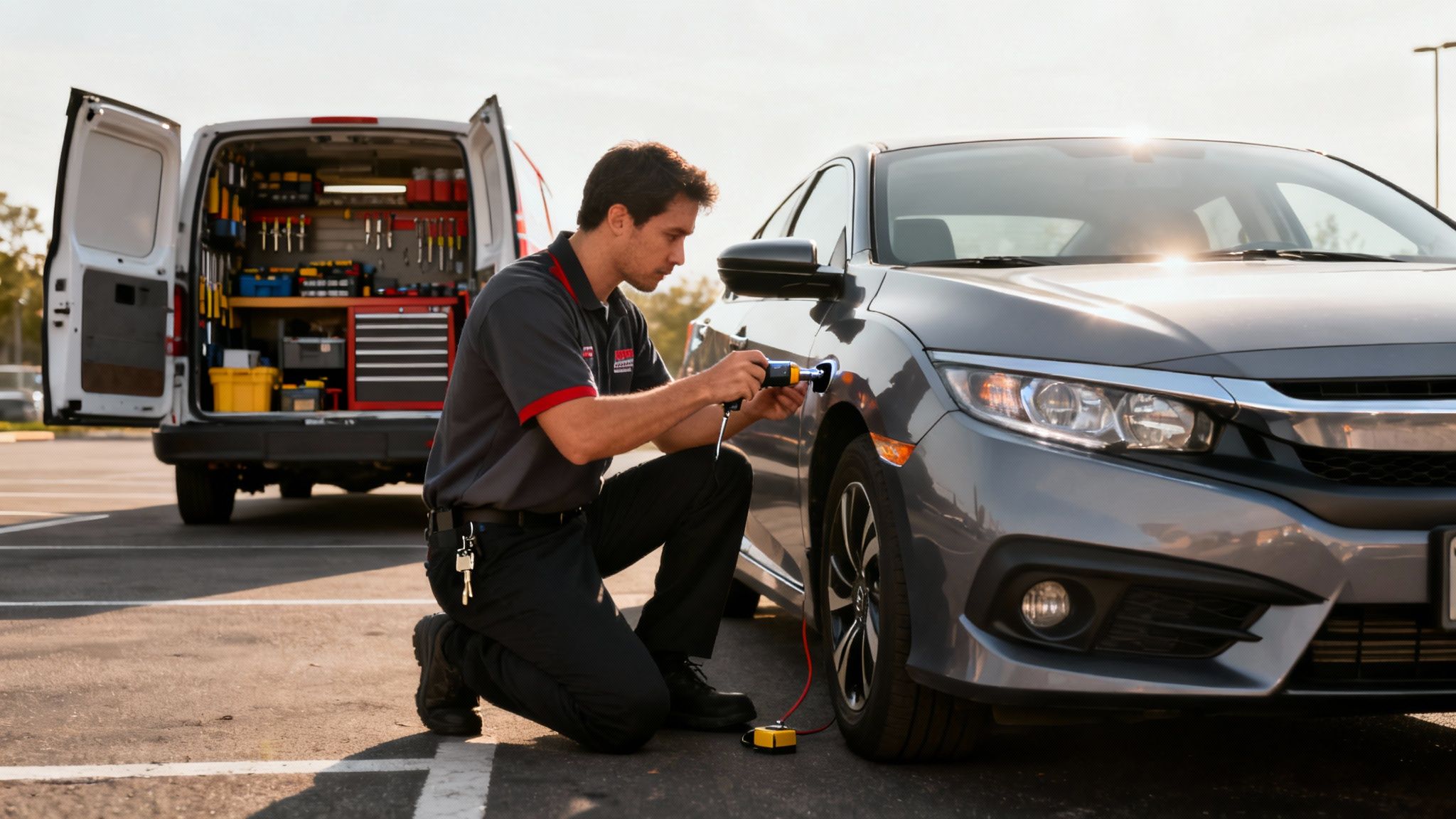

    When you need fast, professional help for a stuck key or any other lock and key issue, trust the local experts. For everything from emergency car lockouts and house lockouts to key fob replacement, Pro-B Locksmith is ready to assist. Call (772) 710-8169 for immediate help across the Treasure Coast.

  • My Key Won’t Turn in the Ignition: A Port St. Lucie Driver’s Guide

    My Key Won’t Turn in the Ignition: A Port St. Lucie Driver’s Guide

    It’s a feeling every driver on the Treasure Coast dreads: you slide your key into the ignition, ready to go, and… nothing. The key is stuck solid. It won’t turn. Before you panic and picture expensive repair bills, take a breath. This common problem often has a surprisingly simple fix.

    From Port St. Lucie to Fort Pierce, we see this all the time. The good news is that a stuck key is rarely a sign of a major mechanical failure. It’s usually caused by a handful of predictable issues that you can often solve yourself in just a few seconds, right there in your driveway in Stuart or a parking lot in Vero Beach.

    Common Reasons Your Key Is Stuck

    Let’s walk through the most frequent culprits we encounter when a customer’s key won’t turn.

    The Steering Wheel Is Locked

    This is, without a doubt, the number one reason. If you turned the steering wheel after taking the key out, you likely engaged the anti-theft steering lock. This feature puts pressure on the ignition cylinder, physically blocking the key from turning. It’s a simple security measure, but it catches a lot of people off guard. A real example: a client in Jensen Beach called us in a panic, but this simple fix had them on their way in under a minute.

    Your Car Isn’t in Park or Neutral

    For safety, vehicles with automatic transmissions will only start when they are securely in Park (P) or Neutral (N). If your gear shifter is even slightly out of alignment—maybe it looks like it’s in Park but isn’t fully clicked in—the car’s neutral safety switch will prevent the ignition from engaging.

    A Worn-Out or Damaged Key

    Keys don’t last forever. Years of rattling around in a pocket or purse can cause the metal grooves to wear down, get bent, or even develop tiny, hairline cracks. If the key’s cuts no longer match the pins inside the ignition cylinder perfectly, it simply won’t work. This is a common issue for older vehicles we service in the Fort Pierce area.

    Car key in ignition switch, illuminated dashboard in background, ready to start vehicle.

    A Faulty Ignition Cylinder

    While less common, the problem can sometimes be the lock itself. Over time, the internal pins and tumblers inside the ignition cylinder can get stuck or wear out. This internal failure will stop even a brand-new key from turning. If this is the case, an ignition repair is needed.

    Pro Tip: When the steering wheel is locked, it’s putting direct pressure on the ignition lock. The fix is usually just as simple: gently wiggle the steering wheel from side to side while turning the key. You’ll feel the pressure release, and the key should turn. This little trick solves the problem in the vast majority of cases.

    If you’ve tried these quick checks and you’re still stuck, don’t force it. The last thing you want is a broken key snapped off in your ignition. That’s when a simple problem becomes a much bigger one. Call (772) 710-8169 for immediate help; our mobile team is ready to assist anywhere from Port St. Lucie to Vero Beach.

    Quick Fixes You Can Try Right Now

    Before you start thinking the worst, here are a few simple steps you can take when your key gets stuck in the ignition. We get calls about this all the time from drivers between Stuart and Jensen Beach, and more often than not, one of these practical tips does the job.

    Let’s start with the number one reason this happens.

    A person's hands on a car steering wheel, with keys in the ignition and an automatic gear shifter.

    Step 1: Is Your Steering Wheel Locked?

    Most cars have a built-in anti-theft feature that locks the steering wheel when it’s moved after the key has been pulled out. It’s a great security measure, but it also puts pressure on the ignition cylinder, physically stopping the key from turning. This is probably the most common cause of panicked calls we receive.

    How to Fix It:
    You just need to take the pressure off the lock. While you gently try to turn the key, rock the steering wheel back and forth. You aren’t trying to force it, just wiggle it. You should feel a little “click” or release as the tension comes off the lock, and your key will suddenly turn.

    Step 2: Double-Check Your Gear Shifter

    Here’s another one we see all the time. For safety, cars with automatic transmissions will only start when they are in Park (P) or Neutral (N). It’s easy to think you’ve pushed the shifter all the way into Park when it hasn’t quite settled into position.

    How to Fix It:

    • First, make sure the gear selector is pushed firmly into the Park position.
    • Give it a little jiggle to ensure it’s properly seated.
    • If that doesn’t work, try shifting into Neutral and then turning the key.

    This simple step has saved plenty of drivers in the Vero Beach area a lot of frustration.

    If you’ve wiggled the wheel and checked the gear selector with no luck, stop right there. The absolute worst thing you can do is try to force the key. That’s how you end up with a key snapped off in the ignition, which turns a small problem into a much bigger, more expensive one.

    Step 3: What About the Car Battery?

    A dead battery won’t physically stop your key from turning in an old-school ignition, but it’s a different story with modern cars. Many newer vehicles have electronic steering locks or security immobilizers linked to the ignition. If the battery is too weak, it might not have enough juice to power these systems and tell them to release the lock.

    If you turn the key and get absolutely nothing—no dashboard lights, no clicks, just silence—a dead battery is a strong suspect. Check your dome light; if it’s dim or completely off, your battery is almost certainly the culprit.

    If you’ve tried these tips and are still getting nowhere, Call (772) 710-8169 for immediate help. Our mobile locksmiths can come right to your location in Port St. Lucie or the surrounding areas to diagnose and fix the issue.

    Checking for a Worn Key or Faulty Ignition

    Alright, so you’ve wiggled the steering wheel and checked the gear shifter, but that key still won’t budge. Now we need to look at the hardware itself. After thousands of starts over the years, both your car key and the ignition cylinder take a beating. It’s simple wear and tear, and a very common reason for a key to suddenly stop working.

    Close-up of two old, worn car keys with black plastic handles on a light surface.

    Grab your key and give it a good, hard look. Are the edges of the cuts sharp, or have they become rounded and smooth? Lay it on a flat table—is there even a slight bend to it? A tiny crack you can barely see is more than enough to throw off the alignment with the pins inside the lock.

    Signs of a Failing Ignition

    The problem might not be the key, but the lock itself. If the key feels sloppy or loose when you insert it, or if you’ve been feeling it catch and stick on its way to the ‘start’ position, those are tell-tale signs. The internal tumblers are likely worn out.

    From our experience serving the Treasure Coast, key and ignition wear accounts for a huge chunk of these issues. You can learn more about common car key problems to see just how these parts fail over time.

    Crucial Warning: Whatever you do, don’t try to force it. A worn key is already weak, and cranking on it is the fastest way to snap it clean off inside the ignition. That’s how a simple service call turns into a much bigger, more expensive headache.

    If you suspect your key is damaged or the ignition is the culprit, it’s time to call in a professional. Call (772) 710-8169, and one of our mobile locksmiths can come right to you. We can perform an ignition repair or provide a key fob replacement on the spot, saving you the hassle and cost of a tow.

    When It’s Time to Call in a Pro for Ignition Repair

    There comes a point where DIY becomes “Don’t Inconvenience Yourself” further. If you’ve given the steering wheel a good jiggle and double-checked the gear shift with no luck, it’s time to stop. This is especially true if you can see your key is bent, cracked, or severely worn down.

    Pushing your luck by forcing a stuck key is one of the most common mistakes we see. All that muscle often does is snap the key blade right off inside the ignition cylinder. What was an annoying problem has now turned into a much bigger, more expensive one involving a delicate extraction.

    A focused technician in uniform kneels beside a white service van, examining car keys.

    Why a Mobile Locksmith Is Your Best Bet

    This is exactly the moment a mobile locksmith shines. Why go through the hassle and cost of towing your car to a dealership in Port St. Lucie or Vero Beach? A professional technician can drive directly to you, whether you’re stranded in your own driveway in Jensen Beach or stuck in a parking lot over in Fort Pierce. On-site service is a game-changer.

    Choosing a mobile locksmith isn’t just about convenience—it’s the smarter, more efficient solution. We bring all the specialized tools needed to figure out the real problem, perform a precise ignition repair, and even cut and program a new key fob right there.

    Our vans are complete workshops on wheels. We’re equipped to handle everything from a car lockout to a full ignition rebuild or a complex key fob replacement. To see just how much we can do on the road, check out our full range of automotive locksmith solutions.

    So, if the quick fixes fail and your key still won’t budge, don’t gamble. Call (772) 710-8169 for immediate help that comes right to you.

    How to Prevent Future Ignition Problems

    Getting back on the road is a relief, but the last thing you want is a repeat performance. A few simple habits can go a long way in preventing your key from getting stuck in the ignition again. It really boils down to reducing the day-to-day stress on your car’s ignition system.

    First, take a hard look at your keychain. Is it loaded down with a dozen other keys, fobs, and heavy accessories? All that weight constantly dangles from your ignition, putting a surprising amount of strain on the delicate tumblers inside. Over time, this accelerates wear and tear. The easy fix is to lighten the load—keep just your car key and fob on their own ring.

    Simple Maintenance Habits

    Get into the habit of giving your key a quick visual check every so often. You’re looking for signs of wear, like the grooves becoming rounded or any subtle bends in the metal. A worn-down key not only struggles to align properly but can actually damage the ignition cylinder itself.

    • Get a Spare Key: The worst time to get a spare key made is when your original is already too worn out to copy accurately. Be proactive and get a duplicate made while your primary key is still in good shape. This guarantees you have a perfect reference copy.
    • Use Lubricant Sparingly: If you start to feel a bit of stickiness or resistance, a small puff of graphite lubricant is the right tool for the job. Avoid a wet lubricant like WD-40, as it can attract dust and gunk up the works.

    Taking these small preventative steps can genuinely extend the life of your ignition and key. And if you ever need expert advice on key duplication, a lock change for your home, or other security concerns, our team provides reliable locksmith services in Port St. Lucie.

    Common Questions About Ignition Issues

    As a locksmith serving the Port St. Lucie, Fort Pierce, and Stuart area, I hear a lot of the same questions when a driver gets stranded with a key that won’t turn. It’s a frustrating situation, so let’s clear up a few of the most common issues with practical, step-by-step answers.

    Can a Dead Car Battery Stop My Key from Turning?

    Yes, it absolutely can in modern vehicles. With older, purely mechanical ignitions, a dead battery wouldn’t stop the key itself from physically turning. But on most modern cars, that’s not the case.

    Many newer vehicles have electronic systems tied to the ignition, like an electronic steering wheel lock. These security features need power to disengage. If your battery is completely drained, the system can’t get the signal to unlock, which keeps your key from turning all the way. A dead giveaway is when you turn the key and get absolute silence—no clicks, no dash lights, nothing.

    What Is the Difference Between Ignition Repair and Replacement?

    This is a great question. The best way to think about it is that ignition repair is like surgery, while a replacement is a full transplant.

    • Ignition Repair: This is what we aim for first. It’s a delicate process where a locksmith takes the ignition cylinder apart to fix what’s broken inside. Maybe a tiny wafer is bent, or a spring is out of place. We fix that specific part, put it all back together, and it works like new. It’s almost always the cheaper and faster option.
    • Ignition Replacement: Sometimes, the damage is just too severe. If the internal housing is cracked or the whole cylinder is warped from a failed theft attempt, a repair just won’t cut it. In that case, we have to install a brand-new ignition cylinder.

    An experienced locksmith can tell you pretty quickly which path you need to take. For more answers to common issues like a house lockout or a car lockout, you can always check out our frequently asked questions page.
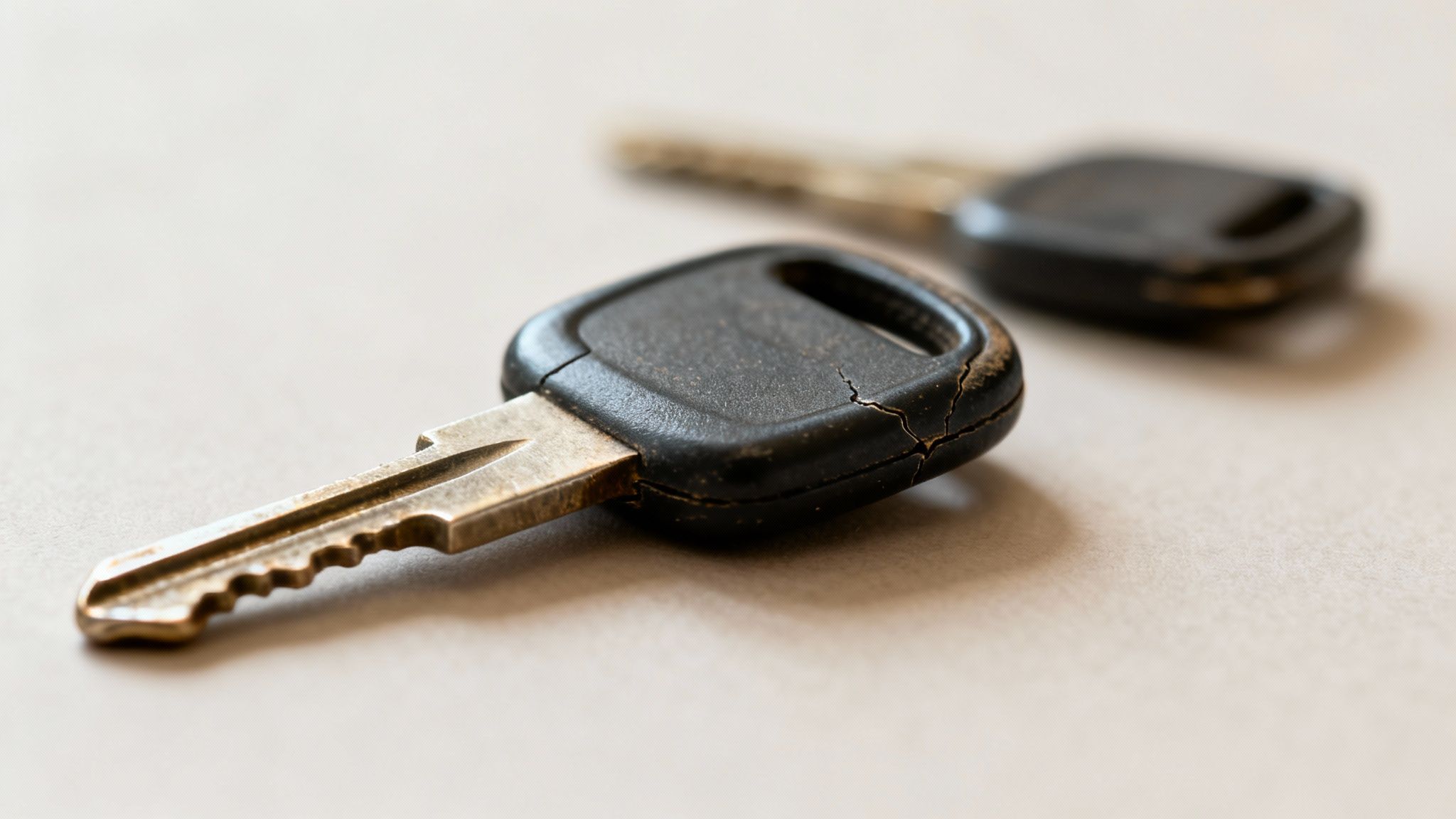

    When you’re stuck in Port St. Lucie, Fort Pierce, or anywhere on the Treasure Coast and need someone you can trust, give Pro-B Locksmith a call. We provide expert mobile service to get you moving again.

    ➡️ Get professional ignition repair and get back on the road fast by visiting us at https://problocksmith.com!