
It’s a sound that makes everyone’s head turn and your stomach drop: the relentless blare of your car alarm. Whether it’s echoing through a quiet Port St. Lucie neighborhood or drawing unwanted attention in a busy Fort Pierce parking garage, your first thought is to make it stop. Fast.
But what if your remote is dead, lost, or just not working?
For most factory-installed alarms, there's a simple, reliable fix. The quickest way to silence the alarm is often to just use your physical car key. Unlock the driver's side door manually, get in, and start the ignition. This tells your car's computer that you're the authorized driver, which should immediately reset the system and bring back the peace and quiet. If this doesn't work or you're locked out completely, Call (772) 710-8169 for immediate help from a local expert.
Why Your Car Alarm Is Blaring and How to Silence It Now
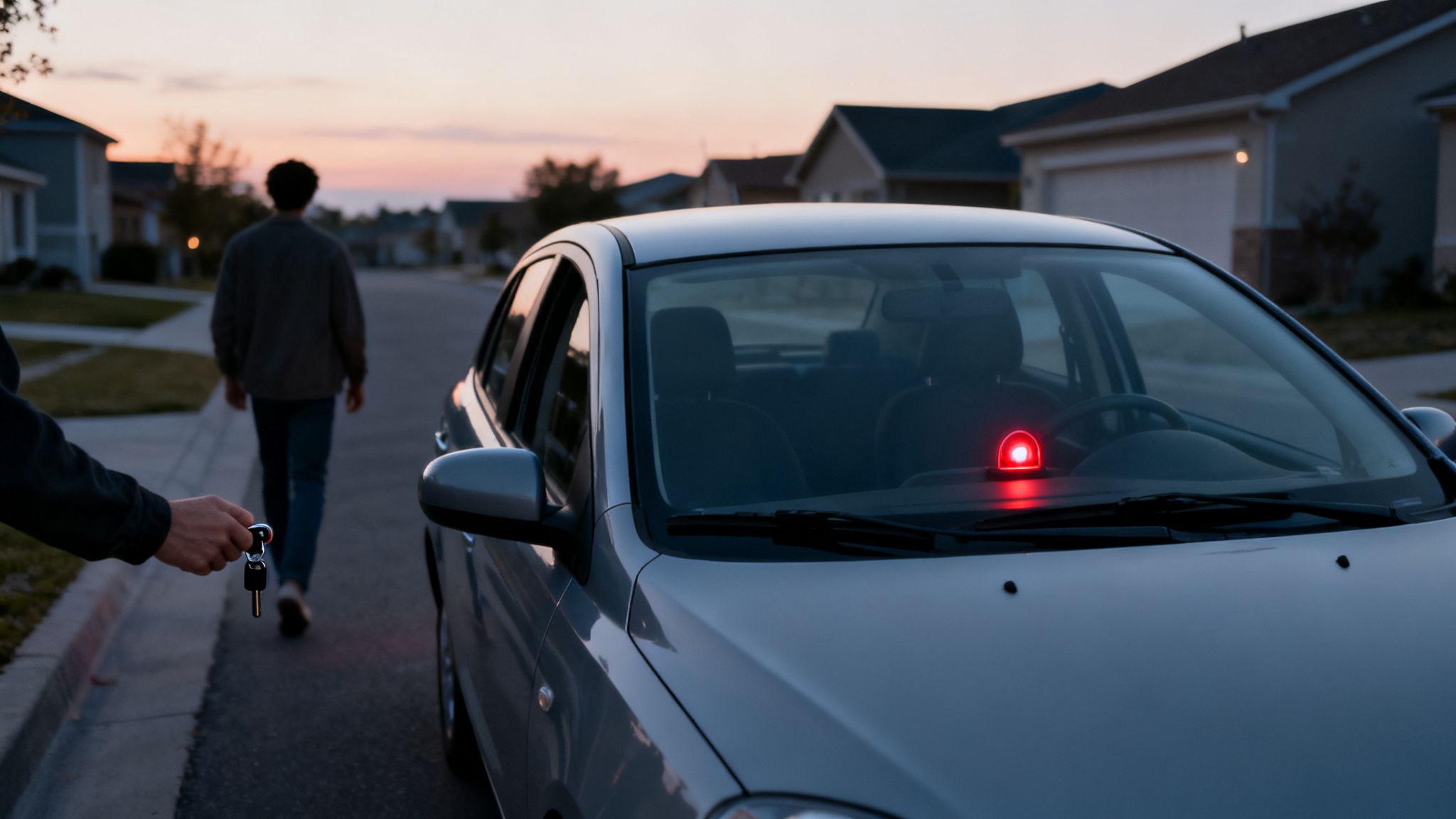
That piercing sound isn't just a random malfunction; it's your car's security system trying to signal a problem. Understanding the why behind the wail is the first step to regaining control and preventing it from happening again.
Sometimes, the simplest answer is the right one. Your key fob might just have a dead battery. Learning how to replace key fob battery is a great skill that can solve the problem in minutes. But if a fresh battery doesn't do the trick, it's time to look at other common culprits.
Common Alarm Triggers on the Treasure Coast
Living on the Treasure Coast, from Vero Beach down to Stuart, we see a few recurring issues that cause most false alarms. Knowing what they are can help you figure out the problem much faster.
- Low Car Battery: A car battery on its last legs can send funky voltage signals to the alarm module, causing it to go off for no apparent reason.
- Faulty Door or Hood Sensors: These sensors can get dirty, damaged, or just knocked out of alignment from our coastal humidity. When that happens, your car might think a door, hood, or trunk is being pried open.
- Key Fob Malfunctions: It's not always the battery. The internal electronics of the fob itself can fail, sending mixed signals or no signal at all to your vehicle. This is a common issue we handle with our key fob replacement service.
When you're faced with a blaring alarm and no remote, it's tempting to try anything to make it stop. But be careful. We've seen botched DIY attempts cause electrical shorts in many local cases, leading to much costlier repairs down the road.
When you need a quick reference, here are some immediate actions you can take.
Immediate Actions for a Blaring Car Alarm
This table gives you a quick rundown of what to try first when your alarm is going off and you can't use your remote.
| Method | Best For | Pro-B Locksmith Tip |
|---|---|---|
| Use the Physical Key | Most factory-installed alarm systems. | Insert the key in the driver's door, turn to unlock, then start the ignition. This is the #1 fix. |
| Cycle the Ignition | When the key-in-door trick doesn't work. | Turn the key to the "On" position and back to "Off" 2-3 times to reset the system. |
| Check the Fob Battery | When the remote is completely unresponsive. | If you have a spare battery, try a quick swap. This is often the simplest solution. |
| Disconnect the Car Battery | A last resort for persistent alarms. | Disconnecting the negative terminal will kill the alarm, but may also reset your radio and clock. |
Knowing these quick fixes can be a lifesaver, but if you find yourself stuck or worried about causing more damage, the safest move is always to call a professional.
For immediate, damage-free help with any car alarm or lockout situation in Jensen Beach or the surrounding areas, call us at (772) 710-8169. We'll get you sorted out quickly and safely.
Using Your Key to Silence a Factory Alarm
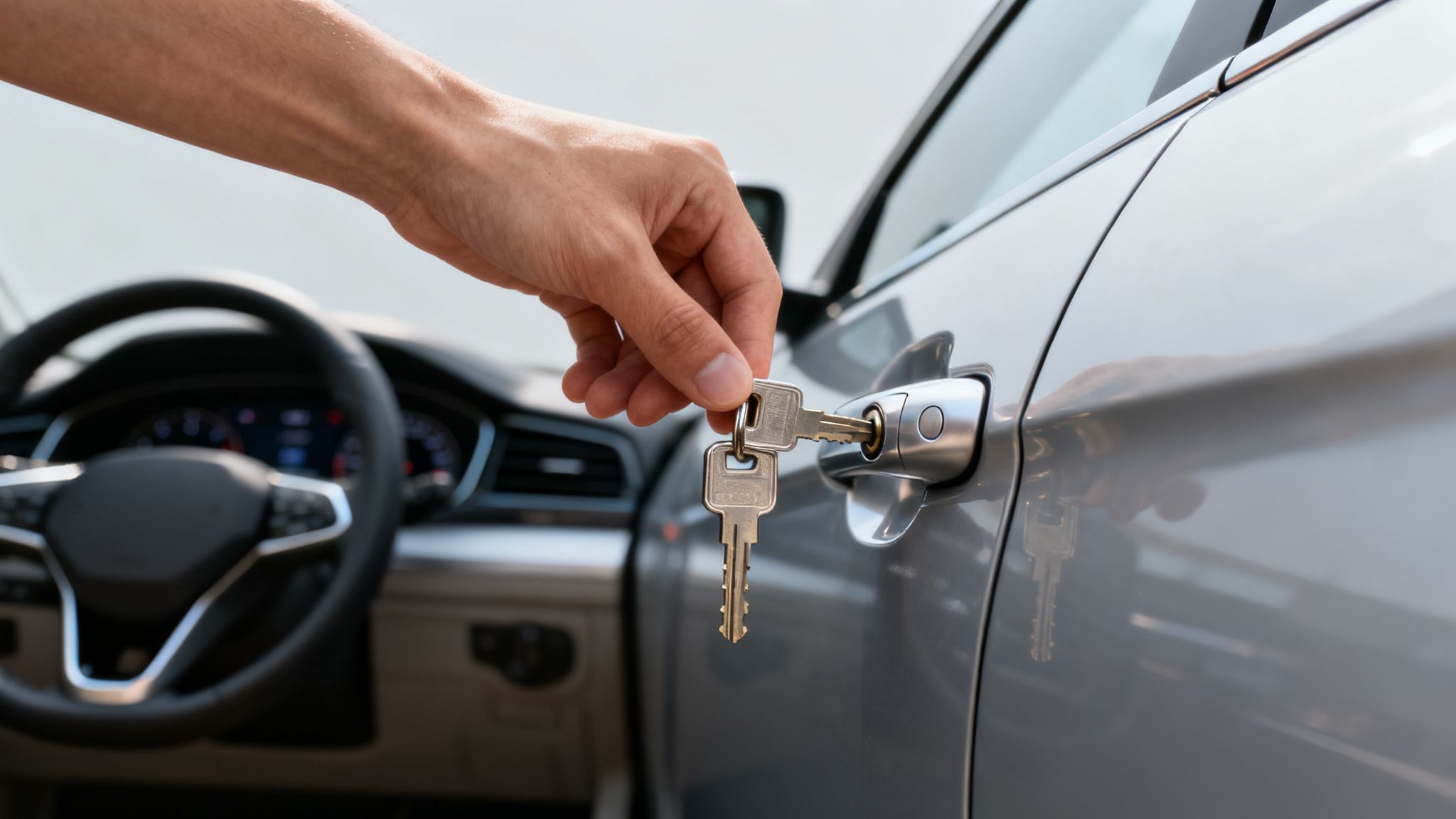
When your remote is dead or missing, your physical car key is your best friend. For most factory-installed alarms, the fix is surprisingly simple and mechanical. No special tools are needed—just the key that’s hopefully already in your pocket.
Car manufacturers build in a manual override for this exact scenario. The alarm system is designed to recognize the unique cut of your physical key as a legitimate way to disarm it, acting as a failsafe when the electronics fail. It's a direct line of communication to your car's brain.
Try the Driver's Door Lock First
The easiest and most common trick is to use the lock on your driver's side door. When you put the key in and turn it, you're doing more than just unlocking the door—you’re sending a signal directly to the vehicle’s Body Control Module (BCM).
This signal is a clear message: "The right key is here." The BCM gets the message and shuts the alarm down, no remote required.
Expert Tip: Don't just jab the key in and quickly turn it. Insert it fully and turn it smoothly to the unlock position, holding it there for a solid second or two. This gives the system time to recognize the command and silence the alarm.
If a single turn doesn't do it, try locking and then immediately unlocking the door. This can sometimes jog a confused sensor back into place. This is always our first move in the field because it’s quick, safe, and works on the vast majority of factory alarms we see in the Port St. Lucie area.
If That Fails, Use the Ignition
Still blaring? The next step is to use the ignition. This method forces the car’s security system to recognize a valid, programmed key, which almost always shuts off the alarm. It's a go-to technique for many Ford, Chevy, and Toyota models we see around the Treasure Coast.
Here's the step-by-step sequence:
- Get in the car and put your key in the ignition.
- Turn the key two clicks forward to the "On" position—the spot where the dash lights up, but before the engine cranks.
- Leave it there for 3-5 seconds. This gives the vehicle's immobilizer time to read the transponder chip embedded in your key.
- Turn the key back to "Off."
For some stubborn systems, you might need to repeat this "On-Off" cycle two or three times in a row to get the alarm to reset completely.
These mechanical methods are your safest bet. If neither one works, you might be looking at a deeper problem with your car's security system or ignition. You can learn more about these complex systems from our team of automotive locksmith services experts.
Trying to force anything beyond these simple steps risks causing expensive damage. If you’ve tried these proven methods and the alarm is still screaming, it’s time to call a professional. For any car lockout or alarm issue, call (772) 710-8169 for immediate help.
Dealing With a Tricky Aftermarket Alarm System
If you’ve already tried turning the key in the door and cycling the ignition but the alarm is still blaring, you're likely dealing with an aftermarket alarm. These systems, from brands like Viper or Avital, are often installed by previous owners and don't play by your car's factory rules. They’re a completely separate entity.
Unlike factory alarms that are tied into your vehicle's main computer, these systems have their own brain—a separate control module with its own unique reset procedures. That's why the standard tricks won't work. To shut it down, you need to find its manual override.
Finding the Hidden Valet Switch
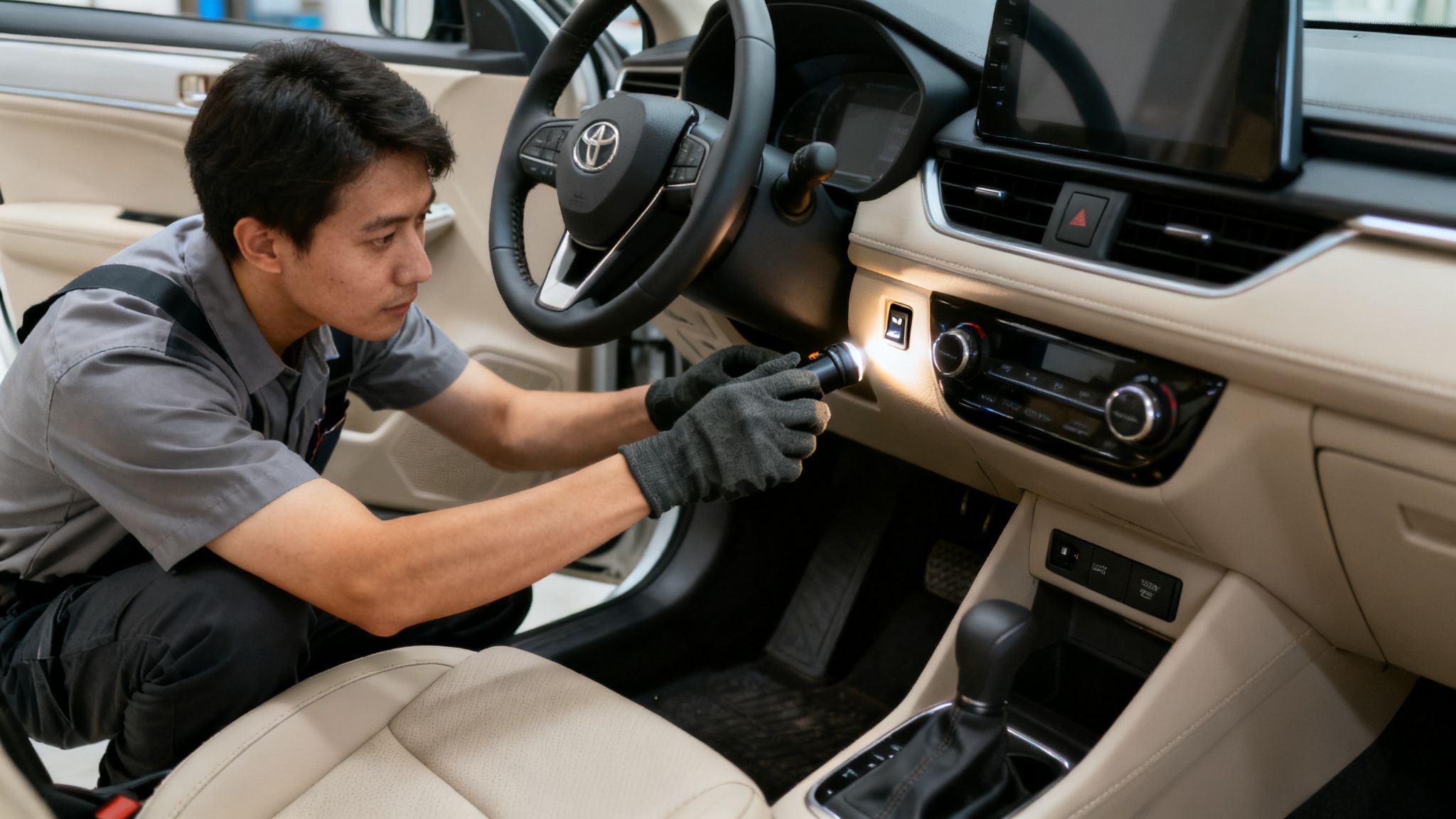
Nearly every professionally installed aftermarket alarm has a hidden "valet" switch. It's a small, often unmarked button that acts as a manual kill switch for when your remote is lost or broken. The only problem? It's designed to be hidden from thieves, which also means it’s hidden from you.
Over years of working on cars across Port St. Lucie and Fort Pierce, we’ve learned the handful of places installers almost always hide these switches. Knowing where to start looking can cut your search time down dramatically.
Common Hiding Spots for Valet Switches
- Under the Driver's Side Dash: This is the most common spot. Feel around the panels near the steering column and above the pedals. You'll likely find it by touch, not by sight.
- Inside the Glove Box: Check the inner walls or the ceiling of the glove compartment. Installers sometimes put it here for slightly easier access.
- Near the Fuse Box: The kick panel on the driver's side, which covers the interior fuse box, is another popular location.
Once you find the switch, resist the urge to just start mashing it. There's a specific sequence to disarming the alarm, and doing it wrong might not just fail—it could even temporarily lock you out of your ignition.
Following the Right Disarm Sequence
Aftermarket systems need a specific combination of actions to enter "valet mode" and finally go quiet. The exact steps can differ between brands, but most alarms you'll find around Stuart or Jensen Beach follow a pretty standard formula.
Here is a practical, step-by-step explanation:
- Put your key in the ignition and turn it to the "On" position (the last click before the engine cranks).
- Within about 5-10 seconds, press and quickly release the valet button.
- You should hear a single chirp from the alarm, and the siren will stop. Success!
If that doesn't do the trick, try the same first step—key to the "On" position—but this time, press and hold the valet button for a few seconds until the alarm silences.
These systems can be finicky, and a wrong move can cause more electrical problems than just a noisy alarm. If you can't find the switch or the sequence isn't working after a couple of tries, it's time to stop. Our team uses diagnostic tools to safely interface with these systems, taking all the guesswork out of it.
For fast, professional help, Call (772) 710-8169 for immediate help, and we'll get it sorted out without damaging your vehicle's wiring.
Disconnecting the Battery as a Last Resort
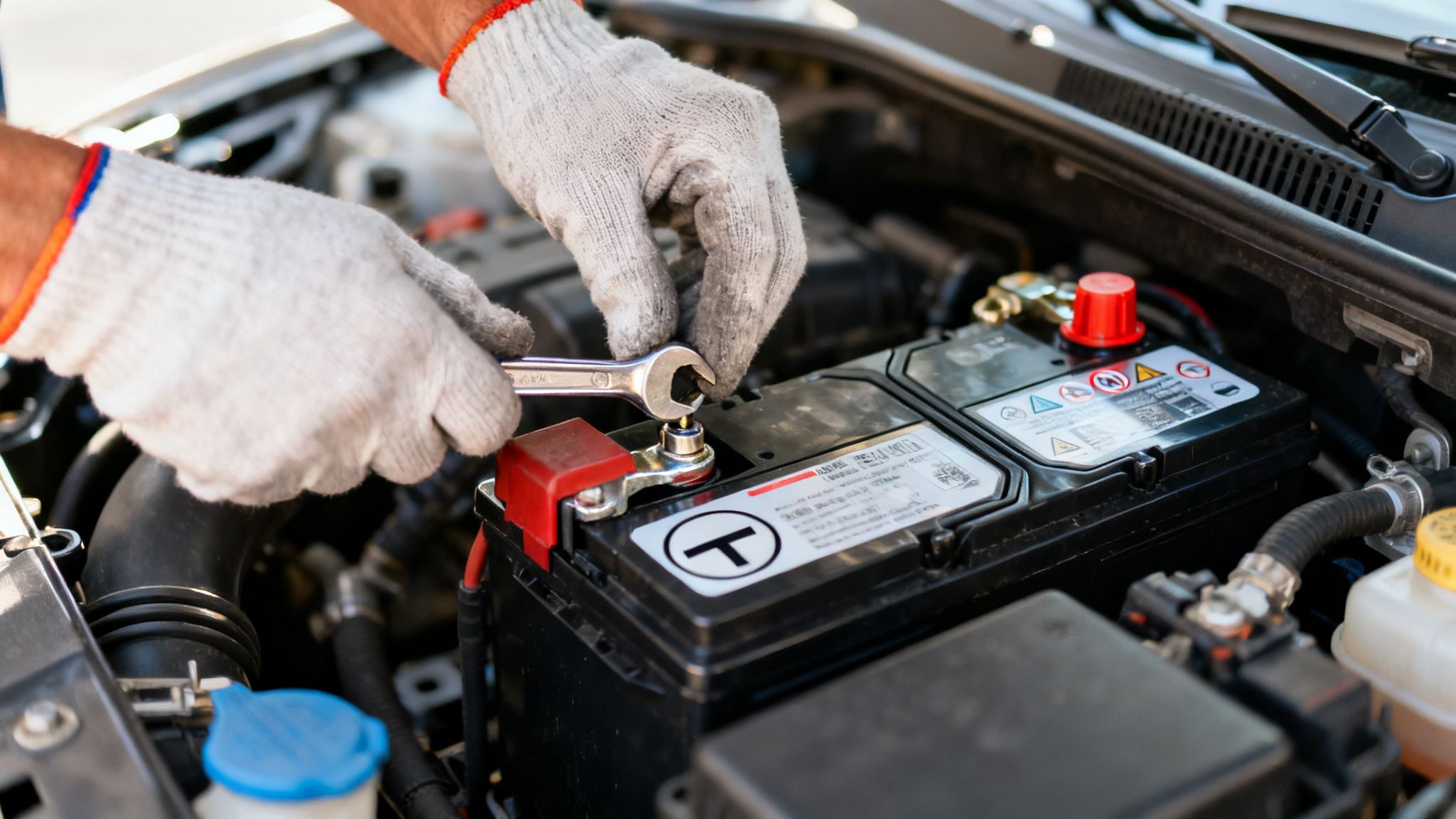
When you've tried all the key tricks and the valet switch remains elusive, it’s easy to feel like you're out of options. There is one final thing you can try, but this must be treated as an absolute last resort. I’m talking about disconnecting the car battery.
This move will absolutely silence the alarm by cutting off its power. It’s effective, but it’s also a blunt-force solution that can create a whole new set of problems. Think of it like pulling the plug on your computer instead of properly shutting it down. For drivers around Port St. Lucie dealing with a blaring alarm, this temporary fix often leads to bigger headaches down the road.
The Risks of a Battery Disconnect
Before you reach for a wrench, you need to know what you’re getting into. Modern cars are rolling computers, and yanking their power source can cause all sorts of electronic amnesia. The fallout can range from mildly annoying to seriously problematic.
- You'll lose your presets. Kiss your saved radio stations, clock settings, and power seat positions goodbye.
- The car's computer resets. Your vehicle’s Engine Control Unit (ECU) will revert to its factory settings. This can mess with your engine’s idle, how the transmission shifts, and even your fuel efficiency while it relearns your driving style.
- You might trigger other alarms. Some higher-end cars have secondary anti-theft systems that run on their own tiny backup batteries. Disconnecting the main battery can sometimes wake these up, landing you in an even worse situation.
Disconnecting the battery only buys you silence; it doesn't solve anything. The moment you reconnect it, the alarm will likely start right back up because the root cause—a faulty door sensor, a dying fob battery—is still there.
If You Absolutely Have to Do It
Okay, let's say you're in a situation where the noise is attracting unwanted attention, it's the middle of the night in your Vero Beach home, and help is hours away. If you must proceed, you'll just need a basic wrench that fits the nut on your battery terminal.
Here’s the safe, step-by-step process:
- Find the battery. Pop the hood. You're looking for a black box with two connection points, or terminals.
- Zero in on the negative terminal. This is the most important step. Look for the post marked with a minus sign (-) or the letters "NEG." It usually has a black plastic cover. You must always disconnect the negative terminal first to avoid creating a dangerous spark.
- Loosen the clamp. Use your wrench to loosen the nut on the negative clamp. You don’t have to take it all the way off—just get it loose enough so you can wiggle the cable off the post.
- Tuck the cable away. Once the cable is off, move it to the side where it can't accidentally touch the battery terminal again. The alarm will go silent instantly.
Instead of risking these complications, a professional can figure out what's really wrong without causing any collateral damage. You can learn more about our 24/7 emergency lockout services that are designed for these exact situations.
Just call (772) 710-8169 for immediate help. A trained technician can solve the problem safely, keeping your car’s settings intact and preventing future alarm meltdowns.
Why Is My Car Alarm Going Off? Finding the Real Problem
A car alarm that just won’t quit is your car’s way of screaming for help. Sure, you want to silence it now, but just killing the noise is a band-aid solution. The real trick is figuring out why it started blaring in the first place. A few minutes of detective work can save you from another 3 AM wake-up call and make sure your car's security system is actually doing its job.
More often than not, a phantom alarm isn't a problem with the alarm itself. It's usually a symptom of a deeper electrical issue. These systems are incredibly sensitive, relying on a whole network of sensors and a consistent power source to work properly. Any little hiccup can set them off.
The Usual Suspects Behind a Rogue Alarm
Think about what else is going on with your car besides the siren. From what we see helping folks from Vero Beach to Stuart, it almost always comes down to one of a few common culprits.
A Dying Car Battery: This is, without a doubt, the #1 reason for false alarms. When a battery is on its last legs, it can't provide the steady, even voltage your car's computer needs. This electrical instability confuses the alarm module, causing it to trigger for no reason, especially when the temperature drops overnight. Is your car slow to start? Are the headlights looking a bit dim? Your battery is the first thing you should suspect.
Bad Hood or Door Sensors: Every door, your trunk, and even your hood has a small sensor to detect a break-in. If that little hood latch sensor gets corroded from our salty air, or a door sensor gets sticky, the alarm thinks a thief is at work. One dead giveaway is an interior dome light that stays on, which means the car thinks something is still open.
A Glitchy Key Fob: Sometimes, the remote really is the problem—but it’s not always a dead battery. If the fob has been dropped one too many times, its internal electronics can get damaged. This can cause it to send out "ghost signals" that randomly lock and unlock your doors, inevitably setting off the alarm.
A car alarm that keeps going off isn't just a headache for your neighbors. It's a constant drain on your battery and can easily leave you stranded. You have to fix the root cause.
Matching Symptoms to the Source
Trying to figure out what's wrong can feel like guesswork, but specific symptoms usually point to a specific problem. Think of this table as a quick cheat sheet to help you connect the dots.
Alarm Problem vs. Potential Cause
| Symptom | Common Cause | Recommended Action |
|---|---|---|
| Alarm goes off, engine struggles to turn over. | A weak or failing car battery. | Get the battery tested. If it's more than a few years old, it probably needs to be replaced. |
| Interior lights stay on, alarm triggers randomly. | A faulty door, trunk, or hood sensor. | Double-check that everything is shut tight. If that doesn't work, the sensor itself is likely bad. |
| Alarm goes off, car doors lock/unlock on their own. | A malfunctioning key fob. | If you have a spare fob, try using it. If the problem disappears, you need a key fob replacement. |
Once you have a better idea of what you're dealing with, you can move past just quieting the alarm. If your troubleshooting points toward a bad sensor or an issue with the ignition system, getting a professional involved is your best and safest move.
Give us a call at (772) 710-8169, and we can run expert diagnostics or provide services like ignition repair to fix the root of the problem for good.
Your Trusted Locksmith on the Treasure Coast
Let's be honest, the quick fixes we've covered can be a real lifesaver in a pinch. But sometimes, they just don't cut it. When you're stuck in a Port St. Lucie parking lot or a Jensen Beach driveway with an alarm that simply refuses to cooperate, it’s time to call in a professional.
Trying to guess your way through a fix can easily lead to fried wiring or a dead battery. Calling an expert isn't giving up—it's the smartest and quickest way to solve the problem for good.
At Pro-B Locksmith, this is exactly the kind of frustrating situation we specialize in, and we know how to handle it without creating new problems. Our technicians use non-destructive techniques that protect your vehicle’s sensitive electronics. That’s a guarantee you just don't get with risky trial-and-error methods. We’re your local Treasure Coast team, not some faceless national chain.
A rogue car alarm can derail your entire day. But a single phone call can get it sorted out in minutes, protecting your vehicle's value and getting you back on the road.
We know you can't wait around. That's why we pride ourselves on fast response times across Fort Pierce, Stuart, and the surrounding communities. We're more than just a quick fix for alarms; we offer a full range of locksmith solutions for when you're in a jam.
- Emergency car lockouts
- House lockout assistance
- Complex ignition repairs
- On-the-spot key fob replacement
- Professional lock change services
For fast, reliable help anywhere on the Treasure Coast, Call (772) 710-8169 for immediate assistance.
Got Questions? We've Got Answers
Over the years, we've heard just about every car alarm question from drivers all over the Treasure Coast. Here are the straight-up answers to a few of the most common ones we get, helping you figure out what to do when your alarm is blaring and your remote is nowhere to be found.
Is It Really Just a Low Battery Making My Alarm Go Crazy?
You bet. It’s probably the #1 reason for false alarms we see out here in Port St. Lucie.
When your car battery starts to die, its voltage gets erratic. The car's computer gets mixed signals from this unstable power source, and it often misinterprets that as a security threat, which sets off the alarm. If you've also noticed your car struggling to turn over, a weak battery is almost certainly the problem.
Will I Mess Something Up by Disconnecting the Battery?
Disconnecting the battery will definitely kill the alarm, but it can open up a whole new can of worms. Doing this forces a hard reset on your car’s computer.
That means you’ll likely lose your radio presets, but it can also mess with more important things, like how your engine idles or when your transmission shifts. On newer cars, it might even activate a second security system. It's a short-term solution that can easily create bigger, more expensive problems.
A Quick Tip from Our Techs: Always try the simple key-in-the-door or key-in-the-ignition tricks first. Disconnecting the battery should be a last resort. If the key doesn't work, there’s likely a deeper issue that needs a professional eye to avoid scrambling your car's electronics. For any lockout or alarm headache, just call us at (772) 710-8169 for immediate help.
My Alarm Went Off Right After a Jump Start. What Gives?
We get this call a lot from folks in Fort Pierce and Vero Beach. Think about it: your car’s system has been limping along on low voltage. When you jump-start it, you’re hitting it with a sudden jolt of full power.
This abrupt surge can sometimes "shock" the alarm's control module, causing it to fire off as a defensive measure. In most cases, just starting the engine with your key will tell the system everything is okay. If the alarm keeps going, the module itself might have a fault.
For more in-depth answers and troubleshooting tips, you might find what you're looking for over in our complete FAQ section.
When you need a surefire, damage-free fix for your car alarm troubles, Pro-B Locksmith is on standby. Get fast, expert service by visiting us at https://problocksmith.com.

