Just moved into a new home in Port St. Lucie or lost a set of keys? Securing your property is priority one, and rekeying your locks is the smartest first step.
Rekeying is a simple process where a locksmith changes the internal pins of your lock cylinder. The result? Your new key works perfectly, and any old keys become instantly useless. It’s a fast, affordable, and effective way to secure your home in Fort Pierce, Vero Beach, Stuart, or Jensen Beach without the expense of replacing all your door hardware.
Why Rekeying Is a Smart Security Move for Your Home
When you get the keys to a new home or rental in Fort Pierce or Vero Beach, you're inheriting a bit of a mystery. Who else has a copy? The list could include former owners, previous tenants, their family members, or contractors.
Instead of the costly and time-consuming project of replacing every single lock, rekeying offers a much more practical solution.
The real benefit here is peace of mind. By rekeying, you regain absolute control over who has access to your property. It’s a powerful first step in making a new house truly your secure space. If you've just moved, dealing with a house lockout because an old key is missing is the last thing you want. Call (772) 710-8169 for immediate help if you find yourself in a bind.
Rekeying vs. Replacing: What’s the Difference?
Homeowners often use "rekeying" and "lock change" interchangeably, but they are fundamentally different services. A lock change means the entire mechanism is swapped out—the knob, the deadbolt, everything.
Rekeying, however, is more precise. A locksmith only works on the internal components, leaving your existing hardware perfectly intact. This difference significantly impacts your wallet and your schedule.
- It’s more cost-effective. You're not buying new locksets, just paying for a professional service.
- It saves time. A skilled locksmith can rekey a standard lock in minutes. A full replacement takes much longer.
- It’s convenient. Want one key for your front door, back door, and garage? We can rekey them all to match, simplifying your keychain.
A rekey is one of the most common and essential home security services we provide. On average, homeowners can save 60-70% by rekeying instead of buying new locks. A professional rekey might run $50-$150 per door, while a full lock change can easily be $200+. The savings add up quickly.
When Is Rekeying the Right Call?
Most often, the decision to rekey is triggered by a specific life event. For our clients in Stuart and Jensen Beach, a few common scenarios always point to rekeying as the best immediate solution.
Did you lose a set of keys? Had a roommate or tenant move out? Even an attempted break-in is a huge red flag. In any of these cases, rekeying should be your top priority to eliminate a potential security gap.
Now, if your locks are old, rusted, or malfunctioning, a full lock change is the better move. It’s also the right choice if you want to upgrade to a more secure or stylish lock. For most other situations, rekeying delivers the same security boost for a fraction of the cost.
Still not sure what's best for your home? Our residential locksmith services are designed to help you make an informed decision. Call (772) 710-8169 for immediate help and professional advice.
Getting Your Hands on the Right Lock Rekeying Tools
Alright, let's talk tools. Before you even think about disassembling that lock, you must have everything ready. Trying to improvise your way through a rekeying job is a recipe for disaster, leaving you with a pile of tiny parts and an unlocked door. This isn't a job for just a screwdriver; you absolutely need a proper rekeying kit.
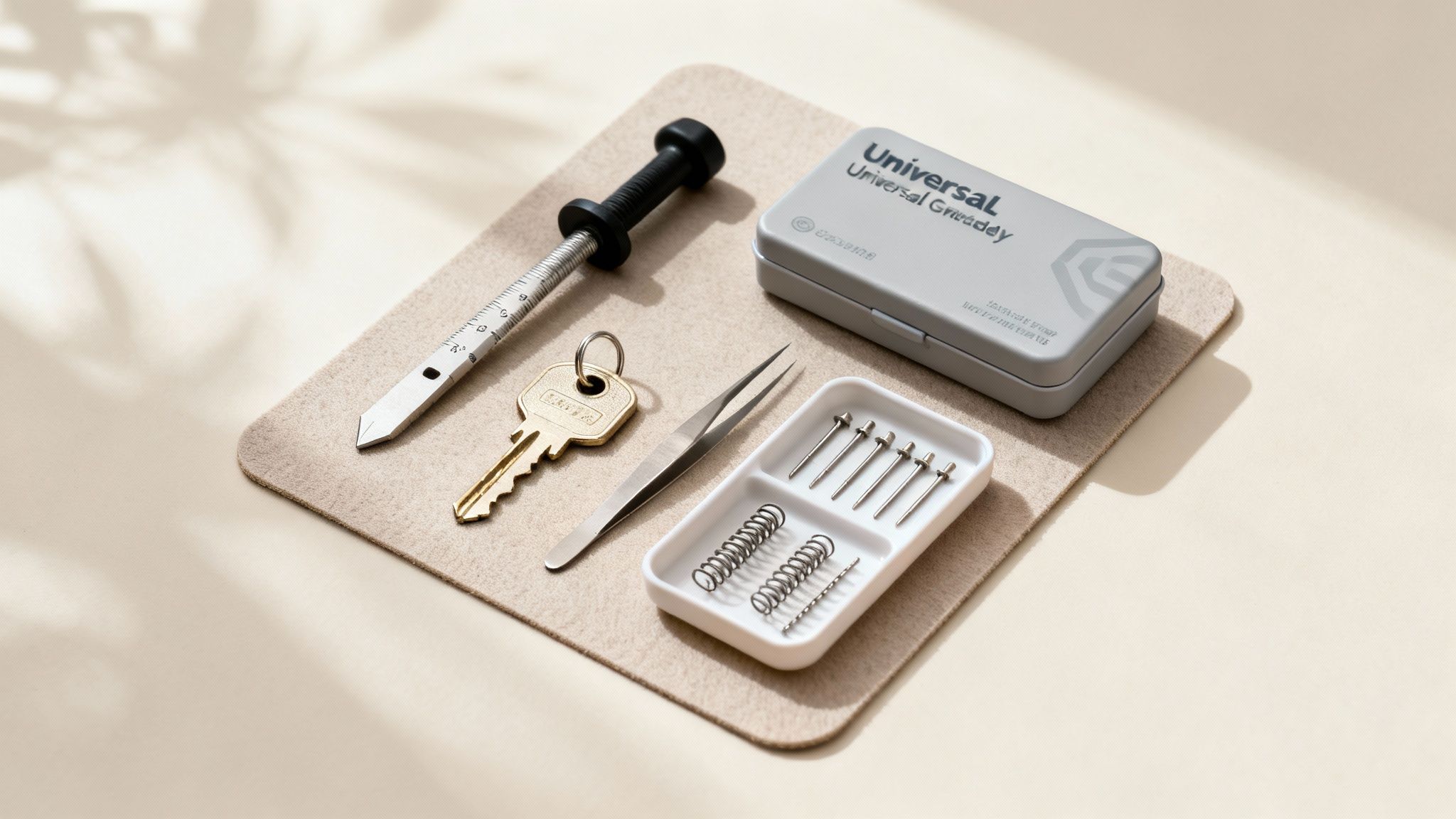
The heart of this operation is a standard rekeying kit. You can find these tailored for specific brands like Schlage or Kwikset, or you can get a more universal set. Inside, you'll find all the small pins, springs, and clips you'll need to match the lock to a new key.
What's Actually in a Rekeying Kit?
The most critical piece of equipment in that kit is the plug follower. It’s a simple cylinder of metal or plastic, but it’s essential for preventing a nightmare scenario. As you slide the lock's core (the plug) out of the cylinder, you slide the follower in right behind it. This single action keeps all the top pins and their tiny springs from launching into oblivion. If you skip this, you'll be on your hands and knees with a flashlight, and your lock will be out of commission.
Your kit should also come with a few other essential items:
- A Removal Tool: This is often a small, stiff piece of wire used to depress a retaining clip and release the lock cylinder.
- Tweezers: You’ll be handling pins that are almost microscopic. Good tweezers are a must.
- A Key Gauge: This tool is a lifesaver. It helps you measure the cuts on your new key so you know exactly which size pins to use. No guesswork required.
- New Pins and Springs: These are the small, color-coded or numbered brass pins that will be arranged to match your new key.
For anyone new to this, grabbing a kit made specifically for your lock's brand is the smartest move. It eliminates guesswork and ensures everything will fit. If you're tackling locks from a few different brands, a universal kit can work, but you’ll need to be extra careful matching the right parts.
DIY vs. Calling a Pro: A Quick Cost Breakdown
Doing it yourself can be rewarding, but it's worth weighing the true cost. For residents here in the Fort Pierce or Stuart area, it boils down to your time and confidence. If you accidentally damage the lock—and it happens more often than you'd think—you're looking at a full lock replacement, which costs far more than a simple rekey.
A professional locksmith doesn't just bring the tools; they bring years of experience dealing with every quirky, stubborn, or unusual lock out there. If you find yourself in a jam—like a house lockout after a rekey attempt goes wrong—we're just a phone call away.
Call Pro-B Locksmith at (772) 710-8169 for immediate help and don't let a small project become a major headache.
To put it in perspective, here's a look at how the costs and benefits stack up for homeowners in and around Port St. Lucie.
DIY Rekeying Kit vs Professional Locksmith Service Cost Breakdown
This table gives a straightforward comparison between buying a kit and hiring an expert like Pro-B Locksmith.
| Item/Service | DIY Rekeying Kit | Professional Locksmith Service (e.g., Pro-B Locksmith) |
|---|---|---|
| Upfront Cost | $15 – $40 for a basic single-brand kit. | Typically $50 – $150 per lock, often with discounts for multiple locks. |
| Included Tools | Basic, single-use tools (plug follower, tweezers). | Professional-grade, high-precision equipment for all lock types. |
| Expertise & Guarantee | Success depends entirely on your skill; no guarantee. | Guaranteed workmanship, ensuring your lock functions perfectly and is secure. |
| Time Investment | 30-60 minutes per lock for a first-timer. | Usually just 10-15 minutes per lock for an experienced locksmith. |
| Risk Factor | High risk of damaging the lock, losing parts, or incorrect pinning. | Very low risk; professionals are insured against any accidental damage. |
While a $15 kit seems appealing, the potential for a much more expensive mistake is real. When you factor in the time, risk, and the peace of mind that comes with a professional guarantee, calling a local pro is often the most practical and cost-effective solution.
Getting Your Hands Dirty: A Practical Guide to Rekeying a Cylindrical Lock
Alright, this is where your preparation pays off. Rekeying a cylindrical lock—the kind on most front doors from Port St. Lucie to Jensen Beach—is a detailed job, but it’s completely manageable if you’re methodical. The absolute key is giving yourself a clean, well-lit space to work. Rushing this is the fastest way to lose a tiny spring and end up with a lock that’s just a paperweight.
Cylindrical door locks are by far the most common type we see. They're a huge part of a global security market valued at USD 3.98 billion in 2023. At its core, the process involves realigning the 5-6 pin tumblers inside the lock, a fundamental skill that hasn't changed much since 1848. Here in North America, where this lock style holds a 47% market share, it’s the bread and butter of both DIY kits and our professional services.
Getting the Lock Off the Door
First things first, let's get that lock off the door. Start by undoing the two main screws on the interior side of your doorknob or deadbolt thumb-turn. Once they're out, you can gently pull both the inside and outside halves of the lock apart. The only thing left in the door should be the latch mechanism.
Next, look at the edge of the door. You’ll see two more screws holding the latch plate in place. Remove those, and the whole latch assembly will slide right out. Do yourself a favor and keep all these parts together in a small tray or bowl so nothing goes missing.
Taking Apart the Lock Cylinder
With the lock free, it's time to get to the core. For most deadbolts, a small retaining ring or clip holds the cylinder in its housing. You might need your removal tool or a small flathead screwdriver to gently pry it off.
Doorknobs are a little different. Look for a tiny hole on the shank (the "neck") of the interior knob. Use the pointy end of your removal tool to press the pin inside that hole while pulling the knob off. After that, the decorative plate, or "rose," usually twists or pops off, exposing the cylinder.
Pro Tip: Be extremely careful when you're removing the cylinder. If you pull the core out of its housing without a plug follower ready, you’ll launch tiny springs and pins everywhere. It’s the number one mistake we see from DIY jobs in Stuart and can quickly turn a simple project into a call for an emergency lock change.
Repinning the Cylinder for Your New Key
Now for the main event. With the cylinder isolated, insert the old key and give it a slight turn—about a quarter of the way around. This lines up the internal pins just right, allowing the core (or "plug") to slide out.
Here’s the crucial move: As you gently push the plug out of the cylinder with one hand, use your other hand to slide the plug follower in right behind it. It needs to be one smooth, continuous motion. The follower's job is to hold the top pins and springs in place so they don't pop out.
With the follower secured, you can now tip the plug over and dump out the old bottom pins. Grab your new key and the key gauge from your kit. The gauge will tell you exactly which numbered pin to use for each cut on the key.
Using your tweezers, carefully place the new bottom pins into the chambers of the plug, one by one, in the correct order. When you're done, the tops of all the pins should be perfectly flush with the top of the plug. This is what we call the "shear line."
Putting It All Back Together and Testing
Once all the new pins are sitting perfectly, it's time to reverse the process. Slide the plug back into the cylinder, pushing the follower out as you go. Just like before, this has to be a smooth, steady action to keep the top pins from getting jammed or twisted.
Test the new key immediately, before you even think about putting the lock back on the door. It should turn smoothly in both directions. If you feel any catching or grinding, a pin is likely the wrong size or in the wrong spot. It's much easier to fix an issue on your workbench than on a half-assembled door.
If you hit a snag or the lock won't cooperate, don't force anything. It’s always better to pause than to accidentally break a critical component. For those times when a project gets complicated, remember professional help is just a call away. Call (772) 710-8169 for immediate help in Fort Pierce or anywhere on the Treasure Coast. We can sort out everything from basic rekeys to full lock changes and get your door secured properly in minutes. You can also explore our full range of locksmith solutions to see how we can help with any security need.
Common DIY Rekeying Mistakes and How to Fix Them
Even when you follow instructions perfectly, a DIY lock rekeying project can go wrong quickly. You think you’ve got it all done, but then the new key grinds, gets stuck, or just won’t work. Don't worry, it happens. The good news is that most of these issues are common and have a straightforward fix once you know what to look for.
One of the most classic—and frustrating—blunders we see from homeowners around Port St. Lucie is spilling the top pins. This happens when the plug follower slips or isn't inserted correctly, and suddenly the tiny top pins and their even tinier springs go flying. When that happens, your project is dead in the water. The only solution is to patiently find every single pin and spring, get them back into their chambers, and then try again. It’s a pain, but you can recover.
Your Key Is Jamming After Reassembly
This is another all-too-common scenario. You get the lock put back together, slide the new key in, and it only turns partway before jamming. This almost always means you’ve made a pinning error.
A single pin that’s too long or too short for its spot will block the shear line from aligning perfectly, creating a physical obstruction that stops the plug from turning. The only solution is to take it apart again.
- Slide the plug back out: Carefully use your follower tool to remove the plug from the cylinder once more.
- Double-check the key: Grab your key gauge and meticulously re-measure every single cut on your new key.
- Verify the pins: One by one, check the pins you placed in the plug against the measurements from the gauge. You’ll almost certainly find one that's the wrong size.
- Swap and test: Replace the incorrect pin with the right one, reassemble it, and test the key before you mount the lock back on the door.
Honestly, this one mistake is responsible for the vast majority of DIY rekeying failures. Precision is absolutely critical here—we're talking fractions of a millimeter.
Losing a Master Pin or Wafer
Some locks, particularly in rental properties in Stuart or Fort Pierce, contain master pins (or wafers). These are tiny, secondary pins that sit between the top and bottom pins, allowing a separate master key to operate the lock. If you accidentally lose one while you're working, your new key might still function, but you've just created a serious security vulnerability.
If you think you've lost a master pin, or if the lock feels "mushy" after you've rekeyed it, that's a huge red flag. Even if it seems to work, the lock is now likely much easier to pick or bump open.
When you run into complex situations like this, the potential savings from a DIY job just aren't worth the risk to your home's security. If you've hit a snag, whether it’s a tricky lock change or you need an urgent car ignition repair, calling a professional is always the smartest move.
Give us a call at (772) 710-8169 for immediate help, and one of our technicians will get your lock rekeyed correctly and securely, guaranteed.
Smart Locks and the Future of Rekeying
The world of home security is moving far beyond the classic pin-and-tumbler lock. As smart lock technology becomes more common in homes across the Treasure Coast, the very idea of "rekeying" is being completely redefined. It's less about physical parts and more about digital control.
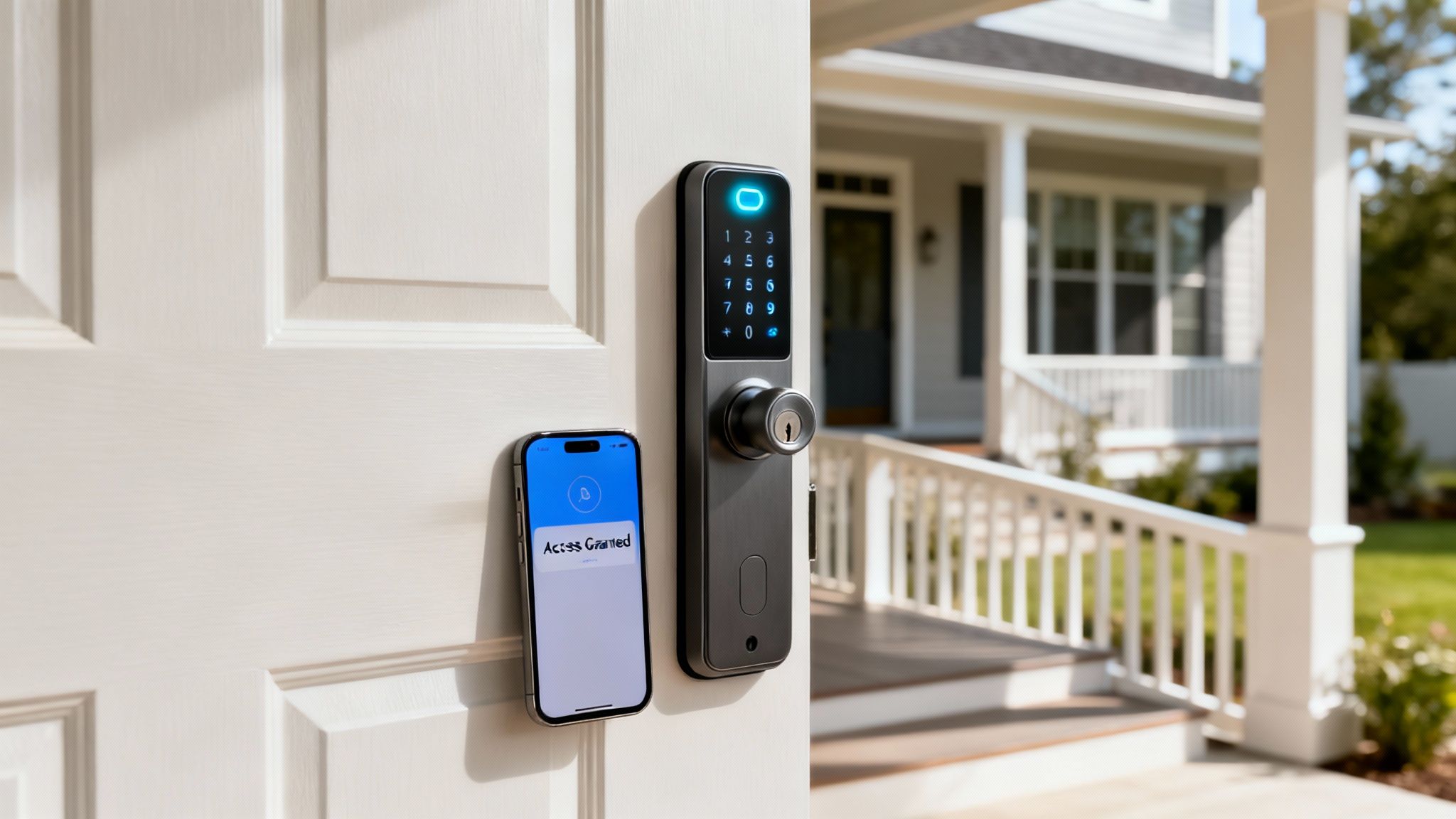
For many of these modern locks, there isn't a single pin to replace. Rekeying simply means revoking a digital credential from your smartphone. This is a huge leap in convenience, but it also introduces new considerations, like Wi-Fi dependency or potential digital vulnerabilities.
Imagine managing a short-term rental in Jensen Beach. In the past, you'd have to physically rekey locks or meet every tenant. With a smart lock, you can grant them temporary access with a few taps on an app. Once they check out, you just as easily revoke their digital key, securing the property for the next guest without ever touching the lock.
The New Meaning of a Rekey
This shift to digital access is a game-changer for convenience and control. The security question is no longer about who has a physical key, but who has authorized digital access to your home.
The numbers don't lie. The global smart door lock market is expected to explode from USD 3.50 billion in 2025 to an astounding USD 13.44 billion by 2032. As this market grows, "rekeying" is all about reprogramming digital access.
In North America, which led the market with 39.5% of smart lock revenues, demand for locksmith services to reprogram these devices jumped 22% between 2021 and 2025. While about 30% of people are hesitant because of the higher cost, 40% of new home installations now include mobile controls. This feature alone can eliminate the need for traditional rekeying by as much as 70%. You can learn more about these smart lock market trends and see how they're reshaping home security.
This technology is transforming how we manage access. Instead of rekeying after a tenant moves out, you simply delete their user code. It’s faster, cleaner, and offers a clear audit trail of who accessed the property and when.
Is Digital Rekeying Right for You?
While the upsides are obvious, it’s wise to weigh the pros and cons for your own home in Port St. Lucie or Stuart.
- Pros: You get instant control over who comes and goes, there are no physical keys to lose, and you can create temporary codes for guests, cleaners, or contractors.
- Cons: The initial cost is higher, the locks rely on batteries and often a Wi-Fi connection, and there's a risk of software bugs or hacking.
Whether you're sticking with traditional hardware, thinking about upgrading to a smart lock, or just need a key fob replacement, our expertise covers it all. If you're considering a change or just have questions about your current setup, call (772) 710-8169 for immediate help.
Answering Your Top Lock Rekeying Questions
After helping countless homeowners across the Treasure Coast, we've heard just about every question there is when it comes to rekeying locks. To wrap things up, here are answers to the most common ones we get in the field.
What’s the Real Cost to Rekey a Lock in Port St Lucie?
The price comes down to one thing: are you doing it yourself or calling a professional?
A DIY rekeying kit for a common brand like Kwikset or Schlage will probably run you $15 to $30. It’s cheap, but as we’ve discussed, it comes with risks if things go wrong.
Having a professional locksmith from Pro-B Locksmith handle it for you in the Port St. Lucie area typically costs between $50 and $150 per lock. That price covers our expertise, specialized tools, and the peace of mind that comes from a job done right the first time. The final cost can vary depending on your lock type or if it's an emergency, like a late-night house lockout. For a solid, upfront quote, it's always best to just give us a call.
Should I Rekey or Just Replace My Locks?
This is a great question. If your current locks are in good shape and work smoothly, rekeying is almost always the best option. It's cheaper since you're not buying new hardware, it’s faster, and it’s more environmentally friendly.
You should only consider a full lock change if your hardware is broken, heavily worn, or an older, less secure model. It’s also the right call if you want to upgrade to a high-security system or are just looking for a new style to match your home’s aesthetic. We can inspect your locks and give you an honest recommendation on what makes the most sense for your security and budget.
Rekeying gives you the exact same security as a brand-new lock, but it must be done correctly. An improperly pinned lock is a serious vulnerability and can actually make your home less secure.
Can I Rekey Any Type of Door Lock?
Most standard residential locks from major brands are designed to be rekeyed. However, not all locks are the same.
Some high-security locks, obscure brands, or very old hardware can be tricky. They often require specialized tools and knowledge, and some are not designed to be rekeyed at all. From a car lockout to a vintage deadbolt, each lock has its own requirements.
If you’re unsure what you’re dealing with, the safest move is to consult a professional. At Pro-B Locksmith, we’ve worked with a massive range of lock types and can quickly tell you what your options are. For a fast answer, Call (772) 710-8169 for immediate help.
How Long Does Rekeying Actually Take?
For an experienced locksmith, rekeying a standard lock is quick work—usually about 10-15 minutes.
If it's your first time doing it yourself, be realistic. You should probably set aside 30 minutes to an hour for each lock, and that's if you don't hit any snags. If you have a whole house to secure in Jensen Beach or Vero Beach, our mobile service can get it all done far more efficiently than spending your weekend hunched over a door.
For more answers to common questions, you can also check out our comprehensive locksmith FAQ page.
When you need it done right, done fast, and backed by a professional guarantee, trust your local experts. Pro-B Locksmith is ready to secure your property with expert rekeying, lock changes, and 24/7 emergency services across the Treasure Coast. https://problocksmith.com