

That piercing, relentless siren is a car owner's nightmare. It always seems to happen at the worst possible time—late at night in a quiet Port St. Lucie neighborhood or in a packed Vero Beach parking lot. When your key fob is dead, lost, or locked inside, your first instinct might be to panic.
Before you consider any drastic measures, take a deep breath. In most situations, you can silence that racket within 60 seconds using simple, non-destructive methods. The goal is just to prove to your car’s security system that you're the rightful owner, not a threat. If you find yourself in a car lockout situation and need help fast, Call (772) 710-8169 for immediate help.
Here's a quick guide to your first moves.
Immediate Actions to Silence Your Car Alarm
This table gives you a snapshot of the safest and quickest things to try right away.
| Method | How It Works | Best For |
|---|---|---|
| Physical Key in Door | Manually unlocking the driver's door tells the car's computer you are an authorized user, overriding the alarm. | The fastest and most reliable first step if you have the physical key but the remote isn't working. |
| Key in Ignition | Turning the key to the "ON" position (without starting the engine) completes a security check and disarms the system. | When unlocking the door doesn't work or if the alarm was triggered after you were already inside. |
| Valet Switch | A hidden button that temporarily disables the alarm system, designed for service technicians or valets. | A good second option if the key-based methods fail, provided you know where to find it. |
These are your best bets for a quick, damage-free resolution. Now let's dig into the details.
What to Do When Your Car Alarm Starts Blaring
Your Physical Key Is the First Line of Defense
Believe it or not, the quickest and safest fix is the one people often forget: your actual metal key.
Simply insert the key into the driver's side door lock and turn it. This manual action sends a direct signal to the car's computer, telling it to stand down. It’s a built-in failsafe that instantly overrides an alarm triggered by a faulty fob battery or an overly sensitive sensor. For example, a customer in Stuart had their alarm going off repeatedly due to a dying key fob; using the physical key in the door solved the problem instantly until they could get a key fob replacement.
This isn't just a happy accident; it's by design. After consumer surveys in the 2010s consistently ranked false alarms among the top five security system complaints, automakers deliberately built in these backup paths for owners.
The Overlooked Valet Switch
If unlocking the door doesn't do the trick, your next move is to hunt for the valet switch. This is a small, often hidden button or toggle designed to temporarily disable the alarm system. You’ll typically find it:
- Under the dashboard on the driver’s side
- Tucked away inside the glove box
- Near the interior fuse panel
The process usually involves a simple sequence. You turn the key to the "ON" or "ACC" position in the ignition, then press and hold the valet switch for a few seconds until the alarm mercifully stops.
Pro Tip for Treasure Coast Drivers: The exact location and procedure for the valet switch can vary wildly between car models and alarm brands. Your owner’s manual is your best friend here. If you're stuck somewhere in Fort Pierce or Jensen Beach and can't find it, don't start pulling panels off—that's a good way to cause more problems and potentially lead to needing ignition repair.
Of course, if your key is missing entirely, you're dealing with an emergency car lockout. When the alarm is blaring and you can't even get inside, you need a solution that’s fast and won't damage your car. While it's helpful to understand why your car alarm keeps going off and how to fix it for the long term, right now you just need to get in.
For immediate, on-the-spot help anywhere on the Treasure Coast, from a house lockout to a car lockout, Call (772) 710-8169 for immediate help from a licensed locksmith.
Tried-and-True Ways to Silence That Blaring Alarm
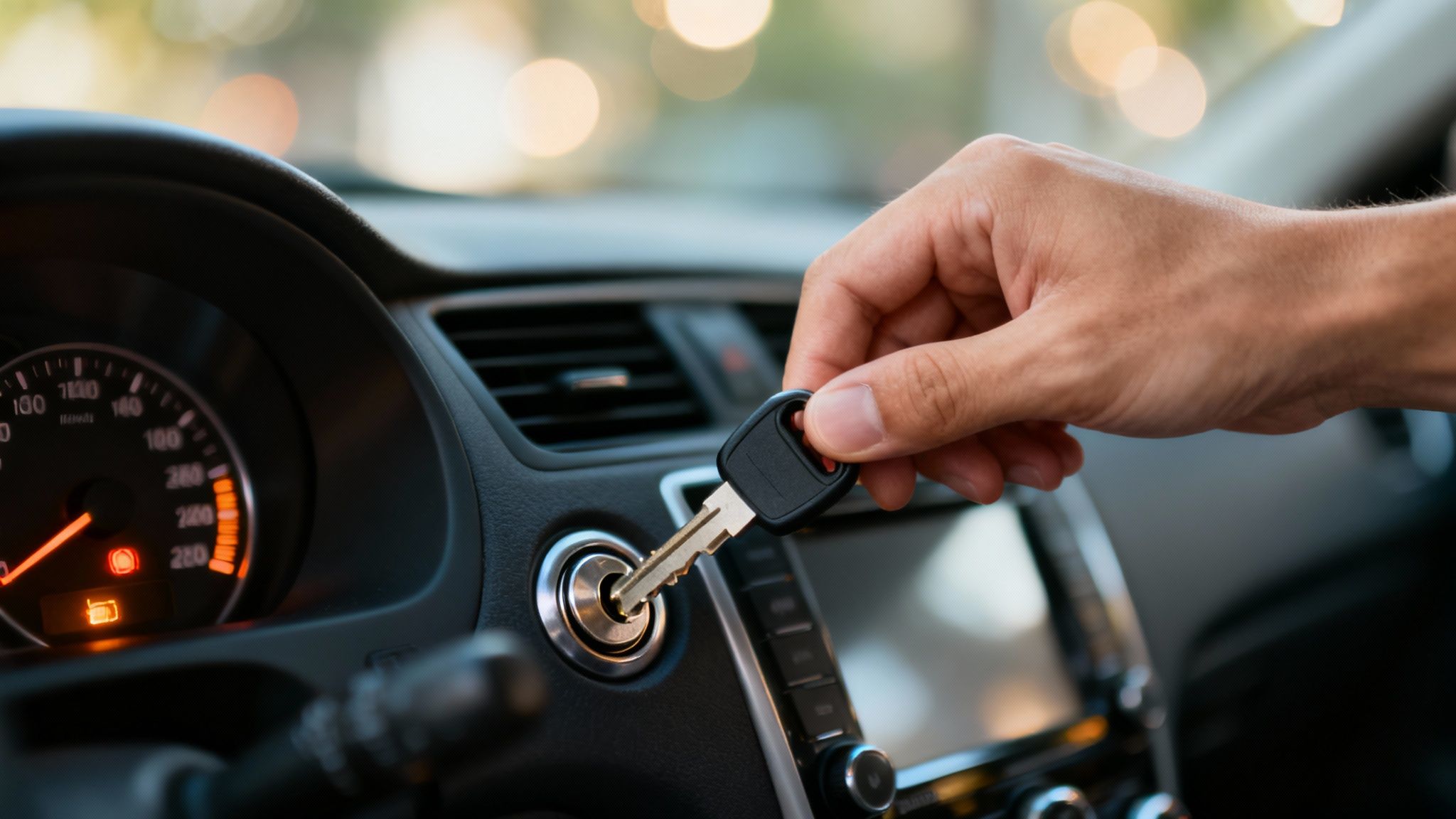
Alright, so the quick fixes didn't work. Now it's time to get a little more hands-on. When your car alarm is making you the least popular person in your Jensen Beach neighborhood, these next steps are usually what get the job done without needing a toolbox.
At the end of the day, your car is designed to recognize you as the owner, even without a working remote. Let's walk through how to remind it.
Try Your Key in Every Lock You Can Find
It sounds simple, but you'd be surprised how often this works. Most of us go straight for the driver's side door out of habit. But don't forget about the other keyholes on your vehicle.
On many cars, especially older ones, turning a physical key in the passenger door or trunk lock sends the same "all clear" signal to the security system as the driver's door.
Give this a shot:
- Stick your key in the passenger-side door lock.
- Turn it to unlock, then turn it back to lock.
- Do this a couple of times.
If the alarm is still wailing, try the exact same thing with the trunk lock. This isn't just a mechanical action; you're manually communicating with the car's computer, telling it that a legitimate key is being used and it can stand down.
Use the Ignition to Reset the System
This is one of the most reliable ways to kill a rogue alarm. By cycling the ignition, you force the car's computer to check for the transponder chip embedded in your key. Once it recognizes that correctly coded chip, the alarm shuts off.
Picture this: you're in a busy Fort Pierce parking lot, and every head has turned your way. Just stay calm and run through this step-by-step sequence. It works like a charm on countless Ford, Chevy, and Honda models.
- First, get in the car and shut all the doors.
- Put your key in the ignition.
- Turn it to the "ON" position. This is the spot where your dashboard lights up, right before you'd actually crank the engine.
- Just let it sit there for about 5-10 seconds.
- Turn it back to "OFF" and pull the key out.
For most cars, that single "ON-OFF" cycle is all it takes to reset the alarm. Some vehicles can be a bit more stubborn and might need you to repeat the process two or three times. It’s a core solution for how to stop car alarm without key because it’s a direct conversation between the key and the car's brain.
A Quick Word of Warning: If you've tried these methods and the alarm is still going, don't start jiggling the key or forcing the ignition. It's an easy way to break the ignition cylinder, and that's a much bigger and more expensive headache. Ignition repair is tricky and often requires a pro to avoid damaging the whole steering column.
If these steps don't solve it, you might be looking at a deeper problem, like a failing ignition switch or a transponder key that's gone bad. Rather than guessing and potentially making things worse, it's smart to call in an expert. For reliable help across the Treasure Coast, find out more about our specialized automotive locksmith services.
For immediate, damage-free help, give us a call at (772) 710-8169.
Why Your Car's Security System Is So Complex
Have you ever been stuck in a Stuart parking lot, your car alarm blaring, with no key in sight? It's a frustrating moment, and you probably found yourself wondering why you can't just pull a single wire to make it all stop. The truth is, that complexity is there for a very good reason: to stop thieves in their tracks.
Vehicle security has come a long way from the simple, noisy alarms of the past. Today's systems are woven directly into your car's central computer, creating a digital fortress that’s deliberately difficult to override. This isn't just a design flaw meant to annoy you when your key fob battery dies; it’s a sophisticated defense mechanism protecting your investment.
More Than Just a Siren
A modern car security system isn't a single part but a whole network of digital guards working together. They're watching over every possible entry point, and the siren is just one piece of the puzzle.
Think of it as a team. The key players usually include:
- Engine Immobilizers: This is the real game-changer. An immobilizer will not let the engine start unless it gets the right signal from a specially programmed chip inside your key. A thief could smash a window and get past the alarm, but without that chip, the car is just a very heavy paperweight.
- Advanced Sensors: It's not just about doors anymore. Modern cars often have tilt sensors to detect towing, glass-break sensors, and even motion detectors inside the cabin.
- Body Control Module (BCM): This is the system's brain. It connects the alarm, immobilizer, door locks, and ignition. When you're trying to shut off a blaring alarm, you're really trying to send an "all-clear" signal to the BCM.
This deep integration is why just yanking the horn fuse doesn't always work. The lights might keep flashing, and more importantly, the immobilizer will almost certainly keep the engine from turning over.
A Response to a Growing Threat
There's a serious reason for all this high-tech security. In 2022 alone, over 1 million vehicles were stolen in the United States, which added up to more than $8.9 billion in losses for their owners.
In response to these staggering numbers, automakers and regulators have made advanced anti-theft features the norm. They’ve intentionally made these systems harder and harder to defeat. You can get a better sense of these industry-wide changes by reading up on the car security systems market trends on alliedmarketresearch.com.
Believe it or not, the headache you're dealing with is a good sign—it means your car’s security is doing exactly what it was designed to do. It’s built to resist simple workarounds, which is a major pain right now but makes it a nightmare for a potential thief.
When you're up against a smart system that won't quiet down, the only real solution is to give it the signal it's looking for. If your key fob is broken, lost, or dead, you're missing the digital handshake your car needs to stand down.
For professional key fob replacement in the Port St. Lucie or Jensen Beach area, your fastest solution is to call (772) 710-8169 for immediate help.
Last Resort Solutions: The Fuse Box and Battery
Alright, if you've tried everything else and that siren is still wailing, it’s time for the last-ditch efforts. We're talking about cutting the power by either pulling a fuse or disconnecting the battery. Think of this as the emergency override. It’ll stop the noise, for sure, but it’s not a real fix and can create other headaches.
Keep in mind that cars today are basically computers on wheels. Cutting the power can do more than just silence the alarm; it might reset your car's entire computer system, wipe your radio stations, or even trigger a full-on security lockout that stops the car from starting once you reconnect everything. So, proceed carefully. This is about stopping the racket so you can figure out the next step.
Hunting Down the Right Fuse
Pulling the specific fuse for the alarm is the more surgical approach. Instead of killing power to the whole car, you’re just targeting the source of the noise.
For this, your owner’s manual is your best friend. Seriously, don't guess. The manual will have a diagram of the fuse box—or boxes, since many cars have one under the hood and another inside the cabin—showing you exactly what each fuse does. Here is a step-by-step guide:
- First, find the fuse box. Your manual will show you if it's tucked under the dashboard or located in the engine bay.
- Next, identify the alarm fuse. You're looking for a label like "Alarm," "Horn," or "Security."
- Then, pull it. Most fuse boxes have a small plastic puller tool clipped inside the lid. Use it to grab the correct fuse and gently wiggle it out.
With the fuse removed, the alarm should go quiet. But remember, you've just silenced the symptom, not cured the disease. The original problem, whether it's a glitchy sensor or a dead key fob, is still there, and now your car's alarm system is offline.
Disconnecting power is a temporary patch, not a permanent solution. The goal is to silence the alarm so you can think clearly and arrange for a proper repair. Once the noise is gone, the real work of fixing the problem, such as a lock change or key replacement, begins.
How to Safely Disconnect the Car Battery
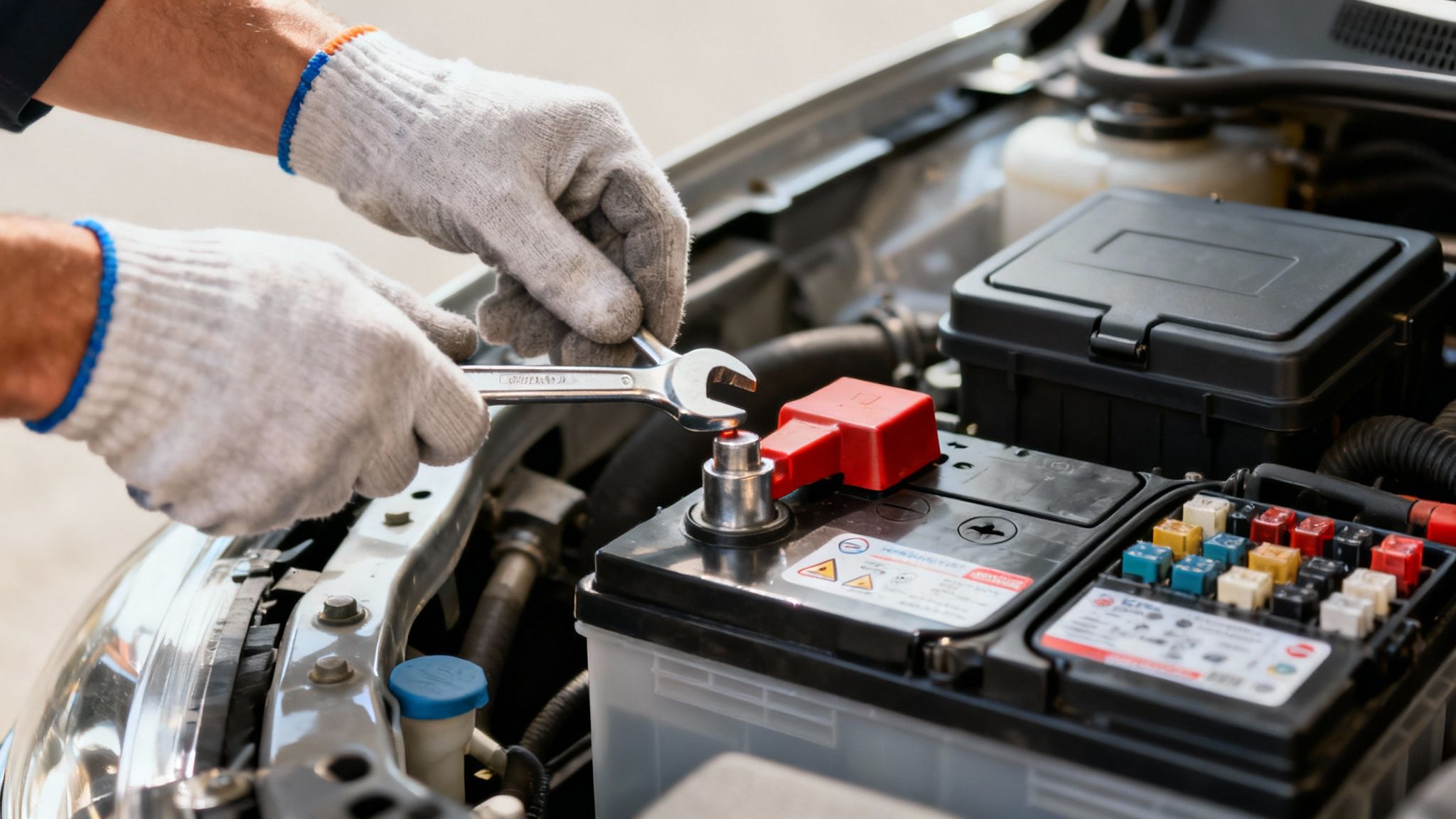
If you can't find the right fuse or pulling it does nothing, disconnecting the battery is the final, guaranteed way to get some peace and quiet. This cuts all power to the vehicle. You'll just need a small wrench, usually an 8mm or 10mm, to fit the terminal nut.
Safety first, always. Always disconnect the negative (-) terminal first. It's the one with the minus sign and usually has a black cable. If you start with the positive (red) terminal, your wrench could accidentally touch a metal part of the car, creating a dangerous spark.
- Loosen the nut on the negative terminal clamp. You don't have to take it all the way off—just enough to wiggle the cable free.
- Pop the cable off the terminal post and move it somewhere it can't accidentally touch the battery again.
- Give it a minute or two for any leftover power in the system to drain. The alarm will be silent instantly.
This method is highly effective for stopping the noise, but it's also a hard reset for your entire vehicle. If you've gotten to this point, you're likely dealing with more than a simple glitch. The car might not start again, or the alarm could come right back once you reconnect the power.
If you’re in Vero Beach or Fort Pierce and have had to resort to disconnecting your battery, your next move is simple. Call (772) 710-8169 for immediate help. Our mobile locksmiths will come right to you, figure out the root cause—whether you need a key fob replacement or an ignition repair—and get your car back in working order.
When to Call a Professional Locksmith on the Treasure Coast
Sometimes, you have to know when to throw in the towel. While trying a few DIY tricks is one thing, there's a fine line between a quick fix and accidentally causing a much bigger, more expensive problem. Forcing a key, yanking the wrong fuse, or repeatedly disconnecting the battery can wreak havoc on your car's delicate computer systems.
Let's be real—if you're stuck outside your car in Port St. Lucie or Jensen Beach, the alarm is wailing, and you have no way to get in, it's time for backup. Pushing your luck at this point could turn a simple dead key fob into a complicated electrical repair. A professional mobile locksmith isn't just a convenience; it's your fastest and safest way out of a frustrating situation.
Signs It's Time for an Expert
You've gone through the checklist, tried the obvious stuff, but that alarm is still screaming. Here are the tell-tale signs that it’s time to stop troubleshooting and make a call.
- You've Lost All Your Keys: This is the most straightforward one. If you don't have a single physical key to try the manual overrides in the door or ignition, you're officially locked out. A locksmith is the only way back in without breaking something.
- Your Key Fob Is Clearly Broken: A fob with a cracked case, signs of water damage, or one that's still dead after a fresh battery probably has an internal failure. This isn’t a DIY fix; it requires professional key fob replacement and programming.
- The Ignition Is Jammed or Won't Turn: If your key goes in but refuses to turn, or it feels like it’s completely stuck, don't force it. That's a surefire way to snap the key off in the ignition or damage the cylinder. This is a classic symptom that you need an expert for ignition repair.
When your car's security system is on the fritz, it often points to a deeper problem that a simple trick just can't solve. Calling a professional isn't admitting defeat; it's choosing a guaranteed, damage-free solution over a risky guess.
Knowing whether to keep tinkering or call in a pro can be tough. Here’s a quick guide to help you decide.
DIY vs Professional Locksmith: When to Make the Call
| Situation | DIY Potential | When to Call Pro-B Locksmith |
|---|---|---|
| Simple alarm won't shut off | High – Try cycling the locks with the door key or starting the car. | After a few minutes of trying the basics with no success. |
| Key fob is unresponsive | Medium – Try changing the battery first. It’s a cheap and easy first step. | The new battery doesn't work or the fob is physically damaged. |
| Locked out with no keys | None – There are no safe, non-destructive DIY methods for this. | Immediately. This is precisely what our car lockout service is for. |
| Key is stuck in the ignition | Very Low – Forcing it can cause hundreds of dollars in damage. | The moment you realize it's stuck. Don't risk breaking it. |
Ultimately, if you feel out of your depth or you’re worried about causing damage, that’s your cue to call for help.
The Pro-B Locksmith Advantage: Dealership Service at Your Location
Why go through the hassle of a tow truck or pay inflated dealership prices? At Pro-B Locksmith, we bring the entire workshop to you. Our fully-equipped mobile vans serve the whole Treasure Coast, from Stuart up to Vero Beach, and our average response time is just 15-20 minutes.
When you call us, you're not talking to a random dispatcher in another state—you're getting a local, certified technician who knows the Port St. Lucie, Fort Pierce, and Vero Beach area.
Our experts arrive with specialized tools to get you back on the road fast:
- Diagnostic Programmers: We plug directly into your car's computer to program new transponder keys and smart fobs on the spot.
- Laser Key Cutters: Our vans have the equipment to cut a precise new key for your vehicle, right there in your driveway.
- Non-Destructive Entry Tools: We'll get you back inside your car without a single scratch, keeping your locks and windows perfectly intact.
Whether you're stranded at home, at the office, or at the beach, we provide the same level of service you'd get at a dealership for about half the cost. From a simple car lockout to a complex ignition replacement, we handle it all. If you're looking for a dependable locksmith in Fort Pierce, our team is ready to help.
For fast, professional assistance that comes directly to you, Call (772) 710-8169 for immediate help.
Your Top Car Alarm Questions Answered
When your car alarm starts screaming, a million questions can race through your mind. It's a frustrating experience, whether you're in a quiet Vero Beach neighborhood or a bustling Fort Pierce parking lot. I get these calls all the time from folks across the Treasure Coast, so here are the straight answers to the most common questions.
How Long Will This Blaring Last?
Thankfully, not forever. Most factory alarms are built with a failsafe and will shut themselves off after about 2 to 5 minutes. This is to save your battery and keep you from becoming the least popular person in the neighborhood.
Now, if you have an aftermarket system, the timing can vary. But if that horn has been blasting for more than 10 minutes, that’s not normal. It’s a pretty clear sign something is wrong with the system itself, and it’s time to call in a professional.
Could a Low Battery Be the Culprit?
Absolutely. In fact, it’s one of the first things I check. As a car battery dies, the voltage it sends out becomes erratic. Your car's security computer can easily mistake these power fluctuations for someone trying to disconnect the battery to steal it, which then triggers the alarm.
If you’ve noticed your car has been a bit sluggish to start lately, a weak battery is a very likely suspect.
A Quick Tip for Treasure Coast Drivers: Our intense Florida sun is brutal on car batteries, often cutting their lifespan short. If your battery is over three years old, get it tested. It could be the silent cause of your very loud alarm problem.
Why Does My Car Alarm Go Off for No Reason?
This is a classic "ghost in the machine" problem, but the cause is almost always a faulty sensor. It's just a matter of figuring out which one. From my experience helping drivers in Port St. Lucie, Stuart, and Jensen Beach, it usually boils down to one of these:
- A Faulty Hood Latch Sensor: This is a big one. A bit of dirt or grime is often enough to make the sensor think someone is prying your hood open.
- Worn-Out Door Sensors: Just like anything else on a car, these sensors can fail with age, sending false signals to the alarm module.
- Overly Sensitive Shock Sensors: Some aftermarket alarms are just too jumpy. They can be set off by a loud truck rumbling by, a strong gust of wind, or even a cat hopping on the roof.
Trying to diagnose a sensor issue yourself can be a real headache. A mobile technician can pinpoint the problem fast, whether it just needs a good cleaning or a full replacement. If your alarm has a mind of its own, call (772) 710-8169 for immediate help so we can figure it out and get it fixed.
When you're stuck with an alarm that won't quit or any other lock and key headache, from a house lockout to needing a complete lock change, don't hesitate to reach out to a local expert who knows the ropes. For fast, reliable service you can count on across the Treasure Coast, give Pro-B Locksmith a call. Check us out online at https://problocksmith.com to see how we can help you out.

