It’s a feeling we all know and dread. You hit the unlock button on your key fob, and… nothing. Just silence. That sinking feeling in your gut is real, but don't panic or start thinking about breaking a window just yet.
More often than not, the reason your car door won't unlock is something simple, like a dead key fob battery or a single failed lock actuator. Before you do anything else, let’s run through the basics that can get you back inside without any drama, especially if you're stuck somewhere along the Treasure Coast, from Fort Pierce to Stuart.
What To Do When Your Car Door Wont Unlock
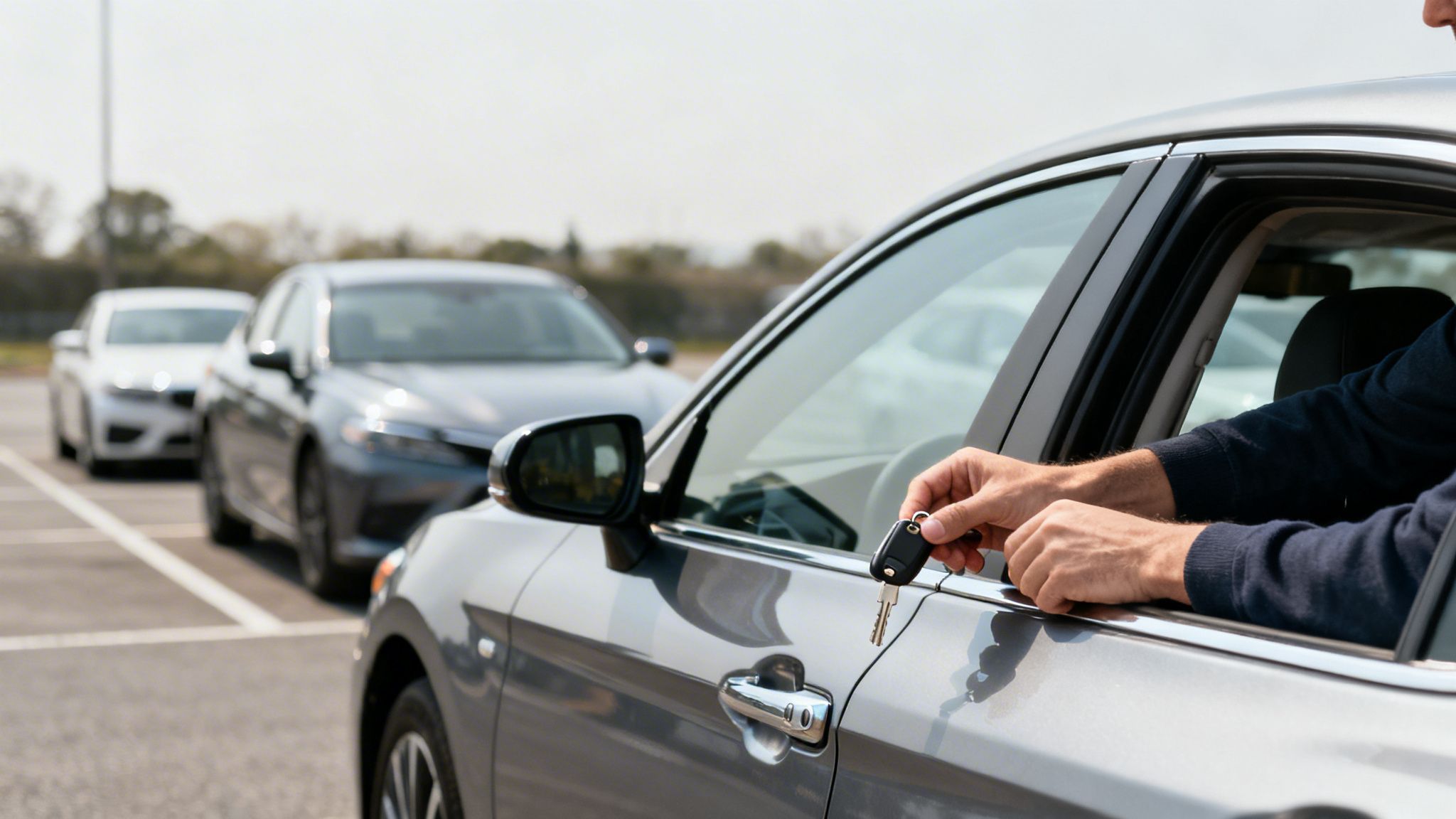
Standing next to your car in a Port St. Lucie parking lot with a door that refuses to open is beyond frustrating. Whether you're in a driveway in Fort Pierce or shopping in Stuart, the good news is the solution is usually much less dramatic than you think.
When you're stressed, it’s easy to miss the most obvious fixes. Think of this as your first-response checklist to quickly figure out what's wrong before it completely throws off your day.
Start With The Manual Key
Believe it or not, your high-tech key fob has a low-tech backup plan. Nearly every car remote has a small, traditional metal key hidden inside for exactly this kind of situation. Find the small release switch or button on the side or back of your fob, and the physical key should slide right out.
Now, take that key and try the driver's side door lock. If the key turns but the lock doesn't budge, don't give up. Go try the passenger side door. It's very common for the lock actuator on just one door to fail, leaving the others working perfectly fine.
A real-world example we see often in Jensen Beach is a failed driver's side lock actuator. The owner panics, thinking they are completely locked out, but the passenger door opens perfectly with the manual key. Methodically checking every door is the most overlooked step in a car lockout.
Assess The Electrical System
If the manual key doesn't work in any of the locks, your next clue lies with the car's electrical system. Take a look and listen for any signs of life.
- Interior Lights: Do the dome lights flicker on when you pull the door handle?
- Dashboard: Can you see any glowing icons or lights on the dash through the window?
- Horn/Headlights: What happens if you press the panic button? Does the horn blare or do the headlights flash?
A total lack of response points straight to a dead car battery. When the battery is completely drained, it can’t power the electronic lock mechanisms, rendering them useless.
Quick Diagnosis for an Unresponsive Car Door
Use this table to quickly pinpoint the most likely issue based on what your car is (or isn't) doing.
| Symptom | Likely Cause | What to Try First |
|---|---|---|
| Key fob does nothing, but manual key works. | Dead key fob battery | Replace the CR2032 or similar battery in your fob. |
| Key fob is unresponsive; manual key works on some doors but not all. | Failed lock actuator in one door | Use the manual key on a working door to get inside. |
| Nothing works—fob, manual key, or interior buttons. No lights. | Dead car battery | You'll need a jump start or a new battery. |
| You hear clicking/whirring, but locks don't move. | Failing or jammed lock actuator | Try the manual key; may require professional repair. |
This quick check can save you a lot of time and worry. But if you've tried these steps and you're still locked out, or if you just feel unsafe, it’s time to call in a professional. If you're dealing with a stubborn lockout, you can find more detailed information in our guide to emergency lockout services. For immediate, damage-free assistance anywhere in Jensen Beach or the surrounding areas, Call (772) 710-8169 for immediate help.
Diagnosing Key Fob and Electronic Lock Failures
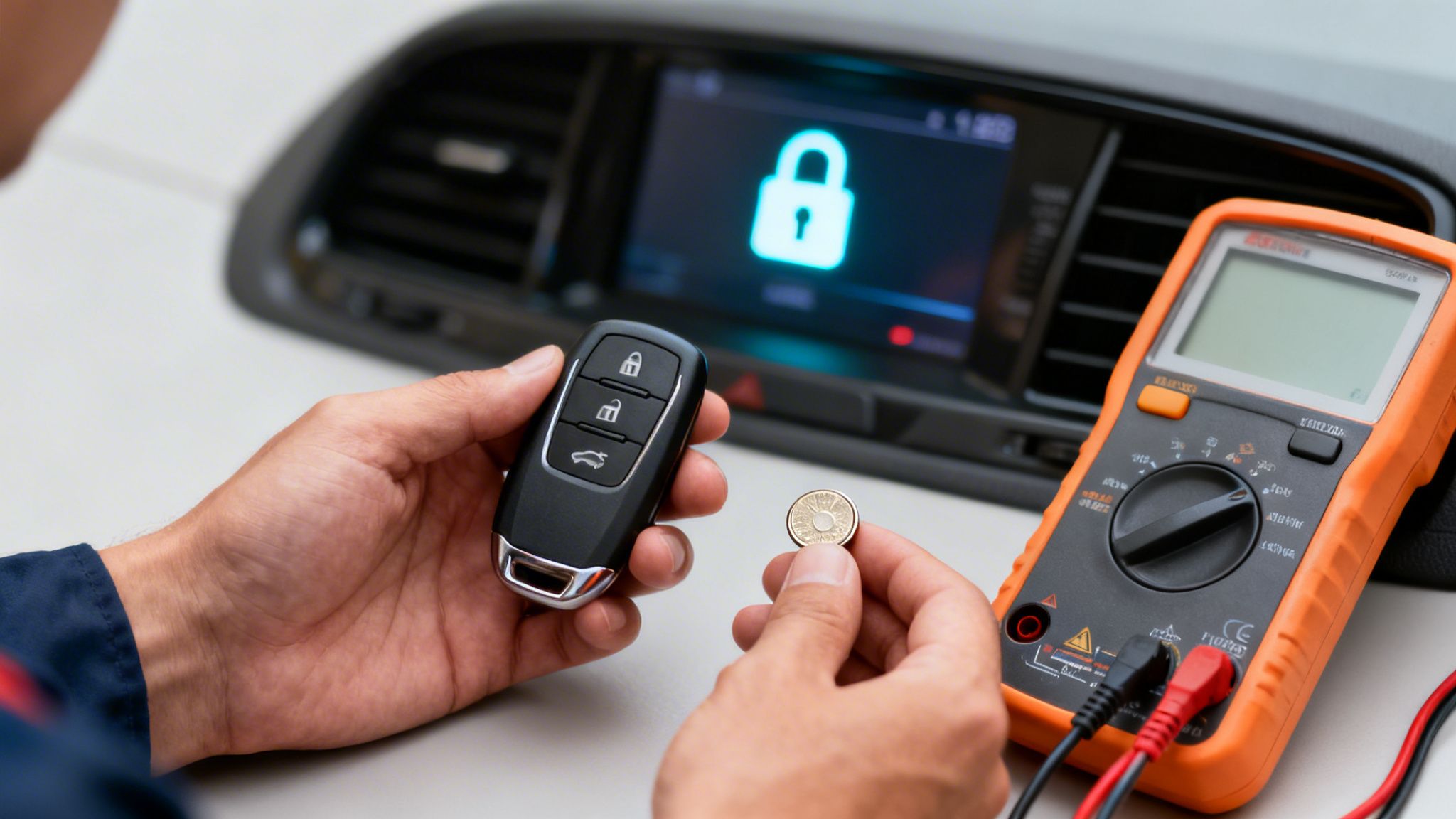
So, you’ve tried the manual key and that didn't work. Now it’s time to look at the electronics. More often than not, when a car door won't unlock with the push of a button, the problem lies with the key fob itself. We see this all the time, leaving drivers stuck everywhere from a Jensen Beach parking lot to their own driveway in Vero Beach.
The simplest and most common issue is just a dead key fob battery. These little coin-style batteries (usually a CR2032 or something similar) don't last forever. You might have noticed some warning signs, like needing to get closer and closer to your car for the remote to work, right before it gave up completely.
Fob Battery or Car Battery
One of the first things to figure out is whether you have a dead key fob or a dying car battery. The symptoms are usually quite different.
A weak car battery tends to cause weird electrical gremlins. You might hear the locks click feebly or watch them struggle to engage. If your dashboard lights dim or flicker when you hit the unlock button, your car’s main battery is almost certainly the culprit.
On the other hand, if the car gives you the silent treatment—absolutely no response to the fob, but the interior lights still pop on when you pull the handle—your fob is the prime suspect. A quick look at the fob itself can confirm it. Most have a tiny red LED that blinks when you press a button; if you see no light, that battery is probably dead.
A practical tip: A dead key fob is an annoyance, but a dying car battery can leave you completely stranded. If you’ve noticed your locks acting sluggishly or the engine cranks slowly, especially in the Florida heat, get your battery tested. It's a small step that can prevent a much bigger headache later.
Changing a fob battery is an easy DIY fix. But with today’s cars, a new battery doesn't always solve the problem. If you find yourself in a bind, remember that our mobile locksmiths can diagnose and resolve car lockout and key fob issues right on the spot.
The Signal and The Sync
Sometimes, the fob has plenty of power, but it's no longer speaking the same language as your car. Your key fob and your vehicle's computer have to stay "synced" to communicate. This digital handshake can get interrupted for a few reasons:
- Physical Damage: We've all dropped our keys. One too many tumbles onto the pavement can easily damage the delicate transmitter inside.
- Battery Change Glitch: It’s not common, but sometimes simply swapping the battery can cause the fob to lose its programming.
- Vehicle System Fault: A glitch in the car’s body control module (BCM) can cause it to "forget" a perfectly good key.
This is where a quick fix can suddenly get more complicated. If a fresh battery does nothing, your fob probably needs to be reprogrammed. For drivers in Stuart and Fort Pierce with newer vehicles, this is a common issue. Before you think about towing your car to a dealership, know that a professional mobile locksmith can handle key fob replacement and programming for far less, right where you are. You can learn more about these on-site services in our guide to automotive locksmith solutions.
If you suspect a programming problem is why your car door won't unlock, don't waste any more time. Call (772) 710-8169 for immediate help, and we'll get an expert out to you.
When the Manual Key Won't Turn in the Lock
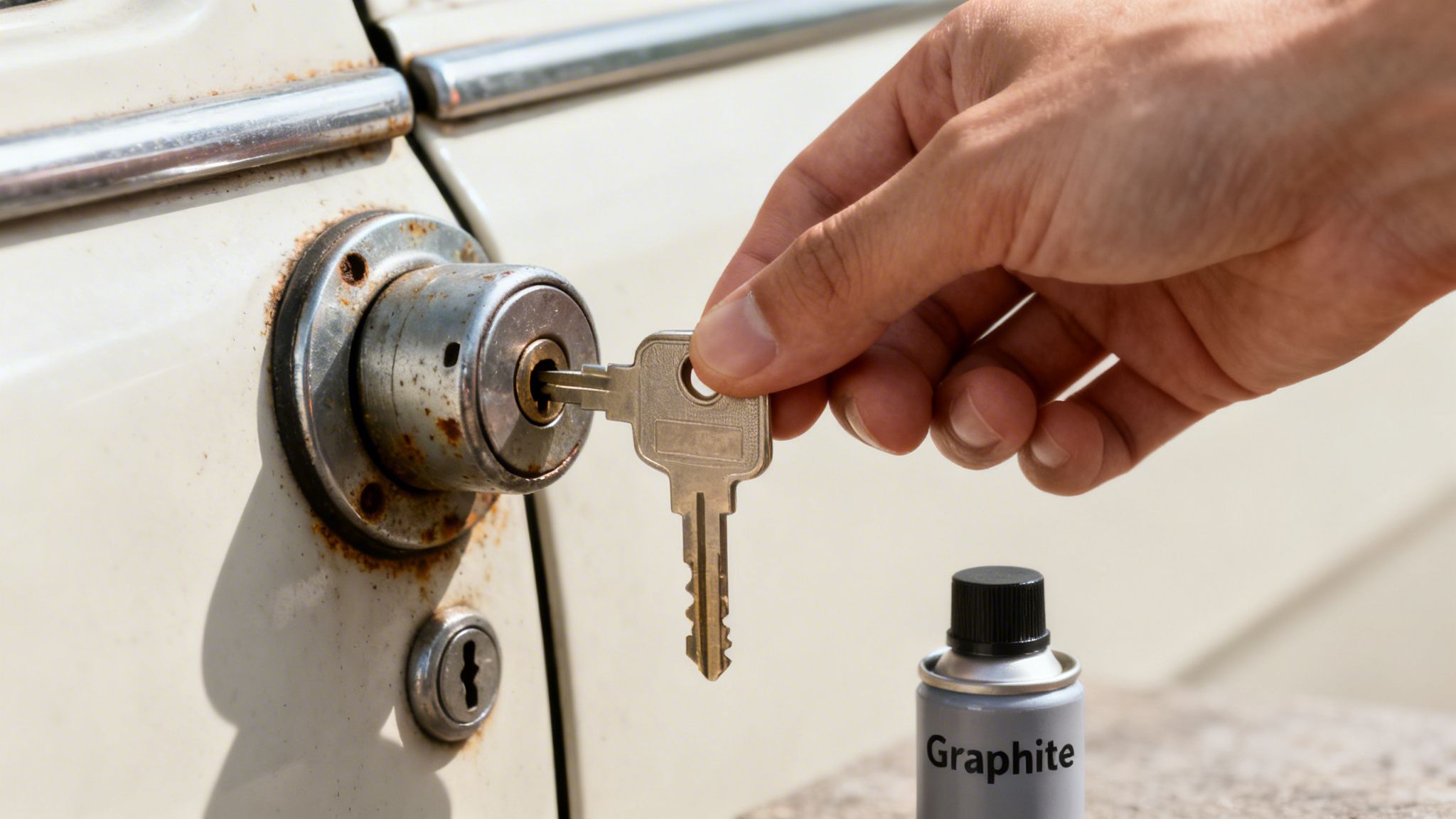
It’s a uniquely frustrating moment. Your remote is dead, so you use the physical key hidden in the fob, but it won’t budge in the lock. Now you’re not just locked out—you’re facing a mechanical problem. When your car door won’t unlock with the actual key, the culprit is almost always inside the door itself.
Living here on the Treasure Coast, we see this all the time. That salty air and constant humidity are brutal on the tiny, precise mechanisms in a car door lock. Over the years, that environment causes corrosion and lets grime cake up inside the lock cylinder, eventually seizing it solid.
When your key feels stuck, your first instinct is probably to put some muscle into it. Don't. Resist the urge to force it. Trying to strong-arm a stuck key is the quickest way to snap it off in the lock, turning a simple lockout into a more complex ignition repair or lock change.
How to Properly Lubricate a Stuck Lock
More often than not, a seized lock cylinder just needs proper lubrication, but what you use makes all the difference.
Under no circumstances should you grab a can of WD-40. While it might work for a day, petroleum-based sprays are a magnet for dirt and dust. In a few months, you'll be dealing with the same problem, only now the lock is gummed up with a sticky paste.
Here's a step-by-step guide to doing it right:
- Get the Right Stuff: Use a dry graphite lubricant spray, which is a fine powder designed for lock cylinders.
- Apply Sparingly: Shake the can and use the thin applicator straw to spray a single, short puff directly into the keyway. A little goes a long way.
- Work It In: Gently slide your key in and out a few times, wiggling it slightly to help spread the graphite around the pins.
This quick fix often frees up a sticky lock. But what if that doesn't do the trick?
A key that turns perfectly in the lock but doesn't actually open the door points to a completely different problem. That’s a classic symptom of a broken or disconnected linkage rod inside the door panel.
What's Going On Inside the Door?
Your car door contains a network of small metal rods and plastic clips. These connect the lock cylinder to the latch mechanism. When you turn the key, you're just moving a rod that tells the latch to release.
Those little plastic clips and thin metal rods get brittle with age, especially in the Florida heat. It’s a common repair for us in Stuart and Jensen Beach. The key turns fine because the cylinder is working, but since the rod is snapped, the signal to unlock never reaches the latch.
Fixing a broken linkage means taking the interior door panel off. It's a delicate job that can easily lead to broken clips or damaged wiring. If your car door won't unlock and you suspect a mechanical issue like this, it's time to call a pro. Call (772) 710-8169 for immediate help for fast, on-site assistance.
The Hidden Danger of Modern Electronic Door Latches
Sleek, pop-out door handles on new cars look fantastic, but they hide a risk most drivers never consider. The problem is their complete reliance on electricity. Unlike older cars where the electronics just help a mechanical latch, these new systems are often entirely digital. When the car's battery dies or power is cut in a collision, those futuristic handles can become useless.
When a Dead Battery Becomes a Trap
Imagine this scenario: there’s a crash on I-95 near Fort Pierce. The vehicle loses all power. Now, the pop-out handles won't present themselves, and the exterior button does nothing. A door that won’t open is more than an annoyance—it's a critical safety hazard.
This can trap people inside and tragically slow down first responders. Even if there's a manual release handle inside, an injured or disoriented driver might not be able to find or use it. It's a design flaw we're seeing more and more, and it’s a terrifying situation.
Regulatory bodies have taken notice of this alarming trend. When a car door won't unlock due to power loss after a crash, seconds count, and these electronic systems can create dangerous delays for occupants and emergency services.
Real-World Incidents and Investigations
This isn't just a "what-if" scenario. The National Highway Traffic Safety Administration (NHTSA) launched a defect investigation into nearly 180,000 vehicles for this exact problem.
Disturbingly, documented cases show fatal accidents where first responders couldn't get in because electronic handles failed after a crash. In one incident, rescuers couldn't quickly find the mechanical override, which contributed to a fatality. You can read more about these concerning door latch safety investigations to understand the full picture.
As locksmiths, it’s our job to stay on top of these technological changes. At Pro-B Locksmith, we constantly train on the newest, most complex vehicle entry systems so we know how to handle them safely. Whether you're dealing with a simple car lockout or a complex electronic failure, you need someone who understands the mechanics and the tech. For expert help in Port St. Lucie, Call (772) 710-8169 for immediate help.
When It’s Time to Call in a Professional Car Locksmith
You've jiggled the key, you've tried the other doors, and you’ve swapped the fob battery. But you're still locked out. There comes a point where trying to fix it yourself risks causing real, expensive damage. Knowing when to call an expert is the smartest move you can make.
Red Flags: Situations That Demand a Locksmith
If your key snaps off in the lock, stop immediately. Trying to yank out the broken piece with pliers can destroy the lock cylinder, turning a simple extraction into a more complex repair.
Here are scenarios where you should call a professional without hesitation:
- A key is broken inside the lock or ignition. This requires specialized extraction tools.
- You're in an unsafe spot. If you're stuck in a dark parking garage in Vero Beach or on the shoulder of a busy road in Fort Pierce, a fast-response mobile locksmith is your safest bet.
- The car’s entire electrical system is dead. If a jump-start does nothing, you likely have a deeper fault.
- The key turns, but nothing happens. This indicates a failed part inside the door. We can perform a professional car lockout to get you inside and then assess the needed repairs.
Calling a mobile locksmith is about protecting your vehicle. When your car door won't unlock, a professional guarantees a damage-free solution. A real example: we recently helped a client who tried using a coat hanger, causing $300 in paint damage. Our service would have been a fraction of that cost.
Why Call a Locksmith Over the Dealership?
Your first thought might be the dealership, but a mobile locksmith is often a better choice. A dealership will require you to tow your vehicle to their service center, adding cost and hours of waiting.
A mobile locksmith brings the solution to you. Whether you’re at home in Jensen Beach or stranded at the Port St. Lucie marina, we arrive on-site. We can handle a simple car lockout, cut and program a new key fob replacement, or even perform ignition repairs—all without the dealership's overhead. Our guide on what to expect when you call a locksmith in Port St. Lucie covers these services in more detail.
If you’ve tried the basics and are still stuck, don't risk damaging your car. Call (772) 710-8169 for immediate help, and we'll dispatch a professional technician.
Your Top Car Lockout Questions Answered
When you're staring at a car door that refuses to open, your mind starts racing. As the locksmiths people rely on from Port St. Lucie to Fort Pierce, here are some straightforward answers to the questions we hear most.
How Much Does It Cost To Unlock A Car in Port St. Lucie?
The cost depends on your car’s make, model, year, and security system. Getting into a 2010 sedan is a different job than unlocking a new luxury SUV. Because we're a local St. Lucie County business, not a national call center, we provide fair, transparent pricing. We'll give you a clear quote over the phone with no hidden fees.
Will A Locksmith Damage My Car When Unlocking It?
A trained professional? Absolutely not. Our technicians use specialized tools like inflatable air wedges and precision picks designed to open your vehicle without leaving a scratch. We treat your car like our own. This is the biggest reason to call a pro instead of trying a risky DIY fix that can lead to chipped paint, torn weather stripping, or a costly house lockout situation if your car keys are also your house keys.
Can You Make A New Car Key For Me On The Spot?
Yes, we can. Our mobile service vans are workshops on wheels, equipped for key cutting and programming. If you're locked out because of a lost or broken key, we can cut and program a new transponder key, smart key, or push-to-start fob right there, whether you need a key fob replacement in Stuart or Vero Beach. Call (772) 710-8169, and we'll come to you.
My Key Turns In The Lock But The Door Stays Locked. What Does That Mean?
This almost always points to a mechanical failure inside the door. A small clip, rod, or cable that connects the lock cylinder to the latch has likely broken or disconnected. Your key can still turn the lock cylinder, but that motion never reaches the latch. Fixing it requires safely taking off the interior door panel to repair the linkage—a job best left to professionals to avoid damage. If you want to learn more about general vehicle upkeep, you can often find good pointers when you explore car care blogs.
No matter what’s keeping your car door shut, Pro-B Locksmith has the local knowledge and professional tools to get you back in safely. For immediate 24/7 help anywhere on the Treasure Coast, including Port St. Lucie, Fort Pierce, Vero Beach, Stuart, and Jensen Beach, visit us online at https://problocksmith.com.